Grandparent Wannabees and Daughters’ Fertility

I am not a grandmother — yet! But my friends who are blessed with grandchildren tell me that grandparenthood is equal parts pure love and complete wonder. Some even tell me they wish they could have skipped parenting and gone straight to grandparenting. I can’t wait.

Or maybe I can.

According to an article published last May in The New York Times, eager grandparents are taking their daughters’ fertility into their own hands by paying for egg freezing. In today’s world of reproductive technology, it’s never too early to harvest viable ovaries for the delicate, sometimes elusive eggs that represent potential grandchildren. As parents watch their single daughters get older, they worry that their children will age out of their reproductive years. Biological clocks are not simply ticking, they’re booming as loudly as Big Ben.

Before I get into the details, I should note that freezing your daughter’s eggs is not an extreme alternative for a particular kind of mother. Back in the day, when I was closing in on 30 without a single marriage prospect, I don’t doubt that my mother would have considered taking me to a fertility clinic for the sake of her own grandmotherhood. Truth be told, I love that I have a feasible option in case my daughter’s baby timeline is not exactly in synch with mine — or biology’s. And if she’s on the other side of 35 without a partner, she can still be a mother if she so chooses.

Perhaps at this point I should mention I may be getting ahead of myself: My daughter is only 18.

In that same New York Times article, Rachel Lehmann-Haupt, a journalist and the author of “In Her Own Sweet Time: Unexpected Adventures in Finding Love, Commitment and Motherhood,” calls the negotiations that happen when grandparents advocate for egg-freezing “the post adult-birds and the-bees-talk.” It’s telling that the article does not mention that after years of romantic disappointments, Lehmann-Haupt decided to freeze her eggs at 35. As she recounts in her book, at $15,000 it was not a cheap choice, but for her, it was an essential alternative.

Lehman-Haupt came of age in the mid-90s, when another journalist, Sylvia Ann Hewlett, caused a stir with her book, “Creating a Life: What Every Woman Needs to Know About Having a Baby and a Career.” Hewlett set 35 as a firm age by which to have a first baby. She may have had biology on her side (after 35 a pregnancy is routinely treated by physicians as high-risk), but her ideas couldn’t be reconciled with modern love and 21st-century life. Lehmann-Haupt saw Hewlett’s clarion call to start a family earlier as a hard proposition and was determined to draw “a new roadmap of [women’s choices].”

Lehmann-Haupt’s decision to take charge of her fate and freeze her eggs is part of a growing social revolution chronicled on Web sites like RetrieveFreezeRelax.com, founded by Jennifer Hayes, and Brigitte Adams’ Eggsurance.com. Hayes notes that most women “are still under the impression that the process has a very low success rate. That was true five years ago. Not so anymore.” Eggsurance.com, the more impressive of the two sites for its depth of knowledge — including step-by-step guidance for women who freeze their eggs — has a tag line that sums up the goals of women who want to take explicit control of their fertility: “For proactive women who want to ensure they have the option of having children — just not now.”

For all the progress that reproductive technology has made in the last decade, the American Society for Reproductive Medicine still considers egg freezing experimental. But as the science continues to be refined the label is bound to change, and so too are the emotions attached to the process. What hasn’t changed is that a significant number of women want to become mothers — and they will go to great lengths to make that happen. Egg freezing was still an unproven technology when Lehmann-Haupt was in her early 30s, but I predict it will eventually become the gold standard that frees women to become mothers regardless of their timing or relationship status.

I may be ready for grandchildren, but I am, in every permutation, pro-choice. If that includes my daughter bypassing motherhood for her career and her passions, then that’s her business. I just want to go on record as saying that I am available for babysitting when the time comes.


You Are Not a Test Score: Some Advice for the College Applicant

With much anticipation and a shot of dread, it’s time for some families of high school juniors and seniors to enter the college sweepstakes. Once a kid is knee-deep into her junior year of high school, the mostly self-imposed requirements to apply to colleges come fast and furious: SATs, SAT tutoring, subject test tutoring. AP classes, exams – midterms and finals. Everything is magnified in search of the Holy Grail at the end of sending out college applications—acceptance to a school you actually want to attend or bragging rights to the kinds of schools that accepted you.

Applying to college in rarefied circles—solid to upper middle class—is a virtual blood sport. The grueling psychological competition is explicitly and humorously laid out in a book I really liked called Crazy U: One Dad’s Crash Course in Getting His Kid into College. The author, Andrew Ferguson, is a self-deprecating realist who manages to poke fun at, as well as take seriously, the business of shepherding your child to the threshold of his college dorm.

The fact is that 70% of high school seniors in the United States will go to college. Most of those seniors will not have cured cancer, written an opera or started a Fortune 500 business by the time they apply. They’ll be just like the zillion other candidates they’re up against at Fancy U. But bear in mind that 80% of college kids will happily matriculate at non-selective colleges—schools that offer automatic acceptance if you meet the minimum requirements. As my father used to say, “You can get a great education anywhere.”

The rest of us well-meaning parents will shell out thousands of dollars for at least one of the following: SAT tutoring, regular subject tutoring, college coaching and application preparation. Here’s how it works at one extreme: An application boot camp can cost $14,000 for four days of marathon essay writing and interviewing strategies. If you’re willing to empty out your 401K you can hire a private counseling service. The Cadillac of private college coaching can run up to $40,000.

SAT tutors in the Boston area can charge up to $200.00 an hour to prep a kid for “the test.” I’m glad I don’t live in the New York metropolitan area. SAT tutors in the Big Apple charge up to $425.00 an hour. In a New York Times article reporting on the fierce competition for perfect grades in high school, an anonymous parent at a tony private school in New York admitted to paying up to six figures in a given year for extra help in regular school subjects. That doesn’t count the steep tuition she already pays. I think my husband may be sitting on a pot of gold. Over the years he has saved us a bundle by tutoring our children in everything from calculus to biology.

Ferguson is at his wryest when he talks about the kitchen people—the folks who gather in the kitchen at a party to share war stories about their kids applying to college. In these clandestine conversations a parent would rather reveal the annual family income than her child’s SAT scores or GPA. Speaking of SATs—this is a test originally administered after the First World War to veterans with college aspirations. Somewhere along the line the SATs garnered the power to make or break a college career.

I could go on about the U.S. News and World Report college rankings. This is the list that admissions offices love to vilify yet secretly pray for a top 20 spot. There’s the college essay, which demands an epiphany so wise, so rare, that most 17-year olds simply don’t have the emotional maturity to have earned it.

Overwhelmed yet?

In the spring of junior year, usually with a guidance counselor and with grudging parental input, a student creates “the list” of schools to which she might apply. The list is usually a mix of colleges for which a kid is a leading candidate and schools that are designated as “a stretch.” As a parent you may look at up the admission statistics for your alma mater and shake your head in wonder at how you ever got into college.

At the core of every college application, job interview or personal relationship is the fear of vulnerability. Yet it’s vulnerability that gives us courage and compassion. Vulnerability begets connection; it keeps us honest. Vulnerability is important to show whether it be in the college essay or the alumni interview. Be human. You are multi-dimensional. And yes, you are not a test score.

I can remember Anna telling me that she didn’t need a campus full of valedictorians to feel academically fulfilled. During the process she was also also wise enough to demonstrate to her mother that lists, whether it the US News & World Report or the college lists she generated–should be used sparingly and mostly for things like groceries.


My Nest

Here’s a joke that I recently heard. An optimist sees the glass half-full. A pessimist sees the glass half-empty. An opportunist drinks the water. Not all that coincidentally, these describe the various emotional states of my half-occupied nest. Sometimes it’s half-full; sometimes it’s half-empty. Although there is more time and space in my house since Anna left for college, I’m still shocked that she packed up and moved away a five hour drive from me. Bearing in mind that our daughter wakes up every day almost 300 miles away, here’s a very short list of what’s changed at my house.

The bedroom. Be careful what you wish for because it may come true. Before she left for school, we blasted Anna’s room, clearing over eight years of detritus. We were sorting stuff that dated all the way back to 4th grade. There was that book project Anna couldn’t part with or that oh so pretty party dress that she wore on the bar mitzvah circuit six years ago! Six years ago?! Mind-boggling. In fact, Parents’ Weekend at Anna’s school falls on the fifth anniversary of her Bat Mitzvah. The quiet, clean bedroom matches the quiet, sort of clean house. I don’t mean to say that Anna is loud. But there is a liveliness, a spirit of wonder and a megawatt smile that she brings into a room. And with her departure for college, I’m now the only girl in the house. Even the dog is a boy and like the men in this house he could care less about the fabulous sweaters and pocketbooks that I find on sale.

The car. Anna never made the deadline we gave her for getting her driver’s license. Even her learner’s permit has expired. This means that Anna needed rides early and often. The longest ride we had together was between her school and Adam’s. I’ll admit I was almost always grumpy about the prospect of driving 15 miles in traffic between schools. But my annoyance evaporated when Anna got in the car and we had a half-hour to ourselves. We put the time to good use. We’d talk about the books she was reading, the people she was hanging out with, the latest doings at Student Council. The car ride was the teenage equivalent of lying down with her before she fell asleep. When she was a little girl that was the time that I learned what was near and dear to her heart, or conversely, what broke her heart.

Mealtime. Anna’s acute dairy allergy shaped who she was and, consequently, who we became as a family. Over the years Ken and I worked to help her advocate for herself at a birthday party or a restaurant. It turns out that Anna’s allergy also informed our Judaism. Since we had such little dairy in our house and we had made the commitment to send our kids to Jewish day school, it was not such a big leap for us to start keeping kosher. At first, we practiced keeping kosher using our non-kosher dishes. That is to say, we didn’t buy new plates or get a second set of plates to separate meat from dairy more fully. The fully stocked kosher kitchen was a natural outcome of our kitchen remodel. Everything was new including a dishwasher with two drawers—one for meat and one for milk. Nevertheless, we mainly lived a meat and pareve existence. When Anna left for college, I was sure that we would have a dairy fest every night in the house. I’ll admit that for the first couple of weeks we went wild and crazy with cheese tortellini and traded some of our Mother’s pareve margarine for a tub of butter. But it wasn’t as fun as we thought it would be. There was something disloyal about indulging in all that dairy and so barely realizing it we went back to our pareve life.

The brother. In many ways, Anna’s departure has been hardest on Adam. When it became clear that Anna was indeed going to college he got downright depressed at the thought of being the only child at home. He’d mumble under his breath, “I can’t believe I’m going to be stuck with those two. “ Those two, in case you haven’t figured it out, are Ken and me. I tried not to be insulted and chalked up his rudeness to anticipatory anxiety. It’s been six weeks since Anna settled into a dorm room with posters of Coldplay and the Beatles, and Adam still can’t believe he’s stuck with the two of us. I thought he’d be thrilled to be picked up on time and have unfettered access to parmesan cheese. It turns out he was just making noise about those things. He’d rather have Anna home.

When it’s all said and done, this half-empty nest, or depending on a given day, half- full nest, is ultimately emotional limbo. I’m not exactly pushing Adam out the door, but I’m kind of curious about what being an opportunist feels like.

Ghosts of Sukkot Past

Sukkot is here and my guests are on the way. Like Chagall’s lovers they fly over the silver moon; their white gauzy clothing double as wings. I greet them in the sukkah—a makeshift structure akin to a hut that we build from a kit. The sukkah also has a roof with slats generously spaced to see the sun and the moon and the stars.

The company I’m talking about stargazing with is called ushpizin—the Hebrew term for mystical guests who will grace sukkot (plural of sukkah) all over the world on each of the seven nights of the holiday. This is my kind of celebration. When I was a kid I loved reenactments of historical events. The old sitcom Bewitched tickled me because someone like Columbus or Shakespeare came alive for me.

To that end, I have a wish list of historical figures I’ve always wanted to meet. Moses and Leah top my list. No one is more associated with the Torah than Moses. In my mind, he’s an inspiration because so much of his leadership was marked by doubt. As a parent in the 21st century, I take solace in the fact that even with God’s direct intervention, Moses still had a difficult time leading the Israelites out of the wilderness and into the Promised Land. Leah is my role model as a mother. Every parent has been a Leah at some point—taken for granted, ignored, but still triumphant in ordinary yet miraculous ways.

The Rachel that I want to meet was Rabbi Akiva’s wife. I like her rebelliousness. She was from a prosperous family who followed her heart and married the illiterate Akiva against her family’s wishes. To complete the fairytale, she recognized Akiva’s natural genius and encouraged him to learn to read when he was 40. Forty! Akiva excelled in his studies beyond their wildest dreams. Rachel was alone for years as he studied and taught in the greatest Jewish academies.

In his absence, Rachel coped with grace and fortitude. I want to ask her how she did it. I want to know if she was as disoriented as I am when my husband is only away for a week on a business trip. I want to know how she controlled herself when her husband finally came home and his students, protective of their beloved teacher, did not let her through the throng to greet him. When Akiva realized what was happening, he ordered his students to let Rachel pass immediately. He told them that she single-handedly was responsible for everything that he and his students had attained. I want to know if witnessing her husband’s success was worth sacrificing his company all those years.

I want to introduce my daughter Anna to Sara Schenirer. Hunched over her sewing machine, she had a revelation. Or was it a moment of despair that gave way to lucidity? She dared to imagine girls in their own schools studying Torah. It was a radical idea in the late 19th century. Although nowhere near egalitarian, the fact that girls had a classroom of their own to be formally educated was inspiring and enduring and just. I want Anna to know that she is the direct beneficiary of Sara Schenirer’s prescience.

I love spirits. I buy into the notion that there are other times during the year for formal visitation from phantasmagoric souls. There are the seven days of shiva or mourning. The week during which the sheva b’rachot—the seven blessings following a marriage—are celebrated. We boldly mingle with our ancestors on Passover when Elijah joins us and Miriam remembers us with a shake of her timbrel.

But it’s on Sukkot that I reflect on people I would give almost anything to see again. I close my eyes and see my father healthy and strong. I remember my father-in-law’s mega-watt smile and can-do optimism. I feel the presence of Anna’s namesake—a grandmother whom I adored. I miss my friend Miriam so much that I ache. My sukkah is a space painted in a full spectrum of memories and emotional colors.

It makes sense that a holiday that welcomes ghosts to the dinner table would end with Yizkor—the service to memorialize the dead. Yom Kippur and the three harvest festivals—Sukkot, Passover and Shavuot—are the four times a year there is time and space to mingle with loved ones who have died.

What comforts me most about remembering my dead on Sukkot is that I can walk out of my fragile sukkah into the sturdy structure of community where, I believe, a lot of people understand that otherworldly visitors frequently stop by throughout the year.


How Children Succeed: An Interview with Paul Tough

Parenting books – love ’em or leave ’em. Most times, I leave them after perusing the table of contents. I don’t like the one-size-fits-all approach that so many of them take. But Paul Tough’s excellent new book, “How Children Succeed: Grit, Curiosity and the Hidden Power of Character,” rises to the top of the parenting book pile for its deep exploration of failure and the ways in which it builds character in our kids.

First a word about character. It’s as unique to each person as her DNA. Tough offers the revolutionary concept that character, unlike DNA, is not fixed or completely innate in a person. It is, in a word that recurs throughout “How Children Succeed,” malleable. I confess that I was initially very uncomfortable with the word malleable for its implication of weakness and undue influence. But read Tough’s book and you quickly learn that malleable is an asset.

Tough talked about character in a recent interview with [start ital.]The Advocate[end ital.], citing a chain of charter schools called KIPP and its dedicated founder David Levin. KIPP schools dole out report cards for academic performance and character assessment. “Dave is doing new and important work,” Tough said, adding:

“He has a new vision for character and it’s quite scientific in that he’s trying to figure out which character strengths make a difference in a kid’s success. And at the root of his research and thinking is the assertion that character is … a set of qualities that [enables] kids to change themselves and qualities that parents and teachers can instill.”

Tough presents living examples of low-income kids who have had the opportunity through mentoring programs, family members or discerning teachers to pause and look inward to shape and reshape their character. Kewauna Lerma was such a student. On the fast track to derailing her life, Kewauna did an about-face during her junior year of high school. She still lived at the poverty level on the South Side of Chicago, picking fights at school and struggling academically. But a spark was lighted inside of Kewauna through a mentoring program and encouragement from her mother and great-grandmother.

“Kewauna,” explained Tough, “became motivated to be a different person. It was very telling that she changed in that it came from her clear vision that she had of herself. That vision was further clarified in the program she was in as well as by her family.”

There is no question that kids mired in poverty have it tougher than children of affluence. But Tough admirably teases apart the hazards of having it too good without falling into the “poor little rich kid” syndrome.

For wisdom on the challenges faced by kids who seemingly have it all he turned to Dominic Randolph, headmaster of the tony Riverdale School in Riverdale, N.Y. – a well-off section of the Bronx. Randolph was initially the subject of a [start ital.]New York Times Magazine[end ital.]article that Tough wrote last fall. In that article, Tough explored Randolph’s claim that failure and character lead to academic success.

Advocating for failure is a radical step for a head of school where the majority of the class goes on to Ivy League and other highly competitive colleges. But that’s exactly what Randolph did when he came to Riverdale in 2009. Tough noted:

“[T]here is this way that certain high-pressure academic environments can stress kids out. They are on this treadmill versus climbing a mountain. At KIPP kids are climbing a mountain and it’s a bigger challenge than staying on that familiar treadmill. I think that’s why KIPP kids get out of college with more success and character. It’s the way you get on a life path, not the actual life path you end up on, and that makes all the difference.”

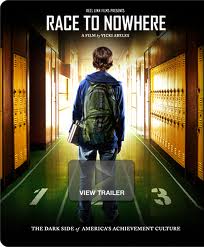
Tough points to the documentary “The Race to Nowhere” as a prime of example of affluence undoing kids. Vicky Abeles, the mother of three kids who were scorched by the heat of extreme academic competition, framed her film as a cautionary tale. I’m not a fan of the film because I think it’s slanted toward sensationalism. Tough thinks it’s a helpful example of the importance of establishing a good relationship with failure. “Affluent kids,” he said, “are in suspended animation throughout college without every hitting road bumps. Then they hit an obstacle in their 20s and they don’t have resources to deal with it.”

I think that Tough is on to something big here. We talked about post-college choices that kids who have graduated competitive colleges have made. He asserts that ironically their fear of failure steers them toward investment banking and management consulting jobs.

I wonder if our adult kids’ pervasive fear of failure hasn’t returned them to their childhood bedrooms, dissatisfied and unemployed. Yes, it’s a tough economy out there, but have we made them afraid to take chances, to bypass meaningful engagement and social justice opportunities?

Which brings me back to where I started. Perhaps character is not destiny, that it’s malleable enough to forge the kind of future that can fulfill our kids.

The Race to Nowhere

Vicki Abeles means well. She is a mother who wanted to give her three children all the advantages she never had as a child. As a result, she and her children weathered long school days followed by a daily onslaught of extracurricular activities. Sound familiar? But somewhere along the way her best intentions went awry and she realized that she and her children were running in, what she descriptively calls a “race to nowhere.”

Out of frustration, Abeles picked up a camera and made a movie, her first, about the never-ending marathon in which we have inadvertently sponsored our children. The resulting film, The Race to Nowhere, alternates between a cautionary tale and an overreaction to what happens when kids and parents are trapped by their own ambitions.

When it came out two years ago, Abeles’ film was screened in various upscale locations followed by question and answer periods. The high-achieving Boston suburbs where I live are the perfect laboratories to test Abeles’ theories. In the question and answer period I attended, a group of educators in the audience said how unfair it was to adjust their lesson plans simply for the sake of delivering high MCAS scores. “It is,” said one of the women, “like putting the cart before the horse.”

There are no surprises in Abeles’ film. Dedicated teachers are thwarted by school boards. One exemplary English teacher felt so beleaguered by the Oakland, California school system that she left teaching altogether. The woman openly wept on camera about leaving her students to fend for themselves in a mediocre school system.

The camera pans to a Stanford University freshman confessing that he regurgitated information for tests in high school only to be woefully unprepared for his freshman year of college. Then there are the befuddled parents and students who have no idea how to get off this exhausting treadmill. Fewer activities, an adjusted academic schedule? If only it were that easy.

In the middle of all this angst is a heart-breaking interview with a mother whose 13 year-old daughter Devon committed suicide after getting a bad grade on a math test. I think back to a column I wrote about Amy Chua, the original tiger mom, wouldn’t accept anything less than an A from her daughters. The Tiger Mother roars and her cubs fall into line. And yet I have to believe that it was more than poor test results that tragically sent Devon over the edge.

I worry about my children and the academic loads they carry. Anna was a three-season athlete in high school and often didn’t get to her homework until after dinner. Nothing annoyed her more than when I ask her how the homework situation is. She’d tell me the work is there and she would get through it no matter how long it took. Most nights I didn’t think she had an unreasonable amount of homework for a student as committed as she was. Yet I still fret about sleep-deprivation and the onslaught of emotional challenges she’s beginning to face as a college studentl.

Adam is no stranger to buckets of homework. His school prides itself on creating young men of character and discipline. Part of cultivating that persona is a full curriculum. For example, most nights he’ll be assigned up to 25 math problems. Although I hate homework as much as the next parent, I don’t think his assignments are busy work or aimed at “survival of the fittest.”

Sara Bennett is among those advocating education reform in Abeles’ film. She co-wrote a treatise with the self-explanatory title: The Case Against Homework. Like Abeles, she was a concerned parent who saw her children struggling against the overwhelming tide of worksheets and reading assignments in middle school.

According to Bennett’s research, a child needs to do only 5 math problems to catch on to a concept. Tell that to Amy Chua whose older daughter was once bested in a math competition. Chua’s solution was to have her daughter complete 200 (no there is not an extra zero) math problems a night for 10 days. That’s 2000 problems. That’s a lot of math. That’s a long race.

I wasn’t surprised to see Wendy Mogel make a cameo appearance to warn about the myriad ways our kids are stressed out. For Abeles and company, Mogel’s latest parenting book, The Blessings of a B-, is an island of calm in the madness of running after perfect SAT scores and padding resumes to resemble the CV of a Nobel prize-winner.

As parents we all too often walk that tenuous line between encouraging our children to be their best and demanding perfection from them. What goes loudly unsaid throughout the film is that entrants in the “race to nowhere” are more often than not socioeconomically privileged. All I can say in the face of these tense times is to hug your kids often. Set a realistic course that takes them towards a fulfilling, healthy future because the alternatives are too upsetting to contemplate.

In the Gray Zone

I’ve been thinking a lot about color lately. Or more to the point, the presence and absence of light that make up white and black. I think all this consideration of color reflects the fact that I’ve been vacillating somewhere between hope and despair this High Holiday season. It’s a state of mind that squarely puts me in the middle of the gray zone. That’s Adam’s term for these ten intermittent days between Rosh Hashana and Yom Kippur. I clearly remember when he first mentioned the gray zone. It was fifth grade and he had just learned about the Ten Days of Awe—the days between the High Holidays. He didn’t see anything awesome about being suspended in doubt and self-criticism.

Which leads me to the conundrum at the heart of the gray zone discussions I had with him. How do you explain the High Holidays to kids without scaring the living daylights out of them? Just the images alone send me into black hibernation. No light, no consciousness. Let God add and erase names in the Book of Life without my awareness.

But that’s not exactly good role modeling. If there’s anything that should be deleted it’s our understanding of the Sunday School God that dips a feathered quill into ink and enters names as part of some macabre accounting. The God I first became acquainted with had a flowing white beard. When I was a little older, he looked exactly like my Uncle Mac of the booming voice and the rosy cheeks. Uncle Mac was God on earth. I imagine that most kids cope with God as the ultimate abstraction by pretending that He’s some version of their own Uncle Mac.In this patch of gray that Adam constructed as a little boy, it followed that God is also gray. But it’s impossible to see anything through the fog that shrouds Him. Also, note how useless it is to shine headlights in the fog. The light reflects back, illuminating nothing. Maybe that’s the hard-edged perspective of an adult.

I found a lovely children’s book called Because Nothing Looks Like God [(http://www.amazon.com/Because-Nothing-Looks-Like-God/dp/158023092X/ref=sr_1_1?s=books&ie=UTF8&qid=1347850420&sr=1-1&keywords=because+nothing+looks+like+god)] by Rabbi Lawrence Kushner and Karen Kushner that breathes life into some of my grown-up jadedness. God is in the details like a birthday cake, the band-aid that fixes a cut. Ultimately, “God looks like nothing. And nothing looks like God.” The authors challenge children to think about how many things we can’t see like the wind, or the sun drying or the joyous moments of a day at the beach. I ‘d also ask kids to think about what love does and does not look like.

But how do you explain God to a teenager whose earliest memories are singed with images of burning towers? What do you say to your children after you’ve been pulled over by airport security for a more thorough search? You’re part of the danger in this very dangerous world? Or let’s turn to the more mundane. You work hard and you study hard and still that A or that role in the play eludes you. Does God have more important matters to attend to than the disappointments in your life?  Or is God simply too distracted these days to care about your problems. “First world problems,” shrugs Adam the now-jaded teenager. That’s his default position to deal with his disillusionment.

Maybe I’m taking all of this too literally. Children grow into more sophisticated thinkers, leaving a parent like me stuck in the concreteness of pshat—the Jewish term for biblical literalism. I envy my teens who, these days, are in the thick of drash—extracting meaning from the subtext of a story or a new situation. Maybe my time in the gray zone is best spent listening to my kids explain life to me.

This is also the time of year when we read Leviticus 18 on the afternoon of Yom Kippur—a verse that many take in as pshat to condemn gay marriage. At first glance it seems odd to be worrying about forbidden unions on a day when the gates of heaven are clanging shut. (More concreteness.) But who knew that the gray zone could be conducive to a personal and loving discussion on sex education with your kids. Who shall live and who shall die can be transformed into a celebration of whom we love. Who will we love better and more thoughtfully in this New Year?

The Ba’al Shem Tov, the father of the Hasidic movement in the eighteenth century, said “there are many halls in the king’s palace and intricate keys to all the doors. But the master key to God’s house is a broken heart.” That leads up to one of my favorite sayings in the Talmud—“There is nothing more whole than a broken heart.” And there’s no better place to learn that than in the space that Adam, in his little boy wisdom, once dubbed the gray zone.

Going to School on Rosh Hashana

This year my 15-year old son and I are having yet another conversation about Judaism’s High Holy Days. He’s intent on capitalizing on his hard-won victory last year, the outcome of which was that he went to school on the second day of Rosh Hashana. This was no small concession for his parents. His father and I had never attended school on the High Holy Days while living under our parents’ roofs. But neither of us went to a high school as academically challenging as our son’s.

To read the rest of the essay please go to: http://nyti.ms/Ub6Xsr

The God of Our Foremothers–Why I am a Feminist Jew

I am a feminist Jew because I am the mother of a daughter and a son.

I am a feminist Jew because the God of my foremothers doesn’t recognize a caste system. When my G0d blessed Jacob’s children, he also blessed Jacob’s concubines, Bilhah and Zilpah. Yet it astounds that mentioning the God of my foremothers – the imahot – is still optional in the Conservative Jewish liturgy. To my mind, this sends a message that the imahot can be optional in the hearts and souls of our children.

I am a feminist Jew because I’m angry over the injustices too frequently lorded over Jewish women.

A few years ago, my children’s day school finally included the imahot in every prayer service. But it came after a struggle. The message that landed in my mailbox announced that in consultation with local Conservative rabbis, the school decided to include the imahot in the Amidah as standard practice. Amen. And yet the message felt perfunctory to me, as if our foremothers were shadowy figures. Had Abraham, Isaac and Jacob finally decided to share their God?

Perhaps lost in redaction, our foremothers are not mentioned as a group in the Bible, but thank goodness they star in many ancient and modern midrashim as role models and prophets.


I am a feminist Jew because Sarah was said to be a greater prophet than Abraham. She understood that God didn’t demand the sacrifice of her first-born son. During her pregnancy, Rebekah knew that she had two great nations inside of her, but that the fate of the Jewish people rested with her younger son. These women triumphed over infertility and infidelity (even when they sanctioned it). I am a feminist Jew because the imahot are summoned to help the Jewish people in times of distress. Rachel was buried at a strategic place on the road where she can hear the cries of her people in captivity. Her prayers uniquely move God on their behalf.

I am a feminist Jew because prayer is instinctively beautiful for Jewish women.

Prior to the modern debate over whether to include the imahot in the liturgy, women had the wisdom and clarity to call upon them in their own prayers throughout the centuries. The imahot are front and center in the techinot, prayers of Jewish women from medieval times through the 19th century.

I am a feminist Jew because our foremothers were called upon to help Jewish women express their deepest desires and most fervent hopes in both set and spontaneous prayer.

I am a feminist Jew because I can frequently call upon the God of my foremothers. God of Sarah, hear my prayers to keep my children safe in planes, trains, automobiles and all manner of place and time. God of Rebekah, help me to recognize perilous situations. God of Rachel, help me guide my children through disappointment and desperation. God of Leah, comfort me when someone doesn’t love my children the way they deserve to be cherished.

I am a feminist Jew because the G0d of Bilhah and Zilpah brings women to the foreground where they belong.

Some sources – the sources that shaped my vision as a feminist Jew – acknowledge Jacob’s concubines, Bilhah and Zilpah – the mothers of four of Israel’s 12 tribes – as matriarchs, bringing the number of imahot to six. In terms of Jewish symbolism, six corresponds to the six days of creation. Who on earth has been more responsible for the creation of the Jewish people than Sarah, Rebekah, Rachel, Leah, Bilhah and Zilpah?

I’ve read about the brouhaha of nursing a child in a public space. I am a feminist Jew because I know that Sarah, a mother who weaned her own child when he was 3 years old, would have defended these women asserting their right to be mothers. Rachel would have heard the cries of those hungry babies and interceded so that their mothers could do the most natural and loving thing in the world for their children – nourish them.

Leah continues to hear the prayers of all mothers who send their children to serve their countries in dangerous places. Rebekah hovers near mothers who must make tough choices for their children. Bilhah and Zilpah understand women who feel marginalized.

I am a feminist Jew because women recovered Leah’s story to teach my children and their children that the woman thought to be plain with weak eyes, was as strong and holy as her husband.

One of my favorite midrashim on the imahot addresses the order in which the matriarchs appear in the liturgy – God of Sarah, Rebecca, Rachel and Leah. After the name Leah appears in the text, the next word is Ha-el – The God. Ha-el is Leah spelled backwards. This wordplay elevates Leah from second class wife to matriarch. Hers is the last name to linger after the initial blessing. Hers is the name that inverts the name of God.

Moving Waters: Racelle Rosett’s Debut Short Story Collection

Racelle Rosett, an award-winning television writer whose credits include “thirtysomething” and “Blossom,” has just published her first volume of fiction, “Moving Waters: Stories.” Rosett’s notable successes with the short story include winning the Moment Magazine-Karma Foundation Prize for Jewish short fiction and the Lilith Fiction Prize. Her work has also appeared in “Tikkun,” “Ploughshares,” the “New Vilna Review,” and “Jewish Fiction,” among other publications.

The title story of “Moving Waters” explores sexuality in all its permutations, including the end of a marriage and the healing effects of immersing in the mikveh. Later, in “The Unveiling,” a young widow’s makeover coincides with the unveiling of her husband’s tombstone. In other stories Rosett ponders the efficacy of lamed vavniks — the 36 righteous people who keep the destruction of the world at bay — and the prohibition of saying God’s name out loud. In a recent interview with the Sisterhood, Rosett discussed her new collection of literary fiction and explained how this latest chapter in her writing life has reflected a deep examination of her Judaism.

BOLTON-FASMAN: You wrote for television for almost three decades. How has that type of writing influenced your literary voice and short stories?

ROSETT: I look for stories in the same places — in moments of transition, places where a character struggles and finds her way. But writing for television is more collaborative. The stories [in “Moving Waters”] represent a very personal exploration. In them, I was immersed in a world that held a lot of contradictions and I needed to get inside of them to make sense of it all.

Your title story is about fluidity in sexuality and individuality. Why did you lead off your collection with the image of a mikveh?

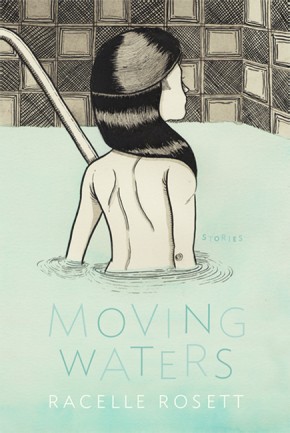
There are two answers to this question. I did a reading from “Moving Waters” for “Zeek” last fall and met a wonderful young artist named Will Deutsch, who heard the title story and shared some of his work with me. His artwork depicting immersion into a mikveh was so tied to what I was doing that I immediately imagined his work adorning the book’s cover. I loved the idea that at first glance the image looked as much like a swimming pool as a mikveh, which underscores the theme of the book that we are in two worlds at once—the ancient and modern.

I also felt drawn to the image of Deutsch’s mikveh because I felt as if I were literally stepping into a pool. I hope this is the experience for the reader in the sense of stepping into the lives of these characters and being engrossed in their world. I also hope readers will be moved to reclaim and redefine mikveh as a ritual that is relevant and useful in contemporary life. I am compelled by the idea of reclaiming and redefining mikveh as a ritual that is relevant and useful in contemporary life. In many communities Mikvah is now being used as a demarcation of transition — to heal from losses like infertility and divorce as well as celebrate new lifecycles like adoption and recovery.

Your stories reflect an intensive interest in Judaism. Can you say something about your own Judaism and how it has influenced your work?

What is most surprising to me is that like the characters in my book, Judaism became relevant to me unexpectedly. I brought Shabbat into our family lives as a way of impressing the idea of community and rest on my children. I did that to anchor them in a place where many forces are competing for their attention.

Do you consider yourself a Jewish writer in the sense that Judaism inspires and moves your stories along?

I certainly feel that [Judaism] informs the stories in “Moving Waters.” My characters embody what I most value and want to keep from my tradition. I think as you mature in your faith you’re constantly holding it up to the light and reappraising it. I was watching “Weeds” recently and there was a plot line with a rabbi and the idea of struggling with yetzer h’rah — the Evil inclination. You write from a place that is shaped by everything you are. Having said that, I may write a story or a script in which the characters are not Jewish but my belief about the world will not change.

Do you still write for television?

I do. I’ve had an ongoing role in television over the years as a consultant working with writers I love. Several months after I completed the story collection I met an extraordinary young woman and I was compelled to write a script about her that is still in the works.

What’s on your agenda this fall?

I’m doing a number of visits to temples and Jewish Book Festivals as part of a Jewish Book Council author tour. I love visiting Jewish communities and seeing their dynamic and energetic engagement. For example, I attended a service in San Francisco that, in addition to being in a beautiful setting, was entirely relevant both socially and politically. It was thrilling to see the kind of deliberate participation not held over from generational guilt but was about bringing together a community in a purposeful and joyful connection.