Hannah’s Prayer: A Rosh Hashanah Story

Struggling with infertility is a loneliness like no other. I have been blessed with two children, but I can still recall that feeling of isolation, hopelessness and, in some sense, failure until I conceived my longed-for first child. Jewish tradition not only validates this emotional state, but also elevates it by telling Hannah’s story publicly every year.

Hannah, the heroine of the haftarah that is traditionally chanted on the first day of Rosh Hashana, desperately wanted a child. Although she is not the first biblical woman to experience the pain of infertility, she is the first woman to confront God about her situation through personal prayer. In a number of midrashim Hannah is acknowledged to have introduced the model for the contemporary way we pray and approach God.

But like many inventions, there were missteps in Hannah’s journey. When Eli the High Priest saw Hannah moving her lips and praying soundlessly he assumed she was drunk. Hannah quickly corrected him. “I am a woman who is hard of spirit,” she said. “I have drunk no wine or other strong drink, but I have been pouring out my soul to God.”

Hannah’s barrenness echoes that of the matriarchs. Like Sarah and Rachel, she went through a long period of yearning for a child. And like her forebears who found concubines for their husbands, Hannah encouraged her husband Elkanah to take Peninnah as a second wife. A midrash further explains that Hannah reasoned that if she told Elkanah to take an additional wife, God would liken her to Sarah and Rachel and also remember her with a child. But Peninnah, who gave birth to many children, turned out to be Hannah’s cruel rival. Each year the family would go to Shiloh to offer a sacrifice and Peninnah would taunt Hannah about her childlessness. After almost two decades, a despondent Hannah had had enough heartbreak and confronted God in bitterness and desperation.

Hannah forthrightly calls God to account for the injustices in His/Her world. Another midrash depicts her comparing her situation to a woman who has been issued a death sentence. While this idea of a life without children as being the severest of punishments does not resonate with modern sensibilities, Hannah is a woman of her time. In the Hebrew text she refers to herself three times as a maidservant – a woman who observes God’s commandments. Her piousness alone is justification for demanding God to answer her prayers.

Alicia Jo Rabins, a teacher of Bible, a poet, and a song writer who has authored a curriculum on biblical women called “Girls in Trouble,” describes Hannah’s call to prayer as “the most radical fertility technology of her time.” Rabins asks: “Is God a partner in Hannah’s transformation, or a force activated through her demands?” For Rabins the story is “a complicated interplay between Hannah’s power to change her life, and her reliance on forces beyond her control. On one hand, Hannah’s decision to take action after years of suffering is a crucial part of changing her story. But on the other hand, Hannah cannot change her destiny alone; God needs to ‘remember’ her in order for her to conceive.”

This is the season to honor Hannah’s brand of ferocious and brave worship. In that spirit I have also been reading Belle Boggs’ beautiful memoir the “Art of Waiting: On Fertility, Medicine and Motherhood.” There is an undercurrent of supplication in Boggs’ book too. In researching her memoir she came upon a phrase, “disenfranchised grief,” coined by another writer. In an interview with The Atlantic, Boggs explained that, “Disenfranchised grief is grief for a loss that cannot be openly acknowledged, publicly mourned, or socially supported. And fertility fits into that category really well because it isn’t something that we are comfortable talking about. Because it is an experience of loss if you’re trying for something and it’s not happening.”

“Disenfranchised grief,” perfectly captures Hannah’s state of mind as she prayed to God for a child. Her prayer was a deceptively spontaneous outpouring of grief. It was a beautifully articulated expression of a deep, recurring disappointment. As we move into this High Holiday season, many of us will confront our own disenfranchised grief. May we pray as authentically and movingly as Hannah.



The Contradictions of Summer by Judy Bolton-Fasman

Summer has always been full of contradictions for me. The days are long yet the season is short. Summer experiences are like gossamer—try too hard to hold on to them and they vanish. During the summer I take stock, look back and marvel that I survived winter’s hibernation or the frenzy of the calendar.

Summer is a quiet time in the Jewish calendar. There is a slow but steady movement towards the high holidays. And then there is Tisha b’Av—simply translated as the ninth day in the Hebrew month of Av. Tisha b’Av is a day of remembrance filtered through bereavement and mourning that is both as private as a yahrtzeit and as public as a yizkor. Tisha b’Av is a crater I seem to stumble into every year—a crater that filled with ancient and modern traumas. Israel’s holiest Temples were destroyed in different years on the same date.

The symbolism of that wholesale destruction comes back to haunt Jews even on the happiest of occasions as in the breaking of a glass at the end of a wedding ceremony. Other historical tragedies befell Jews on that day as well. Pope Urban II declared the First Crusade in which tens of thousands of Jews were killed, and many Jewish communities were annihilated. Jews were expelled from Spain on Tisha b’Av in 1492. World War One broke out on Tisha b’Av in 1914 and set the stage for the Holocaust. Jews in the Warsaw Ghetto were deported to Auschwitz on the ninth day of Av. Old and new history are omnipresent during a month that the Talmud instructs that we must reduce our joy.

In the summer Jewish observance may feel lighter, less busy but it is has its moments. On Tisha b’Av my mother never let us kids swim. We sat on the side of the town pool, sadly dunking our feet. This was a random punishment for nine-year-old me. Under ideal circumstances my mother didn’t let us go into the pool for at least two hours after lunch. This made Tisha b’Av the equivalent of continuously digesting a meal. But food was a moot point because we never fasted. Yet we purposely ate lightly if not more hungrily. The holiday also had a personal resonance for my mother. Her Uncle Baruch, who never observed any aspect of Tisha b’Av, died in a car accident on the very day. A few years later, on another Tisha b’Av, another uncle was run over by a streetcar in Havana.

Tisha b’Av always seemed to sneak up on me when I was a child and then as an adult I lost track of it altogether. Only when I went to work for a Jewish organization was I aware of it again. For some of my colleagues it was a day of true mourning. On the eve of Tisha b’Av they recited Lamentations on the floor of their synagogues. They went to work yet fasted all day. They wore cloth shoes and eschewed comfortably sitting at their desks. I remember my boss consciously trying to stand for most of the day. It was an austere yet functional shiva. I now see that my family and I were in the clutches of a makeshift Judaism, unable to forget Tisha b’Av yet not able to implement its more profound implications. We were on automatic pilot. Our practice never transformed us.

There was the summer when I wanted my Judaism to go beyond arbitrary bans on swimming and I decided to keep kosher. This made my parents anxious about many things including our annual summer vacation. Was there any place within a reasonable distance that we could go to for those two weeks where I would eat? The answer finally came to my father. The Catskills. My parents had honeymooned there and fifteen years later—1975—most of the big hotels were starting to dilapidate. But there was still palpable nostalgia for and loyalty to the Catskills. We stayed at Brown’s Hotel, owned by relatives of Jerry Lewis – a fact you could never forget because his picture was plastered everywhere.

That summer my sister learned to ice skate and my brother perfected his diving. I ate kosher food until I couldn’t eat anymore and fell madly in love with the waiter for my table. Bobby was an aspiring doctor from New Jersey. I was a fourteen-year-old as terrified of mixing meat with milk as I was of imagining myself kissing a twenty-one-year-old. Brown’s was a formative summer experience for me with its hint of summer romance mixed in with my newly found Judaism.

These days there are no bans, no lamentations, no uncomfortable standing for me on Tisha b’Av. I concentrate on honoring memories while living in the present.


A Letter to My Son After Orlando

My Dearest Son—

Orlando. That’s all we have to say now to invoke the horrific reminder of how vulnerable LGBT people still are. Orlando. A portent of how very careful you, a young gay man, must be anywhere in the world.

I am so proud of the man you have become. Your gay identity is just a natural part of who you are. You are not an activist about it. I almost wrote that you are comfortable in your own skin. But I’m not sure that is always true. Each time you are in a new situation you have to come out all over again.

When you came out to your father and me, you were a shy 16-year-old boy. You kept your eyes trained to the kitchen floor and blurted out that you were gay. And then you added, “I’m out of the closet.” How long had you been hiding who you were in such a dark, narrow space?

When you were a little boy, long before you came out, I published another open letter to you and your sister about the debate at the time regarding the status of homosexual men and women in our branch of Conservative Judaism. I said:

You have been taught in school, at Temple and at home that God is compassionate and would not want anyone — homosexual or heterosexual — to live a life without love. That is exactly what Dad and I want for both of you — to find true and fulfilling love with a partner.

I’d like to say that my words were prescient. But somehow a mother knows, and I knew you were struggling with your sexual identity. But I wanted you to come out to me in your own time. Reading that letter again, I also realize how far we have come in ensuring that you live a life in which you can legally marry the man that you love.

When the Supreme Court legalized gay marriage last year, I wept. And then I phoned you. I wanted to be the first person to tell you. You thanked me for calling and said you appreciated that I told you the good news. Your reaction, though, was cool and collected. I pray we had made you feel confident enough, strong enough to see the Court’s decision not so much as a privilege, but as your human right.

Yet even with the Court’s decision and the Conservative movement’s enlightening interpretations of Jewish law, I know if you kiss another man in public it’s still a provocative, even dangerous act. I read that the Orlando murderer became enraged when he saw two men kissing in public. That reaction is incomprehensible to those of us with gay friends and family. But I suspect you know how cautious you must be in this world. After all, there are too many places where your life as a gay man is threatened.

This has happened to Jews as well. I’ve been writing about anti-Semitism for three decades. But as an American I never felt overtly threatened by it even when your day school decided to lock its doors and hired a security guard. I suspect anti-Semitism does not affect your day-to-day life either, although you, who don’t engage much in Judaism, were disturbed by the anti-Israel protests on your campus.

But being gay is different. In interviews that I’ve heard or read, over and over people said that places like Pulse were supposed to be safe havens for the LGBT community. Pulse was a place to dance, to laugh, to flirt. You’re too young to remember, but before Pulse there was a 2009 shooting at a gay nightclub in Tel Aviv. And a young woman, an LGBT ally, was stabbed to death last year at a Pride Parade in Jerusalem. In our country there is a long history of oppressive violence in clubs like Pulse, upsetting a gay person’s sense of security and taking away his dignity.

In your last year of high school, a teacher asked you to imagine yourself in the future. You wrote a lovely essay that included a scenario in which you and your husband lived on the Upper West Side of New York with your two children. I hope you don’t let anyone or any event keep you from dreaming that dream.

If Orlando has taught us anything, it is that you and your LGBT brothers and sisters can’t always live securely and confidently and openly. We must fix this by safeguarding that something as innocent as a night on the town does not turn into a dangerous experience, or God forbid, a tragedy. Fighting against LGBT hate is as important as fighting the scourge of anti-Semitism.

And no matter where you are, always know how much your father and I will always love you.

Mom


The Banana on the Seder Plate

bananabanana.jpgThe moment I saw artist Nicole Eisenman’s seder plate at the Jewish Museum gift shop in New York, I had to have it. Its simplicity gives way to cheekiness. Its bold black lettering and mud-red glaze give it a funky vibe. And the symbols on the seder plate are described in a straightforward, childlike language. My favorite description calls the charoset—the edible stand-in for the material the enslaved children of Israel used to make bricks—“cementy stuff.”

The most declarative symbol on the plate is the bone—the place for the zeroa, or roasted shank bone. That particular object is there to remind seder participants of the 10th plague—the killing of the Egyptians’ firstborn sons—and it screams for attention on this seder plate.

Nicole Eisenman Seder Plate with Pouch

And while this is a dream of a seder plate, there are newer ritual food objects to join the old standbys. The first is an orange. This is a tradition that goes back to the 1980s, when an early feminist Haggadah suggested the radical act of placing a crust of bread on a seder plate in solidarity with Jewish lesbians. Unfortunately the message was that gay Jews were made to feel as if they violated Judaism, like eating bread at Passover. So Susannah Heschel came up with the idea to replace the bread with an orange. In an essay she wrote a few years ago for the Forward, she explained:

“When we eat that orange segment, we spit out the seeds to repudiate homophobia and we recognize that in a whole orange, each segment sticks together. Oranges are sweet and juicy and remind us of the fruitfulness of gay and lesbian Jews and of the homosociality that has been such an important part of Jewish experience, whether of men in yeshivas or of women in the Ezrat Nashim.”

A relatively new tradition on my seder plate is the inclusion of cashews. This is the brainchild of Rabbi Wesley Gardenswartz, senior rabbi of Temple Emanuel in Newton. A few years ago, Rabbi Gardenswartz saw a sign in CVS asking customers to buy bags of cashews for our troops in Iraq. A CVS employee, whose son was on his second tour of duty there, spearheaded the idea. She explained that salted cashews kept the men and women serving in a desert climate hydrated. The next Shabbat, Rabbi Gardenswartz urged his congregation to honor our troops by including cashews on their seder plates.

Now comes the year of the banana. For 3,000 years the Haggadah has reminded us that we were once slaves, and it commands us to experience the Exodus from Egypt as if we had actually gone through it ourselves.

This is where the banana comes in. Like the slaves we were in Egypt, so too are we Syrian migrants fleeing for our very lives. We too are the parents of the little boys—brothers who were 3 and 5—who drowned on an Exodus gone horribly awry. Their mother drowned with them, but their father survived the harrowing journey. In his grief this father remembered how much his boys loved bananas.

Bananas are not easy to come by in war-torn Syria, but every day this father brought his boys a banana to share. Its sweetness was not only a treat, but also a symbol of his deep and abiding love for them. Is this man so different from us? Is he so different from our ancestors wandering in the desert? Did the Israelites make life a little sweeter for their children on their traumatic journey with bits of hard-to-come-by fruits?

In the spirit of Nicole Eisenman’s original plate, what would an updated seder plate convey about these new and sacred ritual objects? Here are my suggestions and their meanings:

  • Orange: cherishing one another
  • Cashews: solidarity
  • Banana: we are all migrants

What would you add to your seder plate?

A Letter to President Obama from the Daughter of a Cuban Exile

Dear Mr. President:

Your trip to Cuba is a dream, a miracle, a revolution to me. Never did I dare to fantasize that in my lifetime a sitting U.S. president would be shaking hands with Cuban officials at José Martí Airport — the airport my family used to escape Fidel Castro. Yes, Mr. President, I am a child of refugees. Although my Cuban mother came here just before Cuba’s iron curtain clanked shut, the same desperate, fierce homesickness that claimed my refugee relatives overtook her as well.

As a teenager, my uncle left Cuba two months after the failed Bay of Pigs invasion. Although on the older side, he was part of the Pedro Pan rescue operation — a CIA undertaking that arranged to airlift children out of Cuba. Many of them were placed with American families. My uncle was lucky. He had an older sister, my mother, waiting for him.

But he almost didn’t make it to America. He was on a Pan Am flight that was suddenly grounded by the Cuban military who claimed there was a draft dodger on the airplane. We’ll never know if it was my 19-year-old uncle they were after, because the pilot declared the aircraft sovereign American territory and took off without permission from the tower. My uncle shakes each time he tells the story.

I was born in my American father’s hometown in Connecticut in December of 1960 as diplomatic relations with Cuba were deteriorating. My grandmother, my Abuela, arrived from Havana to care for my mother and me. She adjusted to the Connecticut winter mostly by rocking me and singing me lullabies in Spanish and her native Greek. (Yes, Mr. President we are a family who hopscotched its way to the United States, but Cuba is where we left our hearts). After three months, she decided it was time to go back to Cuba. My mother pleaded with her to stay and family lore has it that she took the last Cubana Airlines flight out of Idlewild Airport.

I can’t begin to tell you how often I heard my mother softly cry, Hay Cuba, como te estrañò — Oh Cuba, how I miss you, how I long for you. That longing for Havana, for its sea wall along the Malecón — it colored my childhood. I finally walked the Malecón four years ago.

I was overwhelmed with emotion when I arrived at José Martí Airport. The ghosts of my grandparents, who finally left Cuba for good two years after I was born with one small suitcase between them, haunted me. I thought about how they shut the door of their home on almost three decades of life and set out for yet another migration. I went to their house in old Havana. I finally saw the marble stairs I had heard so much about. I saw the heavy wooden door my grandfather still had the keys to in his last exile. He carried those keys until the day he died, believing he was going back to Cuba. The current occupants were kind enough to let me in for a look. They wouldn’t take the money I offered them for their hospitality. They told me this was my home too, and I broke down and cried in front of them. Hay Cuba como te estrañe — Oh Cuba, how I missed you.

Mr. President, you will undoubtedly notice that Havana is like an aging beauty queen. So is my mother who is now marooned in a nursing home wheelchair. When she calls me to tell me that you are in her city, she can barely contain her excitement. Wistfully, she asks me if she will again see a Havana without a Castro in power before she dies. All I can tell her is that you made a return to her country feasible. No matter how remote the possibility that her health will allow her to go back, you have given her hope. Se lo agradezco, and I thank you with all my heart and soul that you have opened up prospects for peace with Cuba for my children.

Felicitaciones,
Judy Bolton-Fasman

This essay originally appeared on Cognoscenti, the ideas and opinion page of WBUR, Boston’s NPR news station — http://cognoscenti.wbur.org/2016/03/22/obama-in-cuba-judy-bolton-fasman

Barbie: New and Improved? by Judy Bolton-Fasman

I’d like to think that Mattel’s introduction of three new body types for the iconic Barbie doll — Petite, Curvy and Tall — is the company trying to make amends for the emotional tsunamis thin, busty Barbie has caused over the decades. To further diversify her, Barbie will also come in seven skin tones and sport 24 new hairstyles. There will be a redheaded Barbie, a curly-hair Barbie and even a Barbie with long blue locks. Yet according to a recent Time magazine cover story on Barbie’s transformation, in little girls’ minds, Barbie is still Barbie and they overwhelmingly identify her as blonde and thin.

The cynic in me knows that Barbie’s makeover was mostly a business decision. Barbie, pardon the very bad pun, is a cash cow. According to the Time article, she does a billion dollars in annual sales across more than 150 countries, and 92 percent of American girls ages 3 to 12 have owned a Barbie at some point.

I … was a short, chubby girl who wouldn’t dare to imagine even coming close to looking like Barbie. It didn’t make me sad exactly, just resigned.

But in the last four years, Barbie has seen her sales lag. In October, Mattel announced a 14 percent global drop in Barbie sales, the eighth consecutive quarter in which profits fell. Barbie’s poor performance is somewhat explained by the fact that Lego has introduced toys aimed at girls who are aspiring engineers and Hasbro has cornered the market on Disney Princesses; two years after “Frozen,” Elsa continues to be a top moneymaker for the company. Also, figure in the negative impression that many millennial moms have of Barbie.

Barbie and I go way back. She came into my life when I was 6-years-old and bedridden for three months. She was a gift from my aunt who also gave me some of Barbie’s exquisite miniature outfits. I went on to collect dresses, bathing suits, and my favorite — a bridal gown. I kept Barbie’s clothes in what I thought at the time was the most gorgeous wardrobe in the world — a small black patent leather case with a handle to transport her and her clothes anywhere and everywhere.

Barbie didn’t look like anyone I knew. That was not a surprise considering she had impossible measurements, perfect hair and immaculate makeup. I, on the other hand, was a short, chubby girl who wouldn’t dare to imagine even coming close to looking like Barbie. It didn’t make me sad exactly, just resigned.

This file photo provided by Mattel shows a group of new Barbie dolls introduced in January 2016. (AP)

Barbie was born fully grown with a checkered past in 1959. She was the invention of Ruth Handler, who named her after her own daughter. Barbie and Handler courted controversy from the beginning when Handler based Barbie’s body on a curvaceous German doll named Lilli. Lilli was often handed out at stag parties as a gag gift. Among Barbie’s other controversies is a book that accompanied her in 1963 entitled, “How to Lose Weight,” which included explicit instructions not to eat. Ten years after playing with my first Barbie, I took that advice and subsisted on Popsicles and saltines for a year.

I have no doubt that I was similar to the subjects in a comprehensive 2006 study of young girls 5 to 8. Researchers found that “early exposure to dolls epitomizing an unrealistically thin body ideal may damage girls’ body image, which would contribute to an increased risk of disordered eating and weight cycling.”

Bingo.

Barbie’s body transformation comes on the heels of a chameleon life in which she has had over a hundred careers ranging from rock star to presidential candidate. She’s been a medic in Operation Desert Storm. She’s been black, Hispanic and even a devout Jew. But after all these years, I still don’t see myself in any of those versions of Barbie. Like the little girls who test drove these new Barbies, I still identify her tiny waist and her perfectly coiffed blonde tresses as hallmarks of the Barbie I know.

And the new Barbies will not pierce her plastic mask of perfection. She still has no paunch, no wrinkles and no thick ankles. Damn her!

And the new Barbies will not pierce her plastic mask of perfection. She still has no paunch, no wrinkles and no thick ankles. Damn her! Only her wide hips constitute body diversity — hips that are the norm for most women. A number of commentators have noted that Barbie’s feet have finally been leveled off so she can now wear flats as well as stilettos. No doubt that will add to the over one billion pairs of shoes she has owned.

I imagine a day when we’ll see Barbie in a wheelchair, or using a walker, or walking on a prosthetic leg. But I suspect she’ll never need a hearing aid or an insulin pump. Her hair, all 24 versions of it, will never frizz. She will never have a pimple or even a freckle. Despite all the angst she’s caused, she remains maddeningly aloof. And she reminds us that women will always find something wrong with their bodies.


This essay originally appeared on Cognoscenti, the ideas and opinion page of WBUR, Boston’s NPR news stationhttp://cognoscenti.wbur.org/2016/02/04/barbies-new-body-judy-bolton-fasman

First They Came for the Muslims by Judy Bolton-Fasman

If things become absurd enough, out of control enough, and quite frankly tragic enough, then my friend N and I have a date to register as Muslims together. It will be my only acknowledgement of Donald Trump’s racist mandate to humiliate our Muslim sisters and brothers, our fellow Americans by asking them to wear a metaphoric armband.

The Holocaust continues to teach us lessons about inhumanity. It was not so long ago—in fact in many of our parents’ lifetimes—that Jews were required to come forward in Germany and then throughout Europe. What followed in just a few short years was one of the most horrific ruptures in history.

N and I met at the all-boys private school our sons first attended in seventh grade. Beyond the classroom, our sons gravitated to each other in the debate club, on the soccer field and in chorus. That was the year that my son, one of the few Jewish boys in the class, soloed ‘Deck the Halls’ in the annual Christmas Concert. N and I laughed at the irony. On the soccer field we talked about peace in the Middle East. N, originally from Pakistan, said how much she wanted to see all of the religious holy sites in Israel. Although I understand the rationale behind it, I didn’t have the heart to tell her that if we traveled together to Israel she would be searched and I would not. Perhaps she, in turn, didn’t want to think about the reception my Israel-stamped passport would receive in Pakistan and other Muslim countries. We were simply friends, confidantes and mothers. On Christmas, our boys were among the minority of the minority, not celebrating the holiday. They went to the movies and played video games at N’s house on Christmas Eve.Our boys are now freshman at large universities. But during those early soccer games, N and I wondered out loud if their friendship was a tiny step towards peace.

I tell you this not to demonstrate my liberalism, but to share my humanity. I panic when I think of the kind of world Trump and others want to impose on my children, on N’s children. I think of the plight of Danish Jews during the Holocaust. Contrary to popular legend King Christian X and his subjects did not wear a yellow Jewish star, but neither did the country’s Jewish citizens. No one was labeled.

I just came back from Israel. My time there was in the midst of a terror spree. N texted me to make sure I was safe. That is what our friendship is about—we put aside stereotypes and engage with each other as sisters, as mothers, as women. We’ll often bring up customs in our respective traditions that challenge us. N only covers her head in the mosque. I try and figure out the world through my egalitarian Judaism. N and her family spend Rosh Hashana and Passover with us—it’s a holiday that brings back to her special memories of her beloved elderly neighbor who taught her how to make gefillte fish. We’ve both tasted the bitter herbs of our traditions as well as the sweetness of hope that we find in them.

A writer once described herself as “complicated with Judaism.” I am also complicated with my Judaism as well as with N’s Islam. I repurpose Rev. Martin Niemölle’s famous, poetic speech about the cowardice of Germans who failed to speak against the Nazi persecution of the Jews to my own time. If I do not speak up for my Muslim friend, who will be left to “speak up when they come for me.”

This op-ed originally appeared in the December 11, 2015 issue of The Jewish Advocate

Introducing Abby Stein by Judy Bolton-Fasman

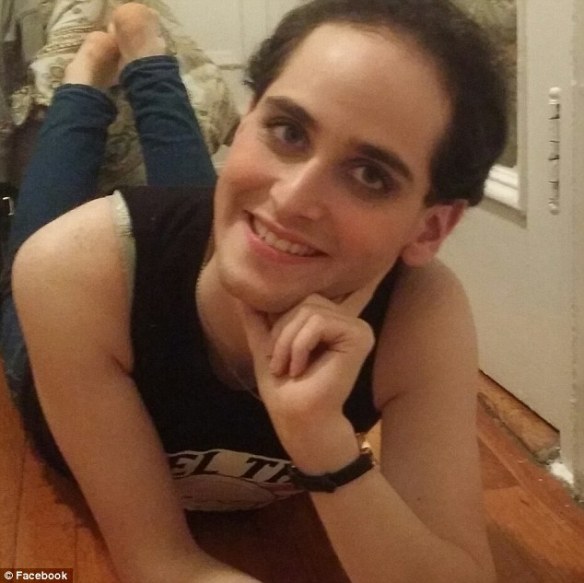
The first thing that Abby Stein wants the world to know is that she did not leave her ultra-Orthodox community solely to become a woman. Since she came out this past August, Stein has been garnering attention as the transgender ex-Hasid. Although she acknowledges that the two events in her life are “intertwined,” she says her initial leave taking from her Hasidic sect “had to do with beliefs. I was done with Judaism, and for over a year, I had nothing to do with it.

AbbyStein

Abby Stein

Stein chronicles her transgender experience and her religious transformation on her moving blog, The Second Transition. In one of her first posts she wrote, “[t]here is something amazingly relieving about ‘knowing’, knowing and coming to terms with the reality I have been trying to run away from for years — I am a girl.”

The Last Chapter by Judy Bolton-Fasman

This week in Jerusalem a new normal has taken over the city. It’s a tenuous calm that prevails until I notice a lone man walking towards me with his hands in his pockets and I instinctively pick up my pace. But friends here don’t see the new normal as a nod to peace. One woman tells me that she is more frightened now than she was during the second intifada when buses were being blown up. She could better calculate then the risk she was willing to take by shopping in a crowded market or riding the bus home from work. This time, there is no obvious calculus for safety. It is a time fueled by the arbitrariness of panic and adrenalin.

This was also the week President Clinton was in Tel Aviv to remember his friend Yitzhak Rabin on his 20th yahrtzeit. Clinton spoke in the square that commemorates the late prime minister—the square where an Israeli Jewish zealot gunned down Rabin. The various estimates I’ve seen of the crowd’s size for the memorial—numbers that range from 40,000 to 100,000—tell me that many Israelis not only mourn Rabin, but also mourn the dashed hopes for peace in the wake of his death. Clinton’s charge to the crowd— “to decide when you leave here tonight…how to finish the last chapter of [Rabin’s] story”—was pointedly singular in its directive.

Clinton’s words especially resonate during this current rash of violence—a violence that is both blurry and distinctive for its randomness. These polar states of fuzziness and clarity are also the underpinnings of coexistence in Jaffa, a mixed town at the southern edge of Tel Aviv. The Arabs call this very old city Arous al-Bahr—the bride of the sea. Arabs and Jews have always lived here together. Pre-statehood the majority was Arab, but in the beginning of 1948, even before Israel’s War of Independence, Jaffa collapsed when its wealthier Arab residents and community leaders sought refuge in places like Lebanon and Syria. Jaffa surrendered and was taken over by a Jewish majority. Today the city is part of the Tel Aviv-Jaffa municipality.

Coexist

Coexistence in Jaffa is neither violent nor friendly. There are no knives here, nor are there any olive branches. Jews and Arabs live alongside each other leading parallel lives, except for the Jews who step out to eat the famous hummus on Abu Hassan Street. Soldiers on furlough comfortably stroll the cobbled streets. The old flea market here has given way to trendy clothing shops and art galleries.

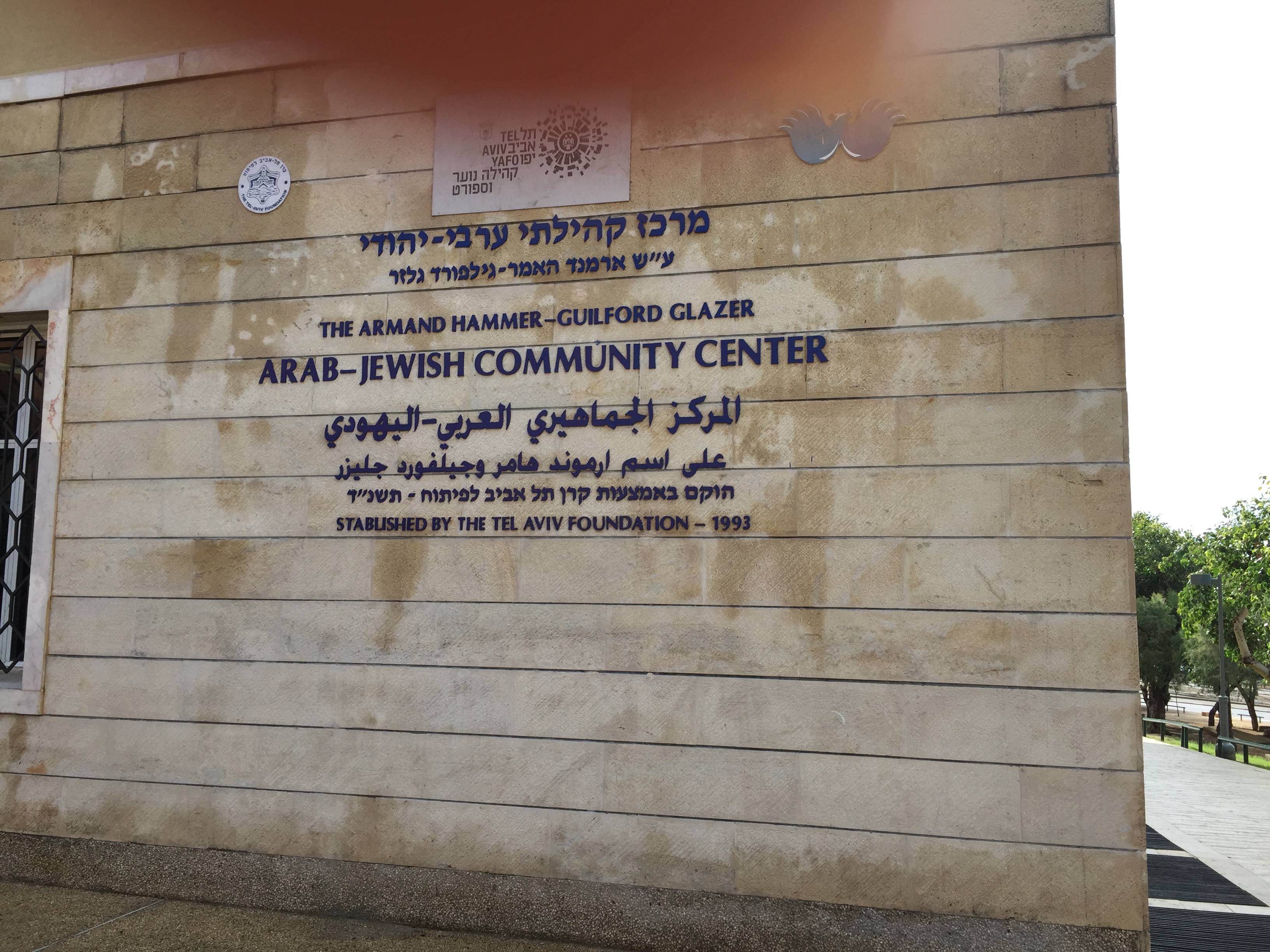
I brought an Israeli friend with me to Jaffa. He jokingly calls himself my fixer, which means he acts as both tour guide and steadfast translator during my afternoon in the city. We walk the streets of Old Jaffa taking in the sea, eating the freshest hummus I have ever tasted, and making our way to the Arab Jewish Community Center (AJCC) in the Ajami section of Jaffa. It’s a 20-minute walk from the city center and along the way we see another kind of blending—ramshackle houses just yards away from expensive condominiums.

AJCC2

Founded in 1993, the AJCC is a cornerstone of this Arab neighborhood. It aims for the look and feel of an American Jewish community center. It offers school children and teenagers after school programs called chugim or electives that range from dance, gymnastics and martial arts to tutoring in the newly constructed library.

The AJCC,, which also aims to undo the de facto segregation of Israeli society, is not unique in that quixotic goal. What is different is that the Tel Aviv-Jaffa municipality underwrites part of the center’s expenses. According to a staff member at the center no other overt peace initiative has that kind of city government funding anywhere in Israel.

In addition to the various chugim, the AJCC sponsors classroom exchanges between Arab and Jewish schools, a youth parliament that focuses on diplomacy and three choirs that perform their own ecumenical outreach. Numbers are important in these endeavors. The activities are purposely populated with an equal number of Arabs and Jews, and tolerance is the watchword associated with them.

It may just be a matter of semantics, but I bristle at the word tolerance. I hope and pray Israelis and Arabs go beyond tolerance to loving kindness and ultimately peace. But for now tolerance is how people survive in Jaffa. Still I give the AJCC credit. Its policy of tolerance encompasses a celebration of differences too. Children who would normally not interact with one another come together here. And the center also fills in a vacuum for Arab schools that lack the facilities and funding for extra-curricular activities.

As I left the center I fantasized that the philosophy behind the AJCC’s programs could one day be part of a different, better new normal in Israel. And as I reflect on President Clinton’s words, I think that maybe this is also the place to begin the last chapter of Yitzhak Rabin’s life story—a story that has yet to unfold.

The Situation by Judy Bolton-Fasman

Fear has been my companion in Jerusalem.

Last Sunday I went to the Kotel—the Western Wall–by myself. I was among the few people who braved the rain and the wind to pray and to wish and to marvel. But I was well aware of the boundaries around me. When I went into the Old City, I didn’t cross into the Muslim Quarter. When I walked around Jerusalem’s City Center, I noticed that taxi drivers advertised they were Jewish by flying the Israeli flag atop their cabs.

JudyWesternWall

The other day a Palestinian boy and his blind grandfather begged me for money. “Mrs., Mrs.,” the boy said in Hebrew. “Kessef, money.” I quickened my steps. “No money,” I said in my fractured Hebrew. “Please, Mrs.,” he said in his equally fractured English. He followed me all the way to the café where I was meeting friends. There he conducted a long, convoluted negotiation with my friend, which yielded him 20 shekels or about $5.

“I’m sorry he frightened you,” said my friend.

“I’m sorry I let myself be frightened by a little boy and his disabled grandfather.”

I felt a mixture of shame and relief.

This is the week of the anniversary of Yitzhak Rabin’s assassination by a Israeli right-wing, extremist Jew. This is also the week that Richard Lakin, an Israeli-American who was originally from Newton, Massachusetts, died of wounds he sustained when a Palestinian stabbed and shot him on a bus in Jerusalem. Lakin immigrated to this country decades ago with hope and optimism and advocated for co-existence and peace in this country.

I have promised my husband that I will not take public transportation on this trip. It’s a promise I easily keep because fear keeps me from boarding the Number 18 bus on Emek Refaim, a busy thoroughfare. During the second intifada in 2003, a suicide bomber blew up a Number 18 leaving ten people dead and over a hundred hurt.

I’ve taken to meeting colleagues and doing work in the Grand Café on Beit Lechem Road. Beit Lechem is Hebrew for Bethlehem. It means house of bread, and I have spent my mornings in a house redolent with the smell of bread and coffee and pastries. Every once in a while it occurs to me that it could also be a house of tragedy or even carnage. I tell myself that a stabbing or a suicide bombing is highly unlikely here. Things have been relatively quiet except for the occasional siren piercing the calm. That’s when my mind blows up my fear into the size of a balloon floating in the Macy’s Thanksgiving Day parade.

“Blood is flowing in the streets of Israel,” a well-meaning friend said to me just before I left. Her comment felt like a throwback to the first and second intifadas. But my Israeli friends are adamant that this is not an intifada. That would imply there is some organization behind this latest spasm of violence. But rather these scattered, random acts of violence are borne of pent up rage. A thirteen-year old Palestinian boy stabs an Israeli Jewish boy. A Jewish settler attempts to stab a peace activist, a rabbi who has accompanied a group of Palestinians harvesting olives on the West Bank.

A journalist friend says that this country runs on magical thinking. During the second intifada, her children were small and every morning she made sure to know what clothes they were wearing as a protection, a charm against getting a call to identify their bodies. In that same conversation she casually mentioned that Palestinians are throwing Molotov cocktails a few streets over from her house. She shrugged her shoulders and told me this is how it is these days.

Ireland had “The Troubles” and Israel has “The Matsav” — the situation.

There is an Israeli saying that, “If you were once burned by hot water, you will be afraid of cold water, too.” There is so much cold water rushing around me—Palestinian construction workers, women in hijabs, little Arab boys looking for a handout.

My fear is valid. My fear is exaggerated. I indulge in magical thinking to keep me safe. Maybe tomorrow I will not be afraid.