The Swing Set and the Birthday

The couple that bought the swing set from us drove a Honda Civic with two car seats side by side in the back. Just like us. The little girl had a baby brother. Just like us. I remember when we went to pick out the swing set—a gift from Grandpa and Grandma who told us to get the best for Anna and Adam. And we did. Two swings, a glider, a slide, a canopy and a ladder leading up to monkey bars.
On the car ride down, Anna suddenly announced that she was something that began with an “F.” Ken and I couldn’t imagine. Actually maybe we could, which is why we braced ourselves. “I’m firsty,” she said. “Ah,” we smiled, producing her sippy cup.

Anna’s eighteenth birthday is around the corner. Last week, the young family in the Honda Civic returned to our house in a rented van, took apart the swing set and went away with it. I watched from the window on the landing. The last thing to go into the U-Haul was the yellow glider. It lay on the ground washed up from the past. The man, the woman and the grandfather squeezed into the front seat and drove off into a life that was once mine.

Please, understand, I’m thrilled that my children have grown and thrived. I thank G-d every day for having the privilege of ushering them through so many seasons of joy. But up until now the changes within my motherhood have felt gradual. We went through grammar school in a series of days in which I looped around Newton dropping them off and picking them up. Quite often I’d defy the carpool rules and linger in the line to watch them walk in to school together. I knew their childhoods would not last, and yet I didn’t quite believe it. I always had another year. How different really was fourth grade from third grade?

I don’t like change. Loathe it. Probably because I’m afraid of it. Always have been. Quite suddenly my daughter can legally buy cigarettes and lottery tickets. She can marry without my permission. She’ll vote in her first ever presidential election and she’s told me quite forthrightly that she’ll make up her own mind about the candidates. And my son. He towers over me. Nine inches taller than I am and counting.

When we bought the swing set, our cholesterol was normal and our blood pressure steady and uneventful. Our kids woke up so early on the weekends that they watched videos sprawled across our bed while we tried to catch an extra hour of sleep. They fit in our laps and they were light enough to carry up and down the stairs. Now we lie wide awake early on a Sunday morning and our exhausted teens cram as much sleep as they can into the day. Both of their grandfathers died over a decade ago. One grandmother can no longer walk. We put all of our hopes and prayers and dreams that the other grandmother stays just the way we like her.

Like the great chess player that my dear father-in-law was, I can see five or six moves ahead. Heck, I think I can see the endgame. This has been a morose summer for me. If another person tells me that I’m going to love having my daughter away at college—ecstatic was how one veteran mama put it—I’m going to collapse and weep uncontrollably. Think of your newfound freedom, said another empty nester. I didn’t realize that I was in jail. What breaks my heart the most is that my kids know I’m sad about the coming transitions. No amount of denying on my part convinces them otherwise. Adam offers to cue up The King’s Speech for me when I’m teary. But he knows that not even Colin Firth can lift me out of my funk. I just have to wait until it burns off like fog. That’s what my father the inveterate weather watcher used to say about sadness. It burns off.

For fifteen years our swing set was the backdrop of my life. Flash, I see Anna’s friends trying to one up each other on the swings. Higher and higher. Flash, Adam and a friend are racing each other across the monkey bars. Flash, someone goes belly down on the slide. Memory has tempered old worries of broken bones and deep bruises. I’ve gone on to worrying about other things like broken hearts, crushing disappointments and anxious decisions.

Little kids, little problems. Big kids, big problems. I never liked that saying. And despite all the gloom and doom I’ve sprinkled between these lines, I don’t really believe the big kids-big problems equation. Especially today on my daughter’s eighteenth birthday. A few hours after Anna was born, I nursed her for the first time and watched special programming on the twenty-fifth anniversary of the moon landing. But the only thing otherworldly that night was that I was a new mother to the most spectacular baby girl on earth.

Tefillin Barbie and Me

The other day I was in my rabbi’s office for what she and I like to call my 10,000-mile tune-up. And there she was on a bookshelf in a plexi-glass frame—a super hero ready to wrap and unwrap at a moment’s notice to redeem the world—my old friend Tefillin Barbie.

Tefillin Barbie is modest and learned and devout. She wears a long denim skirt. Her sleeves are below her elbow. She wears a head covering and is draped in a tallit—a prayer shawl. And, of course, the most notable thing about her is that she wears tefillin. Prominently, proudly and naturally.

I know all the feminist arguments against Barbie, but I can’t help myself, I’ve always loved Barbie. She came into my life when I was six-years-old and bedridden for three months. My aunt sent me a Barbie along with the doll’s extensive miniature wardrobe. I kept her outfits in a black patent leather wardrobe created just for her clothes. I spent hours dressing Barbie in ball gowns, tennis skirts and my favorite—a bridal gown.

Over the years Barbie’s outfits have used over 105 million yards of fabric. She has owned over a billion pairs of shoes. Through it all it never fazed me that Barbie was blonde and tall and I was not. She measured an impossible 36-18-38, but I attributed that to the fact that she was a doll.

A few facts about Barbie and her creator. Ruth Handler invented Barbie in 1959 and named her after her own daughter, Barbara. Ms. Handler went on to co-found the toy company Mattel. Barbie was not her only significant invention. Recovering from a mastectomy in 1970, Handler discovered the need for a suitable prosthetic breast and invented Nearly Me, a prosthesis close in weight and density to natural breasts.

Barbie has had over eighty careers ranging from a rock star to a presidential candidate who focused on educational excellence and animal rights. She has served in every branch of the military and was a medic in Operation Desert Storm. In addition to being a devout Jew, Barbie is also black and Hispanic. Forty-five nationalities claim her as their own. She has been present at diplomatic summits and the dismantling of the Berlin Wall. And now she is a baal koreh—a woman who reads Torah.

I’m not surprised that Tefillin Barbie’s inventor is a soferet—a woman scribe who is trained and certified to write holy texts by hand. According to the Jewish Women’s Archive Jen Taylor Friedman is one of six soferot (plural of soferet) in the world. She has a workshop in her native Southampton, England handwriting an entire Torah for a congregation in St. Louis..

Discovering the occupation of this late incarnation of Barbie led me to do a bit of research on soferot. I learned that the first woman soferet was certified in October of 2003. A congregation in Seattle underwrote the cost of training additional soferot in order to be the first synagogue in the world to have a Torah exclusively hand calligraphed by women. Additionally, women metalwork artists are creating the breastplates, crowns and a clasp for the Torah.

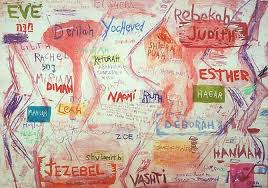
All of this wonderful female energy sent me on a virtual journey that ended up at the Jewish Women’s Archives site where I came upon an entry for Joan Snyder’s lithograph “Our Foremothers.” Serendipity. I have a copy of Snyder’s print hanging in my living room, a gift from my mother-in-law. She thought it was my destiny to have it because the name Judith is so prominent among the Jewish women’s names that Snyder commemorates. Snyder uses shades of red and pink—the colors of blood and tutus—to write names like Hagar, Leah, Rachel and Sarah. She pairs these iconic names with those of her mother, daughter and life partner.

People have two reactions to the print—some are mesmerized and others think it’s the work of a child. “Did Anna make this?” more than a few people have asked me. Snyder’s presentation is both basic and profound. The listing and mixing up of these name reminds me that at some point in a woman’s life she has been cast out like Hagar. She has been adored like Rachel. Taken for granted like Leah or not taken seriously like Sarah. Our foremothers are not simply archetypes. They are us and we are them.

So where does this newest incarnation of Barbie fit in with our own mothers and sisters and foremothers? For one thing she’s an all-American girl who is at ease with every aspect of Jewish ritual. I’m envious of her. A couple of years ago I went to the World Wide Wrap at my synagogue where I was the lone adult among a group of bored pre-teens. I didn’t get a lot of support for trying to learn how to wrap tefillin as a grown woman, so thank God for Tefillin Barbie. When I look at her I remember that nothing in Judaism is off limits to my daughter and my nieces.

Here’s another fun fact about Barbie. Every second of every day a Barbie is sold somewhere in the world. And here’s a wish inspired by Barbie’s sales numbers. Every time that a Jewish girl comes of age, may she be comfortable in her own body and wrapping her own tefillin.


I Pledge Allegiance

With the 4th of July just around the corner, I’ve been thinking about the Pledge of Allegiance. For over a century, American children have sworn loyalty to our flag and to the idea of a country where “liberty and justice for all” is commonplace.

Some history of the Pledge of Allegiance with a brief timeline: The Reverend Francis Bellamy wrote the original Pledge in 1892. It first appeared in a pamphlet called “The Youth’s Companion.” Bellamy intended the pledge to be one size fits all in that any country could adhere to it in principle. Here’s the original wording:

I pledge allegiance to my Flag and the Republic for which it stands, one nation, indivisible, with liberty and justice for all.

In 1923 the pledge was changed to include the words “the Flag of the United States of America,” erasing Bellamy’s utopian globalism.

In 1954 President Eisenhower evoked God as a response to the threat of Communism. Bellamy’s daughter objected to adding the words “under God.” Nevertheless, Congress approved the revision.

I pledge allegiance to the flag of the United States of America and to the republic for which it stands, one nation under God, indivisible, with liberty and justice for all.

The pledge takes me back to what I once thought was my father’s Ivory Snow patriotism. But patriotism is complicated by burden and pride. The more I think about Dad’s national fealty, the more I realize that his patriotism was mixed with a fierce will to serve and protect our country.

I remember my childhood home festooned with the Stars and Stripes flying from the windows on every American holiday. In my 21st century mindset the word allegiance also calls up an old-fashioned concept that can go awry with no room for error. Think fundamentalism, terrorism.

All of this remembering puts me in a midrashic mood. Here is my take on words said early and often in classrooms across America. Here is a legacy that I hope will inspire Anna and Adam to take the Pledge of Allegiance off autopilot so that they find their own meaning in those well-known words.

I pledge allegiance to the flag of the United States of America

I first memorized those words in Miss Blake’s pre-school. Miss Blake lived in a house that might have once been in a fairy tale. Her school was up the street and a million miles away from my house. The living room and dining room were the classroom and playroom respectively. The backyard had seesaws, a sandbox and swings galore. In what was essentially a two-room schoolhouse, I first pledged allegiance to the flag of the United States of America before I knew what a pledge was or what that rubbery word allegiance actually meant.

Thirty years later, the words immediately came back to me in Anna’s kindergarten class. After sitting in a chair sized for a five-year old, I maintained my balance and stood up to pledge. Hand over heart. Just like Miss Blake taught me. Note, that Bellamy’s vision of honoring the flag included a military salute with the right arm extended and the palm down. The gesture, eerily similar to the Nazi salute, was jettisoned during World War II.

And to the republic for which it stands

I think our republic stands for inclusiveness, but American inclusivity is often as convoluted as trying to remember a dream. When Bellamy first wrote the pledge my paternal grandparents were infants born in the Ukraine and passing through Ellis Island to take their turn at American prosperity.

One Nation Under God

When God was ushered into the pledge in 1954 my maternal grandparents heard rumblings from a rickety dictatorship that would soon give way to a government painting Cuba in un carmin encendido—the blazing red of communism that President Eisenhower feared.

Indivisible

The first thing I think of is a prime number—a number that can’t be divided by any other number. I believe that America’s indivisibility is steadfast and humane. All who are hungry come and eat. All who are needy come and celebrate America with us.

With Liberty and Justice for All

God joyfully listens to the Sh’ma—Judaism’s central tenant—in 70 languages making English Only signs in this country highly irrelevant. To my mind, proclamations of American Owned on the marquees of small motels that I recently saw seeding parts of Route 1 in Florida replace signage blaring: No Jews, No Blacks, No Dogs.

Listen up America: “The Lord is God, the Lord is One.” Bearing those words in mind, we circle back to the pledge to stay as one nation under God in a country always aiming to be indivisible .

The Graduate

Thank you for asking; the graduation was lovely. But you can probably sense that’s the party line. The ceremony was actually surreal, emotional and intense. We are, as the old saying goes, in the big leagues. Next stop, university.

I’ve known a lot of Anna’s fellow Gann Academy graduates since kindergarten at Schechter in Newton. Over the years, I’ve stayed quiet in my role as chauffeur to eavesdrop on their arguments and their gossip. When they were in that state between dog-tired and overwhelmed, I heard about their dreams and their fears.

In the mix of growing up together these kids have loved each other, hurt each other, admired each other and, in the end, I think they’ve come to appreciate the time they’ve shared together. Who knows when and where they’ll resurface in each others’ lives. As for me, I’ve watched the Class of 2012 sing and dance. I’ve watched them cry and fail. I’ve watched them whoop for joy when they aced a test. I’ve watched them be remorseful as well as get away with murder.

No one grows up without witnesses. As I dabbed my eyes during the ceremony, what flashed through my head as quick as lightning was that no one parents alone either. Whether or not we admit it, we’ve all been in it together. By that I mean we have some piece of real estate in each other’s hearts and memories. We’ll think of each other at random times when we remember the eighth grade play, or the stunning senior class presentation that melded poetry and song and choreography, bringing us to our feet. Or maybe we’ll just sigh over that long-ago last day of kindergarten.

And then at some point we’ll try to figure out when our children grew up. I can’t give you an exact event or call up that one defining moment that Anna and Adam became autonomous, fully separate from Ken and me. It might have happened as Adam shot up 11 inches in the last two years and steadily improved his running times.

For Anna, maybe it was when she was able to reach into her soul to articulate insights that were hers alone. These past couple of years her spirit and brain were in synch when I read her English essays or rabbinics papers. And yes, there was the college application essay about why she hadn’t learned to drive. (She still doesn’t have her license.) She wasn’t thrilled about the other cars on the road or having to parallel park. But mostly she was worried about losing the intense, personal connection that uniquely incubates on our car rides. With Ken she talked science and music. With me it was the latest family news or class intrigue. But mostly she just needed us to listen as she took apart and put back together the personal conundrum of the moment. At the graduation ceremony, Anna gave the invocation for the Class of 2012. She wore a graduation cap that made the claim that one-size fit all. But I’m not exaggerating when I tell you that that cap looked unique and beautiful on every single graduate. And yet even in her three-inch wedges, Anna still looked like my little girl going to a big university. That is until she told her fellow graduates and their families that:

Gann is truly a place that fosters individuality while still emphasizing the importance of community. Who we become as a person before we leave Gann is just as significant as who we become as a class. In Numbers Chapter 24, Bilam, a member of the enemy nation of Bnei Yisrael, finds himself blessing Jacob and Israel as he looks upon their camp. As the spirit of G-d enters Bilam, he utters the famous phrase “ma tovu ohalecha Yaakov, mishkenotecha Yisrael, how lovely are your tents O Jacob, your dwellings O Israel!” In a moment of genuine awe and humility, Bilam first blesses the individual, Jacob, and then the community, Israel. Like Bnei Yisrael, Gann should be admired not only for the amazing individuals it produces, but also for the classes as a whole, each unique in character and reputation.

Our class of 2012 is no exception. Amongst us we have varsity athletes, talented artists and musicians, jugglers, a cappella enthusiasts and even the lone Irish step dancer. However, each individual connects to those around them, latching on, creating a network that when viewed from the outside is beautiful both for the entities, and the class as a whole. These individuals together make up something much larger, perhaps even awe-inspiring when looked at with the spirit of G-d. May we always take pride in our individuality while finding strength in our community.

The first time Anna read her speech to me, I broke into song. Literally. One of the first tunes I learned in Hebrew contained Bilam’s famous blessing. Lovely, billowing tents. The croaking chorus of 6th grade voices. I still remember those kids. Anna and I sang my version of “Ma Tovu” on the way to one of her graduation rehearsals.

How lovely you are, Class of 2012.

This I Believe: A Father’s Day Column

Here’s a provocative question: Is this generation of daughters their fathers’ new sons? That was my takeaway from a book called Our Fathers, Ourselves, by Dr. Peggy Drexler. The book tracks over 120 hours of interviews with women of all ages, backgrounds and ethnicities within the United States. Drexler, who lost her own father at the age of three, investigated how fathers in this generation of women and recalibrated their expectations to be more in line with what they hoped for their sons.

Sifting through reams of well-worn truths—e.g., a father is the first man in his daughter’s life—three recurring parenting lessons shine through from the women interviewed for the book. Many of the women said that they learned perseverance from their fathers. Their dads didn’t let them give up easily whether it was learning to ride a bicycle or finishing a thesis.

Fathers and daughters who regularly engaged in conversation and did things together whether it was playing tennis, grilling burgers or going to the movies had good self-esteem. Education goes hand-in-hand with self-esteem. The fathers that encouraged their daughters to get an education were the same ones who held their daughters in high regard.

I like reading stories about relationships and that’s what initially drew me to Drexler’s book. But the book that really hooked me was an anthology compiled from essays originally recorded for the radio series, This I Believe: On Fatherhood. Thought not the most polished pieces of prose in print, these essays were intended to be spoken. When I read some of them out loud I clearly heard simplicity, truth and emotion.

Many essays talked about hard working dads who left their children lasting gifts of character and strength. One of my favorite pieces talked about a stern father who wasn’t shy about taking a belt to his son’s bottom. One day the boy accidentally burned down the family’s garage. Instead of spanking his son, his father gave him five dollars—a princely sum in the 1940s. This father told his son that he was more important to him than money, than a garage or anything else material in this world.

While I recognized aspects of myself in Drexler’s interviews, it’s the “This I Believe” format where I met other people’s dads and got reacquainted with my own father. My dad was the only father among my peer group who served in the Second World War. I was the only eight year-old around who could quote Dad’s hero, Winston Churchill.

The father of my childhood both intimidated and fascinated me. I’d look at my reflection in his General MacArthur aviator sunglasses and feel every bit the little girl that I was. He did one-armed pushups in the morning. He ate the same breakfast every weekday morning—half a grapefruit, a bowl of Special K and a cup of Sanka poured into the same mustard-colored mug with the white rim.

I loved his collection of colored pens with which he wrote checks that looked like the flag of another country—the date in red, the payee in blue, the signature in green. I especially loved the elegant check registry, as large as a coffee table book, the brown leather embossed with K. Harold Bolton.

I loved the crisp Ticonderoga pencils he used to print grocery lists on the cardboard that came with his laundered shirts. His small D’s looked like upside-down pennants. The items on his lists rarely varied—a low-calorie cottage cheese, ice milk instead of ice cream, wax paper instead of saran wrap. He set out vitamins for me every morning that included a concentrated tart chalky tablet of Vitamin C called Acerola. Our breakfast cereals had stern names like Product 19, Special K, or if Dad was in a light-hearted mood, Total. Nothing in our house glistened with sugar.

Quite unexpectedly my father and I became close friends. In my mid-20s, he and I saw each other often even though he still lived in Hartford and I was in New York. He was retired by then and came into Manhattan by train. He always dressed in a suit to visit me and he treated my friends and me to beers. When I was nursing a bad break-up, I’d come home on weekends and we’d go to the bar across from the train station. “Anything we say or drink here is just between us,” he said smiling. I noticed for the first time how much he looked like his own father. He peppered his sentences with words like shan’t. I took days off to scour classical record shops with him and search for Cole Porter sheet music for the lyrics we both loved.

Perseverance, self-esteem, education. Check, check, check. Thank you, Dad. But most importantly, by the end of his life, Dad and I believed in each other as father and daughter. Dad’s hero, Churchill, once said that although he was half-American he felt wholly British. I know what he meant. There are moments in my life when I have felt so completely K. Harold Bolton’s daughter.


Help is on the Way: Meredith Goldstein on Relationships and Jewish Identity

There is an impressive trifecta of female Jewish advice columnists based in Boston. Among them is Meredith Goldstein, the popular relationship columnist at the Boston Globe. Goldstein has an active blog on the paper’s Website called Love Letters: Sometimes Love Stinks. Let Us Help. [(http://www.boston.com/lifestyle/relationships/blog)] /

Meredith GoldsteinIn a recent conversation, Goldstein observed, “I’m following in the great tradition of Jewish women who were advice columnists. It’s not surprising that most of these advice givers are Jewish. We’re good listeners and talkers. And maybe we’re a little nosy too.”

Her local colleagues are Margo Howard—daughter of Ann Landers with a syndicated column that is as blunt as it is wise—[(http://en.wikipedia.org/wiki/Margo_Howard)]  and Robin Abrahams. [(http://robinabrahams.com/)] Abrahams is the woman behind Miss Conduct, a cross between personal advice and a discourse on formal manners that appears in the Boston Globe Sunday Magazine.

Goldstein says that each part of the trifecta distinctly approaches her job. “Robin knows what to do. Margo knows what she wants to do. I’m more intuitive. A problem can be told in many different ways for which there is a different framing.”

Goldstein receives hundreds of letters a week, five of which are published on her blog each weekday. It’s not unusual for a given conundrum to garner over 2000 comments. For print, she picks her favorite letter of the week from subjects that can range from a boyfriend repaying a loan to the best way to end a relationship. Goldstein then curates the best readers’ comments and prints them along with the letter for the Globe’s Saturday entertainment section.

Meredith Goldstein, who is 34, says she is happily single. She can also add best-selling novelist to her self-description. Last month Plume published her book, The Singles, [(http://www.amazon.com/Singles-Novel-Meredith-Goldstein/dp/0452298059/ref=sr_1_1?s=books&ie=UTF8&qid=1337026199&sr-1)]  as an original paperback. Goldstein adds her own twist to modern-day nuptials by focusing on five guests who attend a no-holds-barred country club wedding without dates. She calls these floaters “plus ones.” She admits there are autobiographical resonances in the book. A few years ago she attended the wedding of an ex-boyfriend as a plus one. The experience led her to imagine a story that focused not on the bride and groom at a wedding, but their unattached guests.

The novel is also natural movie material and was recently optioned by Lime Orchard Productions, the same company that produced A Better Life. [(http://www.imdb.com/title/tt1554091/)]

Goldstein grew up in Columbia, Maryland, a bedroom community between Baltimore and Washington DC. Her parents were the first couple on the block to get a divorce and Goldstein says the experience adds depth to her work as a relationship columnist. “Dozens of nuclear families in the Jewish community were put off by us. I grew up unaffiliated, but always had a strong Jewish identity.”

The Goldstein home was a busy one. Her mother gave piano lessons in the living room and there was a constant flow of music and people in the house. The fancy bat mitzvahs that Goldstein attended as a young teen presented her with a skewed view of Judaism until she arrived at Syracuse University. “Journalism became my identity [in college],” she noted. “But I also met broad diverse groups of Jewish women who expressed their Judaism in dance, song and even their relationships with grandparents. They were hilarious, warm and loved their families intensely even when they despised their families.”

After graduating from Syracuse’s S.I. Newhouse School of Public Communications, [(http://newhouse.syr.edu/)]Goldstein worked as a reporter at the Providence Journal and began stringing for the Boston Globe. Her freelance work for the Globe led to a full-time job covering communities north of Boston. After a couple of years she came back to the city proper as a reporter for the Globe’s living arts section. “It was the dawn of online-dating and the first generation that did not depend on a land line to communicate. I was writing a lot of trend pieces on how technology affects relationships.”

In Boston, Goldstein also gravitated to her aunt and her family who are modern Orthodox Jews. “I didn’t realize how Jewish I was until I moved to Boston. Spending time with my aunt’s family I realized that Hebrew is a different way of talking to God.” In addition to sharing holidays, Goldstein wrote a lot of The Singles in her aunt’s basement.

As for Hannah, her main character, Goldstein identifies with her confusion over her Jewish identity. Although Goldstein’s parents are both Jewish, in the book Hannah is a patrilineal Jew who embodies some of the marginalization Goldstein felt growing up. “I only felt kind of Jewish and tried to fit in. I identified, but I didn’t know how to say it.

These days Goldstein says she embraces her Judaism. At a recent conference for Jewish teenagers celebrating their own Judaism and power as young women, Goldstein encouraged each member of her audience to follow their intuition and stay true to their values when negotiating relationships.

Commencement 2012

No one remembers graduation speeches—sometimes not even the speaker. And post-graduation advice is rarely welcomed. But I’m weighing in anyway and hope that something resonates with my graduate and yours.

1. You will always be the correct weight.

2. Don’t fill out questionnaires anonymously.

3. Someone once told me that boys are like buses. You miss one and another one eventually comes along. Don’t think about anyone that way.

4. To be discerning is not the same as being judgmental.

5. Study with empathy. Otherwise you learn nothing.

6. Love your children more than anyone, including your parents.

7. Some fool down the line will tell you that you are not the prettiest in the room. Trust me you will always be the most beautiful in the world.

8. When you are scared, remember that you are most afraid of being afraid.

9. Don’t be afraid of passion. It’s the electricity of the soul.

10. Don’t listen to someone who tells you to get over it. You will get over it in your own way and your own time.

11. Think three-dimensionally: no one is completely heroic or totally villainous.

12. Picasso said I never paint red—I paint the suggestion of red. Remember that when you’re solving a particularly thorny problem

13. If a sign says that a parking lot is full, move the cone anyway and go in. I promise you there will always be a space.

14. When you are very upset talk to G-d. Out loud. You’ll get over the initial awkwardness.

15. Remember that a coincidence is a miracle in which G-d chooses to remain anonymous.

16. Don’t be frivolous with money. But don’t be afraid to spend it either.

17. Work hard.

18. Work steadily.

19. Have fun.

20. Don’t worry if you’re not having fun. It’ll pass.

21. When you feel stuck or frightened, dance.

22. Don’t regret falling in love. There’s a piece of Jewish wisdom that says there is nothing more whole than a broken heart.

23. I’ll end with one of my father’s favorite sayings: G-d made the world, but the Dutch made Holland. I have to admit that baffled me as a child, but I think I get it now. Give G-d something to work with by shaping your destiny because in the end it’s all about free will, kiddo.


The Highs and Lows of Etgar Keret

Etgar Keret

It’s no wonder that when Etgar Keret’s name is mentioned, the literary adjectives abound. Post-modern, fabulist, surrealist, subversive. But first and foremost, Keret loves all things Hebrew and Israeli. His ardor was in evidence at a recent appearance at Brookline Booksmith where he discussed his new book, “Suddenly, a Knock on the Door.”

“My parents never read books to me; they made up stories,” Keret said to the standing-room-only crowd. “Reading from a book is what a lazy parent would do.”

Keret’s parents, survivors of the Holocaust, presented an unconventional range of subjects in their bedtime stories. His mother’s tales were fantasies populated with unicorns and fairies and witches. His father’s stories were about drunks and prostitutes – stories that Keret noted were full of “love and warmth and compassion. They were very moral stories.”

‘My stories are much smarter than I am. They are like a dream, which is why it’s difficult to take ownership of them.’
The genesis of the elder Keret’s narratives reflected his peripatetic post-Holocaust experiences. Having been refused entry into Israel after the war, he returned to Europe to acquire arms for the Irgun – Israel’s underground resistance – on the black market. He did business with the Mafia in Sicily by day, and slept in parks at night. His new business associates noticed that he was homeless and offered him an empty room in one of their bordellos.

Keret told his audience “that the people with whom my father associated – mobsters, prostitutes – didn’t care that he was Jewish. He taught me to see a person’s character, not his position. I think that’s why my characters live on society’s margins.”

To that end, Keret’s work remains firmly outside the conventions of literature, and his process is idiosyncratic. “My stories are much smarter than I am,” he said. “They are like a dream, which is why it’s difficult to take ownership of them.”

Keret rarely works from a single idea or has a chronological plot in mind. Rather, he tugs at a thread or explores an image. “It’s all about tone. And the voice is very important. Writing for me is like surfing. I stand on the board, anticipating the next wave, and when it comes I try not to fall off.”

Keret revels in the fact that he writes in a language that was used only for prayer and Torah study for more than 2,000 years, but then updated virtually overnight. This linguistic upheaval, he said, “tells the contemporary story of the country. We needed words to catch up with 2,000 years of social development. So we imported them from other languages, derived them from the Biblical Hebrew or had to make them up. This makes the Hebrew language wild, anachronistic – a combination that is very fundamental to Israeli society.”

Keret told an anecdote from a recent trip to Korea to illustrate Hebrew as a frozen language “microwaved for modern usage.” In trying to explain Israeli society to Koreans, he told them that Jerusalem suspends public transportation on the Sabbath in accordance with Biblical law. His puzzled audience asked if Israel was like Iran? Keret countered that Israel is so liberal that a transgendered singer represented the country in an international contest. Completely confused, the Koreans asked him if Israel was like San Francisco? Keret responded that the answers to both their questions was yes, explaining that Israeli society is distinguished by both religious conservatism and social openness.

He noted that the Hebrew language also reflected these conflicting impulses of old and new – in its use of formal and colloquial speech:

“Hebrew is not exclusively a high-register language. You need to keep switching between registers to move through eras and capture the energy of the country. In my work, I move up and down in sentences, which initially confused my translator. Occasionally a translator calls to ask which register – up or down? I tell him in Hebrew it’s both.” Keret’s written version of colloquial Hebrew is central to his literary identity. During his recent teaching appointment at Wesleyan University, he was confounded when his workshop students talked about skill and craft:

“Engineers build bridges – they craft something. Pilots land planes – they have skill. I’m not a writer by skill. I can’t write ordinary things like birthday cards or a note to my neighbor. My passions overtake my abilities. I think that’s why my stories are so short.”

As for his start in writing, Keret said, “I think I was a writer long before I realized I was a writer.” He began composing stories during his army service to cope with a friend’s suicide. At Hebrew University, he wrote well into the night and was repeatedly late for morning classes. Threatened with the loss of his scholarship, Keret showed his advisor those nocturnal stories as proof that his extracurricular activities were intellectual. He not only salvaged his university career, he also established his literary reputation. A few years later, that same professor edited and published Keret’s first collection of short stories.

And thus his advice to aspiring writers: Wake up late.

A Heroine for Mother’s Day: Bunny Shapero

I met Beatrice Shapero, known universally as Bunny, 10 years ago in a preview class for Me’ah. Me’ah is an adult learning program that, in a hundred hours of classroom time, begins with Biblical history and continues through the founding of the State of Israel. It’s a two-year course of study. But if Bunny was up for it, what excuse could I possibly have not to enroll.

As it turns out, Bunny was the coolest octogenarian any of us had ever met. In fact, she was cool, period. She was also an incredible role model. Me’ah was just one of the stops on her journey of learning and becoming. Bunny came to Me’ah already primed for Jewish learning. A decade before, she had become an adult bat mitzvah and before that, well, she did a million things for the community. She was the young woman who sold bonds door-to door for the newly-created Jewish State in 1948. Rae Gann was the captain of her team, and for 12 years running Bunny sold the largest number of bonds in the group. Israel was so new, and Bunny never promised people that they would get a return on their money. But that was beside the point. Bunny loved Israel, and Israel needed the funds.

Bunny Shapero/Jim Weber Photography

Bunny also loves her synagogue. She’s been a member of Temple Emanuel in Newton for more than 50 years. During that time, she’s been the heart and soul of Sisterhood and the temple’s branch of the Women’s League of Conservative Judaism. No one comes close to selling Bunny’s quota of Torah Fund cards. She’s not sure how many she’s sold over the years, but at the last Torah Fund brunch she was close to moving 500 of those cards for the Jewish Theological Seminary. Bunny may not call herself a feminist, but that’s what she is. Her daughter, Susan, was the first girl at Temple Emanuel to have a bat mitzvah on a Saturday. Susan is a twin, and Bunny insisted that Susan and her brother, Martin, celebrate their b’nei mitzvah together. “They studied the same material, why shouldn’t they get the same recognition?” she reasoned. The ritual committee agreed and consented to the Saturday morning ceremony. Was Susan’s bat mitzvah in 1959 an exception? Yes. But it set an early and important precedent.

Bunny is a natural at setting precedents. This year, at 88, she is the oldest participant in the annual walkathon for the National Alliance on Mental Illness (NAMI). There have been nine walk-a-thons in Boston, and Bunny has walked the three-mile course at each one of them. A founding member of the Boston chapter, Bunny is committed to NAMI because she is devoted to Martin, who had his first schizophrenic breakdown at the age of 15.

“Mental illness is low on the totem pole when it comes to any kind of funding,” Bunny said. “That’s why I got so heavily involved in fundraising for NAMI the past few years.” As of Monday, Bunny had raised close to $10,000 for the organization – and that’s for this year alone.

She’s passionate about erasing the stigma of mental illness, ensuring research on schizophrenia and reducing homelessness among the severely mentally ill. “At the time Martin was diagnosed there was no awareness of the disease. People in the profession blamed the mothers,” she said. “Martin is 66 now, and sometimes I think [society at large] still blames the mother. But mental illness is all over the country, and no one knows exactly what goes wrong with the wiring in the brain.”

Bunny is also dedicated to bringing mental illness out into the open – to have the necessary conversations to give patients and their families hope. The mother of four, she remembers the veils of shame and secrecy that isolated families with a mentally ill child. Martin’s three siblings rarely invited friends to the house for fear he might have an outburst. “It was a silent illness. We didn’t talk about it. I’m so grateful for the support circles and the Family-to-Family programs that NAMI runs.”

Family members with a mentally ill relative staff NAMI’s Family-to- Family program. These volunteers are trained to provide information on everything from medication to day programs. Family-to-Family serves as a resource for the latest research and as an information clearinghouse for caretakers dealing with a loved one’s relapse.

Bunny has helped Martin through his own relapses. Like many people diagnosed with schizophrenia, he has often stopped taking his medication when he felt better. Bunny observes that he underestimates the role that medication plays when he begins to improve. “Medication is tough,” Bunny said. “A lot of it has been trial and error for Martin, and sometimes he feels like a guinea pig. But mental illness is like any other chronic disease. If you have a heart condition or diabetes, you need your medication in the same way.”

The day after the walk-a-thon is Lilac Sunday at the Arboretum. It’s also Mother’s Day, and Bunny and Martin plan to spend the afternoon together at one of their favorite places among the flowers.

Facing Bullies and Ourselves: Lee Hirsch’s Documentary, Bully

Believe all of the hype you’ve been hearing about the movie Bully. I’ve seen it twice and I cried even harder at the second showing I went to, sponsored by the B’nai B’rith Youth Organization, Keshet, ADL, Prozdor and a host of other Jewish and secular organizations.

The first time I walked into Bully I thought that zero-tolerance policies about bullying, adult intervention and a teacher or monitor on a school bus could begin to deal with the problem. Lee Hirsch’s documentary systematically punctures a hole in each of those notions. Bullying, it turns out, is deeply rooted, menacing, and wily. But there’s hope too. All it takes is the strength of just one person to point a much-needed spotlight on the subject. As Hirsch has so poignantly, so tragically demonstrated, sometimes it takes the suicide of a precious child and the eloquence of a grieving parent to once and for all show how deadly bullying can become.

After a year of intense filming, Hirsch and his team settled on five story lines to carry the documentary forward. They are all compelling, heart-wrenching stories, but there were a couple of families with whom I especially suffered.

The Longs of Murray County, Georgia lost their 17 year-old son Tyler to bullying. You know the Longs. They’re the parents that sit next to you on Back-to-School night. You talk to them over coffee at a synagogue or church function. And all the while you have no idea the tremendous pain they bore when they found out their son was shoved into a toilet or his clothes were stolen while he was in the locker room shower.

Tina Long found her son hanging in his bedroom closet. The room has been redone and serves as a de facto headquarters for the Long’s anti-bullying activism. Tyler’s ghost lives there too. Not as a haunting apparition, but as motivation for his parents to mourn his death and celebrate his life. “Tyler’s voice will be heard,” says a t-shirt that his father David wears.

Twelve year-old Alex Libby is the hero of the movie. Every single day of his school life, Alex has been tormented for being different. He was born at 26 weeks gestation and his developmental delays still dog him. His social awkwardness has been diagnosed as Asperger Syndrome.

Alex Libby

Alex Libby from the documentary, "Bully"

The Sioux City School District in Iowa as well as Alex’s family gave Hirsch unfettered access to Alex’s daily life. Hirsch’s camera is rolling on the first day of school at East Middle School. Alex endures insults at the stop of the notorious Bus #54. And the camera trails Alex through moment after moment of loneliness, hopelessness and abuse, both physical and emotional. Hirsch is relentless because Alex’s ostracism is relentless. And he didn’t have to do much more than film Alex by the lockers or on the playground to show that East Middle School looks like a prison.

Alex is the oldest of five children and his parents do their best to support their son. The mother in me fantasizes that with a bit more attention and a little more love, Alex could have triumphed. But it’s not that simple. His parents plead for help that is not forthcoming from the school. One assistant principal in particular is so tone deaf when it comes to understanding children that I didn’t know whether to despise her or feel sorry for her. Bullies almost certainly see well-meaning and ineffective adults as plain ridiculous. When it came to witnessing Kim Lockwood make her rounds at East, judging by the gasps I heard, so did the audience. Another assistant principal doesn’t fare much better when she interviews Alex’s tormentors on the bus. When it comes time to interview Alex, Paula Crandall urges him to speak up.

Alex replies: “Well in sixth grade you did nothing about Teddy sitting on my head.”

Crandall responds: “How do you know we didn’t do anything? Did he sit on your head after you talked to me. I did talk to him and he didn’t do that again did he?”

“No,” says Alex, his voice trailing. “But he was still doing other stuff like that.”

At one point the bullying becomes so physical that Hirsch shares his footage with the school, Alex’s parents and the police. I’ve read that Hirsch said that he was able to capture so much on film because all of the children—bullies and bullied—quickly adapted and forgot they were being filmed.

Throughout filming, Hirsch struggled with whether he should intervene when documenting incidents of bullying. In a curriculum guide to the movie produced by Facing History and Ourselves, Hirsch noted,

It was incredibly difficult not to go and rip those kids off of Alex. Had the violence increased, I’m sure there was a point at which I would have had to and would have absolutely stopped it. But the reality is that Alex wanted people to know what happens to him. And all of the kids that were in the film wanted people to know what they go through. Hirsch also pointed out the most of the parents of the bullies signed releases that allowed them to appear in the film.

At the post-film Q&A moderated by Idit Klein of Keshet and BBYO’s high school members, audience members and panelists alike brought up Hillel’s iconic saying that felt particularly relevant after watching Bully. “If I am not for myself, then who will be for me? And if I am only for myself, then what am I? And if not now, when?”

After the film I bumped into another parent I knew from Anna’s school. She was fired up about bringing Bully into each of her children’s schools. And then when she caught her breath, she asked, “But will it really make a difference?”

I don’t know if viewing Bully, even with substantial curriculum support, will have a strong impact on kids. I do know that after reading Facing History’s curriculum guide for the movie and listening to parents testify at Town Hall meetings in the film, many bullies are aided and abetted by their parents’ benign neglect as well as their flat-out role modeling.

There’s a term for bullying that doesn’t leave physical scars—relational bullying. Relational bullying is not the exclusive domain of teenage girls isolating one from the rest of the group. I see it everyday among my peers. In reality, the quest to end bullying begins with us—the grownups. If you haven’t seen Bully  yet, remember that while many of us contribute to the problem, we also carry the solution to halt this tragic epidemic.