Health Care from the Inside Out: Two Sisters, Two Perspectives

The first time I met Suzanne Salamon, she told my fuming mother that at 74, she was virtually a youngster in Suzanne’s geriatric practice in Boston. She also complimented my mother on her pretty green eyes, which forever put her in my mother’s corner.

Even my porcupine mother appreciated that Suzanne is a dream of a doctor – empathetic, smart and humble.

What I didn’t realize at the time of my mother’s first visit to Suzanne is that I knew her personal story through her sister Julie Salamon’s books. I had read Julie’s autobiographical novel “White Lies” about the child of Holocaust survivors whose father found meaningful work as a country doctor in a small Ohio town. Julie’s memoir, “Net of Dreams,” opens with Julie, her mother Lily (Szimi) and step-father visiting Auschwitz where her mother had been interned. Later in the trip, the trio crosses paths with Steven Spielberg who was filming “Schindler’s List” on location in Poland.
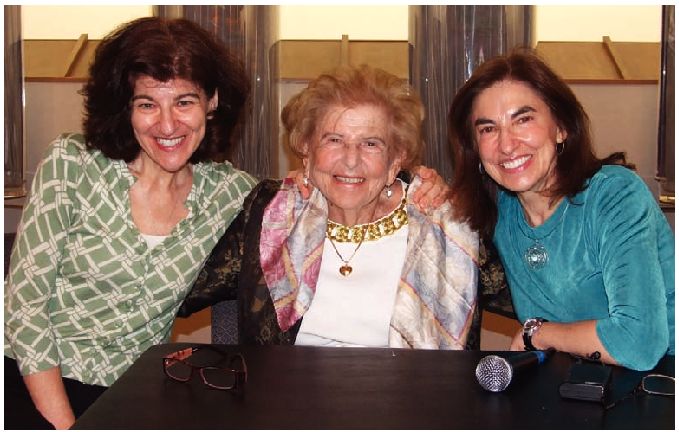
Julie, Lily and Suzanne Salamon

The sisters recently teamed up in Boston for the Hadassah-sponsored program, “Health Care from the Inside Out: Two Sisters, Two Perspectives.” Both women have collective wisdom and extended experience on the subject – Suzanne, as associate chief for clinical geriatrics at Beth Israel Deaconess Medical Center and Julie, as the author of another book, “Hospital: Man, Woman, Birth, Death, Infinity, Plus Red Tape, Bad Behavior, Money, G-d, and Diversity on Steroids.” The “hospital” of the title is Maimonides Medical Center in Brooklyn, where 67 languages are spoken and up to 705 beds are occupied at any time.

It’s clear that the sisters have early and influential memories of the power and the magic of medicine. Their presentation on the current health-care conundrum was as informative as it was compassionate. But it was also their interaction with each other – and their sweet acknowledgement of their mother, who was in the audience – that made their appearance particularly poignant.

The Salamon sisters’ physician father, Alexander (Sanyi) Salamon, had settled the family in Adams County, Ohio, after a difficult and ultimately false start in New York. The only doctor for miles, Sanyi Salamon’s patients revered him. Like many solo practitioners in rural areas, his office was attached to the house.

The sisters told a story that began late one night with a knock on the door of their family’s house. A couple had just received word that their son had died in Vietnam, and the mother was inconsolable. “I always wondered what my father did aside from tranquilizing the woman,” Suzanne said. Their stoic father never talked about his first wife and young daughter who perished in Dachau, but Suzanne wondered if he mentioned them that night to the woman. “As a mother, I looked at that story differently. As a doctor, that story taught me a lot about empathy.”

The year that Julie was at Maimonides, she observed the tension between the bottom line and patient care. “The business of a hospital comes down to people,” she said. “It’s a continuum of experiences from which emerged a lot of discussion of respect, communication or lack thereof. There are competing pressures to secure reimbursement and spend the right amount of time in a system hurrying them.” She added that the moment a patient is admitted to the hospital, the insurance company is forcing the staff to plan the discharge.

With Medicare reimbursements falling far short of actual costs, many geriatric practices are in debt. The 85 and over population is growing, and short visits for patients in their 80s and 90s are ineffective. There are complicated medical histories to sift through and difficult discussions to make about end-of-life issues, such as designating a health-care proxy, when to start palliative care and whether to insert a feeding tube.

“My job is to bring up tough subjects,” Suzanne said. To that end, she never uses euphemisms with her patients, with the exception of characterizing Alzheimer’s as memory loss. “There’s a lot less secrecy today. It’s been years since I’ve been asked to keep a devastating diagnosis from a patient,” she noted.

I looked around at the mostly senior audience and wondered how many of them had healthcare proxies? How many of them have been willing to hand over power of attorney to an adult child? I thought about the 15-year battle my sister and I recently won with our mother to help her legally with her financial issues and health challenges. Did my tablemates more easily accept help from their adult children?

At Maimonides, Julie observed a patient’s room transformed into a sacred space when the subject was end-of-life issues. Stereotypes about doctors and patients fell away as real people emerged. “Finding moments of grace can be difficult,” Julie said. “But part of what you give to your patients is your humanity,” Suzanne added.

The elder Salamons’ grace and humanity remained intact after Dachau and Auschwitz. And those tributes are in full bloom in their daughters: Suzanne Salamon, the doctor and Julie Salamon, the writer.

When Women Were Birds: Fifty-Four Variations on Voice: A Memoir by Terry Tempest Williams

Terry Tempest Williams’s new memoir begins with this stark, bleached declaration: “I am fifty-four years old, the age my mother was when she died.” The mother had bequeathed to the daughter six journals that all turned out to be blank. Not a shadow of a word on any of those pages — pages that Williams describes as “paper tombstones.” Pages that also signal an act of defiance in Mormon culture where “women are expected to do two things: keep a journal and bear children. Both gestures are a participatory bow to the past and future.”

This poetic memoir continues the work Williams, a naturalist and Utah writer, began in “Refuge: An Unnatural History of Family and Place,’’ which interweaved the story of her mother’s unsuccessful battle with cancer with a record-shattering rise of the Great Salt Lake and its destructive effect on a nearby bird refuge.

In “When Women Were Birds: Fifty-four Variations on Voice,’’ Williams explores her mother’s identity — woman, wife, mother, and Mormon — as she continues to honor her memory along with that of the string of women in her family who were stricken by breast cancer. In its 54 sections, one for each year of Williams’s and her mother’s lives, she recounts tales from her mother’s life and from her own in a lyrical and elliptical meditation on women, nature, family, and history.

It’s tempting to think of her mother’s legacy, the untouched journals, as tabulae rasae, blank slates. But Williams brings the literal translation of the Latin phrase to the forefront by inferring that her mother’s unwritten journals are erased slates — there are traces of feelings and dreams and wishes emphasized by William’s italics and capitalization of the word journal. “My Mother’s Journals are words wafting above the page.’’

Williams’s writing pays careful, crisp homage to her family who are “loyal citizens known as ‘downwinders’ ” — people who lived down wind of the Nevada nuclear test site, thus exposed to the radiation that resulted in her mother’s cancer. A year after her mother’s death in 1987, Williams protested at the site where atomic bombs were still being detonated in the desert. Her act of civil disobedience parallels her mother’s subversive act of leaving blank pages behind. The silences, the truths of women’s lives carry the power of an atom, she suggests. Williams quotes the poet Muriel Rukeyser’s famous lines: “What would happen if one woman told the truth about her life? The world would split open.”

Williams traces the personal and artistic influences in her life. “My Mother’s Journals are a creation myth,” declares Williams. Diane Tempest’s empty diaries inspire her daughter to metaphorically fill them with a creation story of her own voice. Her mother’s blank pages offer wide-open spaces for an “unruly imagination” — an imagination that continuously invents stories and shapes memory. She considers her mother’s originality and the work of artists like John Cage and Gustave Courbet and activists like Wangari Maathai. Blank pages beckon Williams to reflect on her life as a daughter, a wife, an activist, and a teacher.

Toward the end of her memoir, Williams makes an exhaustive list of wondrous, exciting possibilities for the blank pages that include clean sheets, white flags of surrender, a white tablecloth not yet set, a scrim, a stage, reviews never written.

The blank pages of Diane Tempest’s journals are full of tacit praise and gleaming admiration for her daughter’s literary gifts — gifts that Williams further understands when she opens her mother’s journals and reads “emptiness, [that] translated to longing, that same hunger and thirst, Mother translated to me. I will rewrite this story, create my own story on the pages of my mother’s journals.”

And so she has written her story, her mother’s story, the story of her clan of one-breasted women by triumphing over the empty page every day.

This review was published in the April 12, 2012 edition of the Boston Globe

The Weight Watcher

This month’s issue of Vogue features an essay by a mother who put her 6- year-old daughter on a Weight Watchers-style diet. My first reaction was: The Horror. The Horror. But not for the reasons you think.

I could easily make the same gaffe; I write about my children almost every week. But I read them every column in which they appear. In keeping with our agreement, I’ve killed a few columns at their request. Forbidden topics with regard to my children include dating, puberty and grades. Oh, and weight was never on the table.

Before judging Dara-Lynn Weiss even more harshly, I read her bad mommy confessional. It begins with Weiss firmly telling a well-meaning friend that her daughter Bea has already eaten her quota of the day’s calories, and she can’t have the Salad Niçoise the woman offers. Did I mention that Bea is still hungry? That she’s always hungry on her diet. But Bea’s pediatrician became concerned when Bea landed in the 99th percentile for weight. What looked like baby fat to her mother was clinically considered obesity.

Bea’s weight was not just about aesthetics for her mother. Weiss cites some very real and sobering statistics about childhood obesity. Overweight kids are courting high blood pressure, high cholesterol and Type 2 diabetes. There’s also the emotional fallout of looking and feeling different than your peers that leads to low self-esteem and depression. Weiss took her daughter to a reputable doctor who designed an age-appropriate diet. That doctor has since then, corrected Weiss’s rigid portrayal and execution of “the green light red light” diet. I’m sure the doctor never intended for Weiss to hold up her hand like a cop and forbid Bea to eat anything that wasn’t on the diet. But like all parents, Weiss got frustrated. Bea felt deprived. Sometimes Weiss would scream at her daughter to stop eating so much junk. Who am I to judge? As Weiss points out, “Everyone supports the mission, but no one seems to approve of my methods.” I get it. After all, I’m the woman who left her daughter at the side of the road because I was so frazzled and fedup with her one night. But my daughter is almost 18, and Bea just turned 7. And my daughter approved that column. She even thought it was funny and shared it with her friends.

And yet amid the negative attention, Weiss makes some good points. For example, if Bea “attempted to walk through the door of [her school] with an almond in her pocket, she’d practically be swarmed by a SWAT team. But who is protecting the obese kids when 350- calorie cupcakes are handed out to the entire class on every kid’s birthday?”

I came back to some of Weiss’ points when I read an alarming article in The New York Times Magazine about “precious puberty” in which our girls are maturing at earlier ages. There are myriad contributing factors, with environmental ones high on the list. For a time, I ran my own quirky branch of the Environmental Protection Agency, purging plastic water bottles and containers, getting hysterical about pesticides and scouring Whole Foods for kosher organic chicken.

Weight was once considered to be one of the causes of precocious puberty. Pediatric endocrinologists believed in the critical-weight theory of puberty –once a girl’s body reaches a certain mass, then puberty begins. But that theory has recently shifted to something called the critical-fat theory of puberty. The idea is that fat tissue, not weight itself, sets off early maturity. More specifically, girls who are overweight have higher levels of a hormone called leptin, which can lead to early puberty. Leptin sets off a cycle that can elevate estrogen levels and affect insulin resistance, causing girls to have more fat tissue.

There’s also that vague bubble of stress floating over a girl’s life. The de rigueur research on the subject points to the salutary affects of growing up in a two-parent household. I’m also fascinated by evolutionary biology and the assertion that reproducing earlier is the result of a stressful childhood – the body’s default response to coping with a difficult life.

Evolutionary psychology aside, our girls’ bodies and psyches are so complicated, so vulnerable. There’s always low selfesteem and negative body image lurking in the background, waiting to pounce. How can parents protect their daughters?

The snarky answer is not to write about a child’s struggles with weight in a national magazine. But Weiss’ article is the exception rather than the rule. Among the best advice that I’ve read on the subject of blooming early, applies to raising girls in general. Focus on your daughter’s physical and emotional health, rather than playing food cop or attempting to slow her development. Treat your daughters appropriately for the age they are, not the age they look or want to be.

While it may seem obvious, be patient and give your daughter a heavy dose of perspective. And please, please respect her privacy. By the way, Bea lost 16 pounds and grew two inches in a year. Not that that’s anybody’s business.

Better Living Through Chemistry: My Happiness Project

Color me jaded, but when I first came across The Happiness Project by Gretchen Rubin it sounded kitschy to me. Nevertheless, a couple of years ago I was curious enough to follow Rubin’s Facebook postings, most of which exhorted me to work on my happiness every day. A simple attitude adjustment, like telling yourself that you were happy, was the first step towards true contentment. Not really convinced, but I kept on keeping on.

I tried to lighten up for a time and absorb some of Rubin’s tips for chasing away the blues by picturing a new landscape, or taking in the following advice for combating boredom:

Take the perspective of a journalist or scientist. Really study what’s around you. What are people wearing, what do the interiors of buildings look like, what noises do you hear? If you bring your analytical powers to bear, you can make almost anything interesting. (Perhaps this is a key to the success of some modern art.)

No can do. I don’t have the patience. And Rubin’s subtitle serves as a telling abridgement— Or, Why I Spent a Year Trying to Sing in the Morning, Clean My Closets, Fight Right, Read Aristotle, and Generally Have More Fun. I have to say, none of things sound like fun to me.

The Happiness Project was born on a cross-town bus ride in Manhattan when Rubin was in a funk. Then it hit her: she was going through the motions of living rather than actually living. It seems like a deceptively simple epiphany. But step back, take a deep breath, turn off the internal chatter running through your brain, and take in your surroundings. Fully live in the moment. Not so easy when a child is not doing well in school or an aging parent is losing her memory.

Let me tell you about my own complicated happiness story. I’ll begin at the end. A few weeks ago I was driving the daily loop that encompasses the 15 miles between my children’s schools. Quite suddenly it hit me that I was happy. Not a euphoric kind of happiness, but simmering contentment instead of an acid angst dwelling in the proverbial pit in my stomach.

Not so remarkable until I tell you what happened to me a decade ago. Yes, I have two great kids.  I have a loving husband whom I adore. There is a mortgage on our lovely home, a Volvo in our driveway. And then the life that I carefully built with Ken came apart for no apparent reason. In layperson’s parlance I had a nervous breakdown. My depression and panic were off the charts. I’d been through this many times, but over the years I’d always managed to climb out of the pit.

This time it was different. The psychological pain wasn’t going away. I began going to weekly psychiatric appointments with Dr. G. For two months I debated, mostly with myself during those sessions, about signing on for an anti-depressant. One day Dr. G asked me if I would take insulin if I had diabetes. When I said that I would, he followed up with another question. Would I take medication to correct a serotonin imbalance? And so my personal happiness project began.

At first I grudgingly took the medication to function. The stigma be damned! Then I gladly took the medication to have a better life. So what if I traded twenty pounds for my happiness, and yes, my sanity. I got the better end of that bargain. Underlying my decision to fill that Prozac prescription was an obligation to do everything I could to be the best for my family. Anti-depressants are not a cure-all, but in conjunction with counseling they have worked wonders for me. That said; please don’t try this at home. Self-medication is dangerous and sometimes deadly.

I share my story to tell you that depression and anxiety can happen to anyone at any time. I share my story to tell you that working out at the gym or reading up on tips to boost your happiness can’t wholly address serious medical conditions like depression and panic disorder. Mostly, I’ve decided to go public to tell you that there is medicine and therapy and, yes, love out there.

Gretchen Rubin’s book is a fun guide to de-cluttering or cleaning out your closets But there’s nothing wrong with you if a best-selling paperback, meant to provide organizing tips leavened with a little perspective, does not lead you to your personal nirvana. I don’t care how many copies of The Happiness Project have been sold. It’s not a guide to expansive living, the Physician’s Desk Reference or a cure-all. And by the way, I’m much happier since I “unfriended” Gretchen Rubin on Facebook.


Just Love Them: Mayim Bialik and Attachment Parenting by Judy Bolton-Fasman

In all the years that I’ve been writing and thinking about kids and parenting, the best piece of advice I got was from my dear, late father in-law, Dennis. We had just brought Anna home from the hospital, and I was panicked. How in the world was I going to raise this tiny, vulnerable girl to womanhood? “Just love her,” Dennis said. “The rest will fall into place.”

Anna is almost a legal adult. Adam is not too far behind. For these past 18 years, I’ve just loved them.

Parents in various cultures bring up their children in distinctive ways. My Connecticut grandma and Cuban abuela had very different ideas about caring for an infant. Grandma thought that I shouldn’t be held too much and that I should “cry it out” until I fell asleep from exhaustion. Abuela wanted to hold me day and night, feed me on demand and let me nap in her arms. But for all the different ways we care for our children, many of us can relate to some of the values of “attachment parenting.”

Mayim Bialik, the actress and scientist, is a passionate advocate of attachment parenting in her new book, Beyond the Sling. You may remember Bialik from the movie “Beaches,” in which she played the Bette Middler character as a child. Bialik went on to star in her own television show, “Blossom,” in the ’90s and now appears in the sitcom, “The Big Bang Theory.”

Bialik – who studied Hebrew and Judaism and pursued a doctorate in neuroscience – cites eight basics for attachment parenting:

• Natural childbirth

• Exclusively feeding a baby breast milk

• Taking the time to formulate sensitive and thoughtful responses to your children

• Bonding through touch

• Co-sleeping

• Consistent parenting by a primary caregiver

• Gentle positive discipline, which means no corporal punishment

• Balancing your needs with those of your child

Bialik comes across as a supportive, informative friend, but that doesn’t dilute her fervency. For example, she’s an unequivocal proponent of natural childbirth. However, a drug-free delivery or a home birth is not an option for everyone. Sometimes there are complications like preeclampsia or gestational diabetes, both of which I had. My water also broke six weeks before Adam’s due date. Bialik considers extenuating circumstances, acknowledging that what worked for her and her family may not be safest or right for another family.

Much has been written about the salutary effects of breastfeeding for mother and child. Bialik anticipates the health and psychological challenges of nursing a baby. She acknowledges that there can be obstacles, but her message is to keep trying to do the best you can. I think she’s on target with that advice.

Sensitive and thoughtful responses to your children may seem obvious in parenting. Getting into that mindset connects with gentle and positive parenting. No hitting. No excuses. The one exception in my experience was the time a 2- year old Anna ran into the street, and I patted her bottom with some force. (I did not spank her). She was surprised, but not in any pain. What did hurt were her feelings. Afterward, she remembered not to approach the street without an adult.

But raise your hand if encouraging your children has sometimes crossed into pressuring them. I’ll raise two hands. And I’ll give you a textbook example of a mistake that I recently made. Adam came home last week with a nice report card. But I couldn’t leave well-enough alone. I suggested that maybe next term he could turn a couple of those B pluses into A’s. At first glance, it seems as if I took Adam’s hard work for granted. What I really did was to take my son for granted, and that was just plain wrong. Bonding through touch has always been a big issue for me. In my mind it links up to co-sleeping, which Ken wasn’t thrilled about when our children were babies. Our kids squirmed and kicked a lot. Nevertheless, I undid all of his scheduling and behavior modification around sleep when he was on business trips.

There are also controversial assertions in Beyond the Sling. For example, Bialik and her husband chose not to have their children vaccinated – a subject that has been addressed by others with much greater knowledge than I. She notes that her two young sons have never been on an antibiotic. Instead she pays careful attention to her sons’ body cues and manages their health accordingly. While her children’s well-being is a blessing, we all know that at times children need serious medical intervention. Bialik, the neuroscientist, points out that thousands of years of evolution have hardwired us to protect and raise our children. She emphasizes that a parent’s intuition is the first and best line of defense in childrearing. She also captures the bittersweet arc of a child gradually moving from dependence to independence.

Time with small children is fleeting. Just love them. That’s the charming, enduring subtext of Beyond the Sling.

Longing for Home in the Middle East: Anthony Shadid’s House of Stone

My Dear Children:

I just read a memoir in which one of the many things I learned was that the Arabic word for house – bayt – is achingly close to the one in Hebrew – bayit. The book is called “House of Stone: A Memoir of Home, Family, and a Lost Middle East,” by Anthony Shadid.

Like me, Shadid grew up in two languages, with two translations of the world around us. He was a Lebanese American whose Arabic was as proficient as my Spanish. As it was for me with Spanish, the more time he spent immersed in Arabic – particularly in Lebanon – the more the words came back to him until he was practically fluent again.

Sadly, Mr. Shadid died last month covering the conflict in Syria for The New York Times. He succumbed to an asthma attack. He was only 43. Not only did he leave behind a body of sterling Pulitzer-prize-winning journalism, he also left his completed memoir of renovating his great-grandfather’s home in Marjayoun, a small town nestled in the hills of southern Lebanon. Renovate is not quite the right word for Shadid’s project. Renovate is what we did to our kitchen. But Shadid didn’t exactly rebuild the house, either. He writes that there was meaning and “an elegance of movement as the house hurtled towards its end and a new beginning.”

Anthony Shadid with his son in front of his great-grandfather's house in Lebanon

A house of stone is strong and proud. Its very material is “the yeast of the earth.” You can make the case that he restored the house to its original Levantine glory. But he did more than that: He wanted to live in this house as a way to reclaim his history while breathing new life into it.

The house had marble stairs buffed until they actually reflected the emotions of the occupants. Marble evokes elegance, antiquity, history. Did you know that your grandmother’s house in Cuba had marble stairs, too?

I remember her telling me how she scrubbed those floors until she saw her face mirrored back. Houses can be so intimate, so personal, so bound-up in identity.

When Shadid looked across the valley from his great-grandfather Isber Samara’s balcony, he crossed decades to make sense of the life that came before and after his sepia-photographed ancestor. Shadid was searching for those elusive sparks that illuminate both purpose and fate in short, intense bursts of insight.

Like your own ancestors from Greece and Turkey, the Ukraine and Poland, Isber had set his sights on America for his family. He sent his children, but never emigrated himself. Isber’s children settled in Texas and Oklahoma. The family worked together peddling, and then opened a dry goods store. Did you know that you had a great-great uncle who settled for a time in Galveston, Texas, running a small grocery store in the early 1900s?

Like Shadid, I have a love-hate relationship with the Diaspora, too. When your relatives have lived in four countries in just two generations, you begin to wonder if your family is “forever doomed to departures.” Where exactly is home anyway?

Shadid literally italicizes his family history. Paragraphs like that usually distract me. But trust me, these extended passages are well worth the time. Isber Samara lived and prospered in the Ottoman Empire, as did your great-grandfather’s family. My people, your people, lived in Ankara. They made their money in silver, and they educated their boys to become Torah scholars.

History was as continuous and borders were as seamless for my grandfather, Jacobo Alboukrek, as they were for Isber Samara. But the Ottoman Empire crumbled and crushed Jacobo’s family. Their Armenian friends and neighbors were disappearing. The Jews were afraid they were next. Some of them joined relatives already settled in Cuba. The rest of the family settled in Palestine.

Shadid longs for the open borders of the Ottoman Empire. Borders that enhanced the beauty and culture of Lebanon. He sees the memory come to life in the tiles that he picks for his home in Marjayoun. The tiles are called cementos, and Shadid goes to a store in Beirut to buy them from the Maalouf Trading Company. Doesn’t that sound like a name right out of Lawrence of Arabia?

Shadid takes time to describe both the artistry of these tiles and the history they awaken in him. For him, these decorative tiles in geometrics and floral, accented in purples and greens and yellows, remind him of “borders that were still for a time, crossable.”

For now, let’s leave politics alone. For the most part, Shadid does. “The Levant is no more,” he writes, “but I had been reminded – by the grace of the triple arches, the dignity and pride of the maalimeen [artisans who worked on the house], and … Isber’s sorrow and sacrifice – that behind the politics, there were prayers still being said with hope for what draws us together.”

Focus on that hope. Focus on the humanity that draws us together. Focus on the similarities between bayt and bayit. For in the end, they mean the same thing.

Love, Mom

Beren Academy Boys’ Basketball Team Forfeits Game for Shabbat by Judy Bolton-Fasman

I get the feeling that the Board members of the Texas Association of Private and Parochial Schools—TAPPS—don’t meet a lot of people who are different then they are. Apparently, it’s impossible for those folks to understand that not everyone celebrates the Sabbath on a Sunday. Enter the Robert M. Beren Academy Boys’ Varsity Basketball—known as the Stars—to shake up the TAPPS Board’s world.

Perhaps it’s the first time that anyone at TAPPS has seen that serious athletes can also be observant Jews. Beren’s players tear up a court with their yamulkas pinned firmly in place. And for the first time in its 42-year history, this Modern Orthodox day school in Houston has made it to the play-offs in their division. Imagine the boys’ excitement when they realized they would be going to the semifinals in Dallas this weekend. Imagine their disappointment when they realized that their playoff game in Dallas was scheduled for 9PM on March 2, Friday night—erev Shabbat. Imagine their heartbreak when their appeal to TAPPS to move the game start time to earlier in the afternoon was unilaterally denied.

Yes, unilaterally denied. TAPPS acted alone when its Board decided to sideline Beren Academy. According to Beren Academy’s head of school, Rabbi Harry Sinoff, the heads of school of the opposing teams had no objection to accommodating the Stars. In fact, just the week before, Beren moved their quarterfinals game against a local Catholic high school to 2pm on a Friday afternoon. Our Lady of the Hills Catholic High School had no trouble understanding that playing basketball on Shabbat is not an option for the Beren Academy boys.

If there was ever a perfect case for the Anti-Defamation League to broker, this was it. The director of ADL’s Southwest’s regional office in Houston wrote a letter to Edd Burleson, TAPPS’ director, which read in part:

Many of the private and parochial schools that are TAPPS members are faith-based institutions where religion is their guiding principal. As such, it is incumbent upon TAPPS to ensure that its members do not have to choose between observing their religious holy days and competing in championship activities. By asking a member school to participate on their Sabbath day, TAPPS will send the message to the Beren Academy team and all other teams whose faith prohibits Sabbath activities, that their religious principles are not valued and that they are not equal members of the TAPPS family.

But the hard truth is that at best TAPPS is sending mixed signals about religious observance and sportsmanship. In 2010, the Association accommodated the Arlington Burton Adventist Academy whose students also observe the Sabbath from Friday sundown to Saturday sunset. The Seventh Day Adventist school had reached the soccer finals in its division and, with TAPPS’ approval, secured a location to play its soccer game after the Sabbath.

When I spoke to Burleson on the phone he said that the logistics for the Seventh Day Adventists’ participation in the soccer finals was simpler, involving only four schools. Logistics? This isn’t a military operation—it’s a high school basketball game. Burleson explained that, “In that case the one school that observed the Sabbath and their opponents were adamant that all of the qualifying teams play.” Okay, so where is Our Lady of the Hills this week? The Stars team has been forced to forfeit Friday night’s upcoming game and the Catholic high school will be taking Beren’s place.

Burleson went on to qualify the Arlington Burton decision. “The [TAPPS] Board made an exception when it allowed [Arlington Burton] to play. Afterwards the Board felt that they had made a mistake and they do not want to make the same mistake again.” Of course they don’t. Who wants to repeat an act of grace and empathy more than once?

This is not the first time that Sabbath observance has been an issue for a Jewish day school. In my backyard, the Modern Orthodox Maimonides School in Brookline faced a similar conflict in 2009 when the school’s mock trial club had reached the national championships in Atlanta. The competition’s organizers initially refused to change the Saturday date, but the school enlisted the help of the Justice Department and two days before the competition, the mock trial organization allowed Maimonides to schedule its appearance on Thursday.

“I’ve been bombarded with hate mail over this issue,” Burleson said. He sounded a bit incredulous. While it’s not right that Burleson has been the target of some folks’ frustration and venom over the incident, it’s not surprising that intolerance and ignorance lead to unpleasant things like hate mail.

Rabbi Sinoff wisely put the TAPPS fiasco in perspective. “Even though the start times for this weekend’s tournament in Dallas haven’t been changed, we’ll still celebrate Shabbat like we always have.”

Amen and Shabbat Shalom.

The Other Wes Moore: One Name Two Fates by Judy Bolton-Fasman


Lately, I’ve been thinking a lot about Wes Moore’s memoir, The Other Wes Moore: One Name, Two Fates. If Moore’s memoir had not actually happened, it would be a neat parable of two radically different lives that originated at the same starting point.

But this is not a There but for the Grace of God Go I story. Moore’s story may appear to be the very embodiment of the symbiotic relationship between fate and choice. But really this is a story about locating and then tapping into free will to beat the odds.

Here’s the book’s stark premise: Around the time that the author Wes Moore became Johns Hopkins University’s first Rhodes Scholar in 13 years and the university’s first-ever African-American Rhodes scholar, another Wes Moore—a contemporary—was wanted for the murder of a police officer in an armed robbery for which he would eventually go to jail for life. That was 2000.

“One of us is free and has experienced things that he never even knew to dream about as a kid,” the author Wes Moore writes in his memoir. “The other will spend every day until his death behind bars. … The chilling truth is that his story could have been mine. The tragedy is that my story could have been his.”

The two men grew up in the same tough West Baltimore neighborhood, but irony does not hang over this book like a dark cloud. Wes Moore, the author, went to Oxford, was a decorated war hero who served in Afghanistan and was a White House Fellow. And yes, the other Wes Moore is serving a life sentence without parole and became a grandfather at the age of 33. Two paths began at the same point, but diverged. The road taken, the road not taken—each of them men spent time on both roads.

The Wes Moores converge on the same destination. Through prison visits and letters, the two Moores bared their souls to one another and laid out their lives side by side. Poverty was both the level playing field and the catalyst that propelled these two men in opposite directions. Both of them grew up without their fathers—author Wes’ father died when he was four, prisoner Wes never met his father. Both were grief stricken. But one mourns the death of a loving father, while the other seethes over his absent one.

The author’s mother was a teacher who kept careful track of her son’s growing apathy toward school and attraction to life on the streets. She moved her family to the Bronx when Wes was a young teenager to be near loving grandparents at the ready to help Wes and his sisters. Wes won a scholarship to Riverdale Country Day School, but he couldn’t connect to his rich white classmates. He missed school and failed most of his classes.

The Rhodes Scholar Wes Moore had a mother who never gave up on him. She bought her son Mitch Albom’s book about a Michigan basketball team, and his spark for reading caught on fire. She scraped together tuition money to send him to a military school in Pennsylvania where he thrived and became one of the youngest officers in the history of the school. The other Wes Moore’s mother did her best to protect Wes from the streets. She did that and more while trying to make rent and put food on the table. It’s heartbreaking that when someone bothered to teach the other Wes Moore to read, he soared up to college level.

There were other aching near misses in the other Wes Moore’s life. His mother enrolled at Johns Hopkins in the early 80s, determined to get an education that would have propelled her into the middle class. Government cuts abruptly ended her college career. Wes himself went through a year-long Job Corps program, earning high scores on his GED and training as a carpenter. But there was no job to be had afterwards, and the money to be made on the streets was too tempting.

You may be thinking “The Other Wes Moore” sounds like a fascinating story—an important call to arms to reform society—even offering a comprehensive appendix of resources at the end of the book to help at-risk youth. You may also wonder if these men’s stories have resonance for a reader beyond the book.

I lived in Baltimore for five years during the 90s. My husband worked at Johns Hopkins Medical School in rough, jagged West Baltimore. When I drove through those streets, I was always overwhelmed by the stories I didn’t know. And I’d think about one of my favorite quotes from Rabbi Hillel of the Talmud: If I am not for myself, who will be for me? If I am not for others, what am I? And if not now, when?


Le Bébé et le Gun-Toting Père: Pamela Druckerman Meet Tommy Jordan by Judy Bolton-Fasman

It seems the French do so many things better than Americans. The cooking is superior. Chicken nuggets? Non! The women are skinnier even though they eat their weight in cheese annually. And now we find out that the French are more successful parents. At least according to Pamela Druckerman, an American journalist who lives in Paris with her husband and three children. She details her anecdotal findings in her new book, “Bringing up Bébé: One American Mother Discovers the Wisdom of French Parenting.”

The book is a breezy cross between parenting manual and personal memoir. The takeaway is that French parents don’t sweat the small stuff and their kids are better adjusted for it. For example, I was impressed that French babies “do their nights” far earlier than their American counterparts, sleeping through the night on average at six weeks old. I guess French babies don’t get “le colic.”

French parents’ success continues by cultivating patience in their children. From the beginning, French children are taught to tolerate frustration whether it be discovering ways to amuse themselves or waiting until a parent finishes a phone call. The French are also visibly less child-centric. Play kitchens and matchbox cars don’t take over a living room in Paris. At least not the ones Druckerman has seen.

About halfway through Druckerman’s book, it suddenly hit me that she should meet Tommy Jordan. He’s the guy who tried to teach his very American teenager a lesson by shooting up her laptop. Furthermore, he videotaped his serious lapse in judgment for the world to see. It wasn’t so much the shooting that scared me (although that was very disconcerting), but it was Jordan’s eerie calmness on camera – a saccharine-like calm studded with emotional landmines that could go off at any moment.

The catalyst for this brouhaha was daughter Hannah’s rude Facebook post in which she bitterly complained about her chore-laden life. Laced with adjectives unfit to print here, Hannah was sick of cleaning up after her siblings and making coffee for her parents. As she points out, her family has a cleaning lady and her name is Maria, not Hannah.

Jordan was also miffed that the day before he read Hannah’s post he had put time and money into fixing his daughter’s laptop, for which she didn’t offer a single word of appreciation. The man clearly was pushed to the brink. What else could he do, but shoot his kid’s laptop at point blank range nine times? I don’t know what 18 million-plus viewers felt when they watched the gratuitous shoot up on YouTube, but I couldn’t shake the feeling that I was witnessing a crime.

If my daughter had written a churlish screed like Hannah’s, I’d be pretty angry, too. By the way, someone should tell Hannah that emptying the dishwasher and making the bed does not qualify as indentured servitude. But here’s where Pamela Druckerman could be useful to Tommy Jordan. First, it’s helpful that they have some cultural commonalities. I don’t think his cigarette smoking would put her off. Everyone smokes in Europe. (I can generalize too, Ms. Druckerman.) And they both like hats. Druckerman appeared on the Today show wearing a beret to emphasize the oh-so-Frenchness of her book. As for Jordan, he sports a ten-gallon hat.

My guess is that mistakes were made with Hannah from the beginning. She probably didn’t do her nights until she was at least 1 – embarrassingly late for a French child not to be sleeping through the night. She was probably never told to be sage. (In French, the word sage rhymes with Taj). Druckerman explains that when French parents urge their children to be sage, they are telling them much more than just to be good. They are exhorting their children to use their discreet judgment and to be in control of their emotions. For example, if Jordan had told his daughter to be sage early and often, she might not have impulsively posted that letter on Facebook.

As for Hannah’s appalling language, the French have solved that problem, too. Preschoolers have their own swear words. That’s right, there’s a lightly scatological phrase particular to kids that allows them to use naughty language in a controlled (there’s that word again) and, albeit, civilized way. I’m sure Jordan would not have minded Hannah’s foul language nearly as much if she were using parent-sanctioned epithets. Hannah’s overall rudeness might have been considerably less offensive if she were taught at a very early age to look an adult in the eye and politely greet them. “Hello” and “goodbye” in France get top billing with “please” and “thank you.” (I’m with the French on that one). Yes Hannah, that means that Maria the cleaning lady must be properly greeted and seen off.

As I think about it, maybe Druckerman should first use French parenting techniques on Tommy Jordan. After all, he acted like the more petulant child.

Out of the Pink — The Color of Breast Cancer by Judy Bolton-Fasman

It’s time to give pink back to little girls and boys. The truth is that breast cancer—any cancer—is a hot angry bloody red, undiluted by white.

Last year my younger sister was treated for breast cancer. The cancer’s progression was caught early, but because of her relatively young age the protocol was horrific. I hope and pray for the day when the medical community will look back on these bald, brutal days—days when a mane of hair is gone and eyelashes fall away—as completely unnecessary. Every day of my sister’s treatment, she’d tell me through sharp, stinging tears how much she wanted to live. And through my own tears, I would tell her that I was certain she would.

Breast cancer is a muddied swirl of dark fear mixed in with light hope. When did pink intrude as the emblematic color of fighting for survival?

Pink is the color of the shag carpeting in the bedroom I once shared with my sister. It was a small room with just enough space for two twin beds and matching dressers. We’d frequently engage in sibling rivalry by running masking tape down the middle of the room.

When my sister had the chicken pox, I thought, at 11-years old, that my sticky border would establish a boundary that kept me safe from the disease. It didn’t. I was blotchy and itchy two weeks later. That was the beginning of the end of magical thinking for me. Now in this gritty, very unpink world of ours, I’m impatient. Hurry up, I shout to someone, anyone with a hospital research lab, and find the definitive cure for all cancers.

Pink is the color of the flowers that mysteriously bloomed alongside our driveway. Every spring my sister and I, in matching outfits, were posed in front of those floppy flowers whose name I still don’t know. Back then it was unimaginable to us that someday we’d be older than our parents when the picture was snapped. As for breast cancer, it only happened in the distance of long generations, to our grandmothers.

Breast cancer was once the odd flesh color of a grandmother’s prosthetic breast. The rubber breast was built into her bra and my grandmother was forever adjusting herself. Grandma was diagnosed and treated for her breast cancer in the 1950s. My grandmother never said a word to me about her bout with breast cancer. My aunt told me about the mastectomy when I was a teenager.

When the buzz cut was over my sister was startled that our late father looked back at her in the mirror. Genetics can be shocking. And there wasn’t a note of pink when her steel gray wisps grew back like young shoots.

Breast cancer can lurk in the intense blank white margins where I’ve scribbled my mad notes about the disease. But cancer margins need to be wide and clear. After the lumpectomy my sister had a second surgery to broaden that protective border of symbolic white space. No masking tape this time.

When my sister told me that her lymph nodes were clean, I was struck by how filthy cancer is.

Pink is a color. Breast cancer is a disease. It’s time to stop confusing the two and return the color pink to little girls and boys.