Goodbye 1735 Asylum Avenue

If you have travelled the stretch of Interstate 84 through Hartford, Connecticut, you might have done a double take when you saw an exit for Asylum Street. I grew up about three miles up the road from that exit where the street unfurls into a suburban avenue.

My ancestral address, 1735 Asylum Avenue, is rich with symbolism and irony. But there is something subtler at work here—something beyond connotations of political or insane asylums. A quirky address like 1735 Asylum befit a kid like me—preternaturally grown-up at six—who emerged out of the rubble created by the collision between my father’s mid-twentieth century American patriotism and the fire-breathing communists in Cuba from which my mother fled.

We settled at 1735 Asylum Avenue in 1963—on my third birthday—into a house whose chief merit was that it sat on a main bus line for my mother—a life-long non-driver. If we couldn’t get from here to there via the Asylum Avenue bus, we didn’t go. More than mastering the transit system, my mother charmed the bus drivers; we always had door-to-door service at 1735.

I know that this former address of mine sounds like a cross between the historical and the unbalanced. But Hartfordites understand that the address was neither—this street was the original location of the American Asylum for the Deaf and Dumb, built in 1817, a precursor to the American School for the Deaf in West Hartford.

The original asylum was a gift of love and devotion from Mason Fitch Cogswell to his brilliant deaf and mute daughter Alice. Take Exit 48 of Asylum Street notoriety and you will almost immediately see a bronze statue of Alice Cogswell that sits at a fork in the road in which Asylum Avenue is to the right and Farmington Avenue is to the left.

Alice looks to be about eight years-old when her likeness was cast in bronze, the same age I was when I began to notice her. Two enormous cupped hands tenderly hold Alice, and she clutches a book to show everyone that dumb means mute, not stupid. As an adult I learned that the hands in which she stands—perfectly manicured hands that resembled my father’s—form the word “light” in sign language.

In many ways, now that I know this detail about those giant hands it make sense that Alice was such an illuminating landmark for me. She not only marked my comings and goings on the Asylum Avenue bus with my mother to and from Downtown Hartford, she marked the beginning and end of Sunday drives to my Bolton grandparents in New Haven. The forty mile trek felt interminable to me. But Alice was a touchstone. She limned crucial beginnings and endings in my childhood.

alicecogswell

Alice’s statue also stood near the stretch of Asylum Avenue where the houses were monied and pretty. On the bus ride west to 1735 Asylum, the Queen Anne homes closest to Alice gave way to larger brick homes that ended at Steele Road, the dividing line of wealth. West of Steele Road were boxy colonials and heavily mortgaged roofs; 1735 Asylum—a three bedroom colonial—among them. The house would be the only property my parents would ever own.

1735Asylum,JPG

When my parents and I moved into 1735, I was still an only child. Beige was everywhere you looked, except for the yellow straw wallpaper in the dining room and the deep lipstick-red shellac inside the kitchen cabinets. The previous owner’s neutrality was at odds with the passion and emotion that now rattled the house. My mother eventually redecorated the hallways, and the dining and living rooms in shades of green—the color of her pretty, translucent eyes.

Last week my sister, brother and I said goodbye to 1735 Asylum Avenue. The house was sold to a contractor who will take it down to its studs and rebuild it into something unrecognizable to us. But the truth of the matter is that these past couple of decades, 1735 Asylum was not the house in which we grew up. Like its proud matriarch, it had declined. Not beyond recognition, but to something else—a memory tinged by inevitable age and benign neglect.

When we were done cleaning out 1735, my sister Carol and I took pictures in front of the house, smiling the smiles of the brave, the weary and the sad. We walked through the rooms slowly, mournfully, as if following some sort of casket. “Do you mind if I say a Kaddish for the house,” I asked Carol.

She told me to say goodbye in my own way and in my own time. The Kaddish is a prayer of mourning that does not say a word about death. It’s all about praising God when one feels least inclined to do so. But there was a lot to thank God for even as we emptied our childhood home. On the way out of town I drove the Asylum Avenue bus route so I could say goodbye to my old friend Alice, still stalwart and serene in the hands of God.


*Cancer: A Big Sister’s Story

I don’t know the name of the flowers that mysteriously bloomed alongside the driveway of our childhood home at 1735 Asylum Avenue. But every spring you and I posed for pictures in front of that small, jungley flowerbed. We grew up together in that house. Back then it was unimaginable that someday we would be middle aged and that you would have breast cancer.

Until recently, I was always dying to know the future. Remember when we had a bit of trastienda with Mom? Trastienda, one of those words that intrigued me.

Trastiendathe back room of a store where secrets are exchanged, fortunes told or blackmail delivered.

Remember that weekend in Miami Mom’s relatives when whispered about her spinster daughters. I was twenty-nine, you were twenty-six. We went to a tarot card reader that had hastily set up shop in the back of a beauty salon. The only beauty in the place was the delicate, exquisite cobweb on one of the hair dryers. Consuelo the Fortune Teller didn’t look too pleased about my cards. She said I would write children’s books or teach. I’d also eventually marry a man who already had a child. “Cuando?” Mom screamed. “I had three children at her age.”

Consuelo told you to throw water out the window and scream “vaya, vaya,” a sure-fire way of sending away any love that lingered for the wrong man. Obsessive loving—it’s in our genes like eye color. Mom still pines away for Manuel, an old boyfriend who may or may not have actually existed. We were told that if you followed Consuelo’s instructions, you’d have a husband in no time. It turns out that Consuelo (did you know her name means consolation in Spanish?) mixed up our fortunes.

Even so, a few months ago I convinced you to go hear a spiritual medium with me in a synagogue on the North Shore. You had just had the biopsy and wanted to avoid the future. But I convinced you that I had questions for our dead father and that you’d want to hear his answers.

Surprise, surprise, it was Grandpa Willy who broke through to this world. We were in a large auditorium and there were a cluster of dead Williams hovering near us. The medium—this time young and runway stylish —wore a headset. “Operators are standing by” ran through my mind like a ticker tape. Is God standing by too?

The pretty medium explained that families whose dead have the same first name tend to sit in close proximity at these kinds of events. She heard one of the Williams whisper something about breast cancer. She turned abruptly away from us. “Cancel that. No breast cancer for you.” She was talking to another family with another dead William seated a couple of rows behind us.

I feel that I’ve learned a lesson at your expense. I don’t want to know anything about tea leaves and tarot cards and mediums anymore.

After all these years, you and I still don’t smile much. The first thing the men that we married noticed about us was our lovely, sad faces. We used to laugh, though, when mail came addressed to 1735 Asglum Avenue instead of 1735 Asylum Avenue.

Like the annual appearance of those floppy, pink-red flowers lining the driveway, somehow we also bloomed. When those odd flowers popped open, they looked like the O of your mouth when I made you cry. I never left a mark on you, and when you cried the cry of a hurt little girl, Dad snapped at you for crying crocodile tears again. In case you’re still wondering, crocodiles have lachrymal glands, but they only cry to clean their eyes. A crocodile feels no remorse. I hope it’s not too late to tell you that your tears were not the same as a crocodile’s.

If you were the crybaby then I was the liar. That moniker still follows me like tails on the kites we loved flying on the fields of Saint Joseph College.  Like Scheherazade, I lied to save my life. I taught you that invaluable skill.

I was Mom’s favorite—her Siamese daughter who shared her heart and mind and language, until I wanted my own memories to shape and impress my life.

You were Dad’s pride and joy—the pint-sized fan that screamed, “Roughing the kicker” at Yale football games. This was in sacred service to Dad’s venerated Elis, so that the team could gain an easy ten yards and a first down. No one at the Yale Bowl was more adorable than you. Dad, a solid man of principle and fairness, could only bring himself to give you a pro forma scolding for bad sportsmanship.

On Saturday nights, Dad showed you off to the guests in the living room.

La mas linda della familia.” You were always the prettier one.

I pretended to be asleep in my twin bed when he carried you downstairs. I was Leah to your Rachel—the older, dowdier sister that the Bible described as having “weak eyes.” My eyes were an ordinary brown. But Dad said that yours were as “black as Spanish olives.” You were part and parcel of Dad’s infatuation with all things Spanish. Yet most everyone thought we were twins. Mom dressed us in fancy matching outfits for those spring pictures, while she refused to change out of her housecoat.

Isn’t it weird that the mystery flowers started dying off when Dad began to forget how to get home from the supermarket? I thought those flowers would last forever. Sometimes I tear up when I remember the lawn guys hacking away at the last remnants of our odd little patch of garden.

Chemotherapy has balded you down to the last root of your thick dark hair. Remember how much we loved the song “Gypsies, Tramps and Thieves?” There’s no one who can pull off a headscarf and hoop earrings better than you. The other day I was walking up the stairs in your house and I thought you were sitting in your guest room—your back was to me—and you were wearing the wig. I was surprised because you said the wig was hot and itchy. I was further startled when I called your name and your voice answered me from another direction.

In the 60s Mom’s wearing a wig was as subversive as burning a bra. The wig was her reprieve from constantly teasing and wrapping her long mane of hair that Dad insisted she never cut. I was so scared of Mom’s wig that I couldn’t be alone with it in her bedroom. Turns out, your wig was also displayed on a macabre sculpture—a head with a nose and mouth and eyes as blank as white space.

Mom called her piece of lifeless hair a fall and anchored it to her head with stretchy, colorful headbands. But I liked it best when her hair was pulled up as if she was ready to wear a mantilla. She never had the kind of patience for my knotted hair. Bolones is what she called my clots of hair that she pulled at with a plastic comb.

After your buzz cut you were startled that Dad looked back at you in the mirror. His face was transposed on yours, complete with the same weary and watery eyes. You’re bulldogs the two of you. Dad’s Yale bulldogs that you rooted for too.

When you found the lump lotioning up in the shower, you had no idea this would be the scene of another trastienda. Your fate was sealed when all you wanted was to smell good to meet your favorite and only niece’s boyfriend—my daughter’s first love. I panicked when my baby’s courtship took off. “It’s not the same,” you said. “She has a loving home. If she falls apart she knows you’ll be there to put her back together.” You also said that I would have been as happy as my girl l if I’d had a loving mother. I’d settle for a mother—warts and all—who simply had had good intentions.

Until you had breast cancer, I thought margins only existed on sheets of paper. But margins are also hurdles you had to jump over. As in, your margins needed to be further cleared. After the lumpectomy you had a second surgery to widen what I imagined this time as a protective border of white space. If your numbers were any higher you would have needed a mastectomy.

At your insistence, soon after your diagnosis, I went to an artist’s colony for three weeks. I was 1500 miles away and floating through what I can only describe as a valley shadowed by despair. No treatments were scheduled for you until I returned. The truth is that no course of treatment was decided for a couple of months. The mills of the cancer gods grind slowly. That’s a tagline for a fortune cookie.

In the middle of my writing residency you called to tell me that your lymph nodes were clean. I was struck by how filthy cancer is—a realization as loud as the thunder you were once so frightened of. I almost didn’t hear you say that you also bought the optional chemo insurance policy. “I want this thing destroyed,” you said. “Torpedoed.”

Our readiness for the battle thrills me. And scares me. Scares me as much as the short haircut I vowed to get. I was in sixth grade the last time I had short hair. My hairdresser initially refused to cut my hair as short as I wanted her to. “We’ll do it in two stages,” she said.

“One stage. Like my sister’s cancer.” But she was insistent that it was too much change at once. After the haircut my hair was shoulder length.

The first time I saw you bald I went back to the salon without an appointment and said, “Round two.” People gathered around me and said I was so brave. Hair grows back for goodness sake. But I can’t stop stroking my phantom ponytail.

You cried when you saw me with short hair. You said you were so sorry you changed our family history for the worse. Our health is collective, like our girlhood.

Since your diagnosis we’ve been bargaining with everyone from doctors to employers to a God who acts enthroned and entitled. Here’s the only deal I want to strike: next spring we have a lush, veritable garden of our new lustrous hair.

And then, I imagine, we’ll pose for another picture.

*Please note this is an older piece. Thank God, my sister has come out the other end and among many things has a beautiful head of hair.


A Deep Longing: An Interview with Michael Lowenthal, author of The Paternity Test

Michael Lowenthal’s fourth novel, [“The Paternity Test,”](http://lowenthal.etherweave.com/) is a beautifully told story that brings myriad social issues to the forefront, and also manages to be a literary page-turner.

Lowenthal’s work is hard to categorize. His first book, [“The Same Embrace,”](http://lowenthal.etherweave.com/the-same-embrace.html told the story of identical twins, one of whom became gay while the other became an Orthodox Jew. [“Avoidance”](http://lowenthal.etherweave.com/avoidance.html) explored the cloistered worlds of the Amish and the protagonist’s long-ago summer boys’ camp. [“Charity Girl”](http://lowenthal.etherweave.com/charity-girl.html) took up a little-known chapter of American history when women were incarcerated during the First World War in a government effort to contain venereal disease.

Versatility is a hallmark of Lowenthal’s work, as is the 43-year-old writer’s gift for language and depth of character. “The Paternity Test” gracefully merges gay marriage, Jewish identity, sexuality, the Holocaust, Jewish continuity and sexual fidelity in one story.

Pat Faunce and Stu Nadler have been together for a decade. Pat is a blue blood  (there’s a small street named after his family near Plymouth Rock) and a failed poet who earns his living by writing textbooks. Stu, a dashing airline pilot, is the son of a Holocaust survivor who, as Lowenthal recently described him in a conversation over coffee, “has a boy in every port. But their ‘no rules relationship’ is starting to wear on them. So in a 21st century twist on saving their ‘marriage,’ they decide to have a baby.”

The issue of Jewish continuity following the Holocaust further complicates the story. Stu’s sister, Rina, recently married Richard, a nice Jewish boy, but she cannot conceive. Meanwhile, Stu also feels the pressure of passing on the Nadler genes.

Lowenthal’s grandparents escaped the Holocaust just before deportations began in Germany. The grandson of a rabbi, has a multi-pronged answer when asked if he considers himself a Jewish writer. He said:

I was raised in a [Conservative] Jewish household, and three of my four novels prominently feature Jewish characters and Judaism-related plot elements, so yes, obviously, I’m a Jewish writer. I’m reminded of a remark by a gay writer when he was asked if there is such a thing as a gay sensibility, and, if so, what effect it has on the arts. He said, ‘No, there is no such thing as a gay sensibility, and yes, it has an immense impact on the arts.’ Maybe the same thing could be said of Jewish sensibility?

Stu and Pat’s search for a surrogate begins, as does an intense exploration of Jewish identity. After visiting various agencies and trolling surrogate sites on the Internet, they settle on Debora Cardozo Neuman. In Stu Nadler’s surprisingly traditional mindset, Jewish babies must be born to Jewish mothers and Debora fits the bill, albeit in an unusual way. A native of Brazil, she comes from a *converso*background — generations before her, Jews practiced Catholicism outwardly yet clung to their Judaism. Now Deborah follows a set of quirky habits and mysterious dietary restrictions until the community uncovers its Jewish roots.

While Stu is taken with Debora’s story, Lowenthal raises the stakes: Rina and Richard adopt, which causes Richard to lose himself in the “minutiae of Judaism. Richard pays attention to legalistic questions that shouldn’t trump choosing to raise a child in a Jewish home. For him it’s not enough. It’s better if the child is converted shortly after birth to avoid the possibility of having a *mamzer*.”

A *mamzer* is a child considered to be illegitimate if born to a woman who has conceived a child outside of her marriage. Like the plight of the *aguna* — a woman who is legally stranded in a marriage because a husband refuses to grant her a Jewish divorce or a *get* — *mamzerim* have no control over their fate or their standing in the community. While liberal branches of Judaism have done away with the *mamzer*status, Richard adheres to ultra-Orthodox tradition and in the process destroys his marriage.

“The book,” says Lowenthal, “is so much about looking from the outside with regard to parenthood, family, sexuality and Judaism. Sexuality is also very fluid in the book, which takes on an intimate situation. But intimacy is so much more important than gender and sexuality.”

Place is also important to Lowenthal. Pat and Stu relocate to a house on Cape Cod very similar to the one in which Lowenthal spent his summers. His Portuguese sounds flawless to this Spanish speaker’s ear as I ask him about the word *saudade* — a word that Debora uses when describing Pat and Stu’s need for a child.

“*Saudade* describes a deep longing for something that can never be recaptured,” he explained. “It’s about the immigrant who can’t return to his homeland because so much has changed. It’s the fantasy of family — the mythical idea of who they are.”

There’s no question that a feeling of *saudade* permeates “The Paternity Test.”Each character has his or her own *saudade* in longing for a baby. And their complex desires irrevocably change life for Stu, Pat and Debora in ways they could never imagine.

The Life You Save May Be Your Own: The Boomer and The Holocaust Survivor

Boom goes my generation with all of the energy and chaos of an atomic blast. Born between 1945 and 1964, there are seventy-six million of us in the United States. Boom goes my generation as we take our places on a historical continuum of social and political revolutions. Boom goes my generation as we take care of aging parents and the children many of us had in our thirties and forties instead of our twenties.

I write this column in my mother’s room at the Hebrew Senior Life Rehabilitation Center. Her house has just been sold. At the moment, her world has shrunk down to one bed as in, “a bed’s come available.” She’s been poked and prodded and operated on while, boom, my siblings and I chase her benefits, balance her checkbook and watch her assets dwindle until Medicare kicks in.

I also write this column after reading Susan Kushner Resnick’s funny, poignant and storied memoir about her relationship with a loveable, difficult Holocaust survivor named Aron Lieb. Boom goes my generation and some of us will blow up before we can appreciate the multi-generational relationships that can so enrich us. Kushner’s memoir is a vital reminder of how important it is to reach across the generational divide, and simply put, love each other.

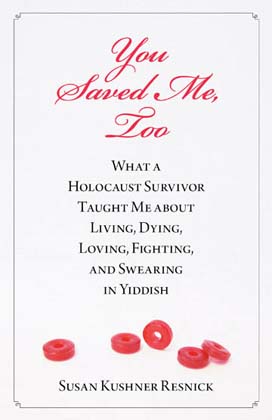
The title alone—You Saved Me, Too: What a Holocaust Survivor Taught Me About Living, Dying, Fighting, Loving and Swearing in Yiddish— maps out Kushner Resnick’s book to some degree. The reader is cued into the fact that it is also a Yizkor book—A Book of Remembrance. Kushner Resnick tracked down the prototype of such a book about Zychlin—Aron’s shtetl in Poland. “This is not your first appearance in a book,” Kushner Resnick writes to her dear friend. “The other one, published when I was eleven years old [in 1974] is called The Memorial Book of Zychlin.” Boom. Most of that generation of Europe’s Jews disappeared in a pestilent cloud of Nazi genocide.

But You Saved Me, Too is a book of life as much as it is a Yizkor book. It begins with the fact that Lieb and Kushner Resnick both liked to talk to strangers. It tells the truth that their friendship rescued Kushner Resnick from a crushing post-partum depression. That was in 1997. Kushner Resnick has a baby that she leaves in babysitting at the JCC so that she can swim off her depression. She meets Aron Lieb on a lark at the same JCC. “[Aron was] my faux father, my son, my crush, and my cause.”

You Saved Me, Too is also a quixotic book. For anyone who has shepherded a parent through the murky health care system, Kushner Resnick’s advocacy for Lieb’s benefits and his dignity will resonate, deeply and painfully. Kushner Resnick is not shy about indicting the Jewish community and its leaders for Lieb’s benign neglect. In her tongue-in-cheek style, she takes on the honchos, the machors, who made empty promises to help a man who bore the ultimate tattoo of Auschwitz.

That tattoo, the number 141324, takes up residence in Kushner Resnick’s imagination. She notes the sloppiness of the letters—the tattooist must have been in a hurry to go down the long cue of people arriving at Auschwitz—the fact that, “for fifty years, every time you’d taken off your shirt at night or reached out to adjust your side-view mirror on a summer day, you saw those numbers, 141324, the brand the Nazis gave you when they thought you were theirs.”

Boom. Kushner Resnick becomes, in essence, a third-generation survivor or a 3G. She’s bent on keeping the memory of the Holocaust alive, intent on telling stories that go beyond the blue Yizkor books from Polish shtetls. “Eventually all the tattooed arms will disappear” she writes. “Then the forgetting will truly commence. … How would the numbers look on my arm? I could get the same tattoo in the same place. 141324. Whenever people asked what it meant, I could tell them about you.”

Although Kushner Resnick, is speaking metaphorically, there are 3G grandchildren who have actually tattooed their grandparents’ numbers on their arms. It’s a radical act that has stirred up as much pride as it has consternation among their survivor relatives. Those numbers are also an address of unimaginable tragedy and entrenched optimism. For all of his heartache and kvetching, Lieb survives because he has dealt with unbearable horror as much as he has thrived in the small joys of life like meeting his friends for a daily cup of coffee at McDonald’s.

With no significant family willing to care for him, Kushner Resnick becomes Lieb’s healthcare proxy and has power of attorney over his affairs. She secures his reparations and learns that she has to open a separate account so that the money is not taxed and therefore not counted as an asset. Boom. She learns that the Boston Jewish community pays mostly lip service to the survivors among them and that it’s a problem also prevalent in Israel.

Halfway through the book she questions her involvement in Lieb’s life. “I can’t write anything conclusive until I figure out why we’re together,” she says. “Some writers say they find the answers by writing their way towards them. But I need to know the last line before I type the first word.” I think I know what she means. My mother sleeps as I type these last words about Aron Lieb and Susan Kushner Resnick, the woman who made his life a blessing for the world to read.


When Bad Things Happen to Good Kids

A day on which a life changes forever always begins as ordinary – so ordinary that thereafter, daily life is a deliberate celebration.

Carolyn Roy-Bornstein writes about an ordinary day gone awry in her new memoir “Crash: A Mother, a Son, and the Journey from Grief to Gratitude.” In her engrossing narrative, Bornstein divides her life “into two unequal parts. A line, like a crack in the glass, which carves time and events into two: those that occurred before the crash and those that tumble and falter in its wake. There is the one moment after which nothing is the same. It occurs in a heartbeat.”


And so begins Roy-Bornstein’s extraordinary account of the minutes, hours and days following her son Neil’s accident with a teenage drunken driver. On the night of Jan. 7, 2003, 17-year-old Neil and his girlfriend, Trista, set off on foot for the short walk between his house and Trista’s. The driver who ran down the two of them sped away from the scene. Neil survived the accident. Trista did not. Nine years later Roy- Bornstein garnered enough perspective to tell the story of the accident that changed her family’s life with humanity and love.

Roy-Bornstein, a pediatrician practicing on Boston’s North Shore, demonstrates her gifts as a writer as she unfurls one of the illuminating quotes that introduce the book: “We must embrace pain and burn it for fuel for our journey.” In a recent interview with the Jewish Advocate, Roy-Bernstein pointed out that she and her family burned gallons of emotional fuel, particularly during the immediate aftermath when “[t]here was something called temporal lobe agitation,” said Roy-Bornstein, “which occurs in many brain-injured patients where they can become very disinhibited, very irritable and act in ways that are totally not like them.”

Neil, a shy and contemplative young man, uncharacteristically lashes out at his mother as both his parent and a doctor. This brings the reader to a poignant quote that gets to the heart of Roy-Bornstein’s story: “No amount of doctoring can prepare you for being a patient.”

She elaborates that “even though I knew it was [Neil’s] injury talking, that was very painful to go through. Months later I found him reading my diary at the dining room table. Before I could decide whether to ask him to stop or let him continue, he looked up at me and said, ‘I’m sorry I yelled at you in the hospital, Mom.’”

Roy-Bornstein’s memoir makes it very clear that first and foremost, she is a mother to Neil and her older son, Dan. And she tilts at windmills during her encounters with the healthcare system. Her frustrations are memorably dramatized in a chapter titled “He’s Gonna Be Just Fine.” Roy-Bornstein recalls, “When we were in the ER at the Brigham and Women’s Hospital, we were told by the emergency room physician that Neil was ‘gonna be just fine.’ But that has not been our experience. Almost 10 years later he still sees a therapist, suffers from anxiety and has petitioned the disabilities office at his graduate school program for a distraction free environment for test taking.”

Roy-Bornstein notes that even as a physician she was unaware of the subtle long-term effects of traumatic brain injury (TBI). After Neil’s accident, she educated herself about TBI and over the years has become a de facto ambassador for the Traumatic Brain Injury Association of Massachusetts. Her role includes educating other health care professionals as well as the general public about TBI. Roy-Bornstein’s advocacy on behalf of TBI patients and their families also extends to education about concussions: “I’m trying to get the word out about concussion and its long-term effects on kids. In July of 2010, Massachusetts instituted new guidelines for public, middle and high school students that require coaches who suspect a concussion in their student-athlete to sit them out for the rest of the game or practice. We’re trying to change the culture in youth sports and the old mantra of ‘If you can walk, you can play’ to ‘When in doubt, sit them out.’” Roy-Bornstein has shared her expertise on the subject on WBUR’s “Radio Boston” and on the lecture circuit where she educates healthcare professionals and social workers about concussion and traumatic brain injury. “It’s become my passion,” she says.

Roy-Bornstein’s passions also include advocating for victim’s rights and health issues related to teens and drinking.

“When the accident occurred there was a lot of chatter in the media about under-aged drinking and drunk[en] driving,” she notes. “A vocal minority of parents stuck by their practice of letting their teens and their friends drink in their home, believing that they were keeping them safe by taking away their keys. But even if kids aren’t drunk[en] driving they’re still drunk.”

And as Roy-Bernstein knows all too well, “Bad things happen to good kids and drunk[en] kids.”

*My Grandmother’s Tallit – A Letter to Anna

Dear Anna:

It’s been five years since your bat mitzvah. In your bat mitzvah state of mind you read trope cues as easily as ABC’s. You teased out meaning from your Torah portion, which recorded the life and death of Sarah. And your wore a tallit or a prayer shawl you picked out in Jerusalem. If you had done any of these things at the Western Wall in Jerusalem the Israeli police might have arrested you and me, the mother who allowed you to commit such a crime.

I must confess to you my dear daughter that I’ve never felt that any of the rituals your Dad and I gifted you with were truly mine. But in light of Anat Hoffman’s recent arrest last week for wearing her tallit at the Wall, your Bat Mitzvah was as much a political statement as it was a rite of passage.

When I look at your tallit—pink and silk and uniquely yours—I think of my grandmother whom I called Abuela. Abuela was born in Greece at the dawn of the 20th century and went to a school there funded by the Rothschilds. She learned the minimum Hebrew to recite the blessings over the Sabbath candles and did needlepoint to fill in the rest of her life.

Nobody wielded a needle and thread like my Abuela. With deft rhythm and mesmerizing patterns, she conveyed a life story of painstaking work and imposed silence. After she arrived in Cuba, Abuela sewed late into the night to make ends meet. She made my mother and my aunt frilly dresses between the sewing jobs she took in from neighbors. Abuela also crocheted her husband and her son’s tallitot—prayer shawls—for which she carefully tied the ritual fringes with sore fingers.

In America Abuela fashioned a kind of tallit for herself when she pulled the wool shawl she wore year round closer to her chest. In her small apartment she sat in a chair with stuffing peeking out of its arm that she was too tired to mend. The few times a year that she ventured to a synagogue, she stood when the ark was opened and blew kisses toward the bimah or altar as if greeting a lover. In a hoarse voice she muttered the Kaddish or the Mourner’s Prayer with her hand firmly on my shoulder so that I could not stand up and tempt fate.

When I was twelve my mother lugged a reel-to-reel tape recorder home, which she borrowed from the high school where she taught Spanish. She had planned to record Spanish lessons for the kids that she tutored on the side. But I quickly seized the recorder. The microphone that came with the machine transformed me into a roving reporter. I walked around the house inventing news about my mundane summer days.

Abuela spent most of that summer sitting on our porch, staring through the slats of the new jalousie windows. I felt that I was doing something important in the way that she intently watched me playing with the reel-to-reel. And then one day I got the idea to interview her. “Talk about anything,” I told her. Recipes, sewing, childhood stories. But mostly I wanted her to sing again. When she was a young girl she played the lute and sang Ladino songs in a lilting soprano. Her father forbade her to sing when she turned twelve.


My grandfather, Abuelo, was more than willing to take Abuela’s turn at the tape recorder. He dressed for prayer, winding the straps of his tefillin around his left arm and placing the leather boxes on his forehead and in the crook of his left arm. Abuelo wore a tallit that he snagged from a local synagogue—he had to leave the one that Abuela made him with the rest of his possessions in Cuba. He sang the shacharit—as if offering that morning liturgy as his personal history. His voice started off as wobbly as the plastic reels spooling the shiny brown ribbon of tape.

His voice was stronger after he gathered the tzitzit or fringes of his tallit to recite the Sh’ma—Judaism’s central prayer. Eyes closed. Voice pleading. I joined him at the microphone. It was thrilling to sing about listening for and loving God with all of my heart and my soul and my strength. In that moment I blurted out that I wanted to be a rabbi.

Abuelo stopped singing and the only thing audible was the squeaking of the reel-to-reel tape recorder, making me cringe as if I heard nails scratching a blackboard. He dropped his tzitzit and said, “Eso es muy feo”—that is so ugly. Abuela looked up.

Suddenly, finding her voice, Abuela said to me, “You can be anything you want.” Abuela could have been anything she wanted too, only she wasn’t allowed to think that way. If she were born in a different time, she might have used her voice to defend Anat Hoffman.

I’m sure she would have been inspired by you as you happily wore your tallit and celebrated your coming-of-age by reading from the Torah about every woman’s life.

Love,

Mamma

*This piece was reconfigured as a letter to my daughter and published in the Jewish Advocate


My Grandmother’ Tallit

It’s been five years since my daughter Anna had her bat mitzvah. In her bat mitzvah state of mind she had read trope cues as easily as ABC’s. She teased out meaning from her Torah portion, which recorded the life and death of Sarah. And she wore a tallit or a prayer shawl she picked out in Jerusalem. I’ve never felt any of the rituals my husband and I gifted her were truly mine, but my daughter didn’t think twice about accepting them. Her Bat Mitzvah was as much about her rights as a Jewish woman as it was her rite of passage.

When I look at Anna’s tallit—pink and silk and uniquely hers—I think of my grandmother whom I called Abuela. Abuela was born in Greece at the dawn of the 20th century and went to a school there funded by the Rothschilds. She learned the minimum Hebrew to recite the blessings over the Sabbath candles and did needlepoint to fill in the rest of her life. Family lore claims that she and her siblings made their way to Cuba after Greek soldiers kidnapped her sister and held her for ransom. Her father and brothers delivered the ransom on horseback and when the exchange was complete, there was just enough money left for passage to Havana. Abuela was a young teenager when she arrived in Havana.

Even in Cuba, nobody wielded a needle and thread like my Abuela. With deft rhythm and mesmerizing patterns, she conveyed a life story of painstaking work and imposed silence. Abuela sewed late into the night to make ends meet. She made my mother and my aunt frilly dresses between the sewing jobs she took in from neighbors. Abuela also crocheted her husband and her son’s tallitot—prayer shawls—for which she carefully tied the ritual fringes with sore fingers.

In America Abuela fashioned a kind of tallit for herself when she pulled the wool shawl she wore year round closer to her chest. In her small apartment she sat in a chair with stuffing peeking out of its arm that she was too tired to mend. The few times a year that she ventured to a synagogue, she stood when the ark was opened and blew kisses toward the bimah or altar as if greeting a lover. In a hoarse voice she muttered the Kaddish or the Mourner’s Prayer with her hand firmly on my shoulder so that I could not stand up and tempt fate.

When I was twelve my mother lugged a reel-to-reel tape recorder home, which she borrowed from the high school where she taught Spanish. She had planned to record Spanish lessons for the kids that she tutored on the side. But I quickly seized the recorder. The microphone that came with the machine transformed me into a roving reporter. I walked around the house inventing news about my mundane summer days.

Abuela spent most of that summer sitting on our porch, staring through the slats of the new jalousie windows. I felt that I was doing something important when Abuela intently watched me playing with the reel-to-reel. And then one day I got the idea to interview her. “Talk about anything,” I told her. Recipes, sewing, childhood stories. But mostly I wanted her to sing again. When she was a young girl she played the lute and sang Ladino songs in a lilting soprano. Her father forbade her to sing when she turned twelve.

My grandfather, Abuelo, was more than willing to take Abuela’s turn at the tape recorder. He held the microphone like a preacher and told me a story from when he was a boy in Turkey. On his way to school he witnessed a Turko soldier stab an Armenian man to death. His family left for Cuba a week later. “Why Cuba?” I asked him. Spanish was easier to learn than English for a Ladino speaker.

The next day Abuelo came back for another recording session dressed for prayer. He wound the straps of his tefillin around his left arm and placed the leather boxes on his forehead in the crook of his left arm. At twelve, I was approaching bat mitzvah age yet had no hope of winding leather straps of my own tefillin around my arm. Abuelo wore a tallit that he snagged from a local synagogue—he had to leave the one that Abuela made him with the rest of his possessions in Cuba. He sang the shacharit—as if offering that morning liturgy as his personal history. His voice started off as wobbly as the plastic reels spooling the shiny brown ribbon of tape.

His voice was stronger after he gathered the tzitzit or fringes of his tallit to recite the Sh’ma—Judaism’s central prayer. Eyes closed. Voice pleading. I joined him at the microphone. It was thrilling to sing about listening for and loving God with all of my heart and my soul and my strength. In that moment I blurted out that I wanted to be a rabbi.

Abuelo stopped singing and the only thing audible was the squeaking of the reel-to-reel tape recorder, making me cringe as if I heard nails scratching a blackboard. He dropped his tzitzit and said, “Eso es muy feo”—that is so ugly. Abuela looked up.

Turko,” she screamed at Abuelo as if he had stabbed me. Finding her voice, she said to me, “You can be anything you want.”

A few years ago Anna had a towel draped around her shoulders. She had been drying her hair. “Look Mom, my tallit,” she joked. I wished I had recorded the moment in memory of my Abuela, in honor of the future. But more importantly, I wished that Abuela could have seen her great-granddaughter happily wearing her tallit and celebrating her coming-of-age by reading from the Torah about every woman’s life.

My Nest

Here’s a joke that I recently heard. An optimist sees the glass half-full. A pessimist sees the glass half-empty. An opportunist drinks the water. Not all that coincidentally, these describe the various emotional states of my half-occupied nest. Sometimes it’s half-full; sometimes it’s half-empty. Although there is more time and space in my house since Anna left for college, I’m still shocked that she packed up and moved away a five hour drive from me. Bearing in mind that our daughter wakes up every day almost 300 miles away, here’s a very short list of what’s changed at my house.

The bedroom. Be careful what you wish for because it may come true. Before she left for school, we blasted Anna’s room, clearing over eight years of detritus. We were sorting stuff that dated all the way back to 4th grade. There was that book project Anna couldn’t part with or that oh so pretty party dress that she wore on the bar mitzvah circuit six years ago! Six years ago?! Mind-boggling. In fact, Parents’ Weekend at Anna’s school falls on the fifth anniversary of her Bat Mitzvah. The quiet, clean bedroom matches the quiet, sort of clean house. I don’t mean to say that Anna is loud. But there is a liveliness, a spirit of wonder and a megawatt smile that she brings into a room. And with her departure for college, I’m now the only girl in the house. Even the dog is a boy and like the men in this house he could care less about the fabulous sweaters and pocketbooks that I find on sale.

The car. Anna never made the deadline we gave her for getting her driver’s license. Even her learner’s permit has expired. This means that Anna needed rides early and often. The longest ride we had together was between her school and Adam’s. I’ll admit I was almost always grumpy about the prospect of driving 15 miles in traffic between schools. But my annoyance evaporated when Anna got in the car and we had a half-hour to ourselves. We put the time to good use. We’d talk about the books she was reading, the people she was hanging out with, the latest doings at Student Council. The car ride was the teenage equivalent of lying down with her before she fell asleep. When she was a little girl that was the time that I learned what was near and dear to her heart, or conversely, what broke her heart.

Mealtime. Anna’s acute dairy allergy shaped who she was and, consequently, who we became as a family. Over the years Ken and I worked to help her advocate for herself at a birthday party or a restaurant. It turns out that Anna’s allergy also informed our Judaism. Since we had such little dairy in our house and we had made the commitment to send our kids to Jewish day school, it was not such a big leap for us to start keeping kosher. At first, we practiced keeping kosher using our non-kosher dishes. That is to say, we didn’t buy new plates or get a second set of plates to separate meat from dairy more fully. The fully stocked kosher kitchen was a natural outcome of our kitchen remodel. Everything was new including a dishwasher with two drawers—one for meat and one for milk. Nevertheless, we mainly lived a meat and pareve existence. When Anna left for college, I was sure that we would have a dairy fest every night in the house. I’ll admit that for the first couple of weeks we went wild and crazy with cheese tortellini and traded some of our Mother’s pareve margarine for a tub of butter. But it wasn’t as fun as we thought it would be. There was something disloyal about indulging in all that dairy and so barely realizing it we went back to our pareve life.

The brother. In many ways, Anna’s departure has been hardest on Adam. When it became clear that Anna was indeed going to college he got downright depressed at the thought of being the only child at home. He’d mumble under his breath, “I can’t believe I’m going to be stuck with those two. “ Those two, in case you haven’t figured it out, are Ken and me. I tried not to be insulted and chalked up his rudeness to anticipatory anxiety. It’s been six weeks since Anna settled into a dorm room with posters of Coldplay and the Beatles, and Adam still can’t believe he’s stuck with the two of us. I thought he’d be thrilled to be picked up on time and have unfettered access to parmesan cheese. It turns out he was just making noise about those things. He’d rather have Anna home.

When it’s all said and done, this half-empty nest, or depending on a given day, half- full nest, is ultimately emotional limbo. I’m not exactly pushing Adam out the door, but I’m kind of curious about what being an opportunist feels like.

Ghosts of Sukkot Past

Sukkot is here and my guests are on the way. Like Chagall’s lovers they fly over the silver moon; their white gauzy clothing double as wings. I greet them in the sukkah—a makeshift structure akin to a hut that we build from a kit. The sukkah also has a roof with slats generously spaced to see the sun and the moon and the stars.

The company I’m talking about stargazing with is called ushpizin—the Hebrew term for mystical guests who will grace sukkot (plural of sukkah) all over the world on each of the seven nights of the holiday. This is my kind of celebration. When I was a kid I loved reenactments of historical events. The old sitcom Bewitched tickled me because someone like Columbus or Shakespeare came alive for me.

To that end, I have a wish list of historical figures I’ve always wanted to meet. Moses and Leah top my list. No one is more associated with the Torah than Moses. In my mind, he’s an inspiration because so much of his leadership was marked by doubt. As a parent in the 21st century, I take solace in the fact that even with God’s direct intervention, Moses still had a difficult time leading the Israelites out of the wilderness and into the Promised Land. Leah is my role model as a mother. Every parent has been a Leah at some point—taken for granted, ignored, but still triumphant in ordinary yet miraculous ways.

The Rachel that I want to meet was Rabbi Akiva’s wife. I like her rebelliousness. She was from a prosperous family who followed her heart and married the illiterate Akiva against her family’s wishes. To complete the fairytale, she recognized Akiva’s natural genius and encouraged him to learn to read when he was 40. Forty! Akiva excelled in his studies beyond their wildest dreams. Rachel was alone for years as he studied and taught in the greatest Jewish academies.

In his absence, Rachel coped with grace and fortitude. I want to ask her how she did it. I want to know if she was as disoriented as I am when my husband is only away for a week on a business trip. I want to know how she controlled herself when her husband finally came home and his students, protective of their beloved teacher, did not let her through the throng to greet him. When Akiva realized what was happening, he ordered his students to let Rachel pass immediately. He told them that she single-handedly was responsible for everything that he and his students had attained. I want to know if witnessing her husband’s success was worth sacrificing his company all those years.

I want to introduce my daughter Anna to Sara Schenirer. Hunched over her sewing machine, she had a revelation. Or was it a moment of despair that gave way to lucidity? She dared to imagine girls in their own schools studying Torah. It was a radical idea in the late 19th century. Although nowhere near egalitarian, the fact that girls had a classroom of their own to be formally educated was inspiring and enduring and just. I want Anna to know that she is the direct beneficiary of Sara Schenirer’s prescience.

I love spirits. I buy into the notion that there are other times during the year for formal visitation from phantasmagoric souls. There are the seven days of shiva or mourning. The week during which the sheva b’rachot—the seven blessings following a marriage—are celebrated. We boldly mingle with our ancestors on Passover when Elijah joins us and Miriam remembers us with a shake of her timbrel.

But it’s on Sukkot that I reflect on people I would give almost anything to see again. I close my eyes and see my father healthy and strong. I remember my father-in-law’s mega-watt smile and can-do optimism. I feel the presence of Anna’s namesake—a grandmother whom I adored. I miss my friend Miriam so much that I ache. My sukkah is a space painted in a full spectrum of memories and emotional colors.

It makes sense that a holiday that welcomes ghosts to the dinner table would end with Yizkor—the service to memorialize the dead. Yom Kippur and the three harvest festivals—Sukkot, Passover and Shavuot—are the four times a year there is time and space to mingle with loved ones who have died.

What comforts me most about remembering my dead on Sukkot is that I can walk out of my fragile sukkah into the sturdy structure of community where, I believe, a lot of people understand that otherworldly visitors frequently stop by throughout the year.


The Race to Nowhere

Vicki Abeles means well. She is a mother who wanted to give her three children all the advantages she never had as a child. As a result, she and her children weathered long school days followed by a daily onslaught of extracurricular activities. Sound familiar? But somewhere along the way her best intentions went awry and she realized that she and her children were running in, what she descriptively calls a “race to nowhere.”

Out of frustration, Abeles picked up a camera and made a movie, her first, about the never-ending marathon in which we have inadvertently sponsored our children. The resulting film, The Race to Nowhere, alternates between a cautionary tale and an overreaction to what happens when kids and parents are trapped by their own ambitions.

When it came out two years ago, Abeles’ film was screened in various upscale locations followed by question and answer periods. The high-achieving Boston suburbs where I live are the perfect laboratories to test Abeles’ theories. In the question and answer period I attended, a group of educators in the audience said how unfair it was to adjust their lesson plans simply for the sake of delivering high MCAS scores. “It is,” said one of the women, “like putting the cart before the horse.”

There are no surprises in Abeles’ film. Dedicated teachers are thwarted by school boards. One exemplary English teacher felt so beleaguered by the Oakland, California school system that she left teaching altogether. The woman openly wept on camera about leaving her students to fend for themselves in a mediocre school system.

The camera pans to a Stanford University freshman confessing that he regurgitated information for tests in high school only to be woefully unprepared for his freshman year of college. Then there are the befuddled parents and students who have no idea how to get off this exhausting treadmill. Fewer activities, an adjusted academic schedule? If only it were that easy.

In the middle of all this angst is a heart-breaking interview with a mother whose 13 year-old daughter Devon committed suicide after getting a bad grade on a math test. I think back to a column I wrote about Amy Chua, the original tiger mom, wouldn’t accept anything less than an A from her daughters. The Tiger Mother roars and her cubs fall into line. And yet I have to believe that it was more than poor test results that tragically sent Devon over the edge.

I worry about my children and the academic loads they carry. Anna was a three-season athlete in high school and often didn’t get to her homework until after dinner. Nothing annoyed her more than when I ask her how the homework situation is. She’d tell me the work is there and she would get through it no matter how long it took. Most nights I didn’t think she had an unreasonable amount of homework for a student as committed as she was. Yet I still fret about sleep-deprivation and the onslaught of emotional challenges she’s beginning to face as a college studentl.

Adam is no stranger to buckets of homework. His school prides itself on creating young men of character and discipline. Part of cultivating that persona is a full curriculum. For example, most nights he’ll be assigned up to 25 math problems. Although I hate homework as much as the next parent, I don’t think his assignments are busy work or aimed at “survival of the fittest.”

Sara Bennett is among those advocating education reform in Abeles’ film. She co-wrote a treatise with the self-explanatory title: The Case Against Homework. Like Abeles, she was a concerned parent who saw her children struggling against the overwhelming tide of worksheets and reading assignments in middle school.

According to Bennett’s research, a child needs to do only 5 math problems to catch on to a concept. Tell that to Amy Chua whose older daughter was once bested in a math competition. Chua’s solution was to have her daughter complete 200 (no there is not an extra zero) math problems a night for 10 days. That’s 2000 problems. That’s a lot of math. That’s a long race.

I wasn’t surprised to see Wendy Mogel make a cameo appearance to warn about the myriad ways our kids are stressed out. For Abeles and company, Mogel’s latest parenting book, The Blessings of a B-, is an island of calm in the madness of running after perfect SAT scores and padding resumes to resemble the CV of a Nobel prize-winner.

As parents we all too often walk that tenuous line between encouraging our children to be their best and demanding perfection from them. What goes loudly unsaid throughout the film is that entrants in the “race to nowhere” are more often than not socioeconomically privileged. All I can say in the face of these tense times is to hug your kids often. Set a realistic course that takes them towards a fulfilling, healthy future because the alternatives are too upsetting to contemplate.