Going to School on Rosh Hashana

This year my 15-year old son and I are having yet another conversation about Judaism’s High Holy Days. He’s intent on capitalizing on his hard-won victory last year, the outcome of which was that he went to school on the second day of Rosh Hashana. This was no small concession for his parents. His father and I had never attended school on the High Holy Days while living under our parents’ roofs. But neither of us went to a high school as academically challenging as our son’s.

To read the rest of the essay please go to: http://nyti.ms/Ub6Xsr

The God of Our Foremothers–Why I am a Feminist Jew

I am a feminist Jew because I am the mother of a daughter and a son.

I am a feminist Jew because the God of my foremothers doesn’t recognize a caste system. When my G0d blessed Jacob’s children, he also blessed Jacob’s concubines, Bilhah and Zilpah. Yet it astounds that mentioning the God of my foremothers – the imahot – is still optional in the Conservative Jewish liturgy. To my mind, this sends a message that the imahot can be optional in the hearts and souls of our children.

I am a feminist Jew because I’m angry over the injustices too frequently lorded over Jewish women.

A few years ago, my children’s day school finally included the imahot in every prayer service. But it came after a struggle. The message that landed in my mailbox announced that in consultation with local Conservative rabbis, the school decided to include the imahot in the Amidah as standard practice. Amen. And yet the message felt perfunctory to me, as if our foremothers were shadowy figures. Had Abraham, Isaac and Jacob finally decided to share their God?

Perhaps lost in redaction, our foremothers are not mentioned as a group in the Bible, but thank goodness they star in many ancient and modern midrashim as role models and prophets.


I am a feminist Jew because Sarah was said to be a greater prophet than Abraham. She understood that God didn’t demand the sacrifice of her first-born son. During her pregnancy, Rebekah knew that she had two great nations inside of her, but that the fate of the Jewish people rested with her younger son. These women triumphed over infertility and infidelity (even when they sanctioned it). I am a feminist Jew because the imahot are summoned to help the Jewish people in times of distress. Rachel was buried at a strategic place on the road where she can hear the cries of her people in captivity. Her prayers uniquely move God on their behalf.

I am a feminist Jew because prayer is instinctively beautiful for Jewish women.

Prior to the modern debate over whether to include the imahot in the liturgy, women had the wisdom and clarity to call upon them in their own prayers throughout the centuries. The imahot are front and center in the techinot, prayers of Jewish women from medieval times through the 19th century.

I am a feminist Jew because our foremothers were called upon to help Jewish women express their deepest desires and most fervent hopes in both set and spontaneous prayer.

I am a feminist Jew because I can frequently call upon the God of my foremothers. God of Sarah, hear my prayers to keep my children safe in planes, trains, automobiles and all manner of place and time. God of Rebekah, help me to recognize perilous situations. God of Rachel, help me guide my children through disappointment and desperation. God of Leah, comfort me when someone doesn’t love my children the way they deserve to be cherished.

I am a feminist Jew because the G0d of Bilhah and Zilpah brings women to the foreground where they belong.

Some sources – the sources that shaped my vision as a feminist Jew – acknowledge Jacob’s concubines, Bilhah and Zilpah – the mothers of four of Israel’s 12 tribes – as matriarchs, bringing the number of imahot to six. In terms of Jewish symbolism, six corresponds to the six days of creation. Who on earth has been more responsible for the creation of the Jewish people than Sarah, Rebekah, Rachel, Leah, Bilhah and Zilpah?

I’ve read about the brouhaha of nursing a child in a public space. I am a feminist Jew because I know that Sarah, a mother who weaned her own child when he was 3 years old, would have defended these women asserting their right to be mothers. Rachel would have heard the cries of those hungry babies and interceded so that their mothers could do the most natural and loving thing in the world for their children – nourish them.

Leah continues to hear the prayers of all mothers who send their children to serve their countries in dangerous places. Rebekah hovers near mothers who must make tough choices for their children. Bilhah and Zilpah understand women who feel marginalized.

I am a feminist Jew because women recovered Leah’s story to teach my children and their children that the woman thought to be plain with weak eyes, was as strong and holy as her husband.

One of my favorite midrashim on the imahot addresses the order in which the matriarchs appear in the liturgy – God of Sarah, Rebecca, Rachel and Leah. After the name Leah appears in the text, the next word is Ha-el – The God. Ha-el is Leah spelled backwards. This wordplay elevates Leah from second class wife to matriarch. Hers is the last name to linger after the initial blessing. Hers is the name that inverts the name of God.

Swimming in the Sea of Parenthood

There are a few universities and colleges in this country from which I could never hope to graduate. These schools require matriculated students to pass a swimming test. I do not know how to swim. And I am terrified of making my way into water in which I cannot stand with my head above the surface.

Before World War II, passing a swimming test was part of the curriculum in many US universities and colleges. But by 1982, passing a swimming test was mandatory in less than 10 percent of them. Anna is matriculating at one of the holdout schools. Not a problem for her. I made sure that both of my children learned to swim at a very young age.

And, yes I’m aware that in the old-fashion parlance of the Talmud, a father is required to teach his son three things: The Torah, a trade and how to swim. That’s as great a blueprint for success as I could have hoped to devise. It presents a child with opportunities for spiritual fulfillment, financial security and self-protection.

My girl has to swim a few laps and then off she dives into her college career. I can remember the first time she put her face in a pool. She was 4, and my husband wisely said it was time for her to learn to swim. Off went my little girl to summer camp, where she’d have proper lessons. I never went to summer camp, and we all know the consequences of that missing link in my life.

I wasn’t so sure I wanted my little girl to go to a big-kid camp. But it was a camp that had a prekindergarten division with the sweet name of Owls’ Nest. Within days, she was proficient in the survivor’s float (known as the dead man’s float until someone wised up). Soon enough, she flipped over and floated on her back. I was amazed. I was relieved. My kid could swim. Almost.

The next summer my daughter graduated to two hours a day of instructional swim. Rain or shine – minus thunder and lightning – she was in the pool learning the breaststroke and the crawl. This was one way I measured that my girl was getting bigger and stronger. But then one day she got in the car and expressed my worst nightmare: “Today my counselor jumped into the pool with his clothes on to save me.” Then she asked me something mundane like what was for dinner that night.

When I got home, I found a message from the camp. Anna was never in danger. Her counselor saw that she had ventured into the deep end and scooped her up before she was literally in over her head. The word “save” was not mentioned. Later in the evening, my girl started grumbling that she didn’t want to go back to camp, and she certainly didn’t want to swim. I, the nonswimmer, knew she had to get back in that pool.

I’m reliving the arc of my child’s swimming story because it mirrors my feelings about my first child going to college. Once upon a time, swimming was completely new to her. It was a skill that challenged her and, at moments, frightened her. Ultimately she triumphed, and now, like the old cliché, she swims like a fish.

As for me, I still struggle mightily, learning to tread water in the shallow end. Right after Anna’s scare in the pool, I thought the camp was trying to cover up that she almost drowned. But soon after, I realized that she was never in danger. It just looked that way. So much parental worry stems from emotional perception.

Thirteen years later my little girl is going to a big school. I daresay she’ll pass her college swimming test. To say this is a time of transition for our family is a bit like thinking of Moby Dick as a big fish. But I have made sure she can swim. Take that as you will and apply it to other skills. I believe that my husband and I have invested in her academic success by supplying her with an education in which she has been challenged and has ultimately thrived. So, I suppose you could say that we’re well on our way to teaching her a trade by giving her a college education.

On the spiritual side of things, all we can do is hope that her Jewish day school career will emerge at various flashpoints during her college years. You can’t teach a child to be observant or to take the Torah into her heart. You can only instruct her in Torah so that she can make meaningful choices about her spiritual life.

And so it began with the doggy paddle in the shallow end of the pool at a preschool summer camp and ends with swimming laps in an Olympic-size pool in a large university. That’s as good a metaphor as any, about parenting a child who is leaving home.

A Visit to Poland with a Camera and a Tombstone: Evan Kleinman’s ‘We Are Still Here’

The family was warm, familiar, Jewish. The grandparents’ English was charming, old-fashioned – glazed in a Yiddish accent.

Meet the Kleinmans, the focus of Evan Kleinman’s new documentary. The 28-year-old filmmaker turned the lens on himself to make the aptly titled “We Are Still Here,” about his trip to his grandparents’ Poland – a Poland that held sweet memories turned bitter and unimaginable.

Kleinman’s paternal grandparents grew up in shtetls near Krakow and were deported to concentration camps. On screen, his grandmother remembers her time in the Warsaw Ghetto and how she volunteered to go to Bergen-Belsen with her best friend.

Although Kleinman’s film records his particular legacy trip – a return to his roots with his father, mother and younger sister – it’s a universal home movie. The message of the film is that every Jew survived the Holocaust. This shared survival is what led to the founding of Boston 3G in 2009, the sponsors of the Boston debut of Kleinman’s film last week.

The group’s name, 3G, stands for the third generation of survivors. The group is made up of people in their 20s and 30s, most of whom are the grandchildren of survivors.

Liz Bobrow’s involvement in Boston 3G stems from her close relationship with her paternal grandparents. Both of them are Holocaust survivors whom Bobrow remembered as “very different from my other set of grandparents.

“While they loved me just as much, they were different,” she added. “They spoke with an accent and had funny quirks like always making sure I had enough to eat. I also recognized [as a child] that we didn’t have the big family reunions with my father’s side as we did with my mother’s side.”

Bobrow, Boston 3G’s president, also noted that this third generation has the “unique privilege of connecting with the survivors in a different way from the second generation. While our parents have become caretakers of the survivor generation, we are able to focus solely on who these people are and their incredible stories of survival. It gives the survivors comfort seeing that their stories are not being forgotten, that we are still telling them so many years later.”

“We Are Still Here” was organized around the central event of taking a tombstone back to Poland – a stone to mark Leib Kleinman’s grave. Leib was Evan’s great-uncle, his grandfather’s kid brother who died in a small concentration camp in central Poland.


“The stone is heavy,” the grandfather tells his grandson. The younger Kleinman has set up the context of his film so well that it’s clear that the weight of the tombstone is as difficult to bear as the history of the Jews in Poland.

But in an e-mail interview, the New York native was ebullient about his grandparents and unequivocal about their positive influence on him:

“They are the most powerful and inspiring people I know, and I wanted to be able to share them with other people and with future generations of my family. By doing a film it provided us with an exercise that would bring us closer together, capture our story, and also perhaps bring closure for them because they had not seen these places in 70 years. When my grandfather revealed to me that he could pinpoint the place where he buried his brother I felt beyond compelled to make sure his brother was memorialized.”

Kleinman’s preparations for the trip to Poland are as poignant as the trip itself. His grandfather sketches a map to help his family find his house in the small town of Sediszow. The grandson dutifully brings the map with him to Poland, and it’s almost miraculous when it proves to be useful and accurate.

In Poland, the four Kleinmans move through the country in a hazy dream. But their disorientation is frequently punctuated by moments of triumph. They find a birth certificate of another greatuncle. They find Leib’s burial place through determination and his brother’s description of a place he hadn’t been to in more than seven decades.

Kleinman is similarly scrupulous in showing that the buildings in Poland are a mixture of the old and the new. The observation is a living, breathing subtext of his portrayal of his family and the intense family history attached to them.

Kleinman’s film was also presented last month at the Museum of Tolerance in New York City as well as at a number of film festivals. Since the film’s debut, Kleinman has been gratified by the positive responses from his third generation of survivors.

“Many have voiced to me that the film inspired them to explore their own family history,” he said. “Also, many have told me that my family even reminds them of their own families.”

It’s the ultimate recognition for a young man who movingly portrays his third generation as “living links” to history.


Judy Bolton—A Mom Detective Who Kept Her Kids Safe in Cyberspace

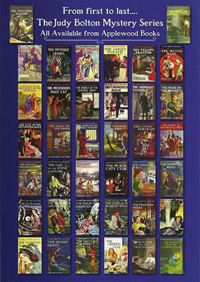
I share my family name, as well as a penchant for snooping, with “Judy Bolton, Girl Detective,” Fictional Judy was the star of her own mid-twentieth century mystery book series. Judy lived smack dab in the middle of Pennsylvania where, surprisingly enough, there was no shortage of mysteries to solve. In all thirty-eight of her books, her snooping was always for the good and welfare of her family and friends. When I became a mother, I snooped for the good and welfare of my children.

Now that they are older, I don’t snoop in my kids’ lives very much. And I have never snooped because I have an unsavory curiosity about other people’s lives. (Though I will sometimes eavesdrop at the table next to me in a restaurant to figure out if a couple is on a blind date). I snoop for interesting stories. I snoop for inspiration to write those stories. I snoop to unknot the mystery of other lives as well as my own. Snooping comes with the territory of being a writer.

While I had no qualms about rummaging around in my children’s lives, it occasionally got me into trouble. When my daughter was 12 she said that I worried over nothing and that I didn’t trust her. Shealso  said that I was nosy.

It’s true. I do worry over nothing until I have something about which to worry. She’s right that I didn’t trust her when she was the tender age of 12. But I didn’t trust because she was too young to understand how quickly the world can turn scary and dangerous.

I prefer to think of myself as curious. And once upon a time my curiosity mostly focused on my children’s computer activities or the dialed and received log on their cell phones. When my children were old enough to have screen names, I ran a benevolent dictatorship. This meant that I was not always right, but I was never wrong. Each month they were required to show me any on-line friends’ lists.

The first rule was that my kids had to know everyone personally—in the flesh—anyone with whom they had an on-line relationship. All the better if I knew them too, but I hadn’t met all of the sleep-away camp buddies. So for 12 and up, I trusted, but only just a little. Under 12, I had to know everyone on a list. No exceptions. This rule, in place like cement, was instituted to prevent my kids from coming into contact with someone they had never met. This rule, to use a word that we used early and often since the dawn of pre-school, was non-negotiable.

I also reserved the right to walk in at any time that my children were on the computer and ask with whom were they chatting on-line or what was new on Facebook. Speaking of Facebook, they had to friend me or do without it. If the spirit moved me, I would also ask what they had just typed. Did I mention that I ran a benevolent dictatorship?

All bets were off for a virtual chat room. This was expressly forbidden and would result in the revocation of computer privileges until the age of twenty-five.

Before they were freshmen in high school and old enough to have laptops, my kids had individual accounts on our family computer so they could access the Internet for homework and pre-approved game sites. Each of their accounts had a filter so that a typo would not send them to God knows where in cyberspace. I always knew the passwords to their accounts or to anything else in their lives. If they somehow managed to get on to a commerce site and try to buy something, the dictatorship was no longer benevolent. Luckily, this never happened.

My children never seriously abused their Internet privileges because they knew I meant business. As generous as I am with them, and believe me I am still generous to the point that it sometimes annoys my husband, they knew that I would not tolerate any infractions with regard to the Internet. Just ask my son about the time he hacked into my account and wrote an e-mail to his teacher to excuse him from an assignment. His third grade grammar gave him away and the teacher immediately notified me that he was e-mailing her under my name. What followed were not good days for my boy.

But I never fully warmed up to being a dictator—benevolent or otherwise. I took unique pride in saying that my children were spoiled, but not rotten. Yet, when it came to snooping for their wellbeing, I held my ground.

I think my parents, particularly my father, named me with the hope that I would develop a curiosity that was both intellectual and empathic. Building on my father’s dreams for me, I taught my children to be as curious and responsible as my fictional doppelganger.

Financial Infidelity

Here, in a nutshell, are the principles of economic empowerment handed down to me from the women in my mother’s family: Your money is your money. Your husband’s money is your money. All the money in the house and the bank is your money. A man only needs enough money in his pocket to buy a snack or, if he must, a lunch.

Imagine my surprise, and yes, even some guilt, when I recently learned that I’d been committing financial infidelity for years. My husband Ken doesn’t believe that all of our money is mine to control. Worse, Ken rarely buys anything for himself. For example, he put an iPod purchase on hold indefinitely until I gave him the darn thing for his birthday. Since I barely make enough money to merit a W2, it might appear that Ken bought the iPod for himself anyway. But in my paradigm of financial independence, appearances are often deceiving. There’s no question that I was the generous giver here.

Financial infidelity is virtually impossible to pull off without a trusting partner. But some perspective please: it’s not like I’m hiding a Swiss bank account. Ultimately, though, I’ve breached my husband’s monetary trust. If you ask Ken he’ll say the only way to make it up to him is to stop buying things I don’t need. He’s right of course, but it’s not that simple. Our standards about what I need often wildly diverge.

When my children were little they liked a song with tongue-in-cheek lyrics that went something like this: “Look left, look right—everything you see is mine.” As the self-appointed chief executive officer of my busy family of four, that pretty much sums up the perks I’ve awarded myself.

For example, after Ken dawdled for months about upgrading our television sets for the 21st century, I finally left the house one Saturday morning and became the proud owner of a forty-inch high definition TV. I announced to my stunned family that our new cable-ready addition was waiting to be unloaded and hooked up. It was apparent from the hurt look on my husband’s face that I had committed an indiscretion.

“I thought we were going to pick out a television together,” he said.

“You had almost a year,” I shot back.

“But this is a major purchase,” he complained.

“I know, it’s too heavy for me to lift by myself.”

My husband’s procrastination with regard to purchases (he’d argue it’s economic prudence) has an upside. It gives me the opportunity to jump in and do what I have to do making me, so far, the proud owner of a GPS, an iPad and another high-def TV for our bedroom. Financial infidelity? I call it reasonable upgrading.

Growing up my parents fought a lot about money—how Dad should earn more so Mom could spend more—an old-fashioned corollary to my mother’s mantras of economic empowerment. I’d go along on revenge shopping trips with my mother to Lord & Taylor where everything was bathed in gold light. I’ll never forget how beautiful my mother looked in her new gray suit with the military jacket and the killer boots she bought to go with it. All the money in the house was hers and she meant it. The day she went back to teaching full-time was the day she opened up her own checking account.

I’ve never thought of myself as financially unfaithful because of my own relatively harmless shopping habit. But there’s been a lot of talk in the media lately about financial infidelity. Suddenly I recognized the blood boiling, heart-racing telltale symptoms of my inner financial philanderer. Since I could never be as openly brazen as my mother, top on the list of can’t-miss signs was leaving purchases in the trunk of my car until the coast was clear. In other words—no witnesses.

Another sign.  Nine times out of ten I will carefully integrate a new piece of clothing or a pair of shoes into my wardrobe. I make it easier on myself by not buying two-toned platform leather boots, stunning as they were back in the day. Camouflaging a new handbag—my Achilles heel—is trickier, especially if it’s a tote or it’s not black.

Like most illicit affairs, my days of overt financial infidelity are winding down. My daughter is in college and I just sent back that designer bag I bought on whim, on-line, at two in the morning. But it seems that once you’re a shopping philanderer, you’ll always be a shopping philanderer. I’m sure there will be the errant purchase here and there—something on sale just begging to be bought. What else could I wear to my uncle’s recent surprise 70th birthday party  but a vest with tulle skirting attached? Reduced from $900 to $200. Just one left, lo and behold, in my size. (I’m wondering who bought the other pieces for almost a thousand dollars. I think, I know. Someone who’s finished paying tuition).

There’s a concrete bottom-line here: All the money in the house was my money. Now it’s being forked over for tuition in the foreseeable future. But I bet I’ll find a way to continue to sneak in chocolate and that pair of shoes that was wondrously reduced just for me.

Breaking Up Is Hard to Do

Dear Teen Me:

When you were growing up in the late 1970s and early ‘80s, it was easy to have a skewed view of love, especially with all those pop love songs you listened to — and inevitably dreamed would come true. If only there had been a meeting for you like the one I went to last week, dedicated to healthy teenage relationships. If only the adults around you had understood what I know now: that some consider teen dating a public health issue.

Today, the Boston Public Health Commission has a program called [Start Strong](http://www.startstrongteens.org), currently the largest funded national initiative aimed at preventing relationship violence and abuse among young people by promoting healthy relationships. Start Strong’s mission is powerful in its simplicity: “Stop teen dating abuse before it starts by using older teens to educate pre-teens.” To emphasize that message, the Commission has sponsored a co-ed gathering of teens for three years running called *Break-Up Summit*. This year, the event took place at Simmons College in Boston, Massachusetts, and focused on cheating as a catalyst to unhealthy relationships turning violent.

This kind of initiative didn’t exist when you were growing up — when boys were boys and girls were expected to be nicer than nice. My generation directly reaped the rewards of the Women’s Movement. Still, for many us, sexual liberation was steeped in guilt and bewilderment at how far we could go and, simultaneously, how badly a relationship could end.

At this year’s conference, teens attended workshops that helped them explore the landscape of healthy relationships, including “Breaking-Up In The Internet Age,” “The ‘What Are We?’ Conversation,” and “It’s Complicated.” In one breakout session, they debated what behavior constituted cheating and what behavior was perfectly innocent. Yes, they said, you can go out to a platonic dinner with a friend of the opposite sex. Actions that fell into a gray area were more difficult for them to agree on. “Flirting is a way of life, it’s healthy,” said one young man. “Dancing with a guy at a party even if your boyfriend’s there isn’t right,” said a young woman. Perhaps consensus is not the point. Teens need to build their own definitions of fidelity and respect.

But how often does that really happen? Today, teens are having sex at a younger age and with more partners. Their relationships are also driven by hormones and developing brains, which means they may not understand why they do what they do and feel what they feel. The drama, the moods, the end-of-the-world heartache — I wish you had known that they didn’t have to be standard issue for teenage relationships.

At the conference, I heard a lot of terms bandied about, like “hooking up,” “friends with benefits,” “just friends” and “full-blown dating.” It made me realize that while the language has changed, human nature hasn’t. One of the more potent metaphors a teenage girl used to describe cheating was a crumpled piece of paper. That’s what cheating does to a relationship, and though the deception may be followed by forgiveness, that sheet of paper will always have wrinkles.

When the program organizers displayed pictures of world-famous cheaters, some of the boys whooped when they saw Tiger Woods. And while there was not a single woman in the montage, the audience was abuzz discussing “Twilight” star Kristen Stewart’s [tearful apology](http://www.huffingtonpost.com/2012/07/25/kristen-stewart-apologizes-cheating-robert-pattinson_n_1702836.html?utm_hp_ref=entertainment&ir=Entertainment) for cheating on Robert Pattinson. Young women, in particular, seemed to admire Stewart for responding quickly by taking responsibility for her actions. Others were bitterly disappointed in her for cheating on Pattinson in the first place. As one girl wondered, aren’t women supposed to be above that?

Maybe it’s the characters she plays, but for me, Stewart embodies the notion of a fairy tale. The version of romance she projects isn’t real — just like the Top 40 songs that inspired and disappointed you, Teen Me, all those years ago. I know it’s confusing and upsetting to consider that fairy tales don’t exist, but in time you will understand that grappling with a strong, healthy relationship — with its inevitable peaks and valleys — is more romantic than an unattainable “happily ever after.”

And so what I want to say most of all, Teen Me, is something I never knew at your age: It gets better, and until it does, there are resources out there. There are people who want to help you extricate yourself from a bad relationship. That is the biggest takeaway of the Break-up Summit. If only you had been guided to realize that love is not a Top 40 song, I would have been spared suffering that was neither noble nor useful.

Love,

(Much) Older Me

Family Blessings

May the Lord bless you and protect you. May the Lord illuminate His/Her countenanceupon you and deal graciously with you. May the Lord bestow favor upon you and grant you peace. Numbers 6:24-26

A few years ago when Anna was assigned to memorize the Priestly Blessing in Hebrew it was an opportunity for me. I would finally bless my children on Friday nights with those famous words without a cheat sheet, or mumbling so my kids wouldn’t realize how poor my Hebrew is.

Blessing one’s children reaches back to biblical times. In the Torah Isaac blesses his sons and Jacob blesses his children as well his grandchildren. One of Aaron’s last acts as the High Priest is to bless the children of Israel. And Moses blesses each of the tribes of Israel. During rabbinic times parents adapted this biblical practice by expressing their pride and love for their children with the Priestly Blessing.

There is nothing sweeter in this life than blessing one’s children especially on a Friday night. When Anna and Adam were little I’d drop to my knees to so that they could look into my eyes and tacitly understand that blessing them was an act of thanksgiving and humility for me.

I recently learned that there are also special hand gestures that accompany the Priestly Blessing. Like the prophets of yore, the kohanim or priests stretched their arms forward (with an outstretched arm!) with their hands palms-down. They also split their fingers so that, counting the space between the opposing thumbs, there were five spaces for each hand.

Another allusion. My reading led me to a reference from Song of Songs 2:8-9 which states that God “peeks through the cracks in the wall.” God watches, God protects, God blesses. Now when I fan my hands on Anna and Adam’s heads, the spaces between my fingers are filled with their goodness, their innocence, their strength and my fragility.

For a while my kids were very clear that this blessing business was not exactly their favorite part of our Friday night festivities. “Do it more quietly,” Anna said. “I don’t think you have all the words down,” Adam said. But I persisted and tried not to let their tween behavior dampen my joy.

Recently I hit on a time-saving method acceptable to both my children and me—blessing them together. After the initial blessing I turn to Anna and ask God to make her strong and wise like Sarah, Rebekah, Rachel and Leah. Then it’s Adam’s turn and I ask God to make him a role model like Ephraim and Menashe.

Asking God to give our daughters the laudable tributes of our foremothers is obvious, but the blessing for our sons is less so. The reference to Ephraim and Menashe comes directly from the Bible. Just before Jacob dies he blesses his grandsons with these words: “In time to come, the people of Israel will use you as a blessing. They will say, ‘May God make you like Ephraim and Menashe’.” (Genesis 48:20)

I think that Anna and Adam don’t mind being blessed these days because they like to reciprocate. My daughter is now tall enough to look me in the eye when I place my hand on her head. My son is nine inches taller than I and has to bow his head. These days they offer me a blessing too by saying the words with me.

Anna and Adam’s Shabbat blessing acquired another level of meaning when our friend Susan asked them what they thought of a blessing that asked God to make them like someone else. She pointed out a contradiction that speaks to one of my favorite midrashim about God’s challenge to Rabbi Zusya. When it came Zusya’s time to go to heaven, he had ready answers for God about why he wasn’t a great prophet like Moses or a gifted scholar like Maimonides. But he was worried that God would ask him the most difficult question of all—why wasn’t Zusya more like Zusya in this life.

Susan sent me to Marcia Falk’s Book of Blessings for an alternative blessing. The subtitle of Falk’s volume promised New Jewish Prayers for Daily Life, The Sabbath and the New Moon Festival. Falk’s didn’t disappoint. The version of her blessing for a child to simply “Be who you are—and may you be blessed in all that you do.” Falk chose these words to echo God’s announcement in

Exodus—“I am that I am”—the ultimate proclamation of authentically being.

In her commentary on her version of the blessing Falk notes that “in its specificity, this blessing seems restrictive rather than expansive: it doesn’t open out to the range of possibility and promise that ought to characterize youth.”

I appreciate Falk’s point that giving our children a strong, unlimited sense of self is crucial. But we—Anna, Adam and I—do not want to give up the ancestors. Our foremothers are not just archetypes. At different points in our lives they are us and we are them. And for me, Jacob directly blessing his grandsons rather than his sons tells me how precious and hopeful the future is. Finally, a pair of brothers in the Bible who don’t want to kill one another!

Anna and I tested each other for a week until I finally got the Priestly Blessing down in Hebrew. We also assimilated the notion that in its three straightforward lines, the beauty and genius of the blessing rests in its simplicity as well as its swift movement from the material world to the ultimate wish for peace.

In Defense of Algebra and Other Difficult Subjects by Judy Bolton-Fasman

Last week a political science professor named Andrew Hacker published an article in the New York Times: “Is Algebra Necessary?” The title alone triggered my math phobia. Math is right up there with my fear of swimming. (More on my aquaphobia another time.)

In my unscientific poll, my math anxiety is pretty typical for a woman my age. The thought of a quadratic equation—whatever that is—sends me into a panic. It’s tempting to agree with Hacker to skip the whole ordeal and just concentrate on the subjects I’m good at.

I don’t doubt Hacker’s statistics that six million high school students and two million college freshmen are suffering under the weight of solving a simple equation like 5x+2 = 3x+10. But the truth is a high school graduate should be able to come up with four as the answer. I almost believed Hacker’s argument when he asserted that, “making mathematics mandatory prevents us from discovering and developing young talent. In the interest of maintaining rigor, we’re actually depleting our pool of brainpower.  I say this as a wrier and social scientist whose work relies heavily on the use of numbers. My aim is not to spare students from  a difficult subject, but to call attention to the real problems we are causing by misdirecting precious resources.”

But then I realized that he is, in fact, asking students to sidestep subjects that are difficult for them. Isn’t the point of being a student to challenge oneself? I ought to know. Writers are perpetual students. There’s no way around the fact that you have to put in the hours researching, writing and rewriting. Having said all of this, I’ve never met a writer who didn’t think writing was the hardest undertaking in the world. I had a teacher who told me that he psyched himself in front of the blank computer screen with these words: Down, Down, In.

To make it to the desk is the first of many small victories. Then it’s time to confront the equation that has to be solved, the Latin paragraph that has to be translated, the essay to say what you intend to communicate. These intellectual conundrums don’t simply loom large, they haunt one. You have to do this work because it matters. Hacker, on the other hand, reinforces the ultimate phobic behavior in education: avoidance.

Down, down, in. That’s how you’ll find your subject, gather your emotional strength, and cultivate your creativity. Lightning bolt inspiration is as rare as getting struck by actual lightning.

I had a geometry teacher who was downright abusive. She assigned an open-ended art project that was supposed to incorporate principles of geometry. For the record, I am totally opposed to art projects after nursery school. My geometry project was a dismal failure. I cut out circles, squares and other shapes and tried to calculate the areas. She took me down in front of the whole class, pointing out I hadn’t done the project at all. She offered no guidance on how I might fix my project. Just withering criticism. Consequently, I break out into hives when I hear the word geometry.

But in my gut, I know that math is important in our increasingly tech-savvy world. I’ve made sure that my daughter knows that she can solve a quadratic equation as well as any boy in her class. Hacker points out that only 9% of men and 4% of women score over 700 on the math portion of the SAT. I’m not worried about that statistic’s discrepancy between girls and boys. I’m astounded by our country’s math illiteracy.

Math students, particularly girls, need both mentors and teachers to excel in the subject. In an article recently published in The American Scholar by Paula Marantz Cohen, an English professor, she points out the subtle but crucial differences between mentors and teachers. “A teacher,” she writes, “has greater knowledge than a student; a mentor has greater perspective.” Marantz Cohen is talking about the editor-writer relationship, but I think a similar relationship is very beneficial for girls in math. A teacher sits down and shows a student how to solve a quadratic equation. A mentor clears away the cobwebs of doubt for a student so that the learning can begin in earnest.

In our house Ken and I take on the roles of teacher and mentor respectively. As mentor, I try to expand my reach beyond that of cheerleader. After I read Hacker’s essay, I was spurred on to demystify algebra and asked Ken to teach me how to prove the quadratic equation Hacker offered in his piece: (x² + y²)² = (x² – y²)² + (2xy)².

“Show me how to do this for our daughter,” I said to my husband as I broke out in a cold sweat.

“She knows how to prove this equation.”

“Please,” I begged.

He proceeded to teach me a strategy called FOIL to tackle the equation. As soon as Anna heard the word in her room she called out incredulously,  “Are you doing algebra?” And then she came in and showed me how to solve the problem.

The right attitude, coupled with competent teaching, means that learning algebra doesn’t have to be a Sisyphean undertaking. Even for me.

Should I Stay or Should I Go?

This is an excerpt from an essay published on the New York Times Motherlode Blog in September of 2010

SHOULD I STAY OR SHOULD I GO?
Judy Bolton-Fasman

I’ve spent a lot of time in front of a blank computer screen fantasizing about having more time to devote to my book. I’d heard of mother writers who act on their fantasies and take up residencies in various artists’ colonies where weeks can run into a month or two.

I long ago resigned myself to deferring my vision until my youngest went off to college. Six years. I could deal with that. I’d be old enough to belong to AARP, but young enough not to collect Social Security.

I didn’t end up waiting six years. One of my favorite authors was slated to be the writer in residence at an artist’s colony in Florida. The timing couldn’t have been more inconvenient for me. If my application was accepted, I’d be gone for half of May and the first week in June. I was deeply conflicted, but not conflicted enough to keep me from applying to spend three weeks and travel 1,260 miles away from my children.

I was accepted to the residency.

To read the rest of the article please clink on the link below:

http://parenting.blogs.nytimes.com/2010/09/14/a-room-of-moms-own/