The Care and Nourishment of a Parent by Judy Bolton-Fasman

The first thing to go was my father’s inimitable printing.

His letters—straight and precise—were self-portraits of sturdiness and discipline. I associated Dad with the single initial that grounded his name—K, as in K. Harold Bolton.

The K stood for Kenneth—a name he never used, a phantom name. Unlike its counterpart C, K is like the father of my childhood—unambiguously hard, unyielding to e or i. K— ramrod straight on one side—was like Dad’s perfect posture making it a letter to lean on, a letter from which to fly the flag that Dad revered. In Dad’s stately block printing K was declarative—shorthand for the unsolved mystery of why he preferred to be called Harold instead of Ken. And then one day K dissolved on the page as he tried to sign his tax return.

There is a Spanish saying that when a parent gives to the child, both the parent and the child laugh. But when the child gives to the parent, both the parent and the child cry. It’s strange and disorienting to watch our parents walk slower, remember less, pepper a conversation with non-sequiturs.

My Dad died ten years ago and I can hardly remember the shrunken old man to whom I fed strained carrots. Instead, in my mind’s eye he is stocky and vital and strong. Against his better judgment, he taught me to drive in the winter. “No one learns to drive in January,” he sighed as he told me to put the car in reverse to get out of a snow bank. Fifteen years later a policeman pulled him over for weaving in and out of lanes. The officer called that same night and said how sorry he was that he had to revoke Dad’s license.

I once saw a bumper sticker that said, “Be Nice To Your Children—They Choose Your Nursing Home.” I was horrified. Caring for our parents with grace and humility, without agenda, is one of the most crucial and moral lessons we impart to our children. Acquiring a new level of patience and love and fortitude is critical to helping a parent grow old in peace and security. It is also one of the most challenging aspects of trying to honor a father and a mother. Resisting the notion that one is parenting a parent—no matter how dependent a parent becomes that person is still the mother or the father—requires an iron-willed patience that insists on nothing less than dignity and respect at all times.

Over the years I have watched family and friends accompany a parent to chemotherapy sessions, stock a mother’s refrigerator each week, balance her checkbook at the end of the month or closely supervise health care aides for a father with a broken ankle. It’s the same skills they have acquired and honed as they bring up their own children. It’s the same admirable behavior that they learned from their own parents.

The day my father could no longer sign his name—the day his signature crumbled before my eyes—was the day he was trapped in his body and his existence curtailed to just a couple of rooms in his house. During the decade that he was ill my mother built a life that depended on the devotion of caregivers, the kindness of family and friends, and more often than not, favors from strangers. And when she could not keep up with Dad’s overwhelming needs the first things she set aside were her own health and sanity. During those years my mother and I had our disagreements over my father’s care, the medications he should or shouldn’t be taking. We had our difficult moments over whether he should go to a nursing home.

As my young children grew more aware of my father’s illness, they saw that I was helpless, frustrated, and angry. I was the one who was vulnerable as I tried to spoon food into my father’s mouth. It was my voice that was shaky when I read books to him. I was the one who looked clumsy as I tried to prop him up in bed. By watching me trying to care for my father, my children and I gradually realized that this kind of encompassing help included loving him anew as my father—a grown man who only appeared as a helpless child.

Neither Dad nor I imagined such a sad, drawn out ending to his life, but I buck against the idea that during that time he was anyone but my father.  And so in his memory I choose to focus on things like the precise checkbook he kept or the glitzy Valentine’s Day cards that he unfailingly sent me every year and signed in red ink—“With all my love, Daddy.”


For the Sake of Jewish Continuity by Judy Bolton-Fasman

We are Jews. However, between Ken and me we are occasional temple going, theoretically God-fearing, skeptical, Sephardic, Ashkenazic, Ladino, Yiddish, kosher non-kosher eating Jews. And at the end of the day we transcend our internal conflicts, our spiritual doubts to do our small part for Jewish continuity.

I thought even more about the religious legacy we are handing down to Anna and Adam after I heard from a friend who is the daughter of a Jewish father and a non-Jewish mother. She is writing a book about bringing up her children to identify as both Jews and Christians. She was brought up in the Reform movement and remembers her Bat Mitzvah as important and affirming to her identity as a Jew. Then in college she dated a Jewish man who told her their relationship had no future because her mother was not Jewish According to halacha or traditional Jewish law she was not a Jew. She was shocked. And then she was angry. I can’t help but thinking that the Jewish establishment drove her to find another way that sacrifices Jewish continuity.

Through the years I have  respected my friend’s intelligence and insights even as they moved further away from mine. A couple of years ago I sent her my column about The Conservative movement’s decision to accept gay and lesbian Jews as clergy and married couples. She wrote back urging me to read my essay through the eyes of a “’halachically non-Jewish’ Jew. We always find it quite amazing that many Jews will accept homosexual marriage (which of course they should) but not a marriage between a Jew and non-Jew, or an interfaith child.”

Her words moved me to seek a thoughtful, principled answer to her quandary. After culling the wisdom of rabbis, teachers and community leaders, I have concluded that the two issues—accepting gay and lesbian unions between two Jews and the marriage of a Jew and non-Jew—are completely unrelated. The first is in line with Jewish continuity; the other is not. The chances are greater that the children of two Jewish parents—gay or straight—will be raised as Jews. According to the National Jewish Population Survey “nearly all children (96%) in households with two Jewish spouses are being raised Jewish, compared to a third (33%) of the children in households with one non-Jewish spouse.”

The question of determining Jewish identity through matrilineal or patrilineal descent is a separate issue that is uniquely addressed within Judaism’s movements. Reform and Reconstructionist Jews recognize the child of either Jewish parent as Jews. Conservative and Orthodox Jews are unwavering in their conviction that only the mother determines the religious identity of a child. I am a Conservative Jew who is thrilled to see the child of one Jewish parent—mother or father—identify as a Jew.

Still, it is crucial for me to walk step by step through the reasoning that has shaped Conservative Judaism’s views on interfaith marriage in order to understand and ultimately support a tenet that at first glance seemed unsympathetic to me. I remember feeling uneasy when we filled out Anna’s application to Solomon Schechter Day School. There in the fine print was the caveat that applicants must be the children of Jewish mothers or be converted in keeping with the standards of the Conservative movement. I was used to reading fine print proclaiming that an applicant would not be denied admission or employment on the basis of religion, gender or sexual orientation. I was at a loss. Was this prejudice or faith?

It all boils down to answering that familiar and uncomfortable question—Is it good for the Jews? The Leadership Council on Conservative Judaism, an umbrella organization that includes the Jewish Theological Seminary and the United Synagogue of Conservative Judaism, bluntly asserts “the marriage between a Jew and non-Jew is not a celebration for the Jewish community. We therefore reach out to the couple with the hope that the non- Jewish partner will move closer to Judaism and ultimately choose to convert. …We want to encourage the Jewish partner to maintain his/her Jewish identity, and raise their children as Jews.”

Jewish outreach or keruv to interfaith families—whether it is through Web sites like Interfaithfamily.com or synagogue programs—unequivocally advocates for interfaith families to raise their children as Jews. My friend’s children are not being strictly raised as Jews. Her ecumenical approach works for her family, but sadly I have to acknowledge that raising them in two religions is not in the interest of klal yisrael—the Jewish community. Our diverging views on interfaith issues have created a divide between us that I pray will someday be bridged.

College Tripper

On the eve of Anna’s departure for college, I’m running the piece on last year’s ubiquitous college tour.

Six days. Seven schools. Three colds and one case of bronchitis later (hello bronchitis, my old friend), we are through with college touring. Okay, maybe not through, but finished with the grand sweep. In keeping with a promise I made to my children to guard their privacy when I started writing this column, I’ll just say we drove a total of 1200 miles in Anywhere, USA. And yes, we schlepped Adam along in the hope that he won’t want to embark on a similarly exhausting itinerary.

If you take away only one piece of advice from this column let it be the following: do NOT, no matter how tempting it is, immediately ask your college applicant what she thought of the school. I made the egregious mistake of pointing out that early decision candidates fared statistically better in the admissions process. Trust me, your child heard the same thing at the same information session. She doesn’t want to hear it again, especially from you

Unfortunately, a tour guide—usually a current student—can color your perception of a school. You and I know that that’s not a fair assessment of a college. But hey, we’re only human. On our college tours, I developed a twitch if a well-meaning guide used the word “schpiel” more than once, For example, one student guide at a very fine small liberal arts school kept reminding our group that the admissions office told him he had to be sure to give us the “schpiel” on—you fill in the blank. Pointing out that you are giving a “schpiel” is the irritating equivalent of overacting.

Another word I never again want to hear from a tour guide’s mouth is that the school is “awesome.” Awesome covers a large vague, area of accomplishment and fun. Which brings me to another pet peeve. You’re given the impression that kids on these campuses are conducting Nobel Prize-worthy research. Everyone’s racing to find the cure for cancer or write the semiotics textbook of our generation. If this is case, how come I haven’t noticed? I read the papers.

A lot of schools try to claim a piece of the Ivy League cachet. We have public ivies, little ivies, ivy equivalents and actual Ivy League schools. There are over 4,000 colleges and universities in the United States. Among them are plenty of wonderful, scholarly and yes, prestigious schools, that are not one of the “official” eight Ivy League schools. Claiming ersatz ivy status is a red flag that the school is desperate to sell itself.

Various colleges had impressive amenities. For example, Starbucks on campus was very attractive to Anna. My girl expects to go off to college with a fully loaded Starbucks card and she doesn’t want to have to go on an expedition to satisfy her caffeine fix. To be fair, she also carefully inspected science buildings and noted the variety of majors each school offered. Interesting fact: every college campus we visited has an observatory.

At this ridiculously early juncture in his college search, Adam rated schools by how boring the tour guide or the information session could become. But things balanced out if the school’s surrounding environs included a great diner.

Ken was the easiest going of the four of us. He wants Anna to be happy and fulfilled. The rest is commentary for him. He was also the brains behind College Tour 2011-2012. He planned and executed this trip like a six-star general. (That means he joins an exclusive group that only includes George Washington and John Pershing of World War I). We ran on time and our accommodations were first rate.

As for me, my priority is also for Anna to be happy and fulfilled in college. Having said that, I think she can achieve those things on campuses in quaint towns with great shopping. But when it came down to it, I liked schools that had some curriculum requirements—I was especially fond of one university where students had to be proficient in a foreign language. I also paid close attention to places that were equally strong in the sciences and humanities.

In conclusion, (don’t use that well-worn phrase on your college essay!) here are the more salient lessons of College Tour 2011-2012:

Parents, do not speak until spoken to before, during or after a tour or information session. Give your child a neutral answer if she accuses you of favoring one school over another. Say something like: My only wish is for you to be happy. Your kid won’t believe you, but it can make a three hour car ride more bearable.

Whatever you do, take this process one day at a time. That includes not freaking out about the application essays or the tuition within earshot of your future college student. Never, ever, suggest to your child to apply somewhere early decision. Let her come to her own conclusion about a potentially binding contract with a college’s admissions office.

Do marvel at how independent your future collegian is as she marches up to admissions to confirm tour and interview times. And don’t forget to take Vitamin C before, during and after the trip. Stress can weaken the immune system and lead to colds.

Mourning Aurora by Judy Bolton-Fasman

Terry Tempest Williams is an extraordinary writer. She recently published a memoir inspired by boxes of journals her mother bequeathed to her – all of them blank. There was not a single word on those fresh, white pages. They were, as Williams wrote, “paper tombstones.”

That’s what I visualize—paper tombstones—as I invoke the dead and the wounded for this column. They are the victims of the wave of hate and terrorism of the past couple of weeks. The youngest victim at the movie theatre in Aurora, Colorado, where a madman opened fire on an unarmed audience, was six years-old. All she did to tempt death was sit next to her mother at the midnight premiere of The Dark Knight Rises—the latest Batman movie. Her fate was intertwined with 11 other people, some of whom died shielding their loved ones.

Here we are again, reading names. Piecing together life stories from the snapshots and accompanying biographical summaries. Here we are again in another “there but for the Grace of God Go I” moment.

And there are more names to remember. A suicide bomber attacked a tour bus of Israelis vacationing in Bulgaria. Five were flown home for burial and 33 more were wounded. Geopolitics boils over and once again Jews are targeted.

It’s a brutal time.

God has come up a lot in discussions with my kids over the Aurora tragedy. I dare say at this point Spiderman and Batman are more divine to them than a seemingly absent God. It’s not surprising. A movie featuring these two superheroes is not just a blockbuster; it’s what the industry calls “a movie event.” It’s a phenomenon. Think about Gotham City, Batman’s stomping grounds. It’s a deeply dark place with psychopaths at the ready behind every building.

A masked gunman armed to the teeth. The bewitching hour of midnight. Sex and violence on the screen. I don’t think for a moment that The Dark Knight Rises short circuited the killer’s brain. But the movie provided a horrifying backdrop. Reading the bewildering amount of commentary about the Aurora massacre, I remembered that President Reagan’s would be assassin, John Hinckley, Jr., was obsessed with the movie Taxi Driver. Loner to loner. Was it a deadly case of transference? Were Hinckley and the Aurora gunman seeking fame, attention, intensely negative admiration? Notice that I won’t name the gunman in Colorado. In this post-Internet age, I won’t make him easier to find on a search engine.

But in the aftermath of this tragedy, how do continue to live with any kind of normalcy? Thanks to Rabbi Harold Kushner’s deceptively simple, brilliant insight we know—we accept to some degree—that bad things happen to good people. Rabbi Kushner wrote his best-selling book from the rubble of his own heartache—his son, Aaron, died in his mother’s arms two days after his fourteenth birthday from a rare genetic disease. It’s no wonder that Rabbi Kushner’s title has a permanent place in our lexicon; he has put a name to a phenomenon so perplexing, so universal. People cling to the notion that tragedy is not deserved. God is far too complicated to want a tit for a tat. God is rarely in those details, I tell my kids.

I’m not wise or worthy enough to understand why God does the things that God does. I do know that when tragedy strikes as it did last week in Aurora and Bulgaria, I don’t believe God is vengeful or sadistic or masochistic. I try to convince Adam, in particular, that God has His reasons for stepping back to observe what human beings, purposefully created in God’s image, have wrought. I don’t know what those reasons might be. I only know that it’s a crazy, twisted, scary, beautiful world out there. Maybe God needs to see what we do next. We are, after all, in a relationship with the Almighty. Pass that along to the children, but don’t forget to talk through the anxiety and fear generated by the Aurora shootings. Don’t plaster this experience with “paper tombstones.”

In Terry Tempest Williams’ Mormon community she notes that the women keep journals and bear children. Her mother’s blank pages are an act of rebellion.  “How do you know your mother didn’t write her entries in invisible ink?” a woman asked Williams at a bookstore reading.

Williams said she wasn’t keen to find out if her mother had pulled a stunt like that. “My mother’s journals are words wafting above the page,” Williams writes in her memoir. Just like the spirits of the innocents that were violently murdered last week in Colorado and Bulgaria.

The Unluckiest Poet in America

Last week The America Library of Poetry was more than “fanning the flames of literacy” at our house.  The Library, sponsor of free poetry contests for kids in kindergarten through twelfth grade, had finally picked this year’s winners. Adam was not among them.

Image

He had been so hopeful after he was notified this summer that he was still in the running for the grand prize. To confirm that he was a serious contender, his poem would appear in a volume of other entries set for publication in December. For $35 my son would forever have his own personal copy of his first work to appear in print.

September 30th.  Adam noted the date on our family calendar. It was the day the winners would be published on the Library’s Web site. He visited the site several times a day throughout September, trolling for hints of how his poem was faring in the contest. Nothing. He was nervous. I was nervous for him because I knew all too well what was coming down the pike.

It’s hard not to take rejection personally. And, boy oh boy, did my son take it personally. I was out when he logged on to the Web site on the evening of September 29th. When I checked my BlackBerry there it was—Adam’s righteous (or self-righteous) indignation that his poem was not among the winners.

My son-turned-critic berated the winning poem in his age category as “a sure sign of uncreativity (sic) and poetic weakness. You rhyme when you can’t be vivid or use figurative language.” Ouch. Who made him the poetry maven?

Welcome to my world Adam. I’ve got a collection of lovely rejection letters from editors at some of the best publications in this country. And you know what? When I started out, I clung to those hand-written two line notes like a life preserver. “Not quite right for us. But send more.” These days I get rejections mostly through email and they’re not nearly as exciting. Ten point Arial dilutes the urgency, the optimism embedded in the rushed handwriting of those earlier notes.

My near misses don’t make me all that angry anymore; they make me determined. Fiercely determined (maybe that’s constructive anger) to show every editor who has rejected me that they were flat out wrong.

In the meantime, Adam needed some perspective because frankly he is not, as he claimed in the heat of the moment, the best children’s poet in America. I know because once upon a time I thought I was the best children’s novelist not only in America, but the world. I was so sure of it that when I was nine I sent my first “book” to a legal publisher I found in the yellow pages. The CEO was charmed and he called my parents to tell them so.

I told Adam the truth about the writing life—albeit one that was dipped in maternal honey:

Congratulations! Every single accomplished and talented writer has been rejected. If he or she hasn’t been rejected he is not remembering correctly. Some of those poems were not as good as yours. But some of the poems were just as good or better. The judges are not “impaired.”  However, judges are human and they have their preferences.

I followed up with a call to home. Ken answered and I asked him if Adam was still upset. My husband had no idea what I was talking about. “He didn’t place in the poetry contest,” I said. “He hasn’t said a word to me,” Ken said. “He saves that stuff for you.”

Yes. I’m the more reactive parent, the mushier parent. While every kid needs a mushy parent, that same parent must take precautions against becoming too malleable. Adam needed to understand that he may have deserved to place in that contest, but so did the actual winners.

The Adam I came home to bore no resemblance to the raging poet who fired off that earlier e-mail. I asked if he would like to read through some of the winning poems with me. I read the Grand Prize Winner aloud and he agreed that it was a very accomplished poem. I pointed out that the poet was a senior in high school. And as for that rhyming poem that took first place in his age category? I said that I thought it worked. We read that one out loud too and he reluctantly agreed.

A few minutes after we had discussed the winning entries, Adam sent me a contrite e-mail. He explained that he felt “angry and unappreciated” when he pounded out the first message. After the disappointment passed (isn’t it great to be twelve?), he asked Ken and me never to work for The America Library of Poetry. Employees and their families are not eligible to enter the contest. Only a true writer would be so optimistic and yet such a glutton for punishment.

Congratulations, Adam. You’ve arrived.

The Swing Set and the Birthday

The couple that bought the swing set from us drove a Honda Civic with two car seats side by side in the back. Just like us. The little girl had a baby brother. Just like us. I remember when we went to pick out the swing set—a gift from Grandpa and Grandma who told us to get the best for Anna and Adam. And we did. Two swings, a glider, a slide, a canopy and a ladder leading up to monkey bars.

On the car ride down, Anna suddenly announced that she was something that began with an “F.” Ken and I couldn’t imagine. Actually maybe we could, which is why we braced ourselves. “I’m firsty,” she said. “Ah,” we smiled, producing her sippy cup.

Anna’s eighteenth birthday is around the corner. Last week, the young family in the Honda Civic returned to our house in a rented van, took apart the swing set and went away with it. I watched from the window on the landing. The last thing to go into the U-Haul was the yellow glider. It lay on the ground washed up from the past. The man, the woman and the grandfather squeezed into the front seat and drove off into a life that was once mine.

Please, understand, I’m thrilled that my children have grown and thrived. I thank G-d every day for having the privilege of ushering them through so many seasons of joy. But up until now the changes within my motherhood have felt gradual. We went through grammar school in a series of days in which I looped around Newton dropping them off and picking them up. Quite often I’d defy the carpool rules and linger in the line to watch them walk in to school together. I knew their childhoods would not last, and yet I didn’t quite believe it. I always had another year. How different really was fourth grade from third grade?

I don’t like change. Loathe it. Probably because I’m afraid of it. Always have been. Quite suddenly my daughter can legally buy cigarettes and lottery tickets. She can marry without my permission. She’ll vote in her first ever presidential election and she’s told me quite forthrightly that she’ll make up her own mind about the candidates. And my son. He towers over me. Nine inches taller than I am and counting.

When we bought the swing set, our cholesterol was normal and our blood pressure steady and uneventful. Our kids woke up so early on the weekends that they watched videos sprawled across our bed while we tried to catch an extra hour of sleep. They fit in our laps and they were light enough to carry up and down the stairs. Now we lie wide awake early on a Sunday morning and our exhausted teens cram as much sleep as they can into the day. Both of their grandfathers died over a decade ago. One grandmother can no longer walk. We put all of our hopes and prayers and dreams that the other grandmother stays just the way we like her.

Like the great chess player that my dear father-in-law was, I can see five or six moves ahead. Heck, I think I can see the endgame. This has been a morose summer for me. If another person tells me that I’m going to love having my daughter away at college—ecstatic was how one veteran mama put it—I’m going to collapse and weep uncontrollably. Think of your newfound freedom, said another empty nester. I didn’t realize that I was in jail. What breaks my heart the most is that my kids know I’m sad about the coming transitions. No amount of denying on my part convinces them otherwise. Adam offers to cue up The King’s Speech for me when I’m teary. But he knows that not even Colin Firth can lift me out of my funk. I just have to wait until it burns off like fog. That’s what my father the inveterate weather watcher used to say about sadness. It burns off.

For fifteen years our swing set was the backdrop of my life. Flash, I see Anna’s friends trying to one up each other on the swings. Higher and higher. Flash, Adam and a friend are racing each other across the monkey bars. Flash, someone goes belly down on the slide. Memory has tempered old worries of broken bones and deep bruises. I’ve gone on to worrying about other things like broken hearts, crushing disappointments and anxious decisions.

Little kids, little problems. Big kids, big problems. I never liked that saying. And despite all the gloom and doom I’ve sprinkled between these lines, I don’t really believe the big kids-big problems equation. Especially today on my daughter’s eighteenth birthday. A few hours after Anna was born, I nursed her for the first time and watched special programming on the twenty-fifth anniversary of the moon landing. But the only thing otherworldly that night was that I was a new mother to the most spectacular baby girl on earth.

To Sleep, Perchance to Snore

The last straw was when I woke up in the bathroom of the Ritz Carlton in New York last weekend. I had made a semi-comfortable pallet for myself—two terry cloth robes, a few fluffy bath towels and a pillow I snatched from the bed just before I was exiled.

The four of us – husband, daughter, son and me – were sharing a room at the hotel. At one in the morning, my fifteen year-old son tearfully shook me awake and said he couldn’t bear my snoring anymore. Please, he begged me, do the sleep apnea study.

This wasn’t the first time I’ve slept on the floor of a hotel bathroom. It started last year on a family vacation. It was to be an idyllic week of looking at colleges in New England and upstate New York for my daughter. Of course, we only needed one hotel room. Who were we anyway, the Rockefellers?

But this last time my kids’ were intensely anxious about sharing a room with me. The previous couple of months my children had taken to shutting my bedroom door and theirs because my snoring was so cartoonishly loud. One night my daughter and her friends taped me so I could hear for myself how bad it was. I was horrified. I asked my husband how he slept through the racket. “I love you,” he said. He refused to comment further.

It was clear I’d have to go to a sleep center to get my snoring under control. I don’t know how I got so loud and disruptive in the first place. Nor am I sure when it began. Menopause may be a factor in there somewhere. So is the sleeping medication I take. In my late forties, I decided that I had had enough of the insomniac life. I was past my childbearing years. I deserved some uninterrupted sleep.

Truth be told, I didn’t want to go to a sleep center. I wasn’t happy about having to sleep in a weird, sterile place hooked up to machines that measured my brain waves and kept track of my oxygenation. I also didn’t want to know if I had sleep apnea because that would involve sleeping with an oxygen mask for the rest of my life. Yes, the rest of my life. The sleep technician made a point of telling me that several times.

I had no idea what to pack for my overnight at the sleep center. Pajamas, sweats? I opted for a nightshirt that said “Hot and Flashy.” You can play with the double entendre. I brought along my iPad so I could watch one of my favorite shows—a British Masterpiece Theatre import called Foyle’s War. It’s about a police inspector protecting his seaside town during the Second World War. I have a crush on Foyle and his younger sidekick, Sergeant Milner. I thought they’d be good company.

But before I got set up with the right sleepwear and the Netflix instant cue there was a matter of finding the place. It was a nondescript building in a business office park. But it was set back in the woods and when the technician let me in all I could think of was that I was stuck in a version of The Rocky Horror Picture Show. I felt as if I were in the wrong place at the wrong time.

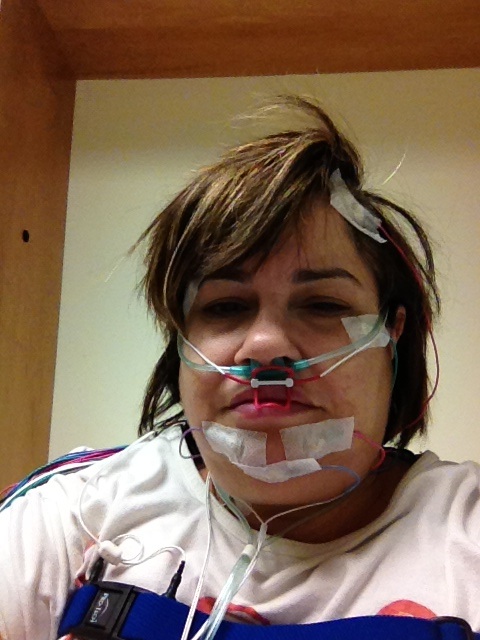
I walked in with my little overnight bag stuffed with books and back up clothes. “Get comfy,” said the technician. A few minutes later she started spreading glob in my hair to secure the electrodes. She fit me with tubing in my nose so she could blast me with oxygen if she needed to. I had electrodes on my legs to test for restless leg syndrome and I was also hooked up to an EKG. To top it off, I had one of those bulky finger clips to keep track of my oxygen saturation. I wore a kind of necklace that looked like a fuse box that could easily plug in and out of the machinery keeping track of my body functions in case I had to go to the bathroom. I looked like a robot. I had to go to the bathroom a lot.

The technician gave me a perfunctory definition of sleep apnea—when your airways shut down temporarily—and how that affected sleep and overall demeanor. If I was experiencing sleep apnea she’d replace the nose tubing with an oxygen mask during the night. I tried on three different masks and chose contestant number two.

I called my house just before lights out and said I wanted to go home. “I know,” said my husband. We had already established he wasn’t allowed to come to the testing site to be with me.

I don’t know if I have sleep apnea. The technician told me that she was not allowed to discuss any results with me and I won’t hear anything from my own doctor for a few weeks. But I actually slept for a few hours and I woke up maskless. When I tried to confirm that I didn’t need a mask at any point in the night, the technician said again that she was prohibited from talking about any aspect of the test with me. She sounded like she was wearing her own fuse box.

“And if you don’t have sleep apnea,” asked my concerned children when I got home, “will you keep snoring.”

“Yup,”  I said. “And it’ll be your turn to sleep in the bathroom the next time we share a hotel room.”

The ABCs of Autism

One of the greater challenges of writing this column is to convey as many aspects of parenthood as I can despite my lack of expertise in a particular parenting topic or dilemma. This means that I have to go beyond my experience as a parent to understand issues with which I’m not familiar – to step out of and look critically at my own parenthood in search of empathy and appreciation for what other parents encounter.

I’ve wanted to write about autism for a long time, but felt I didn’t have the right despite the fact that someone I love very much was diagnosed as a toddler. But the topic has so preoccupied me that I wanted to honor my relatives who have fought so hard for their autistic son to be educated in a school where he is not left in isolation for hours at a time if he becomes agitated. They fought for their son’s right to go to an out-of-district school that would properly nurture him as part of his education. After a lot of tears and angst and legal maneuvering, they won.

I read blogs and books by parents whose direct activism on behalf of their autistic children are changing the way the world understands and accepts this disorder. I think these parents’ dedication has created a historic movement that has led to groundbreaking research on the topic as well as captured an elusive empathy.

To do my job properly, I want to point to people who have shared vital, life-changing stories about the sad, surprising and beautiful ways in which autism has shaped their families. Susan Senator, a local Bostonian, is one of the most passionate and effective teachers and writers I’ve read on autism. Susan’s mothering of her severely autistic son, Nat, is brave and hard, and completely natural. Read her blog. Search out the three books she has written about autism and family life. You’ll learn so much about autism and the obstacles she’s overcome bringing her son to adulthood.

Here’s a lively example from the introduction to her Web site, susansenator.com: Leo Tolstoy once wrote, “Happy families are all alike; unhappy families are all different in their own way.” Tolstoy was wrong, especially when it comes to atypical families. My family is very different from a lot of families; yet I would say we are happy. My oldest son, Nat, now 21, has severe autism. My other two sons, Max and Ben, do not. Autism has provided a certain shape to our family structure; things have been very difficult for us, and yet autism is not a death sentence. Autism is not the end of the world; just the end of one kind of world.”

I recently discovered another go-to parent on autism on the New York Times Motherlode blog. Joel Yanofsky has chronicled his adventures – yes, I use the word intentionally to capture Yanofsky’s wonder and confusion and, at times, sense of urgency as he parents his son Jonah – in a lovely memoir called “Bad Animals.” I came to his book after reading his essay about preparing Jonah to become a bar mitzvah. It’s a piece that works so well and is so memorable for the way it melds humor and pathos:

Anyone who’s organized a bar or bat mitzvah, a communion, a sweet 16, even a relatively big birthday party knows how much there is to prepare. But when your child has autism, as Jonah does, the preparations never seem to end; nor does the worrying about everything that might go wrong. So, yes, it’s even money that on the day of his bar mitzvah Jonah will do something interesting. I’m betting that just as the rabbi is briefing him on the significance of this time-honored ritual, Jonah will give a shout-out to his favorite animals, yaks and zebras.

Hence the title of Yanofsky’s memoir – a reference to Jonah’s obsession with all things related to animals and the title of his illustrated book for a school project, which features animals arranged alphabetically in various states of bad behavior. But the genius of Yanofsky’s memoir is that his son is never an object of curiosity. Nor is Jonah a saccharine source of inspiration. He is what every child should be to a parent: the source of an indescribable love that is more than occasionally laced with frustration, amusement and pride.

As engaging as Senator and Yanofsky are – as brilliant as they are at breaking their readers’ hearts and then putting those hearts back together for them – they are at the end of the day parents who are mired in a thick alphabet soup of acronyms that stand for bureaucratic and sterile terms like Individualized Education Plans, Pervasive Developmental Disorder, Applied Behavioral Analysis. IEP, PDD, ABA – they feel like billboard-sized letters taking over space and time in hearts and minds and homes.

But Senator and Yanofsky are not Don Quixote figures tilting at inflated letters. They scale these letters to tell the world exactly what their children – their autistic children who have created unique, bright universes around which their families orbit – deserve. And it’s not an acronym: it’s a basic right called Respect.

I Pledge Allegiance

With the 4th of July just around the corner, I’ve been thinking about the Pledge of Allegiance. For over a century, American children have sworn loyalty to our flag and to the idea of a country where “liberty and justice for all” is commonplace.

Some history of the Pledge of Allegiance with a brief timeline: The Reverend Francis Bellamy wrote the original Pledge in 1892. It first appeared in a pamphlet called “The Youth’s Companion.” Bellamy intended the pledge to be one size fits all in that any country could adhere to it in principle. Here’s the original wording:

I pledge allegiance to my Flag and the Republic for which it stands, one nation, indivisible, with liberty and justice for all.

In 1923 the pledge was changed to include the words “the Flag of the United States of America,” erasing Bellamy’s utopian globalism.

In 1954 President Eisenhower evoked God as a response to the threat of Communism. Bellamy’s daughter objected to adding the words “under God.” Nevertheless, Congress approved the revision.

I pledge allegiance to the flag of the United States of America and to the republic for which it stands, one nation under God, indivisible, with liberty and justice for all.

The pledge takes me back to what I once thought was my father’s Ivory Snow patriotism. But patriotism is complicated by burden and pride. The more I think about Dad’s national fealty, the more I realize that his patriotism was mixed with a fierce will to serve and protect our country.

I remember my childhood home festooned with the Stars and Stripes flying from the windows on every American holiday. In my 21st century mindset the word allegiance also calls up an old-fashioned concept that can go awry with no room for error. Think fundamentalism, terrorism.

All of this remembering puts me in a midrashic mood. Here is my take on words said early and often in classrooms across America. Here is a legacy that I hope will inspire Anna and Adam to take the Pledge of Allegiance off autopilot so that they find their own meaning in those well-known words.

I pledge allegiance to the flag of the United States of America

I first memorized those words in Miss Blake’s pre-school. Miss Blake lived in a house that might have once been in a fairy tale. Her school was up the street and a million miles away from my house. The living room and dining room were the classroom and playroom respectively. The backyard had seesaws, a sandbox and swings galore. In what was essentially a two-room schoolhouse, I first pledged allegiance to the flag of the United States of America before I knew what a pledge was or what that rubbery word allegiance actually meant.

Thirty years later, the words immediately came back to me in Anna’s kindergarten class. After sitting in a chair sized for a five-year old, I maintained my balance and stood up to pledge. Hand over heart. Just like Miss Blake taught me. Note, that Bellamy’s vision of honoring the flag included a military salute with the right arm extended and the palm down. The gesture, eerily similar to the Nazi salute, was jettisoned during World War II.

And to the republic for which it stands

I think our republic stands for inclusiveness, but American inclusivity is often as convoluted as trying to remember a dream. When Bellamy first wrote the pledge my paternal grandparents were infants born in the Ukraine and passing through Ellis Island to take their turn at American prosperity.

One Nation Under God

When God was ushered into the pledge in 1954 my maternal grandparents heard rumblings from a rickety dictatorship that would soon give way to a government painting Cuba in un carmin encendido—the blazing red of communism that President Eisenhower feared.

Indivisible

The first thing I think of is a prime number—a number that can’t be divided by any other number. I believe that America’s indivisibility is steadfast and humane. All who are hungry come and eat. All who are needy come and celebrate America with us.

With Liberty and Justice for All

God joyfully listens to the Sh’ma—Judaism’s central tenant—in 70 languages making English Only signs in this country highly irrelevant. To my mind, proclamations of American Owned on the marquees of small motels that I recently saw seeding parts of Route 1 in Florida replace signage blaring: No Jews, No Blacks, No Dogs.

Listen up America: “The Lord is God, the Lord is One.” Bearing those words in mind, we circle back to the pledge to stay as one nation under God in a country always aiming to be indivisible .

The Graduate

Thank you for asking; the graduation was lovely. But you can probably sense that’s the party line. The ceremony was actually surreal, emotional and intense. We are, as the old saying goes, in the big leagues. Next stop, university.

I’ve known a lot of Anna’s fellow Gann Academy graduates since kindergarten at Schechter in Newton. Over the years, I’ve stayed quiet in my role as chauffeur to eavesdrop on their arguments and their gossip. When they were in that state between dog-tired and overwhelmed, I heard about their dreams and their fears.

In the mix of growing up together these kids have loved each other, hurt each other, admired each other and, in the end, I think they’ve come to appreciate the time they’ve shared together. Who knows when and where they’ll resurface in each others’ lives. As for me, I’ve watched the Class of 2012 sing and dance. I’ve watched them cry and fail. I’ve watched them whoop for joy when they aced a test. I’ve watched them be remorseful as well as get away with murder.

No one grows up without witnesses. As I dabbed my eyes during the ceremony, what flashed through my head as quick as lightning was that no one parents alone either. Whether or not we admit it, we’ve all been in it together. By that I mean we have some piece of real estate in each other’s hearts and memories. We’ll think of each other at random times when we remember the eighth grade play, or the stunning senior class presentation that melded poetry and song and choreography, bringing us to our feet. Or maybe we’ll just sigh over that long-ago last day of kindergarten.

And then at some point we’ll try to figure out when our children grew up. I can’t give you an exact event or call up that one defining moment that Anna and Adam became autonomous, fully separate from Ken and me. It might have happened as Adam shot up 11 inches in the last two years and steadily improved his running times.

For Anna, maybe it was when she was able to reach into her soul to articulate insights that were hers alone. These past couple of years her spirit and brain were in synch when I read her English essays or rabbinics papers. And yes, there was the college application essay about why she hadn’t learned to drive. (She still doesn’t have her license.) She wasn’t thrilled about the other cars on the road or having to parallel park. But mostly she was worried about losing the intense, personal connection that uniquely incubates on our car rides. With Ken she talked science and music. With me it was the latest family news or class intrigue. But mostly she just needed us to listen as she took apart and put back together the personal conundrum of the moment. At the graduation ceremony, Anna gave the invocation for the Class of 2012. She wore a graduation cap that made the claim that one-size fit all. But I’m not exaggerating when I tell you that that cap looked unique and beautiful on every single graduate. And yet even in her three-inch wedges, Anna still looked like my little girl going to a big university. That is until she told her fellow graduates and their families that:

Gann is truly a place that fosters individuality while still emphasizing the importance of community. Who we become as a person before we leave Gann is just as significant as who we become as a class. In Numbers Chapter 24, Bilam, a member of the enemy nation of Bnei Yisrael, finds himself blessing Jacob and Israel as he looks upon their camp. As the spirit of G-d enters Bilam, he utters the famous phrase “ma tovu ohalecha Yaakov, mishkenotecha Yisrael, how lovely are your tents O Jacob, your dwellings O Israel!” In a moment of genuine awe and humility, Bilam first blesses the individual, Jacob, and then the community, Israel. Like Bnei Yisrael, Gann should be admired not only for the amazing individuals it produces, but also for the classes as a whole, each unique in character and reputation.

Our class of 2012 is no exception. Amongst us we have varsity athletes, talented artists and musicians, jugglers, a cappella enthusiasts and even the lone Irish step dancer. However, each individual connects to those around them, latching on, creating a network that when viewed from the outside is beautiful both for the entities, and the class as a whole. These individuals together make up something much larger, perhaps even awe-inspiring when looked at with the spirit of G-d. May we always take pride in our individuality while finding strength in our community.

The first time Anna read her speech to me, I broke into song. Literally. One of the first tunes I learned in Hebrew contained Bilam’s famous blessing. Lovely, billowing tents. The croaking chorus of 6th grade voices. I still remember those kids. Anna and I sang my version of “Ma Tovu” on the way to one of her graduation rehearsals.

How lovely you are, Class of 2012.