A Letter to Anna: Balancing Work & Life by Judy Bolton-Fasman

Dear Anna,

I watch you carry on with your dream of going to medical school and I’m already worried about the work-life balance issues you will inevitably face. Having a profession will present you with a unique set of challenges that men don’t encounter. We are socialized to be the family’s primary caregiver; men are ingrained to be the breadwinner. It’s changing, but it’s changing too slowly.

stethescope

Maybe I’ve come late to the party, but a book by local author Michelle Cove and an article by law professor Anne-Marie Slaughter have me reaching deeply into my own life. Let me start by saying that I want more for you. It’s not that I don’t have enough or I haven’t made a successful go of my writing career. But my earnings don’t reflect the hours and the keen effort that I put into my work. While that’s been a source of frustration for me, on the flipside I have control over my schedule. I can run an errand or stay home with a sick kid. But if I do that, you can be sure that I’m working after dinner to make up the time.

Slaughter was a high government official in the Obama administration who decided to return to her teaching position at Princeton after two years. Her son was in the midst of a rocky adolescence and Slaughter went home to spend more time with her family. She published an article last July in The Atlantic called Why Women Still Can’t Have It All. At first glance that title is very provocative. But that’s not why I resisted giving the article a close read. I was scared to hold myself up to this super woman who worked closely with Hillary Clinton and then returned to a tenured position at Princeton University. Until she went to Washington she was Dean of the Woodrow Wilson School at Princeton. Slaughter and I are not in the same league. But I read on and I found some comfort. “There are genuine super women,” Slaughter writes. “These women cannot possibly be the standard against which even very talented professional women should measure themselves. Such a standard sets up most women for a sense of failure.”

Let me back up and mention that I read Slaughter’s article after I read Cove’s book, “I Love Mondays.” It’s a unique book for the way it crosses genres as both a handy reference guide and a practical self-help book for working mothers. Subjects range from how a mom should minimize her guilt if she misses a soccer game to moms, like me, who have home offices and must establish strict boundaries. In a recent interview, Cove agrees with Slaughter that having it all is “completely unachievable. It’s not a sustainable state. Power constantly shifts and we need to be much gentler on ourselves.”

Anna, I think the generation between us is dealing more realistically with the work-life balance than my peers or I have. Slaughter quotes a pair of 30 year-old women who realize the importance of linking together every aspect of their lives. I quote them through Slaughter because I want you to hear their bluntness.

If we didn’t start to learn how to integrate our personal, social, and professional lives, we were about five years away from morphing into the angry woman on the other side of the mahogany desk who questions her staff’s work ethic after standard 12-hour workdays, before heading home to eat moo shoo pork in her lonely apartment.

This scenario begs a question you’ll have to grapple with someday—“finding the right sequence of family and career.” When do you marry? When do you have a baby? Slaughter and Cove agree that there is no definitive answer.

Cove has been thinking about these issues for a long time and her book was a natural successor to her documentary “Seeking Happily Ever After.” The film was a retort to media representations of 30-something women who were either career obsessed or so desperate to get married that they were driving men away. Cove notes, “As a journalist and a writer I was interested in why the headlines were proclaiming there were more single 30-something women than ever. I picked up a video camera and did street interviews.” The big take away for you, my dear Anna, is to know that women can define their own “happily ever afters.”

I have faith that your generation will finally tease apart the false morality and promises of “family values.” That by speaking up about implementing family-friendly policies in this country and acknowledging the importance of work-life balance, you and other women will close in on the “leadership gap” in the White House, the corridors of multinationals and yes, even the home.

As for me, I’m starting to understand my choices as part of “the new gender gap”—that is, measuring my success by my wellbeing rather than a paycheck. Maybe I’m not too late to take advice myself. In fact, I think I read Anne-Marie Slaughter’s article and Michelle Cove’s new book just in the nick of time.

Love,

Mama


*Cancer: A Big Sister’s Story

I don’t know the name of the flowers that mysteriously bloomed alongside the driveway of our childhood home at 1735 Asylum Avenue. But every spring you and I posed for pictures in front of that small, jungley flowerbed. We grew up together in that house. Back then it was unimaginable that someday we would be middle aged and that you would have breast cancer.

Until recently, I was always dying to know the future. Remember when we had a bit of trastienda with Mom? Trastienda, one of those words that intrigued me.

Trastiendathe back room of a store where secrets are exchanged, fortunes told or blackmail delivered.

Remember that weekend in Miami Mom’s relatives when whispered about her spinster daughters. I was twenty-nine, you were twenty-six. We went to a tarot card reader that had hastily set up shop in the back of a beauty salon. The only beauty in the place was the delicate, exquisite cobweb on one of the hair dryers. Consuelo the Fortune Teller didn’t look too pleased about my cards. She said I would write children’s books or teach. I’d also eventually marry a man who already had a child. “Cuando?” Mom screamed. “I had three children at her age.”

Consuelo told you to throw water out the window and scream “vaya, vaya,” a sure-fire way of sending away any love that lingered for the wrong man. Obsessive loving—it’s in our genes like eye color. Mom still pines away for Manuel, an old boyfriend who may or may not have actually existed. We were told that if you followed Consuelo’s instructions, you’d have a husband in no time. It turns out that Consuelo (did you know her name means consolation in Spanish?) mixed up our fortunes.

Even so, a few months ago I convinced you to go hear a spiritual medium with me in a synagogue on the North Shore. You had just had the biopsy and wanted to avoid the future. But I convinced you that I had questions for our dead father and that you’d want to hear his answers.

Surprise, surprise, it was Grandpa Willy who broke through to this world. We were in a large auditorium and there were a cluster of dead Williams hovering near us. The medium—this time young and runway stylish —wore a headset. “Operators are standing by” ran through my mind like a ticker tape. Is God standing by too?

The pretty medium explained that families whose dead have the same first name tend to sit in close proximity at these kinds of events. She heard one of the Williams whisper something about breast cancer. She turned abruptly away from us. “Cancel that. No breast cancer for you.” She was talking to another family with another dead William seated a couple of rows behind us.

I feel that I’ve learned a lesson at your expense. I don’t want to know anything about tea leaves and tarot cards and mediums anymore.

After all these years, you and I still don’t smile much. The first thing the men that we married noticed about us was our lovely, sad faces. We used to laugh, though, when mail came addressed to 1735 Asglum Avenue instead of 1735 Asylum Avenue.

Like the annual appearance of those floppy, pink-red flowers lining the driveway, somehow we also bloomed. When those odd flowers popped open, they looked like the O of your mouth when I made you cry. I never left a mark on you, and when you cried the cry of a hurt little girl, Dad snapped at you for crying crocodile tears again. In case you’re still wondering, crocodiles have lachrymal glands, but they only cry to clean their eyes. A crocodile feels no remorse. I hope it’s not too late to tell you that your tears were not the same as a crocodile’s.

If you were the crybaby then I was the liar. That moniker still follows me like tails on the kites we loved flying on the fields of Saint Joseph College.  Like Scheherazade, I lied to save my life. I taught you that invaluable skill.

I was Mom’s favorite—her Siamese daughter who shared her heart and mind and language, until I wanted my own memories to shape and impress my life.

You were Dad’s pride and joy—the pint-sized fan that screamed, “Roughing the kicker” at Yale football games. This was in sacred service to Dad’s venerated Elis, so that the team could gain an easy ten yards and a first down. No one at the Yale Bowl was more adorable than you. Dad, a solid man of principle and fairness, could only bring himself to give you a pro forma scolding for bad sportsmanship.

On Saturday nights, Dad showed you off to the guests in the living room.

La mas linda della familia.” You were always the prettier one.

I pretended to be asleep in my twin bed when he carried you downstairs. I was Leah to your Rachel—the older, dowdier sister that the Bible described as having “weak eyes.” My eyes were an ordinary brown. But Dad said that yours were as “black as Spanish olives.” You were part and parcel of Dad’s infatuation with all things Spanish. Yet most everyone thought we were twins. Mom dressed us in fancy matching outfits for those spring pictures, while she refused to change out of her housecoat.

Isn’t it weird that the mystery flowers started dying off when Dad began to forget how to get home from the supermarket? I thought those flowers would last forever. Sometimes I tear up when I remember the lawn guys hacking away at the last remnants of our odd little patch of garden.

Chemotherapy has balded you down to the last root of your thick dark hair. Remember how much we loved the song “Gypsies, Tramps and Thieves?” There’s no one who can pull off a headscarf and hoop earrings better than you. The other day I was walking up the stairs in your house and I thought you were sitting in your guest room—your back was to me—and you were wearing the wig. I was surprised because you said the wig was hot and itchy. I was further startled when I called your name and your voice answered me from another direction.

In the 60s Mom’s wearing a wig was as subversive as burning a bra. The wig was her reprieve from constantly teasing and wrapping her long mane of hair that Dad insisted she never cut. I was so scared of Mom’s wig that I couldn’t be alone with it in her bedroom. Turns out, your wig was also displayed on a macabre sculpture—a head with a nose and mouth and eyes as blank as white space.

Mom called her piece of lifeless hair a fall and anchored it to her head with stretchy, colorful headbands. But I liked it best when her hair was pulled up as if she was ready to wear a mantilla. She never had the kind of patience for my knotted hair. Bolones is what she called my clots of hair that she pulled at with a plastic comb.

After your buzz cut you were startled that Dad looked back at you in the mirror. His face was transposed on yours, complete with the same weary and watery eyes. You’re bulldogs the two of you. Dad’s Yale bulldogs that you rooted for too.

When you found the lump lotioning up in the shower, you had no idea this would be the scene of another trastienda. Your fate was sealed when all you wanted was to smell good to meet your favorite and only niece’s boyfriend—my daughter’s first love. I panicked when my baby’s courtship took off. “It’s not the same,” you said. “She has a loving home. If she falls apart she knows you’ll be there to put her back together.” You also said that I would have been as happy as my girl l if I’d had a loving mother. I’d settle for a mother—warts and all—who simply had had good intentions.

Until you had breast cancer, I thought margins only existed on sheets of paper. But margins are also hurdles you had to jump over. As in, your margins needed to be further cleared. After the lumpectomy you had a second surgery to widen what I imagined this time as a protective border of white space. If your numbers were any higher you would have needed a mastectomy.

At your insistence, soon after your diagnosis, I went to an artist’s colony for three weeks. I was 1500 miles away and floating through what I can only describe as a valley shadowed by despair. No treatments were scheduled for you until I returned. The truth is that no course of treatment was decided for a couple of months. The mills of the cancer gods grind slowly. That’s a tagline for a fortune cookie.

In the middle of my writing residency you called to tell me that your lymph nodes were clean. I was struck by how filthy cancer is—a realization as loud as the thunder you were once so frightened of. I almost didn’t hear you say that you also bought the optional chemo insurance policy. “I want this thing destroyed,” you said. “Torpedoed.”

Our readiness for the battle thrills me. And scares me. Scares me as much as the short haircut I vowed to get. I was in sixth grade the last time I had short hair. My hairdresser initially refused to cut my hair as short as I wanted her to. “We’ll do it in two stages,” she said.

“One stage. Like my sister’s cancer.” But she was insistent that it was too much change at once. After the haircut my hair was shoulder length.

The first time I saw you bald I went back to the salon without an appointment and said, “Round two.” People gathered around me and said I was so brave. Hair grows back for goodness sake. But I can’t stop stroking my phantom ponytail.

You cried when you saw me with short hair. You said you were so sorry you changed our family history for the worse. Our health is collective, like our girlhood.

Since your diagnosis we’ve been bargaining with everyone from doctors to employers to a God who acts enthroned and entitled. Here’s the only deal I want to strike: next spring we have a lush, veritable garden of our new lustrous hair.

And then, I imagine, we’ll pose for another picture.

*Please note this is an older piece. Thank God, my sister has come out the other end and among many things has a beautiful head of hair.

The Life You Save May Be Your Own: The Boomer and The Holocaust Survivor

Boom goes my generation with all of the energy and chaos of an atomic blast. Born between 1945 and 1964, there are seventy-six million of us in the United States. Boom goes my generation as we take our places on a historical continuum of social and political revolutions. Boom goes my generation as we take care of aging parents and the children many of us had in our thirties and forties instead of our twenties.

I write this column in my mother’s room at the Hebrew Senior Life Rehabilitation Center. Her house has just been sold. At the moment, her world has shrunk down to one bed as in, “a bed’s come available.” She’s been poked and prodded and operated on while, boom, my siblings and I chase her benefits, balance her checkbook and watch her assets dwindle until Medicare kicks in.

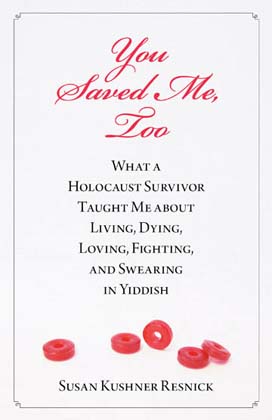
I also write this column after reading Susan Kushner Resnick’s funny, poignant and storied memoir about her relationship with a loveable, difficult Holocaust survivor named Aron Lieb. Boom goes my generation and some of us will blow up before we can appreciate the multi-generational relationships that can so enrich us. Kushner’s memoir is a vital reminder of how important it is to reach across the generational divide, and simply put, love each other.

The title alone—You Saved Me, Too: What a Holocaust Survivor Taught Me About Living, Dying, Fighting, Loving and Swearing in Yiddish— maps out Kushner Resnick’s book to some degree. The reader is cued into the fact that it is also a Yizkor book—A Book of Remembrance. Kushner Resnick tracked down the prototype of such a book about Zychlin—Aron’s shtetl in Poland. “This is not your first appearance in a book,” Kushner Resnick writes to her dear friend. “The other one, published when I was eleven years old [in 1974] is called The Memorial Book of Zychlin.” Boom. Most of that generation of Europe’s Jews disappeared in a pestilent cloud of Nazi genocide.

But You Saved Me, Too is a book of life as much as it is a Yizkor book. It begins with the fact that Lieb and Kushner Resnick both liked to talk to strangers. It tells the truth that their friendship rescued Kushner Resnick from a crushing post-partum depression. That was in 1997. Kushner Resnick has a baby that she leaves in babysitting at the JCC so that she can swim off her depression. She meets Aron Lieb on a lark at the same JCC. “[Aron was] my faux father, my son, my crush, and my cause.”

You Saved Me, Too is also a quixotic book. For anyone who has shepherded a parent through the murky health care system, Kushner Resnick’s advocacy for Lieb’s benefits and his dignity will resonate, deeply and painfully. Kushner Resnick is not shy about indicting the Jewish community and its leaders for Lieb’s benign neglect. In her tongue-in-cheek style, she takes on the honchos, the machors, who made empty promises to help a man who bore the ultimate tattoo of Auschwitz.

That tattoo, the number 141324, takes up residence in Kushner Resnick’s imagination. She notes the sloppiness of the letters—the tattooist must have been in a hurry to go down the long cue of people arriving at Auschwitz—the fact that, “for fifty years, every time you’d taken off your shirt at night or reached out to adjust your side-view mirror on a summer day, you saw those numbers, 141324, the brand the Nazis gave you when they thought you were theirs.”

Boom. Kushner Resnick becomes, in essence, a third-generation survivor or a 3G. She’s bent on keeping the memory of the Holocaust alive, intent on telling stories that go beyond the blue Yizkor books from Polish shtetls. “Eventually all the tattooed arms will disappear” she writes. “Then the forgetting will truly commence. … How would the numbers look on my arm? I could get the same tattoo in the same place. 141324. Whenever people asked what it meant, I could tell them about you.”

Although Kushner Resnick, is speaking metaphorically, there are 3G grandchildren who have actually tattooed their grandparents’ numbers on their arms. It’s a radical act that has stirred up as much pride as it has consternation among their survivor relatives. Those numbers are also an address of unimaginable tragedy and entrenched optimism. For all of his heartache and kvetching, Lieb survives because he has dealt with unbearable horror as much as he has thrived in the small joys of life like meeting his friends for a daily cup of coffee at McDonald’s.

With no significant family willing to care for him, Kushner Resnick becomes Lieb’s healthcare proxy and has power of attorney over his affairs. She secures his reparations and learns that she has to open a separate account so that the money is not taxed and therefore not counted as an asset. Boom. She learns that the Boston Jewish community pays mostly lip service to the survivors among them and that it’s a problem also prevalent in Israel.

Halfway through the book she questions her involvement in Lieb’s life. “I can’t write anything conclusive until I figure out why we’re together,” she says. “Some writers say they find the answers by writing their way towards them. But I need to know the last line before I type the first word.” I think I know what she means. My mother sleeps as I type these last words about Aron Lieb and Susan Kushner Resnick, the woman who made his life a blessing for the world to read.


When Bad Things Happen to Good Kids

A day on which a life changes forever always begins as ordinary – so ordinary that thereafter, daily life is a deliberate celebration.

Carolyn Roy-Bornstein writes about an ordinary day gone awry in her new memoir “Crash: A Mother, a Son, and the Journey from Grief to Gratitude.” In her engrossing narrative, Bornstein divides her life “into two unequal parts. A line, like a crack in the glass, which carves time and events into two: those that occurred before the crash and those that tumble and falter in its wake. There is the one moment after which nothing is the same. It occurs in a heartbeat.”


And so begins Roy-Bornstein’s extraordinary account of the minutes, hours and days following her son Neil’s accident with a teenage drunken driver. On the night of Jan. 7, 2003, 17-year-old Neil and his girlfriend, Trista, set off on foot for the short walk between his house and Trista’s. The driver who ran down the two of them sped away from the scene. Neil survived the accident. Trista did not. Nine years later Roy- Bornstein garnered enough perspective to tell the story of the accident that changed her family’s life with humanity and love.

Roy-Bornstein, a pediatrician practicing on Boston’s North Shore, demonstrates her gifts as a writer as she unfurls one of the illuminating quotes that introduce the book: “We must embrace pain and burn it for fuel for our journey.” In a recent interview with the Jewish Advocate, Roy-Bernstein pointed out that she and her family burned gallons of emotional fuel, particularly during the immediate aftermath when “[t]here was something called temporal lobe agitation,” said Roy-Bornstein, “which occurs in many brain-injured patients where they can become very disinhibited, very irritable and act in ways that are totally not like them.”

Neil, a shy and contemplative young man, uncharacteristically lashes out at his mother as both his parent and a doctor. This brings the reader to a poignant quote that gets to the heart of Roy-Bornstein’s story: “No amount of doctoring can prepare you for being a patient.”

She elaborates that “even though I knew it was [Neil’s] injury talking, that was very painful to go through. Months later I found him reading my diary at the dining room table. Before I could decide whether to ask him to stop or let him continue, he looked up at me and said, ‘I’m sorry I yelled at you in the hospital, Mom.’”

Roy-Bornstein’s memoir makes it very clear that first and foremost, she is a mother to Neil and her older son, Dan. And she tilts at windmills during her encounters with the healthcare system. Her frustrations are memorably dramatized in a chapter titled “He’s Gonna Be Just Fine.” Roy-Bornstein recalls, “When we were in the ER at the Brigham and Women’s Hospital, we were told by the emergency room physician that Neil was ‘gonna be just fine.’ But that has not been our experience. Almost 10 years later he still sees a therapist, suffers from anxiety and has petitioned the disabilities office at his graduate school program for a distraction free environment for test taking.”

Roy-Bornstein notes that even as a physician she was unaware of the subtle long-term effects of traumatic brain injury (TBI). After Neil’s accident, she educated herself about TBI and over the years has become a de facto ambassador for the Traumatic Brain Injury Association of Massachusetts. Her role includes educating other health care professionals as well as the general public about TBI. Roy-Bornstein’s advocacy on behalf of TBI patients and their families also extends to education about concussions: “I’m trying to get the word out about concussion and its long-term effects on kids. In July of 2010, Massachusetts instituted new guidelines for public, middle and high school students that require coaches who suspect a concussion in their student-athlete to sit them out for the rest of the game or practice. We’re trying to change the culture in youth sports and the old mantra of ‘If you can walk, you can play’ to ‘When in doubt, sit them out.’” Roy-Bornstein has shared her expertise on the subject on WBUR’s “Radio Boston” and on the lecture circuit where she educates healthcare professionals and social workers about concussion and traumatic brain injury. “It’s become my passion,” she says.

Roy-Bornstein’s passions also include advocating for victim’s rights and health issues related to teens and drinking.

“When the accident occurred there was a lot of chatter in the media about under-aged drinking and drunk[en] driving,” she notes. “A vocal minority of parents stuck by their practice of letting their teens and their friends drink in their home, believing that they were keeping them safe by taking away their keys. But even if kids aren’t drunk[en] driving they’re still drunk.”

And as Roy-Bernstein knows all too well, “Bad things happen to good kids and drunk[en] kids.”

Breaking Up Is Hard to Do

Dear Teen Me:

When you were growing up in the late 1970s and early ‘80s, it was easy to have a skewed view of love, especially with all those pop love songs you listened to — and inevitably dreamed would come true. If only there had been a meeting for you like the one I went to last week, dedicated to healthy teenage relationships. If only the adults around you had understood what I know now: that some consider teen dating a public health issue.

Today, the Boston Public Health Commission has a program called [Start Strong](http://www.startstrongteens.org), currently the largest funded national initiative aimed at preventing relationship violence and abuse among young people by promoting healthy relationships. Start Strong’s mission is powerful in its simplicity: “Stop teen dating abuse before it starts by using older teens to educate pre-teens.” To emphasize that message, the Commission has sponsored a co-ed gathering of teens for three years running called *Break-Up Summit*. This year, the event took place at Simmons College in Boston, Massachusetts, and focused on cheating as a catalyst to unhealthy relationships turning violent.

This kind of initiative didn’t exist when you were growing up — when boys were boys and girls were expected to be nicer than nice. My generation directly reaped the rewards of the Women’s Movement. Still, for many us, sexual liberation was steeped in guilt and bewilderment at how far we could go and, simultaneously, how badly a relationship could end.

At this year’s conference, teens attended workshops that helped them explore the landscape of healthy relationships, including “Breaking-Up In The Internet Age,” “The ‘What Are We?’ Conversation,” and “It’s Complicated.” In one breakout session, they debated what behavior constituted cheating and what behavior was perfectly innocent. Yes, they said, you can go out to a platonic dinner with a friend of the opposite sex. Actions that fell into a gray area were more difficult for them to agree on. “Flirting is a way of life, it’s healthy,” said one young man. “Dancing with a guy at a party even if your boyfriend’s there isn’t right,” said a young woman. Perhaps consensus is not the point. Teens need to build their own definitions of fidelity and respect.

But how often does that really happen? Today, teens are having sex at a younger age and with more partners. Their relationships are also driven by hormones and developing brains, which means they may not understand why they do what they do and feel what they feel. The drama, the moods, the end-of-the-world heartache — I wish you had known that they didn’t have to be standard issue for teenage relationships.

At the conference, I heard a lot of terms bandied about, like “hooking up,” “friends with benefits,” “just friends” and “full-blown dating.” It made me realize that while the language has changed, human nature hasn’t. One of the more potent metaphors a teenage girl used to describe cheating was a crumpled piece of paper. That’s what cheating does to a relationship, and though the deception may be followed by forgiveness, that sheet of paper will always have wrinkles.

When the program organizers displayed pictures of world-famous cheaters, some of the boys whooped when they saw Tiger Woods. And while there was not a single woman in the montage, the audience was abuzz discussing “Twilight” star Kristen Stewart’s [tearful apology](http://www.huffingtonpost.com/2012/07/25/kristen-stewart-apologizes-cheating-robert-pattinson_n_1702836.html?utm_hp_ref=entertainment&ir=Entertainment) for cheating on Robert Pattinson. Young women, in particular, seemed to admire Stewart for responding quickly by taking responsibility for her actions. Others were bitterly disappointed in her for cheating on Pattinson in the first place. As one girl wondered, aren’t women supposed to be above that?

Maybe it’s the characters she plays, but for me, Stewart embodies the notion of a fairy tale. The version of romance she projects isn’t real — just like the Top 40 songs that inspired and disappointed you, Teen Me, all those years ago. I know it’s confusing and upsetting to consider that fairy tales don’t exist, but in time you will understand that grappling with a strong, healthy relationship — with its inevitable peaks and valleys — is more romantic than an unattainable “happily ever after.”

And so what I want to say most of all, Teen Me, is something I never knew at your age: It gets better, and until it does, there are resources out there. There are people who want to help you extricate yourself from a bad relationship. That is the biggest takeaway of the Break-up Summit. If only you had been guided to realize that love is not a Top 40 song, I would have been spared suffering that was neither noble nor useful.

Love,

(Much) Older Me

The Care and Nourishment of a Parent by Judy Bolton-Fasman

The first thing to go was my father’s inimitable printing.

His letters—straight and precise—were self-portraits of sturdiness and discipline. I associated Dad with the single initial that grounded his name—K, as in K. Harold Bolton.

The K stood for Kenneth—a name he never used, a phantom name. Unlike its counterpart C, K is like the father of my childhood—unambiguously hard, unyielding to e or i. K— ramrod straight on one side—was like Dad’s perfect posture making it a letter to lean on, a letter from which to fly the flag that Dad revered. In Dad’s stately block printing K was declarative—shorthand for the unsolved mystery of why he preferred to be called Harold instead of Ken. And then one day K dissolved on the page as he tried to sign his tax return.

There is a Spanish saying that when a parent gives to the child, both the parent and the child laugh. But when the child gives to the parent, both the parent and the child cry. It’s strange and disorienting to watch our parents walk slower, remember less, pepper a conversation with non-sequiturs.

My Dad died ten years ago and I can hardly remember the shrunken old man to whom I fed strained carrots. Instead, in my mind’s eye he is stocky and vital and strong. Against his better judgment, he taught me to drive in the winter. “No one learns to drive in January,” he sighed as he told me to put the car in reverse to get out of a snow bank. Fifteen years later a policeman pulled him over for weaving in and out of lanes. The officer called that same night and said how sorry he was that he had to revoke Dad’s license.

I once saw a bumper sticker that said, “Be Nice To Your Children—They Choose Your Nursing Home.” I was horrified. Caring for our parents with grace and humility, without agenda, is one of the most crucial and moral lessons we impart to our children. Acquiring a new level of patience and love and fortitude is critical to helping a parent grow old in peace and security. It is also one of the most challenging aspects of trying to honor a father and a mother. Resisting the notion that one is parenting a parent—no matter how dependent a parent becomes that person is still the mother or the father—requires an iron-willed patience that insists on nothing less than dignity and respect at all times.

Over the years I have watched family and friends accompany a parent to chemotherapy sessions, stock a mother’s refrigerator each week, balance her checkbook at the end of the month or closely supervise health care aides for a father with a broken ankle. It’s the same skills they have acquired and honed as they bring up their own children. It’s the same admirable behavior that they learned from their own parents.

The day my father could no longer sign his name—the day his signature crumbled before my eyes—was the day he was trapped in his body and his existence curtailed to just a couple of rooms in his house. During the decade that he was ill my mother built a life that depended on the devotion of caregivers, the kindness of family and friends, and more often than not, favors from strangers. And when she could not keep up with Dad’s overwhelming needs the first things she set aside were her own health and sanity. During those years my mother and I had our disagreements over my father’s care, the medications he should or shouldn’t be taking. We had our difficult moments over whether he should go to a nursing home.

As my young children grew more aware of my father’s illness, they saw that I was helpless, frustrated, and angry. I was the one who was vulnerable as I tried to spoon food into my father’s mouth. It was my voice that was shaky when I read books to him. I was the one who looked clumsy as I tried to prop him up in bed. By watching me trying to care for my father, my children and I gradually realized that this kind of encompassing help included loving him anew as my father—a grown man who only appeared as a helpless child.

Neither Dad nor I imagined such a sad, drawn out ending to his life, but I buck against the idea that during that time he was anyone but my father.  And so in his memory I choose to focus on things like the precise checkbook he kept or the glitzy Valentine’s Day cards that he unfailingly sent me every year and signed in red ink—“With all my love, Daddy.”


Mourning Aurora by Judy Bolton-Fasman

Terry Tempest Williams is an extraordinary writer. She recently published a memoir inspired by boxes of journals her mother bequeathed to her – all of them blank. There was not a single word on those fresh, white pages. They were, as Williams wrote, “paper tombstones.”

That’s what I visualize—paper tombstones—as I invoke the dead and the wounded for this column. They are the victims of the wave of hate and terrorism of the past couple of weeks. The youngest victim at the movie theatre in Aurora, Colorado, where a madman opened fire on an unarmed audience, was six years-old. All she did to tempt death was sit next to her mother at the midnight premiere of The Dark Knight Rises—the latest Batman movie. Her fate was intertwined with 11 other people, some of whom died shielding their loved ones.

Here we are again, reading names. Piecing together life stories from the snapshots and accompanying biographical summaries. Here we are again in another “there but for the Grace of God Go I” moment.

And there are more names to remember. A suicide bomber attacked a tour bus of Israelis vacationing in Bulgaria. Five were flown home for burial and 33 more were wounded. Geopolitics boils over and once again Jews are targeted.

It’s a brutal time.

God has come up a lot in discussions with my kids over the Aurora tragedy. I dare say at this point Spiderman and Batman are more divine to them than a seemingly absent God. It’s not surprising. A movie featuring these two superheroes is not just a blockbuster; it’s what the industry calls “a movie event.” It’s a phenomenon. Think about Gotham City, Batman’s stomping grounds. It’s a deeply dark place with psychopaths at the ready behind every building.

A masked gunman armed to the teeth. The bewitching hour of midnight. Sex and violence on the screen. I don’t think for a moment that The Dark Knight Rises short circuited the killer’s brain. But the movie provided a horrifying backdrop. Reading the bewildering amount of commentary about the Aurora massacre, I remembered that President Reagan’s would be assassin, John Hinckley, Jr., was obsessed with the movie Taxi Driver. Loner to loner. Was it a deadly case of transference? Were Hinckley and the Aurora gunman seeking fame, attention, intensely negative admiration? Notice that I won’t name the gunman in Colorado. In this post-Internet age, I won’t make him easier to find on a search engine.

But in the aftermath of this tragedy, how do continue to live with any kind of normalcy? Thanks to Rabbi Harold Kushner’s deceptively simple, brilliant insight we know—we accept to some degree—that bad things happen to good people. Rabbi Kushner wrote his best-selling book from the rubble of his own heartache—his son, Aaron, died in his mother’s arms two days after his fourteenth birthday from a rare genetic disease. It’s no wonder that Rabbi Kushner’s title has a permanent place in our lexicon; he has put a name to a phenomenon so perplexing, so universal. People cling to the notion that tragedy is not deserved. God is far too complicated to want a tit for a tat. God is rarely in those details, I tell my kids.

I’m not wise or worthy enough to understand why God does the things that God does. I do know that when tragedy strikes as it did last week in Aurora and Bulgaria, I don’t believe God is vengeful or sadistic or masochistic. I try to convince Adam, in particular, that God has His reasons for stepping back to observe what human beings, purposefully created in God’s image, have wrought. I don’t know what those reasons might be. I only know that it’s a crazy, twisted, scary, beautiful world out there. Maybe God needs to see what we do next. We are, after all, in a relationship with the Almighty. Pass that along to the children, but don’t forget to talk through the anxiety and fear generated by the Aurora shootings. Don’t plaster this experience with “paper tombstones.”

In Terry Tempest Williams’ Mormon community she notes that the women keep journals and bear children. Her mother’s blank pages are an act of rebellion.  “How do you know your mother didn’t write her entries in invisible ink?” a woman asked Williams at a bookstore reading.

Williams said she wasn’t keen to find out if her mother had pulled a stunt like that. “My mother’s journals are words wafting above the page,” Williams writes in her memoir. Just like the spirits of the innocents that were violently murdered last week in Colorado and Bulgaria.

The Swing Set and the Birthday

The couple that bought the swing set from us drove a Honda Civic with two car seats side by side in the back. Just like us. The little girl had a baby brother. Just like us. I remember when we went to pick out the swing set—a gift from Grandpa and Grandma who told us to get the best for Anna and Adam. And we did. Two swings, a glider, a slide, a canopy and a ladder leading up to monkey bars.

On the car ride down, Anna suddenly announced that she was something that began with an “F.” Ken and I couldn’t imagine. Actually maybe we could, which is why we braced ourselves. “I’m firsty,” she said. “Ah,” we smiled, producing her sippy cup.

Anna’s eighteenth birthday is around the corner. Last week, the young family in the Honda Civic returned to our house in a rented van, took apart the swing set and went away with it. I watched from the window on the landing. The last thing to go into the U-Haul was the yellow glider. It lay on the ground washed up from the past. The man, the woman and the grandfather squeezed into the front seat and drove off into a life that was once mine.

Please, understand, I’m thrilled that my children have grown and thrived. I thank G-d every day for having the privilege of ushering them through so many seasons of joy. But up until now the changes within my motherhood have felt gradual. We went through grammar school in a series of days in which I looped around Newton dropping them off and picking them up. Quite often I’d defy the carpool rules and linger in the line to watch them walk in to school together. I knew their childhoods would not last, and yet I didn’t quite believe it. I always had another year. How different really was fourth grade from third grade?

I don’t like change. Loathe it. Probably because I’m afraid of it. Always have been. Quite suddenly my daughter can legally buy cigarettes and lottery tickets. She can marry without my permission. She’ll vote in her first ever presidential election and she’s told me quite forthrightly that she’ll make up her own mind about the candidates. And my son. He towers over me. Nine inches taller than I am and counting.

When we bought the swing set, our cholesterol was normal and our blood pressure steady and uneventful. Our kids woke up so early on the weekends that they watched videos sprawled across our bed while we tried to catch an extra hour of sleep. They fit in our laps and they were light enough to carry up and down the stairs. Now we lie wide awake early on a Sunday morning and our exhausted teens cram as much sleep as they can into the day. Both of their grandfathers died over a decade ago. One grandmother can no longer walk. We put all of our hopes and prayers and dreams that the other grandmother stays just the way we like her.

Like the great chess player that my dear father-in-law was, I can see five or six moves ahead. Heck, I think I can see the endgame. This has been a morose summer for me. If another person tells me that I’m going to love having my daughter away at college—ecstatic was how one veteran mama put it—I’m going to collapse and weep uncontrollably. Think of your newfound freedom, said another empty nester. I didn’t realize that I was in jail. What breaks my heart the most is that my kids know I’m sad about the coming transitions. No amount of denying on my part convinces them otherwise. Adam offers to cue up The King’s Speech for me when I’m teary. But he knows that not even Colin Firth can lift me out of my funk. I just have to wait until it burns off like fog. That’s what my father the inveterate weather watcher used to say about sadness. It burns off.

For fifteen years our swing set was the backdrop of my life. Flash, I see Anna’s friends trying to one up each other on the swings. Higher and higher. Flash, Adam and a friend are racing each other across the monkey bars. Flash, someone goes belly down on the slide. Memory has tempered old worries of broken bones and deep bruises. I’ve gone on to worrying about other things like broken hearts, crushing disappointments and anxious decisions.

Little kids, little problems. Big kids, big problems. I never liked that saying. And despite all the gloom and doom I’ve sprinkled between these lines, I don’t really believe the big kids-big problems equation. Especially today on my daughter’s eighteenth birthday. A few hours after Anna was born, I nursed her for the first time and watched special programming on the twenty-fifth anniversary of the moon landing. But the only thing otherworldly that night was that I was a new mother to the most spectacular baby girl on earth.

To Sleep, Perchance to Snore

The last straw was when I woke up in the bathroom of the Ritz Carlton in New York last weekend. I had made a semi-comfortable pallet for myself—two terry cloth robes, a few fluffy bath towels and a pillow I snatched from the bed just before I was exiled.

The four of us – husband, daughter, son and me – were sharing a room at the hotel. At one in the morning, my fifteen year-old son tearfully shook me awake and said he couldn’t bear my snoring anymore. Please, he begged me, do the sleep apnea study.

This wasn’t the first time I’ve slept on the floor of a hotel bathroom. It started last year on a family vacation. It was to be an idyllic week of looking at colleges in New England and upstate New York for my daughter. Of course, we only needed one hotel room. Who were we anyway, the Rockefellers?

But this last time my kids’ were intensely anxious about sharing a room with me. The previous couple of months my children had taken to shutting my bedroom door and theirs because my snoring was so cartoonishly loud. One night my daughter and her friends taped me so I could hear for myself how bad it was. I was horrified. I asked my husband how he slept through the racket. “I love you,” he said. He refused to comment further.

It was clear I’d have to go to a sleep center to get my snoring under control. I don’t know how I got so loud and disruptive in the first place. Nor am I sure when it began. Menopause may be a factor in there somewhere. So is the sleeping medication I take. In my late forties, I decided that I had had enough of the insomniac life. I was past my childbearing years. I deserved some uninterrupted sleep.

Truth be told, I didn’t want to go to a sleep center. I wasn’t happy about having to sleep in a weird, sterile place hooked up to machines that measured my brain waves and kept track of my oxygenation. I also didn’t want to know if I had sleep apnea because that would involve sleeping with an oxygen mask for the rest of my life. Yes, the rest of my life. The sleep technician made a point of telling me that several times.

I had no idea what to pack for my overnight at the sleep center. Pajamas, sweats? I opted for a nightshirt that said “Hot and Flashy.” You can play with the double entendre. I brought along my iPad so I could watch one of my favorite shows—a British Masterpiece Theatre import called Foyle’s War. It’s about a police inspector protecting his seaside town during the Second World War. I have a crush on Foyle and his younger sidekick, Sergeant Milner. I thought they’d be good company.

But before I got set up with the right sleepwear and the Netflix instant cue there was a matter of finding the place. It was a nondescript building in a business office park. But it was set back in the woods and when the technician let me in all I could think of was that I was stuck in a version of The Rocky Horror Picture Show. I felt as if I were in the wrong place at the wrong time.

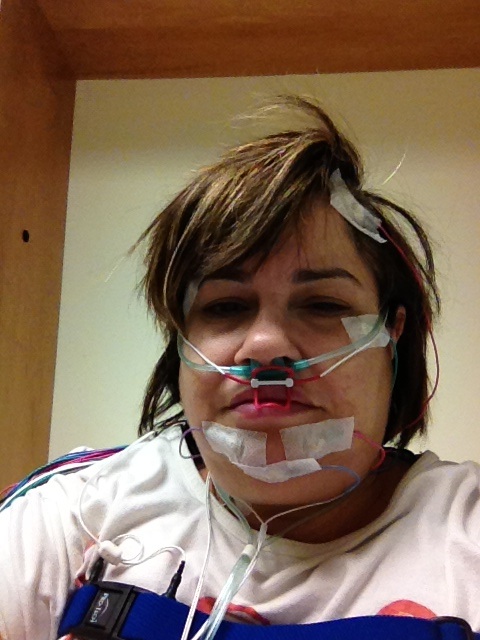
I walked in with my little overnight bag stuffed with books and back up clothes. “Get comfy,” said the technician. A few minutes later she started spreading glob in my hair to secure the electrodes. She fit me with tubing in my nose so she could blast me with oxygen if she needed to. I had electrodes on my legs to test for restless leg syndrome and I was also hooked up to an EKG. To top it off, I had one of those bulky finger clips to keep track of my oxygen saturation. I wore a kind of necklace that looked like a fuse box that could easily plug in and out of the machinery keeping track of my body functions in case I had to go to the bathroom. I looked like a robot. I had to go to the bathroom a lot.

The technician gave me a perfunctory definition of sleep apnea—when your airways shut down temporarily—and how that affected sleep and overall demeanor. If I was experiencing sleep apnea she’d replace the nose tubing with an oxygen mask during the night. I tried on three different masks and chose contestant number two.

I called my house just before lights out and said I wanted to go home. “I know,” said my husband. We had already established he wasn’t allowed to come to the testing site to be with me.

I don’t know if I have sleep apnea. The technician told me that she was not allowed to discuss any results with me and I won’t hear anything from my own doctor for a few weeks. But I actually slept for a few hours and I woke up maskless. When I tried to confirm that I didn’t need a mask at any point in the night, the technician said again that she was prohibited from talking about any aspect of the test with me. She sounded like she was wearing her own fuse box.

“And if you don’t have sleep apnea,” asked my concerned children when I got home, “will you keep snoring.”

“Yup,”  I said. “And it’ll be your turn to sleep in the bathroom the next time we share a hotel room.”

The ABCs of Autism

One of the greater challenges of writing this column is to convey as many aspects of parenthood as I can despite my lack of expertise in a particular parenting topic or dilemma. This means that I have to go beyond my experience as a parent to understand issues with which I’m not familiar – to step out of and look critically at my own parenthood in search of empathy and appreciation for what other parents encounter.

I’ve wanted to write about autism for a long time, but felt I didn’t have the right despite the fact that someone I love very much was diagnosed as a toddler. But the topic has so preoccupied me that I wanted to honor my relatives who have fought so hard for their autistic son to be educated in a school where he is not left in isolation for hours at a time if he becomes agitated. They fought for their son’s right to go to an out-of-district school that would properly nurture him as part of his education. After a lot of tears and angst and legal maneuvering, they won.

I read blogs and books by parents whose direct activism on behalf of their autistic children are changing the way the world understands and accepts this disorder. I think these parents’ dedication has created a historic movement that has led to groundbreaking research on the topic as well as captured an elusive empathy.

To do my job properly, I want to point to people who have shared vital, life-changing stories about the sad, surprising and beautiful ways in which autism has shaped their families. Susan Senator, a local Bostonian, is one of the most passionate and effective teachers and writers I’ve read on autism. Susan’s mothering of her severely autistic son, Nat, is brave and hard, and completely natural. Read her blog. Search out the three books she has written about autism and family life. You’ll learn so much about autism and the obstacles she’s overcome bringing her son to adulthood.

Here’s a lively example from the introduction to her Web site, susansenator.com: Leo Tolstoy once wrote, “Happy families are all alike; unhappy families are all different in their own way.” Tolstoy was wrong, especially when it comes to atypical families. My family is very different from a lot of families; yet I would say we are happy. My oldest son, Nat, now 21, has severe autism. My other two sons, Max and Ben, do not. Autism has provided a certain shape to our family structure; things have been very difficult for us, and yet autism is not a death sentence. Autism is not the end of the world; just the end of one kind of world.”

I recently discovered another go-to parent on autism on the New York Times Motherlode blog. Joel Yanofsky has chronicled his adventures – yes, I use the word intentionally to capture Yanofsky’s wonder and confusion and, at times, sense of urgency as he parents his son Jonah – in a lovely memoir called “Bad Animals.” I came to his book after reading his essay about preparing Jonah to become a bar mitzvah. It’s a piece that works so well and is so memorable for the way it melds humor and pathos:

Anyone who’s organized a bar or bat mitzvah, a communion, a sweet 16, even a relatively big birthday party knows how much there is to prepare. But when your child has autism, as Jonah does, the preparations never seem to end; nor does the worrying about everything that might go wrong. So, yes, it’s even money that on the day of his bar mitzvah Jonah will do something interesting. I’m betting that just as the rabbi is briefing him on the significance of this time-honored ritual, Jonah will give a shout-out to his favorite animals, yaks and zebras.

Hence the title of Yanofsky’s memoir – a reference to Jonah’s obsession with all things related to animals and the title of his illustrated book for a school project, which features animals arranged alphabetically in various states of bad behavior. But the genius of Yanofsky’s memoir is that his son is never an object of curiosity. Nor is Jonah a saccharine source of inspiration. He is what every child should be to a parent: the source of an indescribable love that is more than occasionally laced with frustration, amusement and pride.

As engaging as Senator and Yanofsky are – as brilliant as they are at breaking their readers’ hearts and then putting those hearts back together for them – they are at the end of the day parents who are mired in a thick alphabet soup of acronyms that stand for bureaucratic and sterile terms like Individualized Education Plans, Pervasive Developmental Disorder, Applied Behavioral Analysis. IEP, PDD, ABA – they feel like billboard-sized letters taking over space and time in hearts and minds and homes.

But Senator and Yanofsky are not Don Quixote figures tilting at inflated letters. They scale these letters to tell the world exactly what their children – their autistic children who have created unique, bright universes around which their families orbit – deserve. And it’s not an acronym: it’s a basic right called Respect.