A Heroine for Mother’s Day: Bunny Shapero

I met Beatrice Shapero, known universally as Bunny, 10 years ago in a preview class for Me’ah. Me’ah is an adult learning program that, in a hundred hours of classroom time, begins with Biblical history and continues through the founding of the State of Israel. It’s a two-year course of study. But if Bunny was up for it, what excuse could I possibly have not to enroll.

As it turns out, Bunny was the coolest octogenarian any of us had ever met. In fact, she was cool, period. She was also an incredible role model. Me’ah was just one of the stops on her journey of learning and becoming. Bunny came to Me’ah already primed for Jewish learning. A decade before, she had become an adult bat mitzvah and before that, well, she did a million things for the community. She was the young woman who sold bonds door-to door for the newly-created Jewish State in 1948. Rae Gann was the captain of her team, and for 12 years running Bunny sold the largest number of bonds in the group. Israel was so new, and Bunny never promised people that they would get a return on their money. But that was beside the point. Bunny loved Israel, and Israel needed the funds.

Bunny Shapero/Jim Weber Photography

Bunny also loves her synagogue. She’s been a member of Temple Emanuel in Newton for more than 50 years. During that time, she’s been the heart and soul of Sisterhood and the temple’s branch of the Women’s League of Conservative Judaism. No one comes close to selling Bunny’s quota of Torah Fund cards. She’s not sure how many she’s sold over the years, but at the last Torah Fund brunch she was close to moving 500 of those cards for the Jewish Theological Seminary. Bunny may not call herself a feminist, but that’s what she is. Her daughter, Susan, was the first girl at Temple Emanuel to have a bat mitzvah on a Saturday. Susan is a twin, and Bunny insisted that Susan and her brother, Martin, celebrate their b’nei mitzvah together. “They studied the same material, why shouldn’t they get the same recognition?” she reasoned. The ritual committee agreed and consented to the Saturday morning ceremony. Was Susan’s bat mitzvah in 1959 an exception? Yes. But it set an early and important precedent.

Bunny is a natural at setting precedents. This year, at 88, she is the oldest participant in the annual walkathon for the National Alliance on Mental Illness (NAMI). There have been nine walk-a-thons in Boston, and Bunny has walked the three-mile course at each one of them. A founding member of the Boston chapter, Bunny is committed to NAMI because she is devoted to Martin, who had his first schizophrenic breakdown at the age of 15.

“Mental illness is low on the totem pole when it comes to any kind of funding,” Bunny said. “That’s why I got so heavily involved in fundraising for NAMI the past few years.” As of Monday, Bunny had raised close to $10,000 for the organization – and that’s for this year alone.

She’s passionate about erasing the stigma of mental illness, ensuring research on schizophrenia and reducing homelessness among the severely mentally ill. “At the time Martin was diagnosed there was no awareness of the disease. People in the profession blamed the mothers,” she said. “Martin is 66 now, and sometimes I think [society at large] still blames the mother. But mental illness is all over the country, and no one knows exactly what goes wrong with the wiring in the brain.”

Bunny is also dedicated to bringing mental illness out into the open – to have the necessary conversations to give patients and their families hope. The mother of four, she remembers the veils of shame and secrecy that isolated families with a mentally ill child. Martin’s three siblings rarely invited friends to the house for fear he might have an outburst. “It was a silent illness. We didn’t talk about it. I’m so grateful for the support circles and the Family-to-Family programs that NAMI runs.”

Family members with a mentally ill relative staff NAMI’s Family-to- Family program. These volunteers are trained to provide information on everything from medication to day programs. Family-to-Family serves as a resource for the latest research and as an information clearinghouse for caretakers dealing with a loved one’s relapse.

Bunny has helped Martin through his own relapses. Like many people diagnosed with schizophrenia, he has often stopped taking his medication when he felt better. Bunny observes that he underestimates the role that medication plays when he begins to improve. “Medication is tough,” Bunny said. “A lot of it has been trial and error for Martin, and sometimes he feels like a guinea pig. But mental illness is like any other chronic disease. If you have a heart condition or diabetes, you need your medication in the same way.”

The day after the walk-a-thon is Lilac Sunday at the Arboretum. It’s also Mother’s Day, and Bunny and Martin plan to spend the afternoon together at one of their favorite places among the flowers.

Health Care from the Inside Out: Two Sisters, Two Perspectives

The first time I met Suzanne Salamon, she told my fuming mother that at 74, she was virtually a youngster in Suzanne’s geriatric practice in Boston. She also complimented my mother on her pretty green eyes, which forever put her in my mother’s corner.

Even my porcupine mother appreciated that Suzanne is a dream of a doctor – empathetic, smart and humble.

What I didn’t realize at the time of my mother’s first visit to Suzanne is that I knew her personal story through her sister Julie Salamon’s books. I had read Julie’s autobiographical novel “White Lies” about the child of Holocaust survivors whose father found meaningful work as a country doctor in a small Ohio town. Julie’s memoir, “Net of Dreams,” opens with Julie, her mother Lily (Szimi) and step-father visiting Auschwitz where her mother had been interned. Later in the trip, the trio crosses paths with Steven Spielberg who was filming “Schindler’s List” on location in Poland.

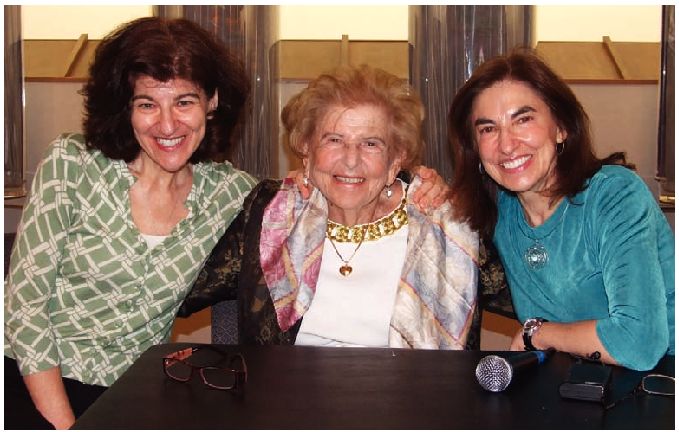
Julie, Lily and Suzanne Salamon

The sisters recently teamed up in Boston for the Hadassah-sponsored program, “Health Care from the Inside Out: Two Sisters, Two Perspectives.” Both women have collective wisdom and extended experience on the subject – Suzanne, as associate chief for clinical geriatrics at Beth Israel Deaconess Medical Center and Julie, as the author of another book, “Hospital: Man, Woman, Birth, Death, Infinity, Plus Red Tape, Bad Behavior, Money, G-d, and Diversity on Steroids.” The “hospital” of the title is Maimonides Medical Center in Brooklyn, where 67 languages are spoken and up to 705 beds are occupied at any time.

It’s clear that the sisters have early and influential memories of the power and the magic of medicine. Their presentation on the current health-care conundrum was as informative as it was compassionate. But it was also their interaction with each other – and their sweet acknowledgement of their mother, who was in the audience – that made their appearance particularly poignant.

The Salamon sisters’ physician father, Alexander (Sanyi) Salamon, had settled the family in Adams County, Ohio, after a difficult and ultimately false start in New York. The only doctor for miles, Sanyi Salamon’s patients revered him. Like many solo practitioners in rural areas, his office was attached to the house.

The sisters told a story that began late one night with a knock on the door of their family’s house. A couple had just received word that their son had died in Vietnam, and the mother was inconsolable. “I always wondered what my father did aside from tranquilizing the woman,” Suzanne said. Their stoic father never talked about his first wife and young daughter who perished in Dachau, but Suzanne wondered if he mentioned them that night to the woman. “As a mother, I looked at that story differently. As a doctor, that story taught me a lot about empathy.”

The year that Julie was at Maimonides, she observed the tension between the bottom line and patient care. “The business of a hospital comes down to people,” she said. “It’s a continuum of experiences from which emerged a lot of discussion of respect, communication or lack thereof. There are competing pressures to secure reimbursement and spend the right amount of time in a system hurrying them.” She added that the moment a patient is admitted to the hospital, the insurance company is forcing the staff to plan the discharge.

With Medicare reimbursements falling far short of actual costs, many geriatric practices are in debt. The 85 and over population is growing, and short visits for patients in their 80s and 90s are ineffective. There are complicated medical histories to sift through and difficult discussions to make about end-of-life issues, such as designating a health-care proxy, when to start palliative care and whether to insert a feeding tube.

“My job is to bring up tough subjects,” Suzanne said. To that end, she never uses euphemisms with her patients, with the exception of characterizing Alzheimer’s as memory loss. “There’s a lot less secrecy today. It’s been years since I’ve been asked to keep a devastating diagnosis from a patient,” she noted.

I looked around at the mostly senior audience and wondered how many of them had healthcare proxies? How many of them have been willing to hand over power of attorney to an adult child? I thought about the 15-year battle my sister and I recently won with our mother to help her legally with her financial issues and health challenges. Did my tablemates more easily accept help from their adult children?

At Maimonides, Julie observed a patient’s room transformed into a sacred space when the subject was end-of-life issues. Stereotypes about doctors and patients fell away as real people emerged. “Finding moments of grace can be difficult,” Julie said. “But part of what you give to your patients is your humanity,” Suzanne added.

The elder Salamons’ grace and humanity remained intact after Dachau and Auschwitz. And those tributes are in full bloom in their daughters: Suzanne Salamon, the doctor and Julie Salamon, the writer.

Better Living Through Chemistry: My Happiness Project

Color me jaded, but when I first came across The Happiness Project by Gretchen Rubin it sounded kitschy to me. Nevertheless, a couple of years ago I was curious enough to follow Rubin’s Facebook postings, most of which exhorted me to work on my happiness every day. A simple attitude adjustment, like telling yourself that you were happy, was the first step towards true contentment. Not really convinced, but I kept on keeping on.

I tried to lighten up for a time and absorb some of Rubin’s tips for chasing away the blues by picturing a new landscape, or taking in the following advice for combating boredom:

Take the perspective of a journalist or scientist. Really study what’s around you. What are people wearing, what do the interiors of buildings look like, what noises do you hear? If you bring your analytical powers to bear, you can make almost anything interesting. (Perhaps this is a key to the success of some modern art.)

No can do. I don’t have the patience. And Rubin’s subtitle serves as a telling abridgement— Or, Why I Spent a Year Trying to Sing in the Morning, Clean My Closets, Fight Right, Read Aristotle, and Generally Have More Fun. I have to say, none of things sound like fun to me.

The Happiness Project was born on a cross-town bus ride in Manhattan when Rubin was in a funk. Then it hit her: she was going through the motions of living rather than actually living. It seems like a deceptively simple epiphany. But step back, take a deep breath, turn off the internal chatter running through your brain, and take in your surroundings. Fully live in the moment. Not so easy when a child is not doing well in school or an aging parent is losing her memory.

Let me tell you about my own complicated happiness story. I’ll begin at the end. A few weeks ago I was driving the daily loop that encompasses the 15 miles between my children’s schools. Quite suddenly it hit me that I was happy. Not a euphoric kind of happiness, but simmering contentment instead of an acid angst dwelling in the proverbial pit in my stomach.

Not so remarkable until I tell you what happened to me a decade ago. Yes, I have two great kids.  I have a loving husband whom I adore. There is a mortgage on our lovely home, a Volvo in our driveway. And then the life that I carefully built with Ken came apart for no apparent reason. In layperson’s parlance I had a nervous breakdown. My depression and panic were off the charts. I’d been through this many times, but over the years I’d always managed to climb out of the pit.

This time it was different. The psychological pain wasn’t going away. I began going to weekly psychiatric appointments with Dr. G. For two months I debated, mostly with myself during those sessions, about signing on for an anti-depressant. One day Dr. G asked me if I would take insulin if I had diabetes. When I said that I would, he followed up with another question. Would I take medication to correct a serotonin imbalance? And so my personal happiness project began.

At first I grudgingly took the medication to function. The stigma be damned! Then I gladly took the medication to have a better life. So what if I traded twenty pounds for my happiness, and yes, my sanity. I got the better end of that bargain. Underlying my decision to fill that Prozac prescription was an obligation to do everything I could to be the best for my family. Anti-depressants are not a cure-all, but in conjunction with counseling they have worked wonders for me. That said; please don’t try this at home. Self-medication is dangerous and sometimes deadly.

I share my story to tell you that depression and anxiety can happen to anyone at any time. I share my story to tell you that working out at the gym or reading up on tips to boost your happiness can’t wholly address serious medical conditions like depression and panic disorder. Mostly, I’ve decided to go public to tell you that there is medicine and therapy and, yes, love out there.

Gretchen Rubin’s book is a fun guide to de-cluttering or cleaning out your closets But there’s nothing wrong with you if a best-selling paperback, meant to provide organizing tips leavened with a little perspective, does not lead you to your personal nirvana. I don’t care how many copies of The Happiness Project have been sold. It’s not a guide to expansive living, the Physician’s Desk Reference or a cure-all. And by the way, I’m much happier since I “unfriended” Gretchen Rubin on Facebook.


Le Bébé et le Gun-Toting Père: Pamela Druckerman Meet Tommy Jordan by Judy Bolton-Fasman

It seems the French do so many things better than Americans. The cooking is superior. Chicken nuggets? Non! The women are skinnier even though they eat their weight in cheese annually. And now we find out that the French are more successful parents. At least according to Pamela Druckerman, an American journalist who lives in Paris with her husband and three children. She details her anecdotal findings in her new book, “Bringing up Bébé: One American Mother Discovers the Wisdom of French Parenting.”

The book is a breezy cross between parenting manual and personal memoir. The takeaway is that French parents don’t sweat the small stuff and their kids are better adjusted for it. For example, I was impressed that French babies “do their nights” far earlier than their American counterparts, sleeping through the night on average at six weeks old. I guess French babies don’t get “le colic.”

French parents’ success continues by cultivating patience in their children. From the beginning, French children are taught to tolerate frustration whether it be discovering ways to amuse themselves or waiting until a parent finishes a phone call. The French are also visibly less child-centric. Play kitchens and matchbox cars don’t take over a living room in Paris. At least not the ones Druckerman has seen.

About halfway through Druckerman’s book, it suddenly hit me that she should meet Tommy Jordan. He’s the guy who tried to teach his very American teenager a lesson by shooting up her laptop. Furthermore, he videotaped his serious lapse in judgment for the world to see. It wasn’t so much the shooting that scared me (although that was very disconcerting), but it was Jordan’s eerie calmness on camera – a saccharine-like calm studded with emotional landmines that could go off at any moment.

The catalyst for this brouhaha was daughter Hannah’s rude Facebook post in which she bitterly complained about her chore-laden life. Laced with adjectives unfit to print here, Hannah was sick of cleaning up after her siblings and making coffee for her parents. As she points out, her family has a cleaning lady and her name is Maria, not Hannah.

Jordan was also miffed that the day before he read Hannah’s post he had put time and money into fixing his daughter’s laptop, for which she didn’t offer a single word of appreciation. The man clearly was pushed to the brink. What else could he do, but shoot his kid’s laptop at point blank range nine times? I don’t know what 18 million-plus viewers felt when they watched the gratuitous shoot up on YouTube, but I couldn’t shake the feeling that I was witnessing a crime.

If my daughter had written a churlish screed like Hannah’s, I’d be pretty angry, too. By the way, someone should tell Hannah that emptying the dishwasher and making the bed does not qualify as indentured servitude. But here’s where Pamela Druckerman could be useful to Tommy Jordan. First, it’s helpful that they have some cultural commonalities. I don’t think his cigarette smoking would put her off. Everyone smokes in Europe. (I can generalize too, Ms. Druckerman.) And they both like hats. Druckerman appeared on the Today show wearing a beret to emphasize the oh-so-Frenchness of her book. As for Jordan, he sports a ten-gallon hat.

My guess is that mistakes were made with Hannah from the beginning. She probably didn’t do her nights until she was at least 1 – embarrassingly late for a French child not to be sleeping through the night. She was probably never told to be sage. (In French, the word sage rhymes with Taj). Druckerman explains that when French parents urge their children to be sage, they are telling them much more than just to be good. They are exhorting their children to use their discreet judgment and to be in control of their emotions. For example, if Jordan had told his daughter to be sage early and often, she might not have impulsively posted that letter on Facebook.

As for Hannah’s appalling language, the French have solved that problem, too. Preschoolers have their own swear words. That’s right, there’s a lightly scatological phrase particular to kids that allows them to use naughty language in a controlled (there’s that word again) and, albeit, civilized way. I’m sure Jordan would not have minded Hannah’s foul language nearly as much if she were using parent-sanctioned epithets. Hannah’s overall rudeness might have been considerably less offensive if she were taught at a very early age to look an adult in the eye and politely greet them. “Hello” and “goodbye” in France get top billing with “please” and “thank you.” (I’m with the French on that one). Yes Hannah, that means that Maria the cleaning lady must be properly greeted and seen off.

As I think about it, maybe Druckerman should first use French parenting techniques on Tommy Jordan. After all, he acted like the more petulant child.

Out of the Pink — The Color of Breast Cancer by Judy Bolton-Fasman

It’s time to give pink back to little girls and boys. The truth is that breast cancer—any cancer—is a hot angry bloody red, undiluted by white.

Last year my younger sister was treated for breast cancer. The cancer’s progression was caught early, but because of her relatively young age the protocol was horrific. I hope and pray for the day when the medical community will look back on these bald, brutal days—days when a mane of hair is gone and eyelashes fall away—as completely unnecessary. Every day of my sister’s treatment, she’d tell me through sharp, stinging tears how much she wanted to live. And through my own tears, I would tell her that I was certain she would.

Breast cancer is a muddied swirl of dark fear mixed in with light hope. When did pink intrude as the emblematic color of fighting for survival?

Pink is the color of the shag carpeting in the bedroom I once shared with my sister. It was a small room with just enough space for two twin beds and matching dressers. We’d frequently engage in sibling rivalry by running masking tape down the middle of the room.

When my sister had the chicken pox, I thought, at 11-years old, that my sticky border would establish a boundary that kept me safe from the disease. It didn’t. I was blotchy and itchy two weeks later. That was the beginning of the end of magical thinking for me. Now in this gritty, very unpink world of ours, I’m impatient. Hurry up, I shout to someone, anyone with a hospital research lab, and find the definitive cure for all cancers.

Pink is the color of the flowers that mysteriously bloomed alongside our driveway. Every spring my sister and I, in matching outfits, were posed in front of those floppy flowers whose name I still don’t know. Back then it was unimaginable to us that someday we’d be older than our parents when the picture was snapped. As for breast cancer, it only happened in the distance of long generations, to our grandmothers.

Breast cancer was once the odd flesh color of a grandmother’s prosthetic breast. The rubber breast was built into her bra and my grandmother was forever adjusting herself. Grandma was diagnosed and treated for her breast cancer in the 1950s. My grandmother never said a word to me about her bout with breast cancer. My aunt told me about the mastectomy when I was a teenager.

When the buzz cut was over my sister was startled that our late father looked back at her in the mirror. Genetics can be shocking. And there wasn’t a note of pink when her steel gray wisps grew back like young shoots.

Breast cancer can lurk in the intense blank white margins where I’ve scribbled my mad notes about the disease. But cancer margins need to be wide and clear. After the lumpectomy my sister had a second surgery to broaden that protective border of symbolic white space. No masking tape this time.

When my sister told me that her lymph nodes were clean, I was struck by how filthy cancer is.

Pink is a color. Breast cancer is a disease. It’s time to stop confusing the two and return the color pink to little girls and boys.

Your Brain on Adolescence by Judy Bolton-Fasman

When Anna was a little girl, she once asked me if she had to hate me when she became a teenager. “Of course not,” I told her. I wanted her to love me unconditionally. I wanted her to love me forever.

But unconditional love for a parent is not that helpful for transitioning into adulthood. The better answer is, “Yes, you’re supposed to hate me once in a while. It’s part of a healthy teen’s developmental separation from her parents.” But bear in mind parent teen relationships are not black and white. There are many shades of gray between love and hate.

A recent study out of the University of Virginia found that allowing a child to argue with a parent calmly is important preparation for her to cope with peer pressure down the line. Specifically, the study found that 13- and 14-year olds who backed down from an argument with a parent were more prone to succumb to bad influences when it came to alcohol and drug us at 15 or 16.

Helping teens to argue fairly and effectively is often a two-step forward, one-step back process. I know for the sake of my children I must have the last word on a sensitive topic such as drinking at parties or teaching them about sexually transmitted diseases. This is tough stuff so a dialogue – albeit one that is managed by a parent – is essential for allowing kids to talk through these difficult subjects.

When I’ve stepped back and listened, I often like what I hear from my kids. They’ll tell me that they have sound judgment and hang out with a group of like-minded friends. They’re right, but I’ll necessarily counter that there are strict under-age drinking laws in this state. Or that one careless physical encounter can saddle them with a chronic, or even fatal, illness.

Then there are the complicated mechanisms of the teenage brain. Over the past decade, researchers have found that a teenager’s wild mood swings and penchant for risky behavior are not just about raging hormones. The adolescent brain – particularly the prefrontal cortex that is responsible for rational thinking – is developing at lightning speed during the teenage years, causing dramatic changes in behavior. Complementary research on the adolescent brain has also found that teenagers don’t necessarily underestimate risk. Rather, they overestimate the reward that comes with dangerous activities.

Throw into the mix that many of us have prolonged our kid’s childhoods by giving them a free pass on making adult decisions. National Public Radio recently reported that a number of parents negotiate job salaries and apartment leases for their recent college graduates. This kind of interference short-circuits the evolutionary hardware that allows young adults to accumulate the hands-on experience to make thoughtful decisions. On the other end of the spectrum, a recent article in The Wall Street Journal pointed out that with puberty starting earlier and adulthood starting later for our children, emotional and physical maturity might not be in harmony until the late 20s.

“If you think of the teenage brain as a car,” wrote Alison Gopnik, a psychology professor at the University of California at Berkeley, “today’s adolescents acquire an accelerator a long time before they can steer and brake.”

This temporary brain disconnect brings about a couple of 21st century parenting conundrums. How do you deal with a 10-year old going through puberty when adulthood is so far off? How do you cope with a child approaching 30 who has postponed life in favor of shelter and dependence?

With the first stirrings of puberty, it’s important to avoid what Laura Kastner, a clinical psychologist and author of “Getting to Calm: Cool-Headed Strategies for Parenting Tweens + Teens,” calls “co-flooding” –adding to the high emotions with which your teen has already “flooded” a conversation. Simply put, don’t spar with your child. Have a full-fledged conversation and listen to each other. Even when parents offer praise with constructive criticism, a teen just hears that as blah, blah, blah. Sometimes it’s simply better to set the rules. When you tell your child that he can’t attend a party where trouble is likely to brew, make sure that he knows that it doesn’t reflect your level of trust in him. Your daughter should know that even though not every piece of clothing is going to flatter her, in no way does that detract from her beauty.

And then there’s a parent’s default argument – the one with a snappy catch-phrase that stops a discussion from veering further off course. Mine is: “Save it for the Supreme Court.” Even if my kids make more sense than I do, I’m still in charge. And I’m in charge because their brains are still developing and syncing, making them the most misunderstood of all people: teenagers.

The Lark and The Owl: Getting a Good Night’s Sleep by Judy Bolton-Fasman

There are two kinds of people in our house – the larks and the owls. Ken and Anna are the larks. They’re “morning people,” capable of carrying on a conversation without caffeine. And worst of all, they’re ridiculously cheerful at breakfast.

Adam and I are the owls. We love staying up late and sleeping in. We only speak when spoken to in the morning, and we’re strictly monosyllabic. It’s so unfair that most night owls have to follow the schedules of flittering morning larks.

Regardless of our natures, no one in our house sleeps as much as he or she should. I’d like to blame homework and deadlines for putting us in the red in the sleep column. But the truer culprit is our inefficiency. I can hear my kids’ objections now. “We start our homework right after dinner. We use free periods in school to stay on top of things.”

Save it kids. I know you’re on Facebook or you’re trolling the Internet for this, that and the other thing when you should be solving equations. You can’t fool the queen of procrastination. And you can’t fool your body. Dr. Lawrence J. Epstein is the regional medical director for the Harvard affiliated Sleep HealthCenters and was recently president of the American Academy of Sleep. He’s written a comprehensive book called The Harvard Medical School Guide to a Good Night’s Sleep. Pick up the book and there is no doubt that Dr. Epstein is the go-to man for everything about sleep.

When I recently heard Dr. Epstein speak at my son’s school, he put my family’s lack of sleep in sobering perspective. At best, each of us is running on a two-hour sleep deficit. In my family, that adds up to eight hours of desperately needed sleep wasted on Angry Birds, Twitter and The New York Times crossword puzzles. Yes, everyone needs down time, but now more than ever there’s so much out there to entertain us. I don’t like to go to sleep early because I think I’ll be missing something.

There’s no getting around the fact that sleep is a basic biological drive. We’re predisposed to circadian rhythms – waking and sleeping at certain times. Sleeping is how we conserve and restore energy. Sleeping strengthens the immune system; it sharpens learning and memory; and it’s key to growth development. Teenagers, in particular, are constantly disrupting their circadian rhythms. To compensate, my son would happily sleep until one in the afternoon on the weekends if I didn’t insist he get up by 11 to join the world.

Statistics show that sleeping away the weekend to stay ahead of a cumulative sleep debt doesn’t work. Seventy million Americans – 25 percent of the population – have sleeping disorders. Twenty-seven percent of college students are at risk for a sleeping disorder.

Dr. Epstein likes the idea of a later start time for high school students. But he’s a pragmatist and acknowledges that pushing up a school’s start time can wreak havoc with a parent’s schedule and may have some economic fallout for the family. But I know the few school days in the year that Adam starts just a half an hour later make him human in the morning. Of course, if a later start time became routine, he’d probably adjust accordingly by staying up later and still be miserable in the morning.

A Good Night’s Sleep covers the obvious and not so obvious obstacles to restorative sleep. If falling asleep is difficult, avoid the bedroom until it’s time to retire. It may seem simple to do, but my kids and I work in our rooms after dinner. I even have a lap desk so I can type in bed. Working in bed (and yes, I’m writing this column there) sabotages sleep. I know that for me, I almost trick myself into thinking that I’m getting some rest by hanging out in my bedroom. But the truth is, it’s harder to wind down when I use the same room for sleep and work.

Limit caffeine and alcohol. No more Coke Zero at night. Wine may initially cause drowsiness, but it’s one of the major causes of sleep fragmentation. We’ve all been there, waking up several times at night. Relaxation and visualization can also be useful to segue into sleep. I’ve coached Adam, the biggest sleep skeptic in our house, using techniques instructing him to relax each muscle in his body. I’ll ask him to visualize lying on a warm beach or looking at a star-studded sky. Visualization worked better when he was younger. These days he shoos me away to write a paper.

Of course the biggest disruption to sleep is kids. Note the best-selling success of a tongue in cheek book called Go the F*** to Sleep. But there was something profound that happened to me when I became a mother. I was no longer responsible just for myself, and I never slept the same way again. I used to listen for cries. Now I listen for the car in the driveway. And I’m almost certain to lose sleep this coming fall worrying and wondering when my lark flies off to college.