For the Sake of Jewish Continuity by Judy Bolton-Fasman

We are Jews. However, between Ken and me we are occasional temple going, theoretically God-fearing, skeptical, Sephardic, Ashkenazic, Ladino, Yiddish, kosher non-kosher eating Jews. And at the end of the day we transcend our internal conflicts, our spiritual doubts to do our small part for Jewish continuity.

I thought even more about the religious legacy we are handing down to Anna and Adam after I heard from a friend who is the daughter of a Jewish father and a non-Jewish mother. She is writing a book about bringing up her children to identify as both Jews and Christians. She was brought up in the Reform movement and remembers her Bat Mitzvah as important and affirming to her identity as a Jew. Then in college she dated a Jewish man who told her their relationship had no future because her mother was not Jewish According to halacha or traditional Jewish law she was not a Jew. She was shocked. And then she was angry. I can’t help but thinking that the Jewish establishment drove her to find another way that sacrifices Jewish continuity.

Through the years I have  respected my friend’s intelligence and insights even as they moved further away from mine. A couple of years ago I sent her my column about The Conservative movement’s decision to accept gay and lesbian Jews as clergy and married couples. She wrote back urging me to read my essay through the eyes of a “’halachically non-Jewish’ Jew. We always find it quite amazing that many Jews will accept homosexual marriage (which of course they should) but not a marriage between a Jew and non-Jew, or an interfaith child.”

Her words moved me to seek a thoughtful, principled answer to her quandary. After culling the wisdom of rabbis, teachers and community leaders, I have concluded that the two issues—accepting gay and lesbian unions between two Jews and the marriage of a Jew and non-Jew—are completely unrelated. The first is in line with Jewish continuity; the other is not. The chances are greater that the children of two Jewish parents—gay or straight—will be raised as Jews. According to the National Jewish Population Survey “nearly all children (96%) in households with two Jewish spouses are being raised Jewish, compared to a third (33%) of the children in households with one non-Jewish spouse.”

The question of determining Jewish identity through matrilineal or patrilineal descent is a separate issue that is uniquely addressed within Judaism’s movements. Reform and Reconstructionist Jews recognize the child of either Jewish parent as Jews. Conservative and Orthodox Jews are unwavering in their conviction that only the mother determines the religious identity of a child. I am a Conservative Jew who is thrilled to see the child of one Jewish parent—mother or father—identify as a Jew.

Still, it is crucial for me to walk step by step through the reasoning that has shaped Conservative Judaism’s views on interfaith marriage in order to understand and ultimately support a tenet that at first glance seemed unsympathetic to me. I remember feeling uneasy when we filled out Anna’s application to Solomon Schechter Day School. There in the fine print was the caveat that applicants must be the children of Jewish mothers or be converted in keeping with the standards of the Conservative movement. I was used to reading fine print proclaiming that an applicant would not be denied admission or employment on the basis of religion, gender or sexual orientation. I was at a loss. Was this prejudice or faith?

It all boils down to answering that familiar and uncomfortable question—Is it good for the Jews? The Leadership Council on Conservative Judaism, an umbrella organization that includes the Jewish Theological Seminary and the United Synagogue of Conservative Judaism, bluntly asserts “the marriage between a Jew and non-Jew is not a celebration for the Jewish community. We therefore reach out to the couple with the hope that the non- Jewish partner will move closer to Judaism and ultimately choose to convert. …We want to encourage the Jewish partner to maintain his/her Jewish identity, and raise their children as Jews.”

Jewish outreach or keruv to interfaith families—whether it is through Web sites like Interfaithfamily.com or synagogue programs—unequivocally advocates for interfaith families to raise their children as Jews. My friend’s children are not being strictly raised as Jews. Her ecumenical approach works for her family, but sadly I have to acknowledge that raising them in two religions is not in the interest of klal yisrael—the Jewish community. Our diverging views on interfaith issues have created a divide between us that I pray will someday be bridged.
The Swing Set and the Birthday

The couple that bought the swing set from us drove a Honda Civic with two car seats side by side in the back. Just like us. The little girl had a baby brother. Just like us. I remember when we went to pick out the swing set—a gift from Grandpa and Grandma who told us to get the best for Anna and Adam. And we did. Two swings, a glider, a slide, a canopy and a ladder leading up to monkey bars.

On the car ride down, Anna suddenly announced that she was something that began with an “F.” Ken and I couldn’t imagine. Actually maybe we could, which is why we braced ourselves. “I’m firsty,” she said. “Ah,” we smiled, producing her sippy cup.

Anna’s eighteenth birthday is around the corner. Last week, the young family in the Honda Civic returned to our house in a rented van, took apart the swing set and went away with it. I watched from the window on the landing. The last thing to go into the U-Haul was the yellow glider. It lay on the ground washed up from the past. The man, the woman and the grandfather squeezed into the front seat and drove off into a life that was once mine.

Please, understand, I’m thrilled that my children have grown and thrived. I thank G-d every day for having the privilege of ushering them through so many seasons of joy. But up until now the changes within my motherhood have felt gradual. We went through grammar school in a series of days in which I looped around Newton dropping them off and picking them up. Quite often I’d defy the carpool rules and linger in the line to watch them walk in to school together. I knew their childhoods would not last, and yet I didn’t quite believe it. I always had another year. How different really was fourth grade from third grade?

I don’t like change. Loathe it. Probably because I’m afraid of it. Always have been. Quite suddenly my daughter can legally buy cigarettes and lottery tickets. She can marry without my permission. She’ll vote in her first ever presidential election and she’s told me quite forthrightly that she’ll make up her own mind about the candidates. And my son. He towers over me. Nine inches taller than I am and counting.

When we bought the swing set, our cholesterol was normal and our blood pressure steady and uneventful. Our kids woke up so early on the weekends that they watched videos sprawled across our bed while we tried to catch an extra hour of sleep. They fit in our laps and they were light enough to carry up and down the stairs. Now we lie wide awake early on a Sunday morning and our exhausted teens cram as much sleep as they can into the day. Both of their grandfathers died over a decade ago. One grandmother can no longer walk. We put all of our hopes and prayers and dreams that the other grandmother stays just the way we like her.

Like the great chess player that my dear father-in-law was, I can see five or six moves ahead. Heck, I think I can see the endgame. This has been a morose summer for me. If another person tells me that I’m going to love having my daughter away at college—ecstatic was how one veteran mama put it—I’m going to collapse and weep uncontrollably. Think of your newfound freedom, said another empty nester. I didn’t realize that I was in jail. What breaks my heart the most is that my kids know I’m sad about the coming transitions. No amount of denying on my part convinces them otherwise. Adam offers to cue up The King’s Speech for me when I’m teary. But he knows that not even Colin Firth can lift me out of my funk. I just have to wait until it burns off like fog. That’s what my father the inveterate weather watcher used to say about sadness. It burns off.

For fifteen years our swing set was the backdrop of my life. Flash, I see Anna’s friends trying to one up each other on the swings. Higher and higher. Flash, Adam and a friend are racing each other across the monkey bars. Flash, someone goes belly down on the slide. Memory has tempered old worries of broken bones and deep bruises. I’ve gone on to worrying about other things like broken hearts, crushing disappointments and anxious decisions.

Little kids, little problems. Big kids, big problems. I never liked that saying. And despite all the gloom and doom I’ve sprinkled between these lines, I don’t really believe the big kids-big problems equation. Especially today on my daughter’s eighteenth birthday. A few hours after Anna was born, I nursed her for the first time and watched special programming on the twenty-fifth anniversary of the moon landing. But the only thing otherworldly that night was that I was a new mother to the most spectacular baby girl on earth.

Tefillin Barbie and Me

The other day I was in my rabbi’s office for what she and I like to call my 10,000-mile tune-up. And there she was on a bookshelf in a plexi-glass frame—a super hero ready to wrap and unwrap at a moment’s notice to redeem the world—my old friend Tefillin Barbie.

Tefillin Barbie is modest and learned and devout. She wears a long denim skirt. Her sleeves are below her elbow. She wears a head covering and is draped in a tallit—a prayer shawl. And, of course, the most notable thing about her is that she wears tefillin. Prominently, proudly and naturally.

I know all the feminist arguments against Barbie, but I can’t help myself, I’ve always loved Barbie. She came into my life when I was six-years-old and bedridden for three months. My aunt sent me a Barbie along with the doll’s extensive miniature wardrobe. I kept her outfits in a black patent leather wardrobe created just for her clothes. I spent hours dressing Barbie in ball gowns, tennis skirts and my favorite—a bridal gown.

Over the years Barbie’s outfits have used over 105 million yards of fabric. She has owned over a billion pairs of shoes. Through it all it never fazed me that Barbie was blonde and tall and I was not. She measured an impossible 36-18-38, but I attributed that to the fact that she was a doll.

A few facts about Barbie and her creator. Ruth Handler invented Barbie in 1959 and named her after her own daughter, Barbara. Ms. Handler went on to co-found the toy company Mattel. Barbie was not her only significant invention. Recovering from a mastectomy in 1970, Handler discovered the need for a suitable prosthetic breast and invented Nearly Me, a prosthesis close in weight and density to natural breasts.

Barbie has had over eighty careers ranging from a rock star to a presidential candidate who focused on educational excellence and animal rights. She has served in every branch of the military and was a medic in Operation Desert Storm. In addition to being a devout Jew, Barbie is also black and Hispanic. Forty-five nationalities claim her as their own. She has been present at diplomatic summits and the dismantling of the Berlin Wall. And now she is a baal koreh—a woman who reads Torah.

I’m not surprised that Tefillin Barbie’s inventor is a soferet—a woman scribe who is trained and certified to write holy texts by hand. According to the Jewish Women’s Archive Jen Taylor Friedman is one of six soferot (plural of soferet) in the world. She has a workshop in her native Southampton, England handwriting an entire Torah for a congregation in St. Louis..

Discovering the occupation of this late incarnation of Barbie led me to do a bit of research on soferot. I learned that the first woman soferet was certified in October of 2003. A congregation in Seattle underwrote the cost of training additional soferot in order to be the first synagogue in the world to have a Torah exclusively hand calligraphed by women. Additionally, women metalwork artists are creating the breastplates, crowns and a clasp for the Torah.

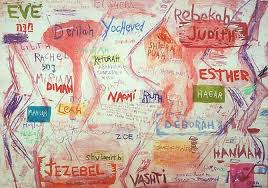
All of this wonderful female energy sent me on a virtual journey that ended up at the Jewish Women’s Archives site where I came upon an entry for Joan Snyder’s lithograph “Our Foremothers.” Serendipity. I have a copy of Snyder’s print hanging in my living room, a gift from my mother-in-law. She thought it was my destiny to have it because the name Judith is so prominent among the Jewish women’s names that Snyder commemorates. Snyder uses shades of red and pink—the colors of blood and tutus—to write names like Hagar, Leah, Rachel and Sarah. She pairs these iconic names with those of her mother, daughter and life partner.

People have two reactions to the print—some are mesmerized and others think it’s the work of a child. “Did Anna make this?” more than a few people have asked me. Snyder’s presentation is both basic and profound. The listing and mixing up of these name reminds me that at some point in a woman’s life she has been cast out like Hagar. She has been adored like Rachel. Taken for granted like Leah or not taken seriously like Sarah. Our foremothers are not simply archetypes. They are us and we are them.

So where does this newest incarnation of Barbie fit in with our own mothers and sisters and foremothers? For one thing she’s an all-American girl who is at ease with every aspect of Jewish ritual. I’m envious of her. A couple of years ago I went to the World Wide Wrap at my synagogue where I was the lone adult among a group of bored pre-teens. I didn’t get a lot of support for trying to learn how to wrap tefillin as a grown woman, so thank God for Tefillin Barbie. When I look at her I remember that nothing in Judaism is off limits to my daughter and my nieces.

Here’s another fun fact about Barbie. Every second of every day a Barbie is sold somewhere in the world. And here’s a wish inspired by Barbie’s sales numbers. Every time that a Jewish girl comes of age, may she be comfortable in her own body and wrapping her own tefillin.


The Graduate

Thank you for asking; the graduation was lovely. But you can probably sense that’s the party line. The ceremony was actually surreal, emotional and intense. We are, as the old saying goes, in the big leagues. Next stop, university.

I’ve known a lot of Anna’s fellow Gann Academy graduates since kindergarten at Schechter in Newton. Over the years, I’ve stayed quiet in my role as chauffeur to eavesdrop on their arguments and their gossip. When they were in that state between dog-tired and overwhelmed, I heard about their dreams and their fears.

In the mix of growing up together these kids have loved each other, hurt each other, admired each other and, in the end, I think they’ve come to appreciate the time they’ve shared together. Who knows when and where they’ll resurface in each others’ lives. As for me, I’ve watched the Class of 2012 sing and dance. I’ve watched them cry and fail. I’ve watched them whoop for joy when they aced a test. I’ve watched them be remorseful as well as get away with murder.

No one grows up without witnesses. As I dabbed my eyes during the ceremony, what flashed through my head as quick as lightning was that no one parents alone either. Whether or not we admit it, we’ve all been in it together. By that I mean we have some piece of real estate in each other’s hearts and memories. We’ll think of each other at random times when we remember the eighth grade play, or the stunning senior class presentation that melded poetry and song and choreography, bringing us to our feet. Or maybe we’ll just sigh over that long-ago last day of kindergarten.

And then at some point we’ll try to figure out when our children grew up. I can’t give you an exact event or call up that one defining moment that Anna and Adam became autonomous, fully separate from Ken and me. It might have happened as Adam shot up 11 inches in the last two years and steadily improved his running times.

For Anna, maybe it was when she was able to reach into her soul to articulate insights that were hers alone. These past couple of years her spirit and brain were in synch when I read her English essays or rabbinics papers. And yes, there was the college application essay about why she hadn’t learned to drive. (She still doesn’t have her license.) She wasn’t thrilled about the other cars on the road or having to parallel park. But mostly she was worried about losing the intense, personal connection that uniquely incubates on our car rides. With Ken she talked science and music. With me it was the latest family news or class intrigue. But mostly she just needed us to listen as she took apart and put back together the personal conundrum of the moment. At the graduation ceremony, Anna gave the invocation for the Class of 2012. She wore a graduation cap that made the claim that one-size fit all. But I’m not exaggerating when I tell you that that cap looked unique and beautiful on every single graduate. And yet even in her three-inch wedges, Anna still looked like my little girl going to a big university. That is until she told her fellow graduates and their families that:

Gann is truly a place that fosters individuality while still emphasizing the importance of community. Who we become as a person before we leave Gann is just as significant as who we become as a class. In Numbers Chapter 24, Bilam, a member of the enemy nation of Bnei Yisrael, finds himself blessing Jacob and Israel as he looks upon their camp. As the spirit of G-d enters Bilam, he utters the famous phrase “ma tovu ohalecha Yaakov, mishkenotecha Yisrael, how lovely are your tents O Jacob, your dwellings O Israel!” In a moment of genuine awe and humility, Bilam first blesses the individual, Jacob, and then the community, Israel. Like Bnei Yisrael, Gann should be admired not only for the amazing individuals it produces, but also for the classes as a whole, each unique in character and reputation.

Our class of 2012 is no exception. Amongst us we have varsity athletes, talented artists and musicians, jugglers, a cappella enthusiasts and even the lone Irish step dancer. However, each individual connects to those around them, latching on, creating a network that when viewed from the outside is beautiful both for the entities, and the class as a whole. These individuals together make up something much larger, perhaps even awe-inspiring when looked at with the spirit of G-d. May we always take pride in our individuality while finding strength in our community.

The first time Anna read her speech to me, I broke into song. Literally. One of the first tunes I learned in Hebrew contained Bilam’s famous blessing. Lovely, billowing tents. The croaking chorus of 6th grade voices. I still remember those kids. Anna and I sang my version of “Ma Tovu” on the way to one of her graduation rehearsals.

How lovely you are, Class of 2012.

Beren Academy Boys’ Basketball Team Forfeits Game for Shabbat by Judy Bolton-Fasman

I get the feeling that the Board members of the Texas Association of Private and Parochial Schools—TAPPS—don’t meet a lot of people who are different then they are. Apparently, it’s impossible for those folks to understand that not everyone celebrates the Sabbath on a Sunday. Enter the Robert M. Beren Academy Boys’ Varsity Basketball—known as the Stars—to shake up the TAPPS Board’s world.

Perhaps it’s the first time that anyone at TAPPS has seen that serious athletes can also be observant Jews. Beren’s players tear up a court with their yamulkas pinned firmly in place. And for the first time in its 42-year history, this Modern Orthodox day school in Houston has made it to the play-offs in their division. Imagine the boys’ excitement when they realized they would be going to the semifinals in Dallas this weekend. Imagine their disappointment when they realized that their playoff game in Dallas was scheduled for 9PM on March 2, Friday night—erev Shabbat. Imagine their heartbreak when their appeal to TAPPS to move the game start time to earlier in the afternoon was unilaterally denied.

Yes, unilaterally denied. TAPPS acted alone when its Board decided to sideline Beren Academy. According to Beren Academy’s head of school, Rabbi Harry Sinoff, the heads of school of the opposing teams had no objection to accommodating the Stars. In fact, just the week before, Beren moved their quarterfinals game against a local Catholic high school to 2pm on a Friday afternoon. Our Lady of the Hills Catholic High School had no trouble understanding that playing basketball on Shabbat is not an option for the Beren Academy boys.

If there was ever a perfect case for the Anti-Defamation League to broker, this was it. The director of ADL’s Southwest’s regional office in Houston wrote a letter to Edd Burleson, TAPPS’ director, which read in part:

Many of the private and parochial schools that are TAPPS members are faith-based institutions where religion is their guiding principal. As such, it is incumbent upon TAPPS to ensure that its members do not have to choose between observing their religious holy days and competing in championship activities. By asking a member school to participate on their Sabbath day, TAPPS will send the message to the Beren Academy team and all other teams whose faith prohibits Sabbath activities, that their religious principles are not valued and that they are not equal members of the TAPPS family.

But the hard truth is that at best TAPPS is sending mixed signals about religious observance and sportsmanship. In 2010, the Association accommodated the Arlington Burton Adventist Academy whose students also observe the Sabbath from Friday sundown to Saturday sunset. The Seventh Day Adventist school had reached the soccer finals in its division and, with TAPPS’ approval, secured a location to play its soccer game after the Sabbath.

When I spoke to Burleson on the phone he said that the logistics for the Seventh Day Adventists’ participation in the soccer finals was simpler, involving only four schools. Logistics? This isn’t a military operation—it’s a high school basketball game. Burleson explained that, “In that case the one school that observed the Sabbath and their opponents were adamant that all of the qualifying teams play.” Okay, so where is Our Lady of the Hills this week? The Stars team has been forced to forfeit Friday night’s upcoming game and the Catholic high school will be taking Beren’s place.

Burleson went on to qualify the Arlington Burton decision. “The [TAPPS] Board made an exception when it allowed [Arlington Burton] to play. Afterwards the Board felt that they had made a mistake and they do not want to make the same mistake again.” Of course they don’t. Who wants to repeat an act of grace and empathy more than once?

This is not the first time that Sabbath observance has been an issue for a Jewish day school. In my backyard, the Modern Orthodox Maimonides School in Brookline faced a similar conflict in 2009 when the school’s mock trial club had reached the national championships in Atlanta. The competition’s organizers initially refused to change the Saturday date, but the school enlisted the help of the Justice Department and two days before the competition, the mock trial organization allowed Maimonides to schedule its appearance on Thursday.

“I’ve been bombarded with hate mail over this issue,” Burleson said. He sounded a bit incredulous. While it’s not right that Burleson has been the target of some folks’ frustration and venom over the incident, it’s not surprising that intolerance and ignorance lead to unpleasant things like hate mail.

Rabbi Sinoff wisely put the TAPPS fiasco in perspective. “Even though the start times for this weekend’s tournament in Dallas haven’t been changed, we’ll still celebrate Shabbat like we always have.”

Amen and Shabbat Shalom.

The Modesty Wars by Judy Bolton-Fasman


Dear Chaya Mushka:

I read that your name is the most popular one among young Lubavitch women. It’s the name of the late Chaya Mushka Schneerson, wife of the fabled Lubavitcher Rebbe. Anywhere you turn in a Bais Yaakov seminary there’s a Chaya Mushka.

I admire the Lubavitch movement for many reasons, not least of which is that my children will soon set off into this great big world. Who knows if they’ll go hiking in Peru, ashram hopping in India or honeymooning in New Zealand? What I do know is that there is likely to be a Chabad outpost nearby to help them be Jews when they most need it. Even a post-modern, skeptical Jew like me can’t help but admire your movement’s dedication and organization. You’re like MasterCard, for heaven’s sake; you’re everywhere I need you to be.

In that spirit, your sisters in Israel – and anywhere else there is oppression of Jewish women – need you, Chaya Mushka. It isn’t just that they’re relegated to the back of a public bus in Israel or even New York. They are the victims of a so-called modesty movement.

Scene from “The Black Bus,” Anat Zuria’s documentary about the plight of haredi women.
We all know that modesty is crucial to an observant woman. Skirt hems and sleeve lengths must cover most of her body. I try not to be judgmental. I know that sometimes we get into situations that are not of our making. Sometimes these dilemmas are as suffocating as a locked trunk. Not many of us are Houdinis, so we do the best we can to survive. But this time, we must speak out.

I’m not asking the Chaya Mushkas of the world to desegregate the public bus lines in Israel singlehandedly. I want you to do something much more long term. I want you to tell your sons that obsessing about a woman’s modesty is, in fact, wantonly sexualizing her.

And if you can manage to see one film this year, watch “The Black Bus,” Anat Zuria’s documentary about the plight of haredi women. Better yet, view it with your sons and daughters. The film, which centers on two young women who have left their haredi communities, will probably make you uncomfortable. But I sense you’ll recognize a bit of yourselves in Sara Einfeld and Shulamit Weintraub. They fled their Gur Hasidic families. I realize your world is more expansive than that of the Gurs. Yes, you follow strict guidelines in dress, behavior and food. But you are educated women, the dream progeny of Sara Schnerir, a seamstress who lived in the late 19th century and founded the Bais Yaakov seminaries.

Equality is a slippery word between us. You think you’re exempt from certain commandments because motherhood is a higher calling. I think that’s a convenient excuse to exclude you from Jewish ritual. But let’s leave equality out of our discussion for the moment and talk about human dignity. You may not completely empathize with Sara and Shulamit as you watch “Black Bus.” But Sara writes a popular blog in Israel called “The Hole in the Sheet” that’s a window into your sisters’ lives in haredi communities. At one point, Sara interviews a former Hasid who tells her that he was taught to be disgusted by women. Not only would he avert his eyes when he saw a woman on the street, he would order women old enough to be his grandmother to wear a scarf over their wigs when they entered the synagogue.

Shulamit takes pictures on the busiest street in Meah Shearim in Jerusalem. The women react to her camera as if she’s pointed a gun at them. No one wants to talk. No one wants to be seen. One woman hides behind the stroller she’s pushing. Off camera she tells Shulamit that she rarely leaves her home, and when she’s in public she tries to use side streets.

Chaya Mushka, you have more authority than I do to tell these men that this is not the Torah of their fathers or their mothers.

I want to leave you with two thoughts. The first is about a siddur from 1471, which replaces the traditional prayer recited by women – “Blessed are You, Lord our G-d, Master of the Universe for creating me according to Your will” – with this: “Blessed Are You Lord our G-d, Master of the Universe for You have made me a woman and not a man.” Clearly, this is a response to the prayer said by observant Jewish men: “Blessed are You for not creating me a woman.” Maybe a woman commissioned this medieval Italian prayer book, I don’t know. But I think the degree to which women have been recently degraded is strictly the depraved interpretation of a few cruel and insecure contemporary haredim.

The second is a picture I recently saw in The Jerusalem Report. Someone caught haredi girls frolicking in a public fountain in Jerusalem. Despite their teachers’ warnings to stop, the girls continued playing. The picture captures the pure joy of simply being a young woman.

Remember that image of your younger sisters when you refuse to step to the back of the bus.