Ghosts of Sukkot Past

Sukkot is here and my guests are on the way. Like Chagall’s lovers they fly over the silver moon; their white gauzy clothing double as wings. I greet them in the sukkah—a makeshift structure akin to a hut that we build from a kit. The sukkah also has a roof with slats generously spaced to see the sun and the moon and the stars.

The company I’m talking about stargazing with is called ushpizin—the Hebrew term for mystical guests who will grace sukkot (plural of sukkah) all over the world on each of the seven nights of the holiday. This is my kind of celebration. When I was a kid I loved reenactments of historical events. The old sitcom Bewitched tickled me because someone like Columbus or Shakespeare came alive for me.

To that end, I have a wish list of historical figures I’ve always wanted to meet. Moses and Leah top my list. No one is more associated with the Torah than Moses. In my mind, he’s an inspiration because so much of his leadership was marked by doubt. As a parent in the 21st century, I take solace in the fact that even with God’s direct intervention, Moses still had a difficult time leading the Israelites out of the wilderness and into the Promised Land. Leah is my role model as a mother. Every parent has been a Leah at some point—taken for granted, ignored, but still triumphant in ordinary yet miraculous ways.

The Rachel that I want to meet was Rabbi Akiva’s wife. I like her rebelliousness. She was from a prosperous family who followed her heart and married the illiterate Akiva against her family’s wishes. To complete the fairytale, she recognized Akiva’s natural genius and encouraged him to learn to read when he was 40. Forty! Akiva excelled in his studies beyond their wildest dreams. Rachel was alone for years as he studied and taught in the greatest Jewish academies.

In his absence, Rachel coped with grace and fortitude. I want to ask her how she did it. I want to know if she was as disoriented as I am when my husband is only away for a week on a business trip. I want to know how she controlled herself when her husband finally came home and his students, protective of their beloved teacher, did not let her through the throng to greet him. When Akiva realized what was happening, he ordered his students to let Rachel pass immediately. He told them that she single-handedly was responsible for everything that he and his students had attained. I want to know if witnessing her husband’s success was worth sacrificing his company all those years.

I want to introduce my daughter Anna to Sara Schenirer. Hunched over her sewing machine, she had a revelation. Or was it a moment of despair that gave way to lucidity? She dared to imagine girls in their own schools studying Torah. It was a radical idea in the late 19th century. Although nowhere near egalitarian, the fact that girls had a classroom of their own to be formally educated was inspiring and enduring and just. I want Anna to know that she is the direct beneficiary of Sara Schenirer’s prescience.

I love spirits. I buy into the notion that there are other times during the year for formal visitation from phantasmagoric souls. There are the seven days of shiva or mourning. The week during which the sheva b’rachot—the seven blessings following a marriage—are celebrated. We boldly mingle with our ancestors on Passover when Elijah joins us and Miriam remembers us with a shake of her timbrel.

But it’s on Sukkot that I reflect on people I would give almost anything to see again. I close my eyes and see my father healthy and strong. I remember my father-in-law’s mega-watt smile and can-do optimism. I feel the presence of Anna’s namesake—a grandmother whom I adored. I miss my friend Miriam so much that I ache. My sukkah is a space painted in a full spectrum of memories and emotional colors.

It makes sense that a holiday that welcomes ghosts to the dinner table would end with Yizkor—the service to memorialize the dead. Yom Kippur and the three harvest festivals—Sukkot, Passover and Shavuot—are the four times a year there is time and space to mingle with loved ones who have died.

What comforts me most about remembering my dead on Sukkot is that I can walk out of my fragile sukkah into the sturdy structure of community where, I believe, a lot of people understand that otherworldly visitors frequently stop by throughout the year.




How Children Succeed: An Interview with Paul Tough

Parenting books – love ’em or leave ’em. Most times, I leave them after perusing the table of contents. I don’t like the one-size-fits-all approach that so many of them take. But Paul Tough’s excellent new book, “How Children Succeed: Grit, Curiosity and the Hidden Power of Character,” rises to the top of the parenting book pile for its deep exploration of failure and the ways in which it builds character in our kids.

First a word about character. It’s as unique to each person as her DNA. Tough offers the revolutionary concept that character, unlike DNA, is not fixed or completely innate in a person. It is, in a word that recurs throughout “How Children Succeed,” malleable. I confess that I was initially very uncomfortable with the word malleable for its implication of weakness and undue influence. But read Tough’s book and you quickly learn that malleable is an asset.

Tough talked about character in a recent interview with [start ital.]The Advocate[end ital.], citing a chain of charter schools called KIPP and its dedicated founder David Levin. KIPP schools dole out report cards for academic performance and character assessment. “Dave is doing new and important work,” Tough said, adding:

“He has a new vision for character and it’s quite scientific in that he’s trying to figure out which character strengths make a difference in a kid’s success. And at the root of his research and thinking is the assertion that character is … a set of qualities that [enables] kids to change themselves and qualities that parents and teachers can instill.”

Tough presents living examples of low-income kids who have had the opportunity through mentoring programs, family members or discerning teachers to pause and look inward to shape and reshape their character. Kewauna Lerma was such a student. On the fast track to derailing her life, Kewauna did an about-face during her junior year of high school. She still lived at the poverty level on the South Side of Chicago, picking fights at school and struggling academically. But a spark was lighted inside of Kewauna through a mentoring program and encouragement from her mother and great-grandmother.

“Kewauna,” explained Tough, “became motivated to be a different person. It was very telling that she changed in that it came from her clear vision that she had of herself. That vision was further clarified in the program she was in as well as by her family.”

There is no question that kids mired in poverty have it tougher than children of affluence. But Tough admirably teases apart the hazards of having it too good without falling into the “poor little rich kid” syndrome.

For wisdom on the challenges faced by kids who seemingly have it all he turned to Dominic Randolph, headmaster of the tony Riverdale School in Riverdale, N.Y. – a well-off section of the Bronx. Randolph was initially the subject of a [start ital.]New York Times Magazine[end ital.]article that Tough wrote last fall. In that article, Tough explored Randolph’s claim that failure and character lead to academic success.

Advocating for failure is a radical step for a head of school where the majority of the class goes on to Ivy League and other highly competitive colleges. But that’s exactly what Randolph did when he came to Riverdale in 2009. Tough noted:

“[T]here is this way that certain high-pressure academic environments can stress kids out. They are on this treadmill versus climbing a mountain. At KIPP kids are climbing a mountain and it’s a bigger challenge than staying on that familiar treadmill. I think that’s why KIPP kids get out of college with more success and character. It’s the way you get on a life path, not the actual life path you end up on, and that makes all the difference.”

Tough points to the documentary “The Race to Nowhere” as a prime of example of affluence undoing kids. Vicky Abeles, the mother of three kids who were scorched by the heat of extreme academic competition, framed her film as a cautionary tale. I’m not a fan of the film because I think it’s slanted toward sensationalism. Tough thinks it’s a helpful example of the importance of establishing a good relationship with failure. “Affluent kids,” he said, “are in suspended animation throughout college without every hitting road bumps. Then they hit an obstacle in their 20s and they don’t have resources to deal with it.”

I think that Tough is on to something big here. We talked about post-college choices that kids who have graduated competitive colleges have made. He asserts that ironically their fear of failure steers them toward investment banking and management consulting jobs.

I wonder if our adult kids’ pervasive fear of failure hasn’t returned them to their childhood bedrooms, dissatisfied and unemployed. Yes, it’s a tough economy out there, but have we made them afraid to take chances, to bypass meaningful engagement and social justice opportunities?

Which brings me back to where I started. Perhaps character is not destiny, that it’s malleable enough to forge the kind of future that can fulfill our kids.

The Race to Nowhere

Vicki Abeles means well. She is a mother who wanted to give her three children all the advantages she never had as a child. As a result, she and her children weathered long school days followed by a daily onslaught of extracurricular activities. Sound familiar? But somewhere along the way her best intentions went awry and she realized that she and her children were running in, what she descriptively calls a “race to nowhere.”

Out of frustration, Abeles picked up a camera and made a movie, her first, about the never-ending marathon in which we have inadvertently sponsored our children. The resulting film, The Race to Nowhere, alternates between a cautionary tale and an overreaction to what happens when kids and parents are trapped by their own ambitions.

When it came out two years ago, Abeles’ film was screened in various upscale locations followed by question and answer periods. The high-achieving Boston suburbs where I live are the perfect laboratories to test Abeles’ theories. In the question and answer period I attended, a group of educators in the audience said how unfair it was to adjust their lesson plans simply for the sake of delivering high MCAS scores. “It is,” said one of the women, “like putting the cart before the horse.”

There are no surprises in Abeles’ film. Dedicated teachers are thwarted by school boards. One exemplary English teacher felt so beleaguered by the Oakland, California school system that she left teaching altogether. The woman openly wept on camera about leaving her students to fend for themselves in a mediocre school system.

The camera pans to a Stanford University freshman confessing that he regurgitated information for tests in high school only to be woefully unprepared for his freshman year of college. Then there are the befuddled parents and students who have no idea how to get off this exhausting treadmill. Fewer activities, an adjusted academic schedule? If only it were that easy.

In the middle of all this angst is a heart-breaking interview with a mother whose 13 year-old daughter Devon committed suicide after getting a bad grade on a math test. I think back to a column I wrote about Amy Chua, the original tiger mom, wouldn’t accept anything less than an A from her daughters. The Tiger Mother roars and her cubs fall into line. And yet I have to believe that it was more than poor test results that tragically sent Devon over the edge.

I worry about my children and the academic loads they carry. Anna was a three-season athlete in high school and often didn’t get to her homework until after dinner. Nothing annoyed her more than when I ask her how the homework situation is. She’d tell me the work is there and she would get through it no matter how long it took. Most nights I didn’t think she had an unreasonable amount of homework for a student as committed as she was. Yet I still fret about sleep-deprivation and the onslaught of emotional challenges she’s beginning to face as a college studentl.

Adam is no stranger to buckets of homework. His school prides itself on creating young men of character and discipline. Part of cultivating that persona is a full curriculum. For example, most nights he’ll be assigned up to 25 math problems. Although I hate homework as much as the next parent, I don’t think his assignments are busy work or aimed at “survival of the fittest.”

Sara Bennett is among those advocating education reform in Abeles’ film. She co-wrote a treatise with the self-explanatory title: The Case Against Homework. Like Abeles, she was a concerned parent who saw her children struggling against the overwhelming tide of worksheets and reading assignments in middle school.

According to Bennett’s research, a child needs to do only 5 math problems to catch on to a concept. Tell that to Amy Chua whose older daughter was once bested in a math competition. Chua’s solution was to have her daughter complete 200 (no there is not an extra zero) math problems a night for 10 days. That’s 2000 problems. That’s a lot of math. That’s a long race.

I wasn’t surprised to see Wendy Mogel make a cameo appearance to warn about the myriad ways our kids are stressed out. For Abeles and company, Mogel’s latest parenting book, The Blessings of a B-, is an island of calm in the madness of running after perfect SAT scores and padding resumes to resemble the CV of a Nobel prize-winner.

As parents we all too often walk that tenuous line between encouraging our children to be their best and demanding perfection from them. What goes loudly unsaid throughout the film is that entrants in the “race to nowhere” are more often than not socioeconomically privileged. All I can say in the face of these tense times is to hug your kids often. Set a realistic course that takes them towards a fulfilling, healthy future because the alternatives are too upsetting to contemplate.

In the Gray Zone

I’ve been thinking a lot about color lately. Or more to the point, the presence and absence of light that make up white and black. I think all this consideration of color reflects the fact that I’ve been vacillating somewhere between hope and despair this High Holiday season. It’s a state of mind that squarely puts me in the middle of the gray zone. That’s Adam’s term for these ten intermittent days between Rosh Hashana and Yom Kippur. I clearly remember when he first mentioned the gray zone. It was fifth grade and he had just learned about the Ten Days of Awe—the days between the High Holidays. He didn’t see anything awesome about being suspended in doubt and self-criticism.

Which leads me to the conundrum at the heart of the gray zone discussions I had with him. How do you explain the High Holidays to kids without scaring the living daylights out of them? Just the images alone send me into black hibernation. No light, no consciousness. Let God add and erase names in the Book of Life without my awareness.

But that’s not exactly good role modeling. If there’s anything that should be deleted it’s our understanding of the Sunday School God that dips a feathered quill into ink and enters names as part of some macabre accounting. The God I first became acquainted with had a flowing white beard. When I was a little older, he looked exactly like my Uncle Mac of the booming voice and the rosy cheeks. Uncle Mac was God on earth. I imagine that most kids cope with God as the ultimate abstraction by pretending that He’s some version of their own Uncle Mac.In this patch of gray that Adam constructed as a little boy, it followed that God is also gray. But it’s impossible to see anything through the fog that shrouds Him. Also, note how useless it is to shine headlights in the fog. The light reflects back, illuminating nothing. Maybe that’s the hard-edged perspective of an adult.

I found a lovely children’s book called Because Nothing Looks Like God [(http://www.amazon.com/Because-Nothing-Looks-Like-God/dp/158023092X/ref=sr_1_1?s=books&ie=UTF8&qid=1347850420&sr=1-1&keywords=because+nothing+looks+like+god)] by Rabbi Lawrence Kushner and Karen Kushner that breathes life into some of my grown-up jadedness. God is in the details like a birthday cake, the band-aid that fixes a cut. Ultimately, “God looks like nothing. And nothing looks like God.” The authors challenge children to think about how many things we can’t see like the wind, or the sun drying or the joyous moments of a day at the beach. I ‘d also ask kids to think about what love does and does not look like.

But how do you explain God to a teenager whose earliest memories are singed with images of burning towers? What do you say to your children after you’ve been pulled over by airport security for a more thorough search? You’re part of the danger in this very dangerous world? Or let’s turn to the more mundane. You work hard and you study hard and still that A or that role in the play eludes you. Does God have more important matters to attend to than the disappointments in your life?  Or is God simply too distracted these days to care about your problems. “First world problems,” shrugs Adam the now-jaded teenager. That’s his default position to deal with his disillusionment.

Maybe I’m taking all of this too literally. Children grow into more sophisticated thinkers, leaving a parent like me stuck in the concreteness of pshat—the Jewish term for biblical literalism. I envy my teens who, these days, are in the thick of drash—extracting meaning from the subtext of a story or a new situation. Maybe my time in the gray zone is best spent listening to my kids explain life to me.

This is also the time of year when we read Leviticus 18 on the afternoon of Yom Kippur—a verse that many take in as pshat to condemn gay marriage. At first glance it seems odd to be worrying about forbidden unions on a day when the gates of heaven are clanging shut. (More concreteness.) But who knew that the gray zone could be conducive to a personal and loving discussion on sex education with your kids. Who shall live and who shall die can be transformed into a celebration of whom we love. Who will we love better and more thoughtfully in this New Year?

The Ba’al Shem Tov, the father of the Hasidic movement in the eighteenth century, said “there are many halls in the king’s palace and intricate keys to all the doors. But the master key to God’s house is a broken heart.” That leads up to one of my favorite sayings in the Talmud—“There is nothing more whole than a broken heart.” And there’s no better place to learn that than in the space that Adam, in his little boy wisdom, once dubbed the gray zone.

Going to School on Rosh Hashana

This year my 15-year old son and I are having yet another conversation about Judaism’s High Holy Days. He’s intent on capitalizing on his hard-won victory last year, the outcome of which was that he went to school on the second day of Rosh Hashana. This was no small concession for his parents. His father and I had never attended school on the High Holy Days while living under our parents’ roofs. But neither of us went to a high school as academically challenging as our son’s.

To read the rest of the essay please go to: http://nyti.ms/Ub6Xsr

A Visit to Poland with a Camera and a Tombstone: Evan Kleinman’s ‘We Are Still Here’

The family was warm, familiar, Jewish. The grandparents’ English was charming, old-fashioned – glazed in a Yiddish accent.

Meet the Kleinmans, the focus of Evan Kleinman’s new documentary. The 28-year-old filmmaker turned the lens on himself to make the aptly titled “We Are Still Here,” about his trip to his grandparents’ Poland – a Poland that held sweet memories turned bitter and unimaginable.

Kleinman’s paternal grandparents grew up in shtetls near Krakow and were deported to concentration camps. On screen, his grandmother remembers her time in the Warsaw Ghetto and how she volunteered to go to Bergen-Belsen with her best friend.

Although Kleinman’s film records his particular legacy trip – a return to his roots with his father, mother and younger sister – it’s a universal home movie. The message of the film is that every Jew survived the Holocaust. This shared survival is what led to the founding of Boston 3G in 2009, the sponsors of the Boston debut of Kleinman’s film last week.

The group’s name, 3G, stands for the third generation of survivors. The group is made up of people in their 20s and 30s, most of whom are the grandchildren of survivors.

Liz Bobrow’s involvement in Boston 3G stems from her close relationship with her paternal grandparents. Both of them are Holocaust survivors whom Bobrow remembered as “very different from my other set of grandparents.

“While they loved me just as much, they were different,” she added. “They spoke with an accent and had funny quirks like always making sure I had enough to eat. I also recognized [as a child] that we didn’t have the big family reunions with my father’s side as we did with my mother’s side.”

Bobrow, Boston 3G’s president, also noted that this third generation has the “unique privilege of connecting with the survivors in a different way from the second generation. While our parents have become caretakers of the survivor generation, we are able to focus solely on who these people are and their incredible stories of survival. It gives the survivors comfort seeing that their stories are not being forgotten, that we are still telling them so many years later.”

“We Are Still Here” was organized around the central event of taking a tombstone back to Poland – a stone to mark Leib Kleinman’s grave. Leib was Evan’s great-uncle, his grandfather’s kid brother who died in a small concentration camp in central Poland.


“The stone is heavy,” the grandfather tells his grandson. The younger Kleinman has set up the context of his film so well that it’s clear that the weight of the tombstone is as difficult to bear as the history of the Jews in Poland.

But in an e-mail interview, the New York native was ebullient about his grandparents and unequivocal about their positive influence on him:

“They are the most powerful and inspiring people I know, and I wanted to be able to share them with other people and with future generations of my family. By doing a film it provided us with an exercise that would bring us closer together, capture our story, and also perhaps bring closure for them because they had not seen these places in 70 years. When my grandfather revealed to me that he could pinpoint the place where he buried his brother I felt beyond compelled to make sure his brother was memorialized.”

Kleinman’s preparations for the trip to Poland are as poignant as the trip itself. His grandfather sketches a map to help his family find his house in the small town of Sediszow. The grandson dutifully brings the map with him to Poland, and it’s almost miraculous when it proves to be useful and accurate.

In Poland, the four Kleinmans move through the country in a hazy dream. But their disorientation is frequently punctuated by moments of triumph. They find a birth certificate of another greatuncle. They find Leib’s burial place through determination and his brother’s description of a place he hadn’t been to in more than seven decades.

Kleinman is similarly scrupulous in showing that the buildings in Poland are a mixture of the old and the new. The observation is a living, breathing subtext of his portrayal of his family and the intense family history attached to them.

Kleinman’s film was also presented last month at the Museum of Tolerance in New York City as well as at a number of film festivals. Since the film’s debut, Kleinman has been gratified by the positive responses from his third generation of survivors.

“Many have voiced to me that the film inspired them to explore their own family history,” he said. “Also, many have told me that my family even reminds them of their own families.”

It’s the ultimate recognition for a young man who movingly portrays his third generation as “living links” to history.

Judy Bolton—A Mom Detective Who Kept Her Kids Safe in Cyberspace

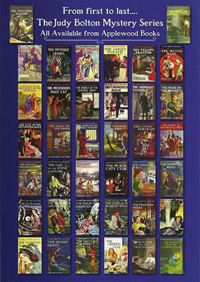
I share my family name, as well as a penchant for snooping, with “Judy Bolton, Girl Detective,” Fictional Judy was the star of her own mid-twentieth century mystery book series. Judy lived smack dab in the middle of Pennsylvania where, surprisingly enough, there was no shortage of mysteries to solve. In all thirty-eight of her books, her snooping was always for the good and welfare of her family and friends. When I became a mother, I snooped for the good and welfare of my children.

Now that they are older, I don’t snoop in my kids’ lives very much. And I have never snooped because I have an unsavory curiosity about other people’s lives. (Though I will sometimes eavesdrop at the table next to me in a restaurant to figure out if a couple is on a blind date). I snoop for interesting stories. I snoop for inspiration to write those stories. I snoop to unknot the mystery of other lives as well as my own. Snooping comes with the territory of being a writer.

While I had no qualms about rummaging around in my children’s lives, it occasionally got me into trouble. When my daughter was 12 she said that I worried over nothing and that I didn’t trust her. Shealso  said that I was nosy.

It’s true. I do worry over nothing until I have something about which to worry. She’s right that I didn’t trust her when she was the tender age of 12. But I didn’t trust because she was too young to understand how quickly the world can turn scary and dangerous.

I prefer to think of myself as curious. And once upon a time my curiosity mostly focused on my children’s computer activities or the dialed and received log on their cell phones. When my children were old enough to have screen names, I ran a benevolent dictatorship. This meant that I was not always right, but I was never wrong. Each month they were required to show me any on-line friends’ lists.

The first rule was that my kids had to know everyone personally—in the flesh—anyone with whom they had an on-line relationship. All the better if I knew them too, but I hadn’t met all of the sleep-away camp buddies. So for 12 and up, I trusted, but only just a little. Under 12, I had to know everyone on a list. No exceptions. This rule, in place like cement, was instituted to prevent my kids from coming into contact with someone they had never met. This rule, to use a word that we used early and often since the dawn of pre-school, was non-negotiable.

I also reserved the right to walk in at any time that my children were on the computer and ask with whom were they chatting on-line or what was new on Facebook. Speaking of Facebook, they had to friend me or do without it. If the spirit moved me, I would also ask what they had just typed. Did I mention that I ran a benevolent dictatorship?

All bets were off for a virtual chat room. This was expressly forbidden and would result in the revocation of computer privileges until the age of twenty-five.

Before they were freshmen in high school and old enough to have laptops, my kids had individual accounts on our family computer so they could access the Internet for homework and pre-approved game sites. Each of their accounts had a filter so that a typo would not send them to God knows where in cyberspace. I always knew the passwords to their accounts or to anything else in their lives. If they somehow managed to get on to a commerce site and try to buy something, the dictatorship was no longer benevolent. Luckily, this never happened.

My children never seriously abused their Internet privileges because they knew I meant business. As generous as I am with them, and believe me I am still generous to the point that it sometimes annoys my husband, they knew that I would not tolerate any infractions with regard to the Internet. Just ask my son about the time he hacked into my account and wrote an e-mail to his teacher to excuse him from an assignment. His third grade grammar gave him away and the teacher immediately notified me that he was e-mailing her under my name. What followed were not good days for my boy.

But I never fully warmed up to being a dictator—benevolent or otherwise. I took unique pride in saying that my children were spoiled, but not rotten. Yet, when it came to snooping for their wellbeing, I held my ground.

I think my parents, particularly my father, named me with the hope that I would develop a curiosity that was both intellectual and empathic. Building on my father’s dreams for me, I taught my children to be as curious and responsible as my fictional doppelganger.

Breaking Up Is Hard to Do

Dear Teen Me:

When you were growing up in the late 1970s and early ‘80s, it was easy to have a skewed view of love, especially with all those pop love songs you listened to — and inevitably dreamed would come true. If only there had been a meeting for you like the one I went to last week, dedicated to healthy teenage relationships. If only the adults around you had understood what I know now: that some consider teen dating a public health issue.

Today, the Boston Public Health Commission has a program called [Start Strong](http://www.startstrongteens.org), currently the largest funded national initiative aimed at preventing relationship violence and abuse among young people by promoting healthy relationships. Start Strong’s mission is powerful in its simplicity: “Stop teen dating abuse before it starts by using older teens to educate pre-teens.” To emphasize that message, the Commission has sponsored a co-ed gathering of teens for three years running called *Break-Up Summit*. This year, the event took place at Simmons College in Boston, Massachusetts, and focused on cheating as a catalyst to unhealthy relationships turning violent.

This kind of initiative didn’t exist when you were growing up — when boys were boys and girls were expected to be nicer than nice. My generation directly reaped the rewards of the Women’s Movement. Still, for many us, sexual liberation was steeped in guilt and bewilderment at how far we could go and, simultaneously, how badly a relationship could end.

At this year’s conference, teens attended workshops that helped them explore the landscape of healthy relationships, including “Breaking-Up In The Internet Age,” “The ‘What Are We?’ Conversation,” and “It’s Complicated.” In one breakout session, they debated what behavior constituted cheating and what behavior was perfectly innocent. Yes, they said, you can go out to a platonic dinner with a friend of the opposite sex. Actions that fell into a gray area were more difficult for them to agree on. “Flirting is a way of life, it’s healthy,” said one young man. “Dancing with a guy at a party even if your boyfriend’s there isn’t right,” said a young woman. Perhaps consensus is not the point. Teens need to build their own definitions of fidelity and respect.

But how often does that really happen? Today, teens are having sex at a younger age and with more partners. Their relationships are also driven by hormones and developing brains, which means they may not understand why they do what they do and feel what they feel. The drama, the moods, the end-of-the-world heartache — I wish you had known that they didn’t have to be standard issue for teenage relationships.

At the conference, I heard a lot of terms bandied about, like “hooking up,” “friends with benefits,” “just friends” and “full-blown dating.” It made me realize that while the language has changed, human nature hasn’t. One of the more potent metaphors a teenage girl used to describe cheating was a crumpled piece of paper. That’s what cheating does to a relationship, and though the deception may be followed by forgiveness, that sheet of paper will always have wrinkles.

When the program organizers displayed pictures of world-famous cheaters, some of the boys whooped when they saw Tiger Woods. And while there was not a single woman in the montage, the audience was abuzz discussing “Twilight” star Kristen Stewart’s [tearful apology](http://www.huffingtonpost.com/2012/07/25/kristen-stewart-apologizes-cheating-robert-pattinson_n_1702836.html?utm_hp_ref=entertainment&ir=Entertainment) for cheating on Robert Pattinson. Young women, in particular, seemed to admire Stewart for responding quickly by taking responsibility for her actions. Others were bitterly disappointed in her for cheating on Pattinson in the first place. As one girl wondered, aren’t women supposed to be above that?

Maybe it’s the characters she plays, but for me, Stewart embodies the notion of a fairy tale. The version of romance she projects isn’t real — just like the Top 40 songs that inspired and disappointed you, Teen Me, all those years ago. I know it’s confusing and upsetting to consider that fairy tales don’t exist, but in time you will understand that grappling with a strong, healthy relationship — with its inevitable peaks and valleys — is more romantic than an unattainable “happily ever after.”

And so what I want to say most of all, Teen Me, is something I never knew at your age: It gets better, and until it does, there are resources out there. There are people who want to help you extricate yourself from a bad relationship. That is the biggest takeaway of the Break-up Summit. If only you had been guided to realize that love is not a Top 40 song, I would have been spared suffering that was neither noble nor useful.

Love,

(Much) Older Me

Family Blessings

May the Lord bless you and protect you. May the Lord illuminate His/Her countenanceupon you and deal graciously with you. May the Lord bestow favor upon you and grant you peace. Numbers 6:24-26

A few years ago when Anna was assigned to memorize the Priestly Blessing in Hebrew it was an opportunity for me. I would finally bless my children on Friday nights with those famous words without a cheat sheet, or mumbling so my kids wouldn’t realize how poor my Hebrew is.

Blessing one’s children reaches back to biblical times. In the Torah Isaac blesses his sons and Jacob blesses his children as well his grandchildren. One of Aaron’s last acts as the High Priest is to bless the children of Israel. And Moses blesses each of the tribes of Israel. During rabbinic times parents adapted this biblical practice by expressing their pride and love for their children with the Priestly Blessing.

There is nothing sweeter in this life than blessing one’s children especially on a Friday night. When Anna and Adam were little I’d drop to my knees to so that they could look into my eyes and tacitly understand that blessing them was an act of thanksgiving and humility for me.

I recently learned that there are also special hand gestures that accompany the Priestly Blessing. Like the prophets of yore, the kohanim or priests stretched their arms forward (with an outstretched arm!) with their hands palms-down. They also split their fingers so that, counting the space between the opposing thumbs, there were five spaces for each hand.

Another allusion. My reading led me to a reference from Song of Songs 2:8-9 which states that God “peeks through the cracks in the wall.” God watches, God protects, God blesses. Now when I fan my hands on Anna and Adam’s heads, the spaces between my fingers are filled with their goodness, their innocence, their strength and my fragility.

For a while my kids were very clear that this blessing business was not exactly their favorite part of our Friday night festivities. “Do it more quietly,” Anna said. “I don’t think you have all the words down,” Adam said. But I persisted and tried not to let their tween behavior dampen my joy.

Recently I hit on a time-saving method acceptable to both my children and me—blessing them together. After the initial blessing I turn to Anna and ask God to make her strong and wise like Sarah, Rebekah, Rachel and Leah. Then it’s Adam’s turn and I ask God to make him a role model like Ephraim and Menashe.

Asking God to give our daughters the laudable tributes of our foremothers is obvious, but the blessing for our sons is less so. The reference to Ephraim and Menashe comes directly from the Bible. Just before Jacob dies he blesses his grandsons with these words: “In time to come, the people of Israel will use you as a blessing. They will say, ‘May God make you like Ephraim and Menashe’.” (Genesis 48:20)

I think that Anna and Adam don’t mind being blessed these days because they like to reciprocate. My daughter is now tall enough to look me in the eye when I place my hand on her head. My son is nine inches taller than I and has to bow his head. These days they offer me a blessing too by saying the words with me.

Anna and Adam’s Shabbat blessing acquired another level of meaning when our friend Susan asked them what they thought of a blessing that asked God to make them like someone else. She pointed out a contradiction that speaks to one of my favorite midrashim about God’s challenge to Rabbi Zusya. When it came Zusya’s time to go to heaven, he had ready answers for God about why he wasn’t a great prophet like Moses or a gifted scholar like Maimonides. But he was worried that God would ask him the most difficult question of all—why wasn’t Zusya more like Zusya in this life.

Susan sent me to Marcia Falk’s Book of Blessings for an alternative blessing. The subtitle of Falk’s volume promised New Jewish Prayers for Daily Life, The Sabbath and the New Moon Festival. Falk’s didn’t disappoint. The version of her blessing for a child to simply “Be who you are—and may you be blessed in all that you do.” Falk chose these words to echo God’s announcement in

Exodus—“I am that I am”—the ultimate proclamation of authentically being.

In her commentary on her version of the blessing Falk notes that “in its specificity, this blessing seems restrictive rather than expansive: it doesn’t open out to the range of possibility and promise that ought to characterize youth.”

I appreciate Falk’s point that giving our children a strong, unlimited sense of self is crucial. But we—Anna, Adam and I—do not want to give up the ancestors. Our foremothers are not just archetypes. At different points in our lives they are us and we are them. And for me, Jacob directly blessing his grandsons rather than his sons tells me how precious and hopeful the future is. Finally, a pair of brothers in the Bible who don’t want to kill one another!

Anna and I tested each other for a week until I finally got the Priestly Blessing down in Hebrew. We also assimilated the notion that in its three straightforward lines, the beauty and genius of the blessing rests in its simplicity as well as its swift movement from the material world to the ultimate wish for peace.

The Care and Nourishment of a Parent by Judy Bolton-Fasman

The first thing to go was my father’s inimitable printing.

His letters—straight and precise—were self-portraits of sturdiness and discipline. I associated Dad with the single initial that grounded his name—K, as in K. Harold Bolton.

The K stood for Kenneth—a name he never used, a phantom name. Unlike its counterpart C, K is like the father of my childhood—unambiguously hard, unyielding to e or i. K— ramrod straight on one side—was like Dad’s perfect posture making it a letter to lean on, a letter from which to fly the flag that Dad revered. In Dad’s stately block printing K was declarative—shorthand for the unsolved mystery of why he preferred to be called Harold instead of Ken. And then one day K dissolved on the page as he tried to sign his tax return.

There is a Spanish saying that when a parent gives to the child, both the parent and the child laugh. But when the child gives to the parent, both the parent and the child cry. It’s strange and disorienting to watch our parents walk slower, remember less, pepper a conversation with non-sequiturs.

My Dad died ten years ago and I can hardly remember the shrunken old man to whom I fed strained carrots. Instead, in my mind’s eye he is stocky and vital and strong. Against his better judgment, he taught me to drive in the winter. “No one learns to drive in January,” he sighed as he told me to put the car in reverse to get out of a snow bank. Fifteen years later a policeman pulled him over for weaving in and out of lanes. The officer called that same night and said how sorry he was that he had to revoke Dad’s license.

I once saw a bumper sticker that said, “Be Nice To Your Children—They Choose Your Nursing Home.” I was horrified. Caring for our parents with grace and humility, without agenda, is one of the most crucial and moral lessons we impart to our children. Acquiring a new level of patience and love and fortitude is critical to helping a parent grow old in peace and security. It is also one of the most challenging aspects of trying to honor a father and a mother. Resisting the notion that one is parenting a parent—no matter how dependent a parent becomes that person is still the mother or the father—requires an iron-willed patience that insists on nothing less than dignity and respect at all times.

Over the years I have watched family and friends accompany a parent to chemotherapy sessions, stock a mother’s refrigerator each week, balance her checkbook at the end of the month or closely supervise health care aides for a father with a broken ankle. It’s the same skills they have acquired and honed as they bring up their own children. It’s the same admirable behavior that they learned from their own parents.

The day my father could no longer sign his name—the day his signature crumbled before my eyes—was the day he was trapped in his body and his existence curtailed to just a couple of rooms in his house. During the decade that he was ill my mother built a life that depended on the devotion of caregivers, the kindness of family and friends, and more often than not, favors from strangers. And when she could not keep up with Dad’s overwhelming needs the first things she set aside were her own health and sanity. During those years my mother and I had our disagreements over my father’s care, the medications he should or shouldn’t be taking. We had our difficult moments over whether he should go to a nursing home.

As my young children grew more aware of my father’s illness, they saw that I was helpless, frustrated, and angry. I was the one who was vulnerable as I tried to spoon food into my father’s mouth. It was my voice that was shaky when I read books to him. I was the one who looked clumsy as I tried to prop him up in bed. By watching me trying to care for my father, my children and I gradually realized that this kind of encompassing help included loving him anew as my father—a grown man who only appeared as a helpless child.

Neither Dad nor I imagined such a sad, drawn out ending to his life, but I buck against the idea that during that time he was anyone but my father.  And so in his memory I choose to focus on things like the precise checkbook he kept or the glitzy Valentine’s Day cards that he unfailingly sent me every year and signed in red ink—“With all my love, Daddy.”