Uncle Jonathan

There is a picture in my sister’s house of my niece as a newborn, being held by her father. She is just three-days old and her father, my brother-in-law Jonathan, is smiling the smile of a proud, new parent. The fact that that picture exists is a testament to this extraordinary man as a father and a person. Two days earlier, Jonathan witnessed his first wife die in childbirth. My niece was saved by an emergency C-section. Jonathan lovingly and sagely posed for that picture so that his daughter would always know how joyous her birth was to him.

Jonathan was immediately thrown into the role of both father and mother to his little girl. He never considered for one moment not raising his child by himself. And he never allowed himself to be hampered by self-pity. He quickly turned his basement into a suite for a live-in nanny and became an expert on all things baby. Fortunately, he has an innate gift with children. He’s one of these people who knows exactly what to say to a child, how to play with a child, and most importantly how to love that child. I’ve never seen anything quite like the rapport that Jonathan has with children.

By the time I knew Jonathan, my niece was three-years-old. We met him for the first time over dinner at his house. We lived in Maryland then and I was visiting my sister with Anna while Ken was away on business. Anna was ten-months-old. Jonathan was a natural when it came to taking care of a child that age, and particularly in all things having to do with girls. That night he had a booster chair, a special plastic Cinderella plate with matching cutlery and Anna’s favorite meal of chicken nuggets ready for her.

Since then Jonathan has been an important resource for Ken and me in both practical and esoteric matters related to parenting. The man is a font of knowledge. In the early years of our parenthood he knew things like where to get Flapdoodles clothing at the best price. He picked up Anna’s hypoallergenic formula in bulk when he was at Costco. All the while his own little girl thrived, growing into a happy well-adjusted child.

When we moved to the Boston area, Anna was two and shortly thereafter I became pregnant with Adam. If Ken was away on a business trip, Jonathan took Anna for a Sunday afternoon so I could have a break. When I went into labor with Adam prematurely, my sister said that Jonathan was understandably terrified for the baby and me. He could barely function until he knew that both of us were safe and healthy.

When Adam presented with fierce infant colic, Jonathan kept Ken and me sane. He had seen this with other babies. In fact, he had seen more of everything having to do with kids than most fathers. He was usually the only Dad at play dates, birthday parties and pre-school events. He knew the deep secrets of the parenting trade and we depended on his knowledge.

When my sister and Jonathan married, my niece walked her father down the aisle and stood under the huppah with him and her new mother. The wedding was a lovely and important testament to the fact that they had already been a family for a long time.

As my children have grown, Uncle Jonathan has become an indispensable part of their childhood. He and Adam have a sweet, funny relationship. The more they tease each other, the more evident it is how much they love each other. Jonathan has a tender and abiding interest in my children. He has steered us toward great pre-schools, gymnastic programs and summer camps. He helped Adam in his quest to achieve balance on a two-wheeler. He convinced me that Anna would do well in sleep-away camp. He was right. He advised us to look into prep school for Adam. Again he was right.

For several years running Jonathan and my sister took care of Adam for an entire week during the summer so that Ken and I could take a vacation on our own. At Uncle Jonathan’s house Adam got ice cream every night, but he also has to go to bed without complaint and make his bed. Every time we picked Adam up after a week with Uncle Jonathan, he lamented that we would undo all of his good work with his nephew in less than 48 hours. And he was right again.

Jonathan is an avid skier and my niece is championship material. At the age of 35 my sister gave in and learned to ski too. From his own experience, Jonathan knew that skiing built self-esteem around sports. He is single-handedly responsible for teaching my children to ski as well as getting Ken back on the slopes with gentle and practical encouragement after almost two decades. Adam is not a particularly sporty kid, but under Uncle Jonathan’s tutelage this winter he became a natural. He went through four levels of ski school in one week.

No doubt Jonathan is a wonderful guy, a loving uncle and brother and a husband par excellence. But every time I look at the picture of him beaming as he held his infant daughter just a day after he buried his first wife, I understand anew that Jonathan epitomizes everything and more that is special about a day dedicated to honoring fathers.

Happy Father’s Day, Jonathan.



Commencement 2012

No one remembers graduation speeches—sometimes not even the speaker. And post-graduation advice is rarely welcomed. But I’m weighing in anyway and hope that something resonates with my graduate and yours.

1. You will always be the correct weight.

2. Don’t fill out questionnaires anonymously.

3. Someone once told me that boys are like buses. You miss one and another one eventually comes along. Don’t think about anyone that way.

4. To be discerning is not the same as being judgmental.

5. Study with empathy. Otherwise you learn nothing.

6. Love your children more than anyone, including your parents.

7. Some fool down the line will tell you that you are not the prettiest in the room. Trust me you will always be the most beautiful in the world.

8. When you are scared, remember that you are most afraid of being afraid.

9. Don’t be afraid of passion. It’s the electricity of the soul.

10. Don’t listen to someone who tells you to get over it. You will get over it in your own way and your own time.

11. Think three-dimensionally: no one is completely heroic or totally villainous.

12. Picasso said I never paint red—I paint the suggestion of red. Remember that when you’re solving a particularly thorny problem

13. If a sign says that a parking lot is full, move the cone anyway and go in. I promise you there will always be a space.

14. When you are very upset talk to G-d. Out loud. You’ll get over the initial awkwardness.

15. Remember that a coincidence is a miracle in which G-d chooses to remain anonymous.

16. Don’t be frivolous with money. But don’t be afraid to spend it either.

17. Work hard.

18. Work steadily.

19. Have fun.

20. Don’t worry if you’re not having fun. It’ll pass.

21. When you feel stuck or frightened, dance.

22. Don’t regret falling in love. There’s a piece of Jewish wisdom that says there is nothing more whole than a broken heart.

23. I’ll end with one of my father’s favorite sayings: G-d made the world, but the Dutch made Holland. I have to admit that baffled me as a child, but I think I get it now. Give G-d something to work with by shaping your destiny because in the end it’s all about free will, kiddo.


Go the F*** to Sleep: Happy First Anniversary

Somewhere in the world there is a still-traumatized man who had the bad luck of delivering a package to me when Anna – at that time the world’s worst sleeper – had finally gone down for her afternoon nap. She was four months old and at the cusp of real sleep when a UPS man rang the doorbell to have me sign for my neighbor’s package. Anna startled awake and began to scream.

“You put her back to sleep,” I hissed at the unfortunate soul.

He tried to lob the ball back in my court. “Some people put a sign on the door that says ‘Sleeping Baby – Do Not Ring Doorbell.’”

I wasn’t buying it. I told him that if he sees a stroller on someone’s property, never ring the doorbell in the middle of the day. He muttered that he was sorry and slunk away. Anna was still crying at an unnaturally high pitch, and I had to start “the process” all over again to get her back to sleep.

I’ve heard incredible stories about children falling asleep in their car seats and transferring to their cribs without making a peep. Children who ball up their sweet little fists to rub their eyes and promptly drift off into a midday nap for three hours. What did the mothers of these children eat during their pregnancies? My children were, to put it mildly, sleep-challenged. I never had the heart to let them cry themselves to sleep, and so I was in turn very cranky with sleep-deprivation.

In our early parenthood, Ken was a stalwart follower of Dr. Ferber – the baby sleep doctor. He began the one step forward, two steps back approach of letting our children cry it out, checking on them every 15 minutes until they fell asleep in a puddle of tears and aggravation. This is popularly known as “Ferberizing” your baby. But children are wily opponents, and when Ken was away on business, they knew they had me exactly where they wanted me. They went right back to starring in their bedtime soap operas with me as the hapless stage manager.

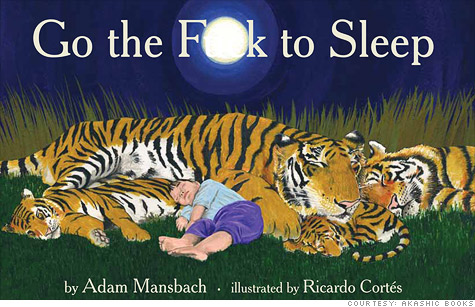
The novelist Adam Mansbach perfectly captured the frustration and exhaustion of dog tired parents in his wildly successful children’s book parody Go the F*** to Sleep. It all started with Mansbach’s insomniac 2 year-old daughter. An exhausted Mansbach jokingly posted on his Facebook wall “look out for my forthcoming children’s book Go the F*** to Sleep.”

The reaction to the posting was so positive that Mansbach played around with some verses for his still imaginary book and shared them on his Facebook wall. The book soon took shape, and he asked his friend Ricardo Cortés to illustrate the book. The result was primary colored, tranquil illustrations paired with the rhythms and quiet words of a classic children’s book. Only don’t read this book to your children. Here’s a sampling of the treacly verse punctuated with attitude as sharp as barbed wire:

The eagles who soar through the sky at rest And the creatures who crawl, run and creep. I know you’re not thirsty. That’s bull s***. Stop lying. Lie the f*** down my darling and sleep.

Before the book was published, it went viral amidst a flutter of tweets from a reading that Mansbach gave in Philadelphia. Soon after, booksellers received a PDF file of the book from the ecstatic Brooklyn-based publisher, Akashic Books. The book was forwarded until it landed in inboxes of folks who had never met a bookseller.

Go the F*** to Sleep soared to the top of Amazon’s general best-selling list. The buzz around the book was so deafening that the publisher moved up the just in time for Father’s Day last year. Film rights have been acquired, the book is to be translated into more than 12 languages, and there is an audiobook version read by the actor Samuel L. Jackson.

When I first came upon Mansbach’s book I filed it away as a column idea and moved on to final exams with Anna. Lo and behold, there was an excerpt from Mansbach’s fine literary novel, The End of the Jews, on Anna’s Biblical literature test. The book is the complicated story of three generations of one Jewish family and was lauded as “beautiful and heartbreaking and brilliant.” The passage on Anna’s test was a deep slice of life from a portrait of a marriage, remarkable for its bruising realism and painful resonance. A wife misreads her husband’s social cues, and he tortures her for days with the silent treatment. Anna’s task was to explicate the consequences of speaking up to an emotionally abusive husband versus taking the easy way out and ignoring him until his bad mood passed through like a storm cloud.

Mansbach is a smart, versatile writer. His work is remarkable for the way he understands the beguiling, frail and ugly humanity of his characters. So yes, my child, Go the F*** to Sleep. Your parents will recognize Mansbach’s vulnerable humanity as wise and sad and funny and introspective because that’s what a good writer can do in any genre.

The Highs and Lows of Etgar Keret

Etgar Keret

It’s no wonder that when Etgar Keret’s name is mentioned, the literary adjectives abound. Post-modern, fabulist, surrealist, subversive. But first and foremost, Keret loves all things Hebrew and Israeli. His ardor was in evidence at a recent appearance at Brookline Booksmith where he discussed his new book, “Suddenly, a Knock on the Door.”

“My parents never read books to me; they made up stories,” Keret said to the standing-room-only crowd. “Reading from a book is what a lazy parent would do.”

Keret’s parents, survivors of the Holocaust, presented an unconventional range of subjects in their bedtime stories. His mother’s tales were fantasies populated with unicorns and fairies and witches. His father’s stories were about drunks and prostitutes – stories that Keret noted were full of “love and warmth and compassion. They were very moral stories.”

‘My stories are much smarter than I am. They are like a dream, which is why it’s difficult to take ownership of them.’
The genesis of the elder Keret’s narratives reflected his peripatetic post-Holocaust experiences. Having been refused entry into Israel after the war, he returned to Europe to acquire arms for the Irgun – Israel’s underground resistance – on the black market. He did business with the Mafia in Sicily by day, and slept in parks at night. His new business associates noticed that he was homeless and offered him an empty room in one of their bordellos.

Keret told his audience “that the people with whom my father associated – mobsters, prostitutes – didn’t care that he was Jewish. He taught me to see a person’s character, not his position. I think that’s why my characters live on society’s margins.”

To that end, Keret’s work remains firmly outside the conventions of literature, and his process is idiosyncratic. “My stories are much smarter than I am,” he said. “They are like a dream, which is why it’s difficult to take ownership of them.”

Keret rarely works from a single idea or has a chronological plot in mind. Rather, he tugs at a thread or explores an image. “It’s all about tone. And the voice is very important. Writing for me is like surfing. I stand on the board, anticipating the next wave, and when it comes I try not to fall off.”

Keret revels in the fact that he writes in a language that was used only for prayer and Torah study for more than 2,000 years, but then updated virtually overnight. This linguistic upheaval, he said, “tells the contemporary story of the country. We needed words to catch up with 2,000 years of social development. So we imported them from other languages, derived them from the Biblical Hebrew or had to make them up. This makes the Hebrew language wild, anachronistic – a combination that is very fundamental to Israeli society.”

Keret told an anecdote from a recent trip to Korea to illustrate Hebrew as a frozen language “microwaved for modern usage.” In trying to explain Israeli society to Koreans, he told them that Jerusalem suspends public transportation on the Sabbath in accordance with Biblical law. His puzzled audience asked if Israel was like Iran? Keret countered that Israel is so liberal that a transgendered singer represented the country in an international contest. Completely confused, the Koreans asked him if Israel was like San Francisco? Keret responded that the answers to both their questions was yes, explaining that Israeli society is distinguished by both religious conservatism and social openness.

He noted that the Hebrew language also reflected these conflicting impulses of old and new – in its use of formal and colloquial speech:

“Hebrew is not exclusively a high-register language. You need to keep switching between registers to move through eras and capture the energy of the country. In my work, I move up and down in sentences, which initially confused my translator. Occasionally a translator calls to ask which register – up or down? I tell him in Hebrew it’s both.” Keret’s written version of colloquial Hebrew is central to his literary identity. During his recent teaching appointment at Wesleyan University, he was confounded when his workshop students talked about skill and craft:

“Engineers build bridges – they craft something. Pilots land planes – they have skill. I’m not a writer by skill. I can’t write ordinary things like birthday cards or a note to my neighbor. My passions overtake my abilities. I think that’s why my stories are so short.”

As for his start in writing, Keret said, “I think I was a writer long before I realized I was a writer.” He began composing stories during his army service to cope with a friend’s suicide. At Hebrew University, he wrote well into the night and was repeatedly late for morning classes. Threatened with the loss of his scholarship, Keret showed his advisor those nocturnal stories as proof that his extracurricular activities were intellectual. He not only salvaged his university career, he also established his literary reputation. A few years later, that same professor edited and published Keret’s first collection of short stories.

And thus his advice to aspiring writers: Wake up late.

A Heroine for Mother’s Day: Bunny Shapero

I met Beatrice Shapero, known universally as Bunny, 10 years ago in a preview class for Me’ah. Me’ah is an adult learning program that, in a hundred hours of classroom time, begins with Biblical history and continues through the founding of the State of Israel. It’s a two-year course of study. But if Bunny was up for it, what excuse could I possibly have not to enroll.

As it turns out, Bunny was the coolest octogenarian any of us had ever met. In fact, she was cool, period. She was also an incredible role model. Me’ah was just one of the stops on her journey of learning and becoming. Bunny came to Me’ah already primed for Jewish learning. A decade before, she had become an adult bat mitzvah and before that, well, she did a million things for the community. She was the young woman who sold bonds door-to door for the newly-created Jewish State in 1948. Rae Gann was the captain of her team, and for 12 years running Bunny sold the largest number of bonds in the group. Israel was so new, and Bunny never promised people that they would get a return on their money. But that was beside the point. Bunny loved Israel, and Israel needed the funds.

Bunny Shapero/Jim Weber Photography

Bunny also loves her synagogue. She’s been a member of Temple Emanuel in Newton for more than 50 years. During that time, she’s been the heart and soul of Sisterhood and the temple’s branch of the Women’s League of Conservative Judaism. No one comes close to selling Bunny’s quota of Torah Fund cards. She’s not sure how many she’s sold over the years, but at the last Torah Fund brunch she was close to moving 500 of those cards for the Jewish Theological Seminary. Bunny may not call herself a feminist, but that’s what she is. Her daughter, Susan, was the first girl at Temple Emanuel to have a bat mitzvah on a Saturday. Susan is a twin, and Bunny insisted that Susan and her brother, Martin, celebrate their b’nei mitzvah together. “They studied the same material, why shouldn’t they get the same recognition?” she reasoned. The ritual committee agreed and consented to the Saturday morning ceremony. Was Susan’s bat mitzvah in 1959 an exception? Yes. But it set an early and important precedent.

Bunny is a natural at setting precedents. This year, at 88, she is the oldest participant in the annual walkathon for the National Alliance on Mental Illness (NAMI). There have been nine walk-a-thons in Boston, and Bunny has walked the three-mile course at each one of them. A founding member of the Boston chapter, Bunny is committed to NAMI because she is devoted to Martin, who had his first schizophrenic breakdown at the age of 15.

“Mental illness is low on the totem pole when it comes to any kind of funding,” Bunny said. “That’s why I got so heavily involved in fundraising for NAMI the past few years.” As of Monday, Bunny had raised close to $10,000 for the organization – and that’s for this year alone.

She’s passionate about erasing the stigma of mental illness, ensuring research on schizophrenia and reducing homelessness among the severely mentally ill. “At the time Martin was diagnosed there was no awareness of the disease. People in the profession blamed the mothers,” she said. “Martin is 66 now, and sometimes I think [society at large] still blames the mother. But mental illness is all over the country, and no one knows exactly what goes wrong with the wiring in the brain.”

Bunny is also dedicated to bringing mental illness out into the open – to have the necessary conversations to give patients and their families hope. The mother of four, she remembers the veils of shame and secrecy that isolated families with a mentally ill child. Martin’s three siblings rarely invited friends to the house for fear he might have an outburst. “It was a silent illness. We didn’t talk about it. I’m so grateful for the support circles and the Family-to-Family programs that NAMI runs.”

Family members with a mentally ill relative staff NAMI’s Family-to- Family program. These volunteers are trained to provide information on everything from medication to day programs. Family-to-Family serves as a resource for the latest research and as an information clearinghouse for caretakers dealing with a loved one’s relapse.

Bunny has helped Martin through his own relapses. Like many people diagnosed with schizophrenia, he has often stopped taking his medication when he felt better. Bunny observes that he underestimates the role that medication plays when he begins to improve. “Medication is tough,” Bunny said. “A lot of it has been trial and error for Martin, and sometimes he feels like a guinea pig. But mental illness is like any other chronic disease. If you have a heart condition or diabetes, you need your medication in the same way.”

The day after the walk-a-thon is Lilac Sunday at the Arboretum. It’s also Mother’s Day, and Bunny and Martin plan to spend the afternoon together at one of their favorite places among the flowers.

Facing Bullies and Ourselves: Lee Hirsch’s Documentary, Bully

Believe all of the hype you’ve been hearing about the movie Bully. I’ve seen it twice and I cried even harder at the second showing I went to, sponsored by the B’nai B’rith Youth Organization, Keshet, ADL, Prozdor and a host of other Jewish and secular organizations.

The first time I walked into Bully I thought that zero-tolerance policies about bullying, adult intervention and a teacher or monitor on a school bus could begin to deal with the problem. Lee Hirsch’s documentary systematically punctures a hole in each of those notions. Bullying, it turns out, is deeply rooted, menacing, and wily. But there’s hope too. All it takes is the strength of just one person to point a much-needed spotlight on the subject. As Hirsch has so poignantly, so tragically demonstrated, sometimes it takes the suicide of a precious child and the eloquence of a grieving parent to once and for all show how deadly bullying can become.

After a year of intense filming, Hirsch and his team settled on five story lines to carry the documentary forward. They are all compelling, heart-wrenching stories, but there were a couple of families with whom I especially suffered.

The Longs of Murray County, Georgia lost their 17 year-old son Tyler to bullying. You know the Longs. They’re the parents that sit next to you on Back-to-School night. You talk to them over coffee at a synagogue or church function. And all the while you have no idea the tremendous pain they bore when they found out their son was shoved into a toilet or his clothes were stolen while he was in the locker room shower.

Tina Long found her son hanging in his bedroom closet. The room has been redone and serves as a de facto headquarters for the Long’s anti-bullying activism. Tyler’s ghost lives there too. Not as a haunting apparition, but as motivation for his parents to mourn his death and celebrate his life. “Tyler’s voice will be heard,” says a t-shirt that his father David wears.

Twelve year-old Alex Libby is the hero of the movie. Every single day of his school life, Alex has been tormented for being different. He was born at 26 weeks gestation and his developmental delays still dog him. His social awkwardness has been diagnosed as Asperger Syndrome.

Alex Libby

Alex Libby from the documentary, "Bully"

The Sioux City School District in Iowa as well as Alex’s family gave Hirsch unfettered access to Alex’s daily life. Hirsch’s camera is rolling on the first day of school at East Middle School. Alex endures insults at the stop of the notorious Bus #54. And the camera trails Alex through moment after moment of loneliness, hopelessness and abuse, both physical and emotional. Hirsch is relentless because Alex’s ostracism is relentless. And he didn’t have to do much more than film Alex by the lockers or on the playground to show that East Middle School looks like a prison.

Alex is the oldest of five children and his parents do their best to support their son. The mother in me fantasizes that with a bit more attention and a little more love, Alex could have triumphed. But it’s not that simple. His parents plead for help that is not forthcoming from the school. One assistant principal in particular is so tone deaf when it comes to understanding children that I didn’t know whether to despise her or feel sorry for her. Bullies almost certainly see well-meaning and ineffective adults as plain ridiculous. When it came to witnessing Kim Lockwood make her rounds at East, judging by the gasps I heard, so did the audience. Another assistant principal doesn’t fare much better when she interviews Alex’s tormentors on the bus. When it comes time to interview Alex, Paula Crandall urges him to speak up.

Alex replies: “Well in sixth grade you did nothing about Teddy sitting on my head.”

Crandall responds: “How do you know we didn’t do anything? Did he sit on your head after you talked to me. I did talk to him and he didn’t do that again did he?”

“No,” says Alex, his voice trailing. “But he was still doing other stuff like that.”

At one point the bullying becomes so physical that Hirsch shares his footage with the school, Alex’s parents and the police. I’ve read that Hirsch said that he was able to capture so much on film because all of the children—bullies and bullied—quickly adapted and forgot they were being filmed.

Throughout filming, Hirsch struggled with whether he should intervene when documenting incidents of bullying. In a curriculum guide to the movie produced by Facing History and Ourselves, Hirsch noted,

It was incredibly difficult not to go and rip those kids off of Alex. Had the violence increased, I’m sure there was a point at which I would have had to and would have absolutely stopped it. But the reality is that Alex wanted people to know what happens to him. And all of the kids that were in the film wanted people to know what they go through. Hirsch also pointed out the most of the parents of the bullies signed releases that allowed them to appear in the film.

At the post-film Q&A moderated by Idit Klein of Keshet and BBYO’s high school members, audience members and panelists alike brought up Hillel’s iconic saying that felt particularly relevant after watching Bully. “If I am not for myself, then who will be for me? And if I am only for myself, then what am I? And if not now, when?”

After the film I bumped into another parent I knew from Anna’s school. She was fired up about bringing Bully into each of her children’s schools. And then when she caught her breath, she asked, “But will it really make a difference?”

I don’t know if viewing Bully, even with substantial curriculum support, will have a strong impact on kids. I do know that after reading Facing History’s curriculum guide for the movie and listening to parents testify at Town Hall meetings in the film, many bullies are aided and abetted by their parents’ benign neglect as well as their flat-out role modeling.

There’s a term for bullying that doesn’t leave physical scars—relational bullying. Relational bullying is not the exclusive domain of teenage girls isolating one from the rest of the group. I see it everyday among my peers. In reality, the quest to end bullying begins with us—the grownups. If you haven’t seen Bully  yet, remember that while many of us contribute to the problem, we also carry the solution to halt this tragic epidemic.

Health Care from the Inside Out: Two Sisters, Two Perspectives

The first time I met Suzanne Salamon, she told my fuming mother that at 74, she was virtually a youngster in Suzanne’s geriatric practice in Boston. She also complimented my mother on her pretty green eyes, which forever put her in my mother’s corner.

Even my porcupine mother appreciated that Suzanne is a dream of a doctor – empathetic, smart and humble.

What I didn’t realize at the time of my mother’s first visit to Suzanne is that I knew her personal story through her sister Julie Salamon’s books. I had read Julie’s autobiographical novel “White Lies” about the child of Holocaust survivors whose father found meaningful work as a country doctor in a small Ohio town. Julie’s memoir, “Net of Dreams,” opens with Julie, her mother Lily (Szimi) and step-father visiting Auschwitz where her mother had been interned. Later in the trip, the trio crosses paths with Steven Spielberg who was filming “Schindler’s List” on location in Poland.

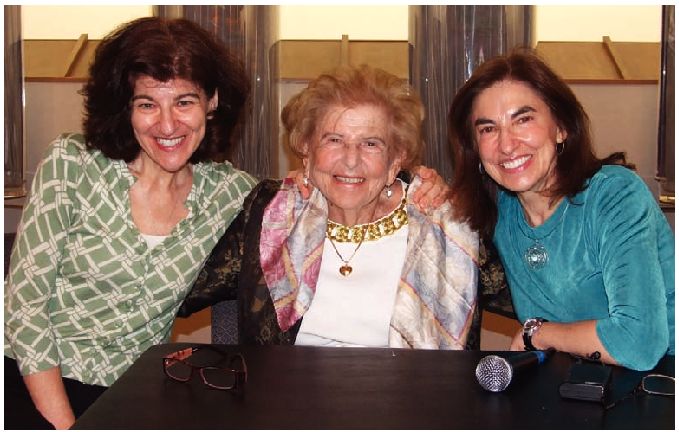
Julie, Lily and Suzanne Salamon

The sisters recently teamed up in Boston for the Hadassah-sponsored program, “Health Care from the Inside Out: Two Sisters, Two Perspectives.” Both women have collective wisdom and extended experience on the subject – Suzanne, as associate chief for clinical geriatrics at Beth Israel Deaconess Medical Center and Julie, as the author of another book, “Hospital: Man, Woman, Birth, Death, Infinity, Plus Red Tape, Bad Behavior, Money, G-d, and Diversity on Steroids.” The “hospital” of the title is Maimonides Medical Center in Brooklyn, where 67 languages are spoken and up to 705 beds are occupied at any time.

It’s clear that the sisters have early and influential memories of the power and the magic of medicine. Their presentation on the current health-care conundrum was as informative as it was compassionate. But it was also their interaction with each other – and their sweet acknowledgement of their mother, who was in the audience – that made their appearance particularly poignant.

The Salamon sisters’ physician father, Alexander (Sanyi) Salamon, had settled the family in Adams County, Ohio, after a difficult and ultimately false start in New York. The only doctor for miles, Sanyi Salamon’s patients revered him. Like many solo practitioners in rural areas, his office was attached to the house.

The sisters told a story that began late one night with a knock on the door of their family’s house. A couple had just received word that their son had died in Vietnam, and the mother was inconsolable. “I always wondered what my father did aside from tranquilizing the woman,” Suzanne said. Their stoic father never talked about his first wife and young daughter who perished in Dachau, but Suzanne wondered if he mentioned them that night to the woman. “As a mother, I looked at that story differently. As a doctor, that story taught me a lot about empathy.”

The year that Julie was at Maimonides, she observed the tension between the bottom line and patient care. “The business of a hospital comes down to people,” she said. “It’s a continuum of experiences from which emerged a lot of discussion of respect, communication or lack thereof. There are competing pressures to secure reimbursement and spend the right amount of time in a system hurrying them.” She added that the moment a patient is admitted to the hospital, the insurance company is forcing the staff to plan the discharge.

With Medicare reimbursements falling far short of actual costs, many geriatric practices are in debt. The 85 and over population is growing, and short visits for patients in their 80s and 90s are ineffective. There are complicated medical histories to sift through and difficult discussions to make about end-of-life issues, such as designating a health-care proxy, when to start palliative care and whether to insert a feeding tube.

“My job is to bring up tough subjects,” Suzanne said. To that end, she never uses euphemisms with her patients, with the exception of characterizing Alzheimer’s as memory loss. “There’s a lot less secrecy today. It’s been years since I’ve been asked to keep a devastating diagnosis from a patient,” she noted.

I looked around at the mostly senior audience and wondered how many of them had healthcare proxies? How many of them have been willing to hand over power of attorney to an adult child? I thought about the 15-year battle my sister and I recently won with our mother to help her legally with her financial issues and health challenges. Did my tablemates more easily accept help from their adult children?

At Maimonides, Julie observed a patient’s room transformed into a sacred space when the subject was end-of-life issues. Stereotypes about doctors and patients fell away as real people emerged. “Finding moments of grace can be difficult,” Julie said. “But part of what you give to your patients is your humanity,” Suzanne added.

The elder Salamons’ grace and humanity remained intact after Dachau and Auschwitz. And those tributes are in full bloom in their daughters: Suzanne Salamon, the doctor and Julie Salamon, the writer.

Confessions of a Scary Mommy

A couple of weeks ago my friend Sam complimented me when he said I articulated an 11th commandment for him in one of my columns: Honor thy Daughter and Son. I hope I don’t disappoint Sam this week with the 360-degree turn I take in confessing that I was a scary mommy when my children were younger.

In fact, I’m having vivid flashbacks to the days when I counted the hours until Ken came home from work or a babysitter relieved me for a solo trip to the grocery store. That’s because I just read Confessions of a Scary Mommy: An Honest and Irreverent Look at Motherhood – the Good, the Bad and the Scary by Jill Smokler.

The book is an offshoot of Smokler’s popular blog of the same name. She has not only chronicled her faux pas, her indignities and ultimately her intense loving moments with her three small children, she has also created an on-line community for women to anonymously post their grievous maternal sins.

What catharsis to read that I’m not the only one who gave my baby Benadryl so I could survive a three-hour flight to Florida. Yes, I too irrationally worried throughout my second pregnancy that I couldn’t possibly love another baby as much as I loved my little girl. And then I freaked out that the second little girl I was so sure I was having was actually a little boy.

Even after all of these years, it’s comforting to know that I wasn’t the only woman who was scared to have a boy. But then something even crazier occurred after Adam was born; I was completely smitten with him. Ken had to practically wrestle my baby boy from my arms when it came time for his circumcision. I was so distraught over what was about to happen to Adam that I stayed upstairs in the fetal position until the deed was done.

Like Smokler, I was never a baby person. I occasionally babysat in high school to earn pocket money and surreptitiously read the dog-eared copy of “The Joy of Sex” or “Everything You’ve Always Wanted to Know About Sex” that seemed to be in every house. In college I never thought about my future children or anyone’s actual children. And in my 20s, when my girlfriends cooed over babies being strolled down the street or holding court from a high chair in a restaurant, I just rolled my eyes.

It’s a good thing that for the vast majority of us the instinct to reproduce is innate. It’s also a good thing that it’s impossible to understand how difficult and frustrating parenthood is until you’re actually a parent. And it’s an even better thing that an intense feeling of love will sweep you away when your child falls asleep in your arms.

But in between the ridiculous and the sublime, Smokler humorously catalogs the big stuff and the not so big stuff that can drive a mother to the edge of her sanity. For example, there are the vacations. Sure, it’s easy to romanticize the days when we played the license plate game on long car rides. Remember magnetic checkers? Well, if you think really hard, I’ll bet you remember that all of that good, simple fun got boring pretty quickly.

Sure, it’s easy to be judgmental about installing DVD players in cars. But until you’ve been lost in Canada for hours and hours with two fidgety kids, you have no right to chastise me for secretly thanking a higher power that we had DVDs and a player with us. What’s that? Children should be able to entertain themselves? You’re probably one of those mothers who tried to take away her baby’s pacifier at six months. Believe me, it all works out in the end. No kid uses a pacifier once the braces go on. I was relieved to learn that I wasn’t the only exhausted mother who, once upon a time, gave her kids chicken nuggets too many times in a week. I was also relieved that I wasn’t the first woman to be jealous of her nanny. The kids adored her, and she folded laundry like she worked for the Gap. It was a nightmare.

But what tripped me up for so many years were the birthday parties. Smokler has a chapter dedicated to the Birthday Party Wars. Who comes up with the most creative theme? Orders the most memorable cake? Or, worst, bakes the best cake themselves. I remember for Anna’s third birthday, I had sand pails and shovels personalized with every kid’s name. Adorable. Original. Except chaos ensued when the kids grabbed the nearest pail because none of them could read.

So yes, I was once a scary mommy. (I probably still am). But the truth is, even though those days of early motherhood were sometimes unbearably long, the ensuing years have gone by all too quickly. That’s the confession of a scary mommy who wished she had a little more wisdom and understanding when she started out.

When Women Were Birds: Fifty-Four Variations on Voice: A Memoir by Terry Tempest Williams

Terry Tempest Williams’s new memoir begins with this stark, bleached declaration: “I am fifty-four years old, the age my mother was when she died.” The mother had bequeathed to the daughter six journals that all turned out to be blank. Not a shadow of a word on any of those pages — pages that Williams describes as “paper tombstones.” Pages that also signal an act of defiance in Mormon culture where “women are expected to do two things: keep a journal and bear children. Both gestures are a participatory bow to the past and future.”

This poetic memoir continues the work Williams, a naturalist and Utah writer, began in “Refuge: An Unnatural History of Family and Place,’’ which interweaved the story of her mother’s unsuccessful battle with cancer with a record-shattering rise of the Great Salt Lake and its destructive effect on a nearby bird refuge.

In “When Women Were Birds: Fifty-four Variations on Voice,’’ Williams explores her mother’s identity — woman, wife, mother, and Mormon — as she continues to honor her memory along with that of the string of women in her family who were stricken by breast cancer. In its 54 sections, one for each year of Williams’s and her mother’s lives, she recounts tales from her mother’s life and from her own in a lyrical and elliptical meditation on women, nature, family, and history.

It’s tempting to think of her mother’s legacy, the untouched journals, as tabulae rasae, blank slates. But Williams brings the literal translation of the Latin phrase to the forefront by inferring that her mother’s unwritten journals are erased slates — there are traces of feelings and dreams and wishes emphasized by William’s italics and capitalization of the word journal. “My Mother’s Journals are words wafting above the page.’’

Williams’s writing pays careful, crisp homage to her family who are “loyal citizens known as ‘downwinders’ ” — people who lived down wind of the Nevada nuclear test site, thus exposed to the radiation that resulted in her mother’s cancer. A year after her mother’s death in 1987, Williams protested at the site where atomic bombs were still being detonated in the desert. Her act of civil disobedience parallels her mother’s subversive act of leaving blank pages behind. The silences, the truths of women’s lives carry the power of an atom, she suggests. Williams quotes the poet Muriel Rukeyser’s famous lines: “What would happen if one woman told the truth about her life? The world would split open.”

Williams traces the personal and artistic influences in her life. “My Mother’s Journals are a creation myth,” declares Williams. Diane Tempest’s empty diaries inspire her daughter to metaphorically fill them with a creation story of her own voice. Her mother’s blank pages offer wide-open spaces for an “unruly imagination” — an imagination that continuously invents stories and shapes memory. She considers her mother’s originality and the work of artists like John Cage and Gustave Courbet and activists like Wangari Maathai. Blank pages beckon Williams to reflect on her life as a daughter, a wife, an activist, and a teacher.

Toward the end of her memoir, Williams makes an exhaustive list of wondrous, exciting possibilities for the blank pages that include clean sheets, white flags of surrender, a white tablecloth not yet set, a scrim, a stage, reviews never written.

The blank pages of Diane Tempest’s journals are full of tacit praise and gleaming admiration for her daughter’s literary gifts — gifts that Williams further understands when she opens her mother’s journals and reads “emptiness, [that] translated to longing, that same hunger and thirst, Mother translated to me. I will rewrite this story, create my own story on the pages of my mother’s journals.”

And so she has written her story, her mother’s story, the story of her clan of one-breasted women by triumphing over the empty page every day.

This review was published in the April 12, 2012 edition of the Boston Globe

The Weight Watcher

This month’s issue of Vogue features an essay by a mother who put her 6- year-old daughter on a Weight Watchers-style diet. My first reaction was: The Horror. The Horror. But not for the reasons you think.

I could easily make the same gaffe; I write about my children almost every week. But I read them every column in which they appear. In keeping with our agreement, I’ve killed a few columns at their request. Forbidden topics with regard to my children include dating, puberty and grades. Oh, and weight was never on the table.

Before judging Dara-Lynn Weiss even more harshly, I read her bad mommy confessional. It begins with Weiss firmly telling a well-meaning friend that her daughter Bea has already eaten her quota of the day’s calories, and she can’t have the Salad Niçoise the woman offers. Did I mention that Bea is still hungry? That she’s always hungry on her diet. But Bea’s pediatrician became concerned when Bea landed in the 99th percentile for weight. What looked like baby fat to her mother was clinically considered obesity.

Bea’s weight was not just about aesthetics for her mother. Weiss cites some very real and sobering statistics about childhood obesity. Overweight kids are courting high blood pressure, high cholesterol and Type 2 diabetes. There’s also the emotional fallout of looking and feeling different than your peers that leads to low self-esteem and depression. Weiss took her daughter to a reputable doctor who designed an age-appropriate diet. That doctor has since then, corrected Weiss’s rigid portrayal and execution of “the green light red light” diet. I’m sure the doctor never intended for Weiss to hold up her hand like a cop and forbid Bea to eat anything that wasn’t on the diet. But like all parents, Weiss got frustrated. Bea felt deprived. Sometimes Weiss would scream at her daughter to stop eating so much junk. Who am I to judge? As Weiss points out, “Everyone supports the mission, but no one seems to approve of my methods.” I get it. After all, I’m the woman who left her daughter at the side of the road because I was so frazzled and fedup with her one night. But my daughter is almost 18, and Bea just turned 7. And my daughter approved that column. She even thought it was funny and shared it with her friends.

And yet amid the negative attention, Weiss makes some good points. For example, if Bea “attempted to walk through the door of [her school] with an almond in her pocket, she’d practically be swarmed by a SWAT team. But who is protecting the obese kids when 350- calorie cupcakes are handed out to the entire class on every kid’s birthday?”

I came back to some of Weiss’ points when I read an alarming article in The New York Times Magazine about “precious puberty” in which our girls are maturing at earlier ages. There are myriad contributing factors, with environmental ones high on the list. For a time, I ran my own quirky branch of the Environmental Protection Agency, purging plastic water bottles and containers, getting hysterical about pesticides and scouring Whole Foods for kosher organic chicken.

Weight was once considered to be one of the causes of precocious puberty. Pediatric endocrinologists believed in the critical-weight theory of puberty –once a girl’s body reaches a certain mass, then puberty begins. But that theory has recently shifted to something called the critical-fat theory of puberty. The idea is that fat tissue, not weight itself, sets off early maturity. More specifically, girls who are overweight have higher levels of a hormone called leptin, which can lead to early puberty. Leptin sets off a cycle that can elevate estrogen levels and affect insulin resistance, causing girls to have more fat tissue.

There’s also that vague bubble of stress floating over a girl’s life. The de rigueur research on the subject points to the salutary affects of growing up in a two-parent household. I’m also fascinated by evolutionary biology and the assertion that reproducing earlier is the result of a stressful childhood – the body’s default response to coping with a difficult life.

Evolutionary psychology aside, our girls’ bodies and psyches are so complicated, so vulnerable. There’s always low selfesteem and negative body image lurking in the background, waiting to pounce. How can parents protect their daughters?

The snarky answer is not to write about a child’s struggles with weight in a national magazine. But Weiss’ article is the exception rather than the rule. Among the best advice that I’ve read on the subject of blooming early, applies to raising girls in general. Focus on your daughter’s physical and emotional health, rather than playing food cop or attempting to slow her development. Treat your daughters appropriately for the age they are, not the age they look or want to be.

While it may seem obvious, be patient and give your daughter a heavy dose of perspective. And please, please respect her privacy. By the way, Bea lost 16 pounds and grew two inches in a year. Not that that’s anybody’s business.