What Kind of World Am I Leaving You, Dear Daughter by Judy Bolton-Fasman

My Dearest Daughter:

At some point over the last 18 years, I, like many other moms out there, started to worry about the sort of world I brought you into. This is your first week of college, and it’s also your first time away from home for an extended period of time. Your world is opening up in exciting and challenging new ways, but still, sometimes I feel as if I’ve launched you into outer space — into a disorienting, alien landscape that I don’t quite recognize. Case in point: Rep. Todd Akin’s statement about “legitimate rape.” By now you know the ridiculous essence of the story — that Akin said that when a so-called “legitimate rape” occurs, a woman’s body somehow knows to shut itself down to prevent pregnancy.

My precious daughter, you plan to major in biology and you will surely learn that this man has propagated a disgusting, bald lie in order to force women to carry a traumatic or unwanted pregnancy to term. In fact, last year Akin co-sponsored a bill with Paul Ryan, the presumed Republican vice-presidential nominee, that permitted Medicaid to pay for an abortion only in the case of a “forcible rape.” If an adult relative raped a young girl or a co-ed was date-raped by another student, these men believe that those rapes should not be eligible for abortions under Medicaid.

How did we get here? What sort of country am I leaving to you?

The other day you called me on the way to your very first class. How ironic that it was physiology. How strange that you begin your pre-medical studies in the wake of ignorance and misogyny stirred up by this nobody congressman. But as an aspiring physician and a member of a freshman class that is 52% women, you need to understand the grave ramifications of what’s happening. The word ‘legitimate’ should never be associated with rape. And under no circumstances should this politician — who’s serving in history’s most embattled and stridently anti-woman congress — be excused for his poor or unfortunate choice of words. Allegedly he meant to use the word “forcible.” God, spare us from such semantics.

If medicine turns out to be your vocation, some day you may work in an ER, where you could see rape frighteningly close and disturbingly personal. You may come face-to-face with a rape victim, and she may very well be a girl between the ages of 11 and 17. You may learn that one in six women is raped in the United States, and girls under the age of 18 report 60% of rapes.

This is your time, dear daughter. You have a singular voice, and you have the potential to mobilize a collective, booming voice along with your peers. Tell these men to stay out of your bedroom and get the hell out of your pants. Knock on doors, sign petitions, write letters — you’ll figure out how to tell them that you know exactly what they’re up to when they use foul euphemisms like “informed consent” and “mandatory waiting periods.” Let them know that their transparent ploys humiliate women by forcing them to undergo superfluous medical tests before having abortions. This is your life; you determine when and if you want to create and carry another life to full term.

Shortly after you were born, your late blessed grandfather said that with a boy you worry about one penis and with a girl you worry about thousands of them. I thought it was an odd observation at the time. But I’m afraid we live in very odd times where woman-haters masquerade as politicians and care only about their own penises.

Take care of yourself. Take care of your sisters. It’s never been more apparent that we only have each other.

Love always,

Mamma

This piece was originally published on the Sisterhood Blog of the Forward

Three Cheers for Boredom by Judy Bolton-Fasman

“I’m bored.”

That’s a phrase that no parent cares to hear from her child. That’s a phrase that provokes my ire.

Avoiding boredom is big business. No more sitting in bumper-to-bumper traffic with only the radio to take the edge off the tedium. If you’re not moving, you can take out your smart phone and answer your e-mail—assuming that you’re a passenger. Or you can make a call on your cell phone on your Bluetooth if you are the driver to wile away the time.

I recently upgraded to an iPhone, reducing my boredom to “microboredom”— a term that one cell phone maker has coined to describe those dwindling moments when we have absolutely nothing to do. I’m not the best role model when it comes to microboredom. But I like to think that I’m not so much bored as I am obsessive, another syndrome served by mobile technology. I sit in the carpool line reading e-mail and downloading the news, while listening to music from my iPod wafting from the car stereo.

Anna got her microboredom under control years ago when we bought her a video iPod for her Bat Mitzvah. She giddily downloaded everything from movies to episodes of her favorite television shows. The video iPod became a sleeping aid. I should probably be more concerned about this than I am. But as a life-long insomniac, I’m grateful that Anna found something relatively harmless and drug-free to help her fall asleep.

When I was a kid whining about how bored I was, my father would look at me over the thick book he was reading and tell me to read. I’d stomp out of the room with my AM transistor radio and find a quiet place to listen to Top 40 pop. But when that got boring, I got desperate and took his suggestion. Sigh. Yawn. And then something happened. Twenty pages in and I was in a relationship with characters. Plots engaged me. Language fascinated me to the point that I tried to emulate the prose of my favorite writers.

A few years ago a skulking Adam said there was nothing to do in a house where there are four computers, two DVD players and not one, but two devices on which to play videogames. He picked up a Gameboy, but that did nothing for his malaise. My suggestions sounded desperate. What about playing Guitar Hero? Let’s play Text Twist—an on-line game that adds an unprecedented level of anxiety to a simple word scramble.

Nothing took. I wondered what would happen if he was disconnected from the computer, the television, and other forms of technology. At first he acted like a caged animal until I told him to go outside and ride his scooter up and down the driveway.

“For how long?” he mumbled.

“A hundred times,” I said.

“You’re kidding, Mom. That’s as boring as counting sheep.”

“Don’t fall asleep on your Razor,” I said.

It turns out that a bit of fresh air is exactly what my boy needed. He lost count of how many times he went up and down the driveway. He ran into the house rosy cheeked and hungry. Fresh air—the time-honored elixir for boredom.

Boredom is a relatively new word in the English language. Charles Dickens is credited as the first writer to use it. The word appears in a very long convoluted novel called “Bleak House.” I had to read it my sophomore year of college and I must confess I didn’t finish it. It was boring.

But think about what would have happened if Marcel Proust had not taken a maddeningly, boring amount of time to dunk his madeleine cookie in a cup of tea? We might have a completely different paradigm for the interplay between memory and imagination. And what about philosophy? There would be no existentialism without a substantial dose of boredom.

Researchers who study boredom have found that watching paint dry sparks creativity, imagination and introspection. Young children naturally tolerate boredom and eventually overcome it by simply playing . Have you ever seen a bored toddler? Everything is wondrous to him. His world is full of possibilities all day, every day. Young children see options even in the most mundane of surroundings, the most basic of toys. My children often preferred the box to the toy that came in it.

As children get older, boredom can be menacing. In school it can indicate a lack of understanding or the inverse—a lack of meaningful challenges in the classroom.

Allowing our kids to confront and overcome boredom is an important life lesson. Maybe we should start by having our kids regularly disconnect from television, computer games, or cell phones. I recently read that the amount of time for an old habit to dissipate and a new one to take root is three weeks. My father must have intuited that. He never gave up on me until I enjoyed reading books as thick as the ones he read.


A Letter to Alice Walker

Dear Ms. Walker:

Please think of this letter like those notes full of wishes that people fold and fold and fold to fit into a crevice in the Wailing Wall in Jerusalem. I tell you this because I just re-read The Color Purple, in all of its epistolary glory, after I learned that you wouldn’t allow the book to be translated into Hebrew.

I tell you this because letters like Celie’s—thousands of letters like hers—live in the Wall until they are swept away by maintenance workers. But before that happens, I’d like to believe that those words reach heaven on the breath of all the prayers constantly hovering over Jerusalem. These multi-religious pleas and praises to God are what the late Israeli poet Yehuda Amichai described as “the ecology of Jerusalem.”

Celie and Shug have their own astonishing floating theology. Neither of them has ever found God in a church. God is genderless. God is nature. God is part of everything and so are we. Jews and Christians and Muslims. Palestinians, Arabs and Israelis. “God love everything you love—and a mess of stuff you don’t,” Shug tells Celie. God loves beauty for the sake of beauty. Nothing makes God angrier than walking by the color purple in a field and taking no notice of its glory.

There is so much color in Israel. Some of it invented though, like the Green Line. I imagine that kind of color is anathema to your politics, to your soul. I don’t like it either. But I must tell you that I am still a Zionist. I feel the same way about Israel that Celie’s missionary sister Nettie felt about Africa. The first time she set eyes on the African coast something like a large bell struck her soul. The first time I went to Jerusalem my friends made me get out of the car and physically walk into the city. I felt like a pilgrim. But the first time I truly saw Israel — the golden colors of Jerusalem stone, all shades of blue in the Armenian quarter, the glittery reds and pinks in the Arab market — was when I landed in Israel directly from visiting the ashes of Auschwitz.

Or more accurately the ashes of Majdanek, another camp in Poland. Auschwitz is a tourist attraction. You can buy a hot dog outside of the sanitized concentration camp. The piles of shoes and pots and pans that the Jews thought they needed when they were deported to concentration camps look more like sculptures—frozen by history and cliché. But Majdanek is black, charcoal black, and the bleakest place I’ve ever seen. The day after I visited, I was in Israel and it was the first time I shed personal tears for the Nazi genocide of my people. It was the first time I understood why Israel has always been and will always be the heart and soul of the Jewish people.

But life has never been a fairy tale in Israel. There are distinct geographic and class divisions. They exist as sharply among Jews as they do between the Palestinians and Israelis. But to call these social problems apartheid is a false historical equivalency, Ms. Walker. Israel is not an apartheid state. There is no official policy of discrimination of any one people as there was in South Africa. Yes, there is injustice and oppression. But there is also an entire society of Celies— Jewish women burdened by sexism, misogyny and wholesale ignorance. These women need Celie. I know that somehow The Color Purple will reach some of these women surreptitiously if the book is available in Israel in Hebrew. They’ll read that God’s will has nothing to do with their husbands’ ill wills. God is a savior. Their husbands are jailers.

If your book were translated into Hebrew, I would hand out copies in the streets of Me’ah Shearim in Jerusalem and B’nai Brak in Tel Aviv, where women are forced to cross the street in deference to men. I’d hand them out in the back of buses where women are corralled because of some twisted, sinful interpretation of Jewish religious law. I’d distribute them to Palestinian women, for many of whom Hebrew is also their first language.

But until I have your book to give them, these women are as mute as pillars of salt. That was Lot’s wife’s punishment when she was instructed not to look back at the ongoing destruction of Sodom and Gemorrah. But how could Lot’s wife, whose name was believed to be Judith, not turn around to make sure her children were safe. Celie looked back to locate her children too and for that she was also entombed in a metaphorical stony pillar of salt. But she didn’t stay trapped. When she broke out of her numb existence it was not so much a miracle, but an act of womanhood.

Don’t your Palestinian and Israeli sisters deserve to read Celie’s story? Don’t they need to know that noticing the color purple is their God-given right too?

Yours truly,

Judy Bolton-Fasman


I Am More Than a Paycheck

Okay, Elizabeth Wurtzel, you’re incendiary, condescending, a bit heartless and inexperienced, but you’re not totally wrong. The premise of your screed in The Atlantic that motherhood is not a job is true. At the risk of engaging in some blustering semantics—motherhood is messy. It’s consuming. It’s a woman’s blood. A mother’s milk. Motherhood is a mind-blowing, body-altering experience and no one can come close to telling you how radically amazing, frightening, depressing, frustrating and exhausting it is until you become a mother. That’s just the way it is. And believe me, I hate to admit when my mother is right.

Wikicommons
Elizabeth Wurtzel

Just to be clear, I’m not the 1% stay-at-home mother you take to task, Ms. Wurtzel. I’m a writer. I work hard at it, but I don’t come close to paying the mortgage from my wages. I also devote a lot of my time to mothering my two teenagers and I don’t get a dime for that. My husband supports our family. He’s in a field that’s more lucrative than mine. That’s a fact.

I’m blessed to have the choice to work from home, but I’m not spoiled. I think multi-tasking is a myth perpetuated to drive women crazy. I decided to stay at home when my first child was born because I wanted to be the most important person in her life. That’s not egotistical, that’s love. Full-blown maternal love. I break my own glass ceilings each time my children choose me as their go-to-person. Sometimes I lose out to their friends, but I can live with that. At the end of the day, I’m the one that they confess their sins and their fears to. And to paraphrase you, if you tell me that anyone can do that for my kids, I swear I’m going to smack you. No one, but no one, could ever love my kids like I do because I am their mother. Period.

Just in case you’re wondering, I don’t shop at Chanel. (Once in a blue moon I buy makeup at Bloomingdale’s.) I don’t get facials unless I have a gift certificate. And I don’t wear Lululemon to some fancy shmancy gym. But you probably think I’m a slacker for grabbing an extra hour of sleep in the middle of the day after I’ve stayed up most of the night with my daughter to see her through a prolonged asthma attack. And ditto for staying up very late to support my kids when they’re studying. Once upon a time I slept late with my infant son in my arms after he stayed up all night with colic, which trust me is no fairytale.

I’m the best person to comfort my children when they are bullied, when someone breaks their hearts or when they’re preparing for a big test. Mothers are special that way. True, I don’t get a salary for supporting my kids through life. Accordingly, I’m not a real feminist in your book. But I’m a woman who knows what it’s like to love two human beings so much that I would die for them without a second thought. I daresay that’s past, present and post-feminism.

And by the way, I got married when I fell in love with someone who made me a better person than I was. He’s my best friend. I haven’t compromised my integrity or my independence one whit. I’m damned proud to be my husband’s wife. Grimace all you want, but I’m also damned lucky. And by the way, if you’re in a healthy marriage, by definition you’re a full-time wife whether or not you’re getting a paycheck. We can generalize forever about monogamy and the balance of power in a relationship. But I’ll lay it out in terms that you, as a paid working woman, can relate to. Think of monogamy as a career that you adore. Not always easy. Not always fun. But there are a lot of bonuses and that ultimate reward: fulfillment, As far as power goes, well sometimes, I have it in the relationship and sometimes he does. Domestic office politics. We deal with it.

Maybe wealthy women—the lunchers, the shoppers, and the gym rats—have betrayed feminism. But the last time I checked, feminism wasn’t autocratic or conformist. Feminists are discerning not judgmental. Just to complete the picture for you, I drive a Volvo because I hate driving in the snow and feel more secure in a steel-enforced car. The roads ice up faster in the suburbs. And if you notice me talking to myself while I’m driving, I’m either answering an editor’s questions or fielding a complaint from one of my mother’s caretakers on my Bluetooth. I won’t even get into my role as the daughter of a cantankerous, difficult woman. Suffice it to say, I don’t get paid for that either.

K is for Kenneth — Father’s Day Column

The other day I was reading a quirky grammar book with a chapter headed “Adopt a Favorite Letter.” (Yes, I sometimes read grammar books and dictionaries to relax). I was intrigued by the author’s notion that he detects a secret meaning in each letter of the alphabet. Yes, I thought, someone understands how I feel about the letter K.

K is for Kenneth. That’s my husband’s name and it was also my father’s first name. But Dad was never a Ken or a Kenny. He went by his middle name Harold. Kenneth was his phantom name. Unlike its phonetic counterpart C, K is unambiguously hard, ramrod straight on one side, making it the perfect letter to lean on. A letter from which to fly the flag that Dad revered, the Stars and Stripes he flew from his bedroom window on every national holiday. The flag that draped his coffin.

The K in my father’s name stood alone. My father’s luggage, chunky signet ring, and a check register as big as a ledger were all monogrammed with an indelible K. The signature that followed was a comet tail of script meant to read as Harold Bolton. I grew up in the shadow of Dad’s K—a patch of dusk in which good posture, impeccable manners, and fair outcomes were cultivated.

When I eulogized my father ten years ago, I talked about my father’s inimitable K and my brother said at that moment he knew that his son’s name—born two months to the day after Dad’s death—would lead off with the stalwart K. The family K now anchors my young nephew’s name. The K of my nephew’s name is not associated with a particular name. It is a stand-alone initial that perpetuates my father’s solid K-like presence in our lives.

I particularly love the Hebrew alphabet for its array of meaningful letters. I also like that the Aleph Bet occasionally doubles as numbers, forming a quirky numerology or gematria that engages the compulsive in me. A well-known word-number correlation is the Hebrew word for life—chai. The two Hebrew letters that make up the word correspond to the numbers eight and ten. In the realms of Jewish luck and superstition, eighteen is a powerful number and one that I am forever trying to extract by adding up street addresses and birth dates.

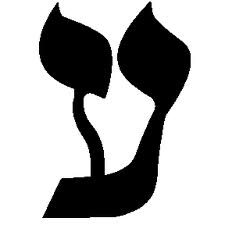
But my favorite Hebrew letter is ayin. Ayin is for Akiva—my father’s Hebrew name. Akiva is also Adam’s Hebrew name. My Dad was alive when Adam was born and I latched on to the Sephardic tradition of naming after the living. I’m all for dynamic continuity. Ayin is for Akiva and this time the hard K sound of the Hebrew letter kaph that follows the ayin is subordinate to it. Large, resonant kaph must make room for the almost inaudible “a” sound that ayin carries. But kaph is also for Kalman—my husband Ken’s Hebrew name. The sturdy chiseled sound of the kaph suits him. The shape of the letter kaph also reminds me of a shepherd’s staff, like the one I imagined Moses carried.

As for me, I can’t resist telling you about the tiny letter yud that leads off my Hebrew name Yehudit. Yud, is a smudge of a letter slipped into words to space out consonants or give vowels a new sound. Unobtrusive yet effective. I aim to be that kind of parent, do you?

Jewish mystics tapped into the otherworldly qualities they intuited from the Hebrew alphabet.  Ayin is for Akiva and in the dreamy, swirling, opaque world of the Kabbalah, the letter ayin is associated with the unique uncomprehending nothingness before the creation of the world, the windswept darkness of creation, the airy nothingness of God’s incorporeal existence.

A great Hasidic master once said that “nothing can change from one thing to another without first losing its own identity. Before an egg can grow into a chicken, it must completely cease to be an egg. Each thing must lose its original identity before it can become something else. Before a thing is transformed, it must come to the level of ayin.”

My son loses his little boy identity by shooting up 11 inches in two years. I listen to his deepening voice. I watch him fix my computer. I read his essays full of insights wholly his own. When he puts his hand on my shoulder he’s returning the reassurance and the protection that I hope his father and I have given him.

I think Jewish tradition has made Father’s Day, and for that matter Mother’s Day, a recurrent event. In Hebrew the names by which we are called to the Torah are as long and magical as the trailing comet of my father’s signature. We never forget that we are a son or a daughter. Or, for those of us so blessed, a parent.


Help is on the Way: Meredith Goldstein on Relationships and Jewish Identity

There is an impressive trifecta of female Jewish advice columnists based in Boston. Among them is Meredith Goldstein, the popular relationship columnist at the Boston Globe. Goldstein has an active blog on the paper’s Website called Love Letters: Sometimes Love Stinks. Let Us Help. [(http://www.boston.com/lifestyle/relationships/blog)] /

Meredith GoldsteinIn a recent conversation, Goldstein observed, “I’m following in the great tradition of Jewish women who were advice columnists. It’s not surprising that most of these advice givers are Jewish. We’re good listeners and talkers. And maybe we’re a little nosy too.”

Her local colleagues are Margo Howard—daughter of Ann Landers with a syndicated column that is as blunt as it is wise—[(http://en.wikipedia.org/wiki/Margo_Howard)]  and Robin Abrahams. [(http://robinabrahams.com/)] Abrahams is the woman behind Miss Conduct, a cross between personal advice and a discourse on formal manners that appears in the Boston Globe Sunday Magazine.

Goldstein says that each part of the trifecta distinctly approaches her job. “Robin knows what to do. Margo knows what she wants to do. I’m more intuitive. A problem can be told in many different ways for which there is a different framing.”

Goldstein receives hundreds of letters a week, five of which are published on her blog each weekday. It’s not unusual for a given conundrum to garner over 2000 comments. For print, she picks her favorite letter of the week from subjects that can range from a boyfriend repaying a loan to the best way to end a relationship. Goldstein then curates the best readers’ comments and prints them along with the letter for the Globe’s Saturday entertainment section.

Meredith Goldstein, who is 34, says she is happily single. She can also add best-selling novelist to her self-description. Last month Plume published her book, The Singles, [(http://www.amazon.com/Singles-Novel-Meredith-Goldstein/dp/0452298059/ref=sr_1_1?s=books&ie=UTF8&qid=1337026199&sr-1)]  as an original paperback. Goldstein adds her own twist to modern-day nuptials by focusing on five guests who attend a no-holds-barred country club wedding without dates. She calls these floaters “plus ones.” She admits there are autobiographical resonances in the book. A few years ago she attended the wedding of an ex-boyfriend as a plus one. The experience led her to imagine a story that focused not on the bride and groom at a wedding, but their unattached guests.

The novel is also natural movie material and was recently optioned by Lime Orchard Productions, the same company that produced A Better Life. [(http://www.imdb.com/title/tt1554091/)]

Goldstein grew up in Columbia, Maryland, a bedroom community between Baltimore and Washington DC. Her parents were the first couple on the block to get a divorce and Goldstein says the experience adds depth to her work as a relationship columnist. “Dozens of nuclear families in the Jewish community were put off by us. I grew up unaffiliated, but always had a strong Jewish identity.”

The Goldstein home was a busy one. Her mother gave piano lessons in the living room and there was a constant flow of music and people in the house. The fancy bat mitzvahs that Goldstein attended as a young teen presented her with a skewed view of Judaism until she arrived at Syracuse University. “Journalism became my identity [in college],” she noted. “But I also met broad diverse groups of Jewish women who expressed their Judaism in dance, song and even their relationships with grandparents. They were hilarious, warm and loved their families intensely even when they despised their families.”

After graduating from Syracuse’s S.I. Newhouse School of Public Communications, [(http://newhouse.syr.edu/)]Goldstein worked as a reporter at the Providence Journal and began stringing for the Boston Globe. Her freelance work for the Globe led to a full-time job covering communities north of Boston. After a couple of years she came back to the city proper as a reporter for the Globe’s living arts section. “It was the dawn of online-dating and the first generation that did not depend on a land line to communicate. I was writing a lot of trend pieces on how technology affects relationships.”

In Boston, Goldstein also gravitated to her aunt and her family who are modern Orthodox Jews. “I didn’t realize how Jewish I was until I moved to Boston. Spending time with my aunt’s family I realized that Hebrew is a different way of talking to God.” In addition to sharing holidays, Goldstein wrote a lot of The Singles in her aunt’s basement.

As for Hannah, her main character, Goldstein identifies with her confusion over her Jewish identity. Although Goldstein’s parents are both Jewish, in the book Hannah is a patrilineal Jew who embodies some of the marginalization Goldstein felt growing up. “I only felt kind of Jewish and tried to fit in. I identified, but I didn’t know how to say it.

These days Goldstein says she embraces her Judaism. At a recent conference for Jewish teenagers celebrating their own Judaism and power as young women, Goldstein encouraged each member of her audience to follow their intuition and stay true to their values when negotiating relationships.

A London Eye’s View of my Daughter

The last time Anna and I went to London together we marked the fact that she had just entered the “double digits” – she was 10 and mostly wanted to hang out at Harrods’ toy department and Yo Sushi. Last week we left our guys at home to celebrate her upcoming high school graduation. What a difference eight years does and does not make.

My girl and I took off for our five-day extravaganza with a vague plan to see some shows, eat at Yo Sushi (again) and shop. And then squeeze in a few museums between more shopping. That’s what I thought we agreed to in principle, but then reality reared its black and white head.

I observed a side of my daughter I intuited, but couldn’t exactly articulate before our trip. Anna, princess over the sloppiest sovereign space in our house, likes order, craves structure. I get claustrophobic at the thought of being tethered to an organized tour. Not Anna. She likes to climb up to the top of that double-decker bus and listen to the guide.

On Day 2 of our London adventure we went on the London Eye – a super slow Ferris wheel, powered by sustainable energy – that eventually provides panoramic views of London. Compared with eight years ago, Anna was not as happy to pose in front of various landmarks in our little bubble compartment – “Go, go there’s a great view of Westminster Abbey,” I said a bit too shrill. “How many times can you photograph Big Ben?” asked Anna, princess of the perfect eye roll.

After we hopped off the London Eye, I thought we’d pop up to Madame Tussauds. After all, Anna loved Posh and Beck’s wax figures on our last visit. But my girl had my number. She knew I was willing to schlep on the tube and suffer through two transfers just to get a picture of me standing next to Colin Firth’s heart-racing likeness. Colin was featured in an advertisement for the iconic museum at a tube station. “Don’t even think about it,” warned Anna, princess of the perfectly raised eyebrow. She told me to step away when I approached the poster. One person’s idea of vandalism is another person’s idea of procuring an innocent souvenir.

No poster, no Madame Tussauds. We negotiated and decided to go to the Tate Modern as long as I got to walk across the Millennium Bridge and flit around Saint Paul’s Cathedral. “Princess Diana was married at Saint Paul’s,” I told Anna breathlessly. That fact did not impress my daughter, who barely remembers Diana. I also insisted we walk across the same bridge that Bridget Jones sauntered along in the first movie. Again, my motives were embarrassingly naked. “You won’t see Colin Firth no matter how many times you walk back and forth across that bridge. Oh and I hate bridges as much as you hate sitting in the middle of a row in the theater.”

Eight years on, and a wisecracking teenager had replaced my little girl. But I found my sweet girl the next day on the Harry Potter tour. The last thing I wanted to do was go to the English countryside to look at ossified movie sets from the various Harry Potter movies. But this was Anna’s trip, so I shelled out way too much money for the two of us to go on the tour. I love Harry Potter as much as the next person. I took Anna to a bookstore at midnight for one of the series’ releases so she could be the first kid on the block to read the doorstopper of a book. The anticipation on her face on that long ago night was delicious.


There was the same look when she happily posed in front of a replica of the Hogwarts gates. I loved watching my daughter having so much fun strolling through the Great Hall and peering into Harry’s closet bedroom under the stairs of 4 Privet Drive. And, yes, we posed for a picture in front of the exterior of what is arguably the most infamous Muggle house in the United Kingdom.

At night back in London, we strolled on the Strand or in Covent Garden. We also made a nightly stop in the hotel’s business center to check Facebook – hers and mine. Subtle parent that I am, I asked her what was new on her page. “Everything’s fine,” she said gently.

The next day Anna and I went to the Queen’s Gallery in Buckingham Palace and saw an exhibit of Leonardo Da Vinci’s anatomy drawings. I was astonished by the way my daughter so carefully went through the exhibit and pointed out the flaws as well as the prescience of Da Vinci’s work. Suddenly, I realized that more and more Da Vinci moments would replace the Harry Potter ones.

Little girl. Big girl. The next time we go to London, Anna will be a woman, and I will finally pose next to Colin.

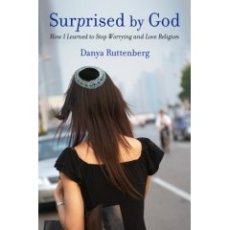
Looking for God–Surprised by God by Rabbi Danya Ruttenberg

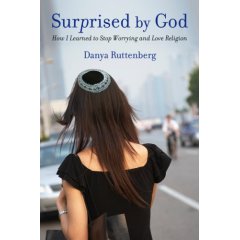
Image“Philosophy,” Plato once said, “begins in wonder.” Rabbi Danya Ruttenberg quotes Plato early in her intelligent, luminous memoir Surprised by God: How I Learned to Stop Worrying and Love Religion. Rabbi Ruttenberg’s moving inquiry into faith is consistently inspired by her ongoing sense of wonder and appreciation for Judaism. She grounds her exploration in story—her story and the stories of our ancestors—and ultimately offers readers a blank page to write their own stories.

It is tempting to summarize Ruttenberg’s book as “Girl Meets God.” But such glibness would miss the point. As Ruttenberg explains, faith is a workaday project that is both personal and communal. Ritual operates in tandem with faith “on multiple planes at once: emotional, physical, theological, familial, social, liturgical.”

For Ruttenberg faith and ritual slowly emerge after her mother’s death and an intense phase of post-college partying in San Francisco during the dot-com era. All the while, Ruttenberg is also searching for a meaningful spiritual life, even if it is punctuated by moments of suffering. “I would discover,” she writes, “that pain and fear were a hundred thousand times better than this unconscious sleepwalking through parties and distraction even when it was harder.”

I met Rabbi Ruttenberg a few years ago among a group of seekers and skeptics at a Boston community mikveh to help them prepare spiritually for the High Holidays.  She noted that although the word “spiritual” means many things to people, it can also be too amorphous for others. She described a period of intense grief during her senior year of college when she took midnight walks which made her world momentarily “softer” and  “plugged her into God.”

Daily ritual takes over where reverie leaves off. Ruttenberg remembered, “There was never a moment when I deliberately and consciously decided to say the Mourner’s Kaddish, as an adult child traditionally does for the first eleven months after a parents’ burial.”

During her year of mourning Ruttenberg attended synagogue almost every day to say a prayer of mourning she did not initially understand. Her persistence paid off and she gradually became familiar with daily services.

Na’aseh v’Nishma—we will do and we will understand. It’s the transformative response from the Israelites as Moses reads the Torah for them for the first time at the foot of Mt. Sinai. Ruttenberg’s early religious practice exemplifies Na’aseh v’Nishma. When she consistently does, she is graced with spiritual insights. She lives for those moments and learns how to access them through meditation.

Meditation happens. It happens spontaneously on long walks; it happens during focused episodes seated on a cushion; it happens in a packed synagogue. In her book, Rabbi Ruttenberg recalls a moment in which she becomes so aware of her breath while meditating that her tendinitis painfully flares up. She writes, “For me meditation is about awareness. I don’t push away thoughts. I simply keep on breathing. If I don’t grab on to my thought, they’ll eventually fall away of their own accord.”

Grief often bubbles to the surface. “There are many halls in the King’s palace, and intricate keys to all doors, but the master key is the broken heart,” said the Ba’al Shem Tov—the father of Hasidism.

The group at the mikveh reflected on the Ba’al Shem Tov’s wisdom, but no one was entirely sure what it meant. The woman next to me was quietly crying. Her breath came in fits and starts. “Everyone is broken-hearted in some way,” Rabbi Ruttenberg assured them. “Entering pain in whatever degree we can alleviates true suffering.”

I thought of the Binding of Isaac. On Rosh Hashana we read about his near death experience as a sacrifice to God. One midrash points out that Isaac not only accepted that he would be sacrificed, but on the altar he asks his father to tighten his bindings so escape is impossible. Kierkegaard argues that the story is bearable because in the end Abraham did not believe that God would allow him to sacrifice his son. Although he was seemingly prepared to kill Isaac, Abraham went through the motions with a profound trust that God would do the right thing.

I thought about Kierkegaard’s insight. Is he saying that Abraham had keen intuition?  “Intuition is how God talks to us,” Rabbi Ruttenberg told us. “Intuition is the way we navigate into a space that becomes deeper, richer, fuller and bigger.”

She sensed the group’s skepticism about achieving kavanah—intentionality—in a crowded synagogue. How can intuition complement set prayer? How can one create a meaningful space in a crowded row of seats? And how can one experience spiritual solitude in a makeshift sanctuary accommodating an overflow crowd? Personally, I was not convinced any of these things can be achieved. But like Abraham, maybe God wants me to be there, needs me to be there to participate in the conversation.

Rabbi Ruttenberg expounded on the salutary effects of meditation. “For me meditation is the warm up. It gets me to a place where I can pray.” Did that mean that praying is like exercising? “Not exactly. Set prayer in the machzor—the prayer book used on Rosh Hashana and Yom Kippur—pushes us to a place we don’t automatically go to. The service can be a way to start our journey.”

Language is both the most and least effective tool we have for reaching God. Rabbi Nachman of Bratslav often went into the woods alone to address God out loud. On the advice of my rabbi, I’ve tried to talk to God a couple of times when my house empties out in the morning. Even though I’m alone I’m self-conscious, as if someone is watching me talk to an imaginary person.

Only grief snaps me out of my uncomfortable awareness of self. A few months ago I was driving home from an evening meeting. My best friend had recently died. Suddenly grief overtook me. I pulled the car over. The soft clicking of my flashers kept time to my wailing. Sometimes I miss my friend so much that I am sure I will never be able to climb out of the void her absence has created in my life.

“There is nothing more whole than a broken heart,” says Rabbi Nachman. I like that saying for its intense grouping of joy and sadness, but I never quite understood it until that night in the car. Broken heartedness is the time when we are most open to God in our fragility and vulnerability. “I hate you God,” I screamed. At that moment only those words could serve as my prayer to God.

The Catholic monk Thomas Merton acknowledges the discomfort, even the embarrassment, of going public while praying. Publicly prayer often feels superficial to me. I bow and repeat on cue. Perhaps that is the reason I have not been able to pray for a couple of years. Rabbi Ruttenberg explains that my inability to pray is a valid form of worship. “Bring whatever you’ve got. It opens up the connection. Telling God you can’t pray, you want to pray or even that you are angry with God begins the conversation.”

Man plans and God laughs. So goes the Yiddish saying. After reading Danya Ruttenberg’s memoir, I am convinced that is a cynic’s perception of God. Only a cynic cannot see the wonder of God all around her. “The Gates of Prayer may be closed after Yom Kippur,” Rabbi Ruttenberg pointed out to us, “but the Gates of Weeping are always open.”

And I have a hunch that the Gates of Weeping lead to the backdoor of God’s palace.


The Wisdom of Counting Up – No Regrets Parenting

My colleague KJ Dell’Antonia, editor of The New York Times parenting blog Motherlode, pointed out in a recent post that there are 940 Saturdays between the time your child is born and the time she turns 18. KJ’s calculation comes from Dr. Harley Rotbart, a parent, a pediatrician and author of a wise book called No Regrets Parenting.

Image
The days of early parenthood are long and chaotic and exhausting. Sometimes those days lead into nights that are puzzling or downright scary. I still remember the times when Anna or Adam’s cries broke through the scrim of night or light sleep. Ken and I felt helpless as we asked each other the same question over and over: What do you think is wrong with her?

“I don’t know,” the other would say. “What do you think is wrong with her?”

There’s an old chestnut that says the very definition of insanity is repeatedly asking the same question, but expecting a different answer. The truth is there was no answer. We never found out why our babies cried. We never understood why Adam’s colic descended like the darkest cloud and then lifted just as suddenly five months – yes, five months – later.

As the mother of an almost 18- year-old who has an exact date for when she starts her first year of college, I’ve put aside Dr. Rotbart’s calculations. I simply pretend that time is still on my side.

But then the finite amount of time I have with my children took center stage last week when I heard my rabbi, Michelle Robinson, sermonize about the Omer and parenting. The Omer literally means to count and that’s what’s done during the 49-day period between Passover and Shavuot. The Omer originally staked out the time during which wheat was harvested and counted in preparation for a sacrifice at the Temple. Save for the Western Wall, the Temple is long gone. But Talmudic Judaism still observes the Omer by ticking off the days between the holidays.

Counting the Omer was not the only thing on Rabbi Robinson’s mind when she delivered her sermon. Like KJ, she too had just read “No Regrets Parenting.” As the mother of three children, she was deeply impressed with Dr. Rotbart’s approach to mindful parenting and his wisdom that although the days are long with young children, the years are short.

Rabbi Robinson’s sermon then pointed me to my friend Aliza Kline’s recent blog post about Omer. Aliza is the founding executive director of Mayyim Hayyim and has been instrumental in bringing the ancient ritual of immersing in the mikveh into the 21st century. She and her family have been on an “extraordinary” sabbatical in Israel this past year, which is coming to an end next month. But instead of counting down the days until she leaves Israel, Aliza is counting up the days just as the Israelites counted up to the day they received the Torah. Aliza astutely writes:

It’s an interesting idea to count up. Rather than thinking about all that we have to do before a deadline we can focus on all that we get to do once we’ve reached that momentous day. Counting also provides that helpful reminder to be mindful of each day, to be aware of time passing. To be “present” regardless of whether the day or hour or minute brings joy or sorrow.

So between now and mid- July, when Anna turns 18, and then four weeks later when she sets foot for the first time on a college campus as a matriculated student, I need to count up. I hope that counting up will help me to distinguish that the milestones of Anna’s life are not the tombstones of my parenthood. I will try not to think of what I’m losing, but what I am gaining by sending my girl off to school.

First and foremost, Ken and I are giving our daughter one of life’s most vital resources – an education. As my mother used to say, no one can take your education away from you. My mother was all about independence for her daughters. She went back to school for a teaching degree when I was 5 and never looked back. A few years later, after she landed her first full-time job, she opened her own checking account and contributed significantly to her three children’s college tuitions.

Maybe this next phase of our family life will be as exciting for me as it will certainly be for Anna. After all, I won’t have to drive the 15-mile round trip to her school when she forgets her soccer cleats. I won’t have to look at the messiest room in town every day. But I know I’ll get weepy when I see the return of that sloppy wasteland because it means Anna’s in residence.

I envy KJ, Michelle and Aliza for the hundreds of Saturdays still ahead of them with their kids. As for me, I have 11 Saturdays until Anna turns 18 and 15 Saturdays until she leaves for college.

But who’s counting?

No Biking in the House Without a Helmut: Nine Kids, Three Continents, Two Parents, One Family by Melissa Faye Greene

 The subtitle of Melissa Faye Greene’s memoir, out in paperback this week, breezily summarizes the plot. But the narrative slows down into a story that is filled with the joy, the pathos, and the frenzy that comes with a big family bound together by loving-kindness.

Greene has nine children—four of whom are biological and five of whom are adopted. With the exception of the first child that Greene and her husband, Donny Samuel adopted, four out of their five adopted children were born in Ethiopia. But it’s Jesse’s adoption from Bulgaria that builds the scaffolding of Greene’s enchanting memoir No Biking in the House Without a Helmet.

My husband Ken and I talked about adopting several years ago after close friends adopted two sons from Ethiopia. I watched the tapes sent to our friends from the orphanage in Addis Ababa. Each time a new child was introduced on film, I was terrified and excited all over again. Who would my friends choose? At the time these children were the ages of my young kids—beautiful, innocent, sweet—and they broke my heart over and over again.

I can’t give you a good reason why we didn’t adopt. I can give you a million reasons why we should have. We had a lot of love to give and compared to most of the world, an abundance of resources to bestow on a child.  And I felt I was getting better at this parenting thing. As my kids grew older, I could see the bigger picture. I knew that I wasn’t stuck with diapered, runny-nosed, colicky babies forever.

I thought about adoption anew when I interviewed Greene five years ago about her fourth book, the award-winning There Is No Me Without Youa compassionate, vivid account of an orphanage in Addis Ababa and the remarkable foster mother who founded, grew and ruled the place.

In No Biking, Greene begins the book with the hard-won wisdom that expanding her family was not solely about filling an empty nest. Adoption for the Greene-Samuel family was about loving a child, reconfiguring the family to integrate that child into the family, and reveling in a new group dynamic.

Greene writes about four-year old Jesse’s early rages—he was a madman on the flights from Sofia to London to Atlanta. At home he horded food. And if anyone came near his food he threw an earth-quaking tantrum. His language was as mangled as his behavior. Jesse suffered the physical and mental deprivation common in children languishing in run-down Eastern European and Russian orphanages. Greene waited for Jesse to come around, and more poignantly, waited to have an affirmative answer to the question that haunts many adoptive parents: Do I love him yet?

Jesse blossomed into a charming if mischievous little boy.  And within his new family, he took the lead in welcoming his sister Helen, who was the first to be adopted from Ethiopia. Greene and her husband are committed Jews who are aware that Jewish identities were never one-size-fits-all for their children. Rather the potential and the desire to be Jews were nurtured in each of them. In the case of Jesse and Helen, early on brother and sister bonded when Jesse served as Helen’s impromptu mikveh guide.

Greene writes that with the exception of his circumcision under anesthesia, Jesse had loved converting to Judaism. “Now in the backseat of the car, he excitedly prepared Helen for her visit to the mikveh. ‘The blue-green water will cover all your body and make you Jewish,’ he enthused.”

Soon after Solomon and then biological brothers Daniel and Yosef were also adopted from Ethiopia. The question of conversion was trickier for Daniel and Yosef who were eight and eleven and had been raised as Ethiopian Orthodox Christians. But the boys eventually came into their own as Jews and chose to be bar mitzvahed.

My urge to adopt was recently reawakened as I wandered around the mall and came upon a gallery of photographs of kids waiting to be adopted. The pictures were captioned with just a first name and a biographical line like: “I draw exceptionally well. I want to be a superhero.” One girl with the lovely, hopeful, yet somehow fragile name of Destiny wanted to be a teacher.

That day in the mall I wanted to take every one of those kids home with me. But as Greene so wisely observes, adoption is not a good response to a humanitarian crisis. “Adoption is the appropriate response to only one situation: the need of a child for a new family, combined with a family’s desire for a new child.”

As difficult as it is to contemplate, I think I have my answer to why we never adopted a child. But I’m in awe of families like my friends’ and Melissa Fay Greene’s who truly forge bonds, never falling into the trap of serving as a way station or a group home or becoming one of those families who “collect” orphans.

And I pray that Destiny and her cohort soon meet the loving parents they deserve to have.