Recognizing Signs of Abusive Dating Among Teenagers by Judy Bolton-Fasman

I wish February had been Teen Dating Violence Awareness Month when I was growing up. I might have realized that in the era before e-mails or cellphones, my boyfriend’s demand that we speak on the telephone every night was unreasonable. I was in college and my life revolved around those phone calls.

At 18, I thought his behavior demonstrated intense love for me. Young and inexperienced, it never occurred to me that he wanted to control me. In my mind, this was love and love always hurts, doesn’t it? All I had to do was listen to a pop song or watch a soap opera to see that a love worth having was often portrayed as painful, or at the very least, something mostly difficult to endure.

To read the rest of this post please click on : http://parenting.blogs.nytimes.com/2013/02/15/recognizing-signs-of-abusive-dating-among-teenagers/#more-43701

Painting a Child’s Spirituality by Judy Bolton-Fasman

Rabbi Sandy Sasso told the following story at Temple Emanuel in Newton:

There were two brothers in town who were always getting into mischief. One day the rabbi got a hold of the younger brother and asked him to face up to his misdeeds by asking him “where is G-d?” In an increasingly stern voice the rabbi asked the boy “where is God” three times until the young lad ran home and hid under his bed covers. When his older brother found him, he asked what his brother was hiding from. The little boy replied “G-d was missing and the rabbi thinks we did it!”

Rabbi Sasso the author of twelve books for children—many of them award winning—recently addressed the ways in which G-d is absent in children’s lives as the weekend scholar-in residence at Temple Emanuel. Rabbi Sasso, who is also a congregational rabbi in Indianapolis with her husband Dennis, tackled children’s religious imaginations and identities in sermons, talks and readings.

According to Rabbi Sasso, the vast majority of youth think there is a spiritual dimension to life, yet only 14 percent of these children feel as if someone is helping them with their spirituality. That number roughly correlates to the adult statistic in which one in five people claims that there is no assistance available when trying to cultivate a spiritual life.

Rabbi Sasso illustrated the interplay of spirituality and religion using a recent Torah portion. Moses’ revelation on Mount Nebo, in which he is profoundly changed internally as well as externally, is a spiritual experience. The Ten Commandments is the religious expression of that deep and holy occurrence. Religion, explained Rabbi Sasso, serves as a “container to hold spirituality and we must learn how to connect the larger questions of life to spirituality.”

Questions lead to open conversations and according to Rabbi Sasso even very young children have the skills to engage in larger, profound inquires about the role of G-d in their lives. The difficulty in talking about G-d may lay at the feet of parents and Jewish educators. “Don’t let your own worries and misgivings stand in the way of conversations about G-d,” said Rabbi Sasso. “What you don’t believe anymore can be an effective way to allow yourself to rethink your beliefs. It’s okay to be unsure. You don’t have to have all the answers and remember that these answers are not ‘googleable’.” To that end, Rabbi Sasso advised adults to “get in touch with what awes you, or as the poet Mary Oliver says, tap into ‘appreciation swelling into astonishment.’”

Parents looking for ways to broach a conversation about G-d, particularly with younger children, would do well to read “G-d’s Paintbrush” to them. Rabbi Sasso noted that her intent in the book was “to broaden children’s creative lives when thinking about G-d.” Illustrated in rich primary colors, “God’s Paintbrush” asks the ways in which G-d is concrete and present in a child’s life.

GodsPaintbrush

I wonder if G-d has a big lap to curl up in, just like my Mom’s, and strong arms, just like Dad’s to lift me up and catch me when I fall.

I wonder if G-d has strong hands to hold me tight, just like Mom’s and big shoulders, just like Dad’s to carry me when I am tired.

What makes you safe and warm and loved?

Most of us grew up with the standard names and images for G-d such as King or Lord or Father, but G-d has many different names and images. For a little boy in Rabbi Sasso’s congregation, whose mother was dying of breast cancer, G-d was “Healer.” For a woman whose mother was dying G-d was a comfortable bathrobe. Later that year when the woman’s mother passed away, she felt closer to G-d by wearing her mother’s old robe. Rabbi Sasso was not advocating for jettisoning traditional prayer. She emphasized that the language of the prayer book is an important connection to community and the Jewish people at large. After all she noted, “in our tradition there are 70 names for G-d.”

Most touching for me was Rabbi Sasso’s wisdom on connecting social justice issues to a child’s spiritual coming-of-age. “You cannot have social justice in Darfur,” she said, “when a child is being isolated in school. Bullying is very much a social justice issue. Take a stand on immigration, but also welcome the new neighbor. Inclusivity is part of Tikkun Olam—repairing the world.”

We would do well to remember that as parents we are the single most important influence in our children’s lives. We don’t need to be rabbis or academics to explain G-d to our children. Rabbi Sasso recommended to start simple. State your own ideas about G-d without cluttering those ideas in abstract or philosophical language. As she pointed out, “Noah was an amateur and the builders of the Titanic were experts.”


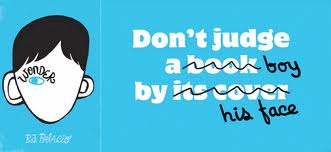
Wonder: A Consideration of RJ Palacio’s Book for Jewish Disabilities Month by Judy Bolton-Fasman

If you read only one book this year with your kids, that book should by Wonder by R.J. Palacio. The book moved me to tears. The story begs to be read aloud with kids because you’ll want to stop after each short chapter to catch your breath and discuss the clear-eyed issues of bullying and notions of beauty that it raises.

Wonder

Wonder is the fictional story of August Pullman, a ten year-old born with a profoundly disfigured face as a result of chromosomal abnormalities. August, or Auggie as he is known, has endured 27 surgeries that may have scarred his face, but have not touched his pure and sweet soul.

Auggie is homeschooled until his parents decide it’s time for him to enter the greater world via the fifth grade at Beecher Prep. Middle school is an emotional minefield particularly for a kid like Auggie. What makes Wonder unique is that Auggie not only has inner reserves to draw on, but also has a family who supports him. This is not to say that his family is perfect, which is one of the very affecting and real touches that abound in the story. Fissures develop in his parents’ relationship over what is best for their son. How many of us as parents have disagreed with our partners about raising our children.

Palacio’s gentle realism unfurls into optimism.  Stories about unusual kids who crave to fit in with their peers are often heart breaking. They come with a particular kind of loneliness that can be dystopian in its fear of abandonment and isolation. Auggie has a particularly tender relationship with his older sister, Olivia. This is a sister and brother who deeply love each other. But Olivia is very human too and when she enters high school she seizes the opportunity to start anew. That fresh beginning includes not being the sister of the kid with the ugly face. At one point, she goes to great lengths to exclude Auggie from attending a play at her school. One of the notable things about Wonder is that there is no judgment. Palacio not only empathizes with Auggie, but also with the people in his life.

No amount of direction from the well-meaning middle school principal prepares Auggie’s classmates for his disfigurement. When Auggie first arrives in school, his classmates avoid him. No one wants to sit next to him in class or be his lab partner. He’s shunned in the lunchroom until a classmate named Summer takes him under her wing. Summer is a fascinating character. She’s one of those sturdy girls who doesn’t aspire to be in the popular crowd. Girls like that aren’t as rare as some young adult literature would have us believe. Summer doesn’t have a disability and she’s not agonizing over how to fit in. She’s simply herself and at the end of the day she wins over her classmates without being invited to the right parties.

And then there is Jack, Auggie’s ally in school. Jack had been selected by the principal to shepherd Auggie through his first few days of school. The task is wrenching for Jack who is genuinely torn between liking Auggie and fitting in with classmates who refuse to touch Auggie for fear of getting “the plague.” Auggie and Jack’s relationship takes a sharp turn when Auggie overhears Jack telling another student that he would rather be dead than look like Auggie. Therein is one of the great takeaways of this book.  There are people who love Auggie who are not always kind to him, showing the range of humanity inherent in all of us.

In a recent interview with Slate magazine, Palacio explained that the idea for Wonder came to her after she and her two young sons saw a girl with a facial condition similar to Auggie’s at an ice cream parlor. Her three year-old began to cry and her older son was shocked. Palacio immediately left with her kids to spare the little girl’s feelings. But the incident haunted her and she pondered what she could have done differently. “I was really disappointed in my response,” she said.

It took me a whole book to figure out the answer, which has since been confirmed for me by parents of kids who look like Auggie. I wish I’d had the courage to turn around and look at the girl at the store. Even if my son kept crying, I should have just said, “I’m sorry, my son’s not used to seeing people like you. What’s your name?”

By the end of the book the characters have regrouped, as many kids in middle school are apt to do. Auggie’s perseverance pays off and most of his classmates have softened their attitudes. Grit is a critical message to impart to our kids, but perhaps more importantly so is kindness.

Sh’ma – Listen by Judy Bolton-Fasman

Sh’ma Yisrael Adonai Elohanu Adonai Echad.

shma
Even an assimilated, lip-synching Jew like my father knew those first six words of Judaism’s central prayer—a prayer tucked into Jewish liturgy morning, noon, and night. Words that are emblazoned on the Jewish psyche.

The prayer of prayers, that’s the Sh’ma. It’s the prayer that turns the tables on the petitioner by asking her to stop and to listen—to stop and to hear. It’s the prayer I said as a child every night before I went to sleep. It’s the prayer that was always punctuated with my mother’s breathless “amen.” My father, on the other hand, stood at his usual spot by my door doing exactly as the prayer asked. He listened. He heard.

Saying the Sh’ma during the day becomes a cry, a plea from God to listen, but I’ve said the Sh’ma so many times in my life when I meant: Listen. To me. God. There is no one else to turn to. And I, in turn, at different stages in my life, have strained to hear God’s still, small voice. But in the end, I know that I have God’s ear, even as God remains silent. Silence is God’s voice, just as water is God’s color.

When I recited the Sh’ma each night, the six short words cleared space and reined in time. The Sh’ma created a spotlight of comforting silence. It was the spotlight of the hall light that my parents left on, illuminating a path to the bathroom or their room.

Sh’ma Yisrael Adonai Elohanu Adonai Echad.

I implored God, with all of my heart and soul, for someone to stop and hear me.

I also bargained with God for joy and gladness. What if I promised to stop flushing my vitamins down the toilet or to cease hitting my sister in the middle of the night because she was asleep and I wasn’t? Would God give me the sweet silence of a family listening to the television or riding contentedly in the car? Would God finally send quiet and its silent partner, peace, to my unhappy family?

The Sh’ma has always been a prayer of the night for me—a time when strictly defined identities blurred into dreams or nightmares. Yet, at night, identities can also be blurred into something softer, sweeter. At night, my strict, seat belt-wearing, MacArthur-sunglassed father would often stand vigil at the foot of my bed, looking out the window, presumably to keep track of the weather. But, really, he was there to listen, to monitor my asthma. My father came to my room like an explorer—flashlight in one hand, a pitcher of water in the other. He’d fill up the vaporizer to steam me back to health.

When my ragged breathing eventually calmed down, my father hummed his preferred liturgy—Viennese waltzes and Gilbert and Sullivan operettas. Listen. Hear. Understand my soul, he telegraphed with his music. For me to breathe normally was to hear his favorite tunes, to be lulled by them. Listening to him was a crystalline, multi-faceted moment when I was in synch with him. My silent recitation of the Sh’ma spun around us like the delicate yet strong silk of a spider’s web.

I thought I had outgrown the Sh’ma as a teenager. I fell asleep to Top 40 crackling from an AM transistor radio I hid under my pillow. I swapped prayer for Sylvia Plath and Emily Dickinson. At night, I was the ghost of Cathy from Wuthering Heights, pretending to scratch at my bedroom window, asking for God to listen to me. I stopped listening for God.

Sh’ma Yisrael Adonai Elohanu Adonai Echad.

When I finally had my own children, I took out the Sh’ma like a favorite childhood blanket. I’d calm my squirming, crying children with the shhh of Sh’ma. That shushing also soothed me into believing that God was listening again, that God was hearing my prayers again. The Sh’ma was a call around which every other prayer and wish rallied. A prayer beyond words. The Sh’ma announced God’s presence to me.

Sh’ma Yisrael Adonai Elohanu Adonai Echad.

The Sh’ma was the first movement of a Symphony of Silence. It was movement towards God’s embrace. I have heard snippets of that symphony throughout my life. I heard it when I fell in love with my future husband. I heard it when the heads of my children crowned inside of me. I heard it in jarring moments during my father’s long, slow death. Every one of his incremental declines was like the short steep falls from which I would awake just before I hit the ground.

I yearn again and again for a primal connection to God. The older I am, the more I realize that establishing a connection to the divine is surprisingly prosaic. Prayer takes practice, and practice is repetition to which we always say “amen.” In Hebrew, the word for practice shares the same root as the word for amen—both of them reach back to the Hebrew word for faithemunah. I like this mingling of the work-a-day and the divine. It feels very real to me.

Sh’ma Yisrael Adonai Elohanu Adonai Echad.

When my father died, and I said the Kaddish, the mourner’s prayer, every evening for a year, I said the Sh’ma along with it. Once again, I was a child; the Sh’ma was a touchstone in a dark, bewildering night, and God was listening.

This essay was originally published by the Hadassah-Brandeis Institute

How to Parent a Kid Smarter Than You Are by Judy Bolton-Fasman

The first rule is to never let the kid see you sweat. When your kid is smarter than you are (and aren’t all kids smarter than their parents), perfect your comeback. This is critical. Think of it as a one-size-fits-all response, although in reality your retort will be more like one-size-almost-fits-all. Mine is: “Save it for the Supreme Court.” My children often run concentric circles around me in an argument. I never succumb to temptation and tell them “Because I’m the mother.” This is lame—you know it, and your kid knows it.

Bribery works; I’m not above it and neither should you be. It has circumvented many stalled arguments in my house.  Just about anything is bribable with younger kids. Finishing all your peas, successfully going to the potty, staying in bed until a parent is ready to wake up. Promise him a toy, a movie, a playdate at Chuck E. Cheese. I think it’s a fair tradeoff for a bit of peace and quiet. Older kids are trickier and more expensive to bribe. But for your kid, who is almost certainly smarter than you are, bribery might be the way to go before her logic exhausts you. Yes, that shirt at Urban Outfitters can be yours. There are exclusions: no electronics or personal digital assistants. Does your 15 year-old really need an iPhone? Is he expecting breaking news from his stockbroker?

smartkid

The kid who is smarter than you are can jump and twist through loopholes like a gymnast. And don’t be surprised when your kid finds these loopholes in your arguments quicker than a tax accountant. Be prepared to plug those holes even if you have to be irrational. But don’t threaten to lock your kid in his room until he’s 35. Hyperbole makes you look foolish. Remember you’re the parent and you have the final word, but don’t tell that to your kid.

Homework is a convoluted problem in our house. My children do it, but sometimes the distractions of YouTube and Facebook extend doing homework into the wee hours of the morning. When I threaten to take away the computer, Adam will gleefully tell me that he can’t do homework without access to the Internet. I grudgingly admit that this is partially true since assignments are posted on-line. And yet just when I think I’ve cornered him—can’t you make note of your assignments and then work off-line—he’ll walk right through a gaping loophole and mutter something about teachers posting work at different times. He makes it sound as if his teachers are living in different time zones.

Under no circumstances should you say, “I’m not made of money” or “I don’t have a money tree in the backyard.” Your smarter-than-you-are kid will point out simple biology. People are composed of flesh and blood and cells and DNA. Trees only bear fruit, silly Daddy. And whatever you do, don’t spell. It doesn’t matter how young the child is. Somewhere along the line, this child who is so much smarter than you are, learned to spell while you were distracted.

If speaking in a foreign language is an option for you, don’t assume your kid won’t understand—especially if your smart kid is learning that language in school. Unless it’s your first language, when your kid asks you how to say words like “engulfed” or “mission accomplished,” you probably don’t know. Take me as an example. I speak a kitchen Spanish and I read the language at a fourth or fifth grade level. Your very smart kid knows this when he asks you to help him translate a Borges story. After all, it’s fun for them to see you squirm in a language that was once your secret code.

When you tell your very smart daughter that to be treated like an adult she must act like an adult, she’ll say something like she can legally buy cigarettes and a lottery ticket. Refrain from telling her that in the old country she would have been running a farm and pregnant with her second child at her age. You’ll look and sound ridiculous. (Remember hyperbole always backfires with the smarter-than-you-are kid).

Don’t lie to your child about your checkered past. Since this is a family paper, suffice it to say your kid knows you had boyfriends or girlfriends and that you may have tried cigarettes in the past. Simply tell the child that you are happily married or more mature and that you are a former smoker. All you can do is pray that your kid doesn’t repeat your folly by justifying that if you did that stuff so can she.

Please note again that retorts rarely work so don’t make a sweeping statement like “Someday you’ll understand when you’re a parent.” Kids can’t see that far ahead. You’re smart enough to know that. And you’re smart enough to know that your very smart kid is just that—a child or a young adult casting about for experience. Remember that, please, because you’re the parent and you have to.


Parenting the Ritalin Generation: An Interview with Bronwen Hruska by Judy Bolton-Fasman

Bronwen Hruska gained national prominence last August as a mother and activist when she published an opinion piece in The New York Times called “Raising the Ritalin Generation.”

BronwenHruska
The piece was a clarion call to parents to closely assess the accuracy of a child’s Attention Deficit Disorder (ADD) or Attention Deficit Hyperactivity Disorder (ADHD) diagnosis. Hruska outlined her own son’s tumultuous journey when he was misdiagnosed with ADD at the age of 8. Two years later, Hruska and her son decided that the treatment was not only unnecessary, but had also been unwarranted. Hruska, the publisher of SoHo Press, recently published her first novel, “Accelerated,” through Pegasus Publishers. Part thriller and part social commentary, “Accelerated” is a brilliant, complex story about the consequences of over-diagnosing children with ADD and ADHD.
Q: There have been a number of articles, including your own, written about ADD and ADHD. Why do you think there’s an increase in interest?

A: With diagnoses of ADHD increasing 5.5 percent every year in this country, I believe we’re finally at a tipping point. As of 2010, 5.2 million children had been diagnosed with the neurological disorder. If that’s not an epidemic, I’m not sure what is. And I don’t believe that the increase in diagnoses has anything to do with a decreased attentiveness of children overall. There was an article in The Atlantic earlier this year that cited a study by a team of Penn State psychologists in The Journal of Attention Disorders that stated, “Children are no more or less inattentive and impulsive today than in 1983.” But schools and doctors routinely recommend medication for “Inattentive-type ADHD,” which means simply that in distracting situations, such as school, these children find it more difficult to focus. And with more and more children being medicated to help them succeed academically (as opposed to help manage the symptoms of the disorder), more children are at risk of suffering from the real and often scary side effects of the psychotropic medication that has been downplayed by the medical community as “safe.”

“Accelerated” examines the consequences of over-diagnosing children with ADD and ADHD. As medicating kids becomes more and more common, so does the general sentiment that if your child isn’t on medication, he or she is at a disadvantage. It’s the same mentality that created the phenomenon of “juicing” in athletics. We’re ratcheting up the level of competition in school with performanceenhancing drugs.

Accelerated

Q: “Accelerated” is told from a dad’s point of view. Would it have been a different book if the protagonist had been a single mother?

A: I wanted Sean Benning to feel very outside of the Manhattan private school community where his son Toby goes to school. Not only did Sean grow up in Troy, N.Y., but he’s also one of the only fathers in the estrogen-heavy circle of mothers that make up the vast majority of parents responsible for drop-off and pickup at The Bradley School. Without a community of parents to share information with, Sean feels even more at sea when the school strongly suggests that “a little bit of medication could turn everything around for Toby.”

Q: Third grade seems to be the time kids (especially boys like fictional Toby and your own son) are diagnosed with ADD. Why the zealousness? Is it warranted?

A: Schools tend to crank up the scrutiny in 3rd grade. As a parent, I was grateful that teachers were paying attention, making sure nothing fell through the cracks. But in their zealousness I worry that teachers are so determined to find something, anything, that they often err on the side of overkill. Don’t forget, 3rd grade is also the time when children are expected to sit still for longer periods of time, transition quietly between classes and cut the silliness. And the truth of the matter is that some children (especially boys) at 8, 9 and 10, who are perfectly within the developmental norm, still find this challenging.

It’s important to understand that Attention Deficit has become the go-to diagnosis. Sanford Newmark wrote in The Wall Street Journal this fall that many doctors making the diagnoses aren’t distinguishing between normal developmental immaturity and ADHD. These misdiagnoses could account for as many as 20 percent of the current ADHD diagnoses in the U.S., or about 900,000 children.

That said, for kids who do suffer from Attention Deficit, medication could truly turn things around for them. One adult, who was diagnosed late in life, told me that as soon as he took that first pill, the white noise in his head (a noise he’d never even noticed) turned off and he was finally able to complete projects he started, including reading books. It changed his whole life, and he wished he’d been diagnosed as a child. My worry is that kids who are simply not ready for the expectations of accelerated curricula are being diagnosed with a disorder. The flipside, of course, is that in poorly funded regions, children are being medicated so they can succeed within a broken school system with too few teachers.

Q: I read that boys are being treated like “defective girls” with regard to diagnosing ADD and ADHD. Do you think this has some validity or is it just an inflammatory statement?

A: Just look at the statistics. Boys are 2.8 times more likely to be diagnosed with ADHD than girls. If 13.2 percent of all boys have been diagnosed with the disorder (as opposed to 5.6 percent of girls), I’d say that we need to determine what the barometer for “normal” is. In “The War Against Boys,” Christina Hoff Sommers looks at how the education system was overhauled in the wake of Carol Gilligan to accommodate the specific learning styles of girls and as a result has left boys in the dirt. I think that schools now do value traits that are more traditionally female, and leave little room for the very normal (and different) developmental style of boys.

Q: Medication doesn’t carry as much of a stigma as it used to. Are we changing the way children develop with so many ADD and ADHD diagnoses?

A: I want to be careful because, again, I believe that for kids who do suffer from ADD and ADHD, medication can actually help them to develop on a level playing field with kids who don’t suffer from it. But when so many kids are taking medication to enhance their academic performance, it really does send a powerful message to an entire generation. We’re teaching our kids that challenges should be met and problems solved by swallowing a pill.

Too often, due to extreme pressure from an accelerated society that demands everything be better, faster and more impressive, kids aren’t being allowed to do the hard work of growing up, getting organized and learning what’s expected of them. Also, if a young child is put on medication and it’s deemed to be “working,” parents are loathe to take them off of it, and as a result will never know whether their child has “outgrown” the attention issues. Instead, dosages continue to be raised as the child grows, and soon kids are selling their prescription medication as study drugs in college where Ritalin and Adderall and other focus drugs are as commonly used the way No Doze was used when I was in college.

Q: How does your novel help parents grappling with the decision to give their kids Ritalin or even to seek out help?

A: The reason I started the novel was to explore the impossible position in which so many parents find themselves – deciding whether or not to medicate. When my son’s 3rd-grade teacher suggested we get him evaluated, it was a no-brainer. Of course, I wanted to catch anything that might be an issue. Of course, I’d trust the school if they thought there was a problem, and I’d trust the doctor who did the evaluation. But there’s a moment when, as a parent, you’re torn between your gut and the experts. There is both too little information out there and too much (if you’re looking on the Internet). You don’t know who or what to trust, and parents aren’t talking about it. There’s this feeling of being alone at sea – you feel like your child is the only one going through this.

As I started researching the topic for my novel, I realized that there were approximately 10.5 million parents having to make this very same decision. I thought it was crazy that no one was talking about it, sharing information, anecdotes, research. Simply knowing how many kids were getting this diagnosis made me think about my son’s diagnoses differently.

I’m hoping that parents read “Accelerated” and continue the dialogue. Whether they like what it has to say or hate it, I want people to tell each other their stories. Just talk. It’s a powerful thing.

Parenting a Child Far From the Family Tree by Judy Bolton-Fasman

“Parenting is no sport for perfectionists,” writes Andrew Solomon in his rich tome, Far From the Tree: Parents, Children and the Search for Identity. Solomon’s 700-plus- page book—an 11-year undertaking—is a vivid portrayal of children who are born or grow up in ways that their parents never expected. The book is also a memorable catalogue of how parenting can be one long mystery tour that often mixes utter desperation with boundless joy.

Image

Consider the heart-breaking example of the mother of an autistic child who, Solomon reports, has only spoken four times in her life. But each time her response was “appropriate to the situation.” Given that brief glimpse into her daughter’s psyche, the mother frets that her child’s soul is trapped in her body. How many of us have felt that way when a child has lost his way or becomes a stranger to us?  How many of us have turned to our partner after we brought home our new baby and said, “Now what?”

What to Expect When You’re Expecting always struck me as an ironic title for an advice book for pregnant women. There is no primer for what happens when the doctor sees an abnormality on the twenty week sonogram and your child may be a dwarf. Or amniocentesis shows an extra copy of chromosome twenty-one and your child has Down Syndrome. Maybe your baby is closing in on turning a year old and doesn’t look you in the eye. He hasn’t uttered a word yet. That happened with Adam. We were lucky parents. It turns out that he was severely far-sighted. At ten months he wore his first pair of glasses and a few days later he crawled on his own.

But parenting isn’t just about happy endings. It’s often about the little victories within the bigger battles. Solomon is intimately acquainted with what happens when a child doesn’t meet parents’ expectations. He was dyslexic as a child and came out of the closet as a teenager. Far From the Tree grew out of a 1994 article that he wrote about deafness for the New York Times magazine. In the course of researching and reporting, he realized that issues surrounding deafness were not unlike the challenges that he faced as a gay man. A few years later, he saw the same pattern after watching a documentary on dwarfism. He eventually expanded his theory on identity and outsider status to include Down Syndrome, autism, schizophrenia, children conceived during rape, and children who become criminals.

While this may seem like a hodgepodge of various conditions and situations, Solomon unites them by distinguishing between vertical and horizontal identities. Vertical identity is handed down through the generations such as religion or racial identity. If a child’s parents identify as black in all likelihood so will that child. Horizontal identity arises from a break between the reality of a child’s life and the parents’ experiences. For example, a deaf child navigates the world very differently than her hearing parents. I found it fascinating that Solomon included prodigies alongside conditions that have otherwise been stigmatized throughout the centuries. The mother of a child who entered college at the age of nine was as bewildered as the parents of a disabled child.

Solomon explores family dynamics, seeking common ground among families who find themselves with children they never expected. Most of the parents were grateful to have the children they had. What might have been initially frightening or insurmountable for these parents had been transformed into a deep, bedrock love for their children.  In a recent interview on Salon.com, Solomon noted:

“I found that there is so much that [these family’s] experiences have in common—that process of accommodating, accepting, loving, even celebrating a group. It didn’t matter whether we were looking at what the child did, as we were in the crime chapter; or how the child was born, in the Down Syndrome chapter. That was consistent. And it had a lot in common, in my view with the experience I had negotiated as the gay child of straight parents. And so I think that sense of difference is actually something that almost everyone has in common, rather than something that isolates people.”

In Solomon’s view reproduction is an imprecise term. On the very first page of the book he talks about having children as an act of “production.” We just don’t know who or what we’ll produce as parents. And if we have toss aside perfectionism for imagination and acceptance, the one thing we’ll get in return is realizing that love for a child is like no other love in the world.

A Letter to Anna: Balancing Work & Life by Judy Bolton-Fasman

Dear Anna,

I watch you carry on with your dream of going to medical school and I’m already worried about the work-life balance issues you will inevitably face. Having a profession will present you with a unique set of challenges that men don’t encounter. We are socialized to be the family’s primary caregiver; men are ingrained to be the breadwinner. It’s changing, but it’s changing too slowly.

stethescope

Maybe I’ve come late to the party, but a book by local author Michelle Cove and an article by law professor Anne-Marie Slaughter have me reaching deeply into my own life. Let me start by saying that I want more for you. It’s not that I don’t have enough or I haven’t made a successful go of my writing career. But my earnings don’t reflect the hours and the keen effort that I put into my work. While that’s been a source of frustration for me, on the flipside I have control over my schedule. I can run an errand or stay home with a sick kid. But if I do that, you can be sure that I’m working after dinner to make up the time.

Slaughter was a high government official in the Obama administration who decided to return to her teaching position at Princeton after two years. Her son was in the midst of a rocky adolescence and Slaughter went home to spend more time with her family. She published an article last July in The Atlantic called Why Women Still Can’t Have It All. At first glance that title is very provocative. But that’s not why I resisted giving the article a close read. I was scared to hold myself up to this super woman who worked closely with Hillary Clinton and then returned to a tenured position at Princeton University. Until she went to Washington she was Dean of the Woodrow Wilson School at Princeton. Slaughter and I are not in the same league. But I read on and I found some comfort. “There are genuine super women,” Slaughter writes. “These women cannot possibly be the standard against which even very talented professional women should measure themselves. Such a standard sets up most women for a sense of failure.”

Let me back up and mention that I read Slaughter’s article after I read Cove’s book, “I Love Mondays.” It’s a unique book for the way it crosses genres as both a handy reference guide and a practical self-help book for working mothers. Subjects range from how a mom should minimize her guilt if she misses a soccer game to moms, like me, who have home offices and must establish strict boundaries. In a recent interview, Cove agrees with Slaughter that having it all is “completely unachievable. It’s not a sustainable state. Power constantly shifts and we need to be much gentler on ourselves.”

Anna, I think the generation between us is dealing more realistically with the work-life balance than my peers or I have. Slaughter quotes a pair of 30 year-old women who realize the importance of linking together every aspect of their lives. I quote them through Slaughter because I want you to hear their bluntness.

If we didn’t start to learn how to integrate our personal, social, and professional lives, we were about five years away from morphing into the angry woman on the other side of the mahogany desk who questions her staff’s work ethic after standard 12-hour workdays, before heading home to eat moo shoo pork in her lonely apartment.

This scenario begs a question you’ll have to grapple with someday—“finding the right sequence of family and career.” When do you marry? When do you have a baby? Slaughter and Cove agree that there is no definitive answer.

Cove has been thinking about these issues for a long time and her book was a natural successor to her documentary “Seeking Happily Ever After.” The film was a retort to media representations of 30-something women who were either career obsessed or so desperate to get married that they were driving men away. Cove notes, “As a journalist and a writer I was interested in why the headlines were proclaiming there were more single 30-something women than ever. I picked up a video camera and did street interviews.” The big take away for you, my dear Anna, is to know that women can define their own “happily ever afters.”

I have faith that your generation will finally tease apart the false morality and promises of “family values.” That by speaking up about implementing family-friendly policies in this country and acknowledging the importance of work-life balance, you and other women will close in on the “leadership gap” in the White House, the corridors of multinationals and yes, even the home.

As for me, I’m starting to understand my choices as part of “the new gender gap”—that is, measuring my success by my wellbeing rather than a paycheck. Maybe I’m not too late to take advice myself. In fact, I think I read Anne-Marie Slaughter’s article and Michelle Cove’s new book just in the nick of time.

Love,

Mama


*Dreaming in Cuban by Judy Bolton-Fasman

Dear Mamá:

You came to the United States in 1958, a year before the revolution. Havana is an aerosoled city—Viva la Revolucion 54 is spray painted everywhere. It’s been fifty-four years since Castro came down from the Sierra Maestra Mountains and triumphantly marched into Havana on New Year’s Day. You once waved the Cuban flag for him. He was going to change Cuba for the better. Maybe he did for some people. But in the end your family fled along with 90% of the country’s middle class. You like to say that your mother packed a small bag and closed the door on forty years of her life at Calle Merced 20.

Calle Merced #20

Calle Merced #20

Calle Merced was a storied address in my childhood. It was Never Never Land, the place of your eternal youth. When I finally saw it a few weeks ago, the heavy wooden door you described was still there and I recognized the balcony from pictures you had shown me. You lived in Old Havana. But that too was consigned to fantasy. There were no marble steps that a maid had shined in your apartment. You lived simply on one floor, with a courtyard between the dining room and kitchen. Sometimes your mother brought home a live chicken and called the shochet – the kosher butcher – to slaughter it for the Sabbath meal. I imagine he did it right there in that open area between cooking and eating.

When I think of what is now our Havana, I envision the laundry on the balconies hanging like team pennants. But we are no longer divided into them and us. The people of Cuba hope and dream and cry with you for your country. How often did I hear you say in one long sigh – Hay Cuba como to estrano. I didn’t realize how much I missed Cuba too until I went there.

I saw the synagogue where you grew up. Women in the balcony, men gathered around a raised bima. I also went to the Patronato where you dreamed of being married before Castro took over the country. Your schoolmate Adela Dworin stayed in Cuba. She said that to be a revolutionary before the age of 40 is about passion. After 40 it seems like a foolhardy decision. Adela’s parents, who emigrated from Russia in the 1920s, stayed in Cuba because she was committed to the new socialism and they couldn’t bear another exile. Adela remembers you. Your old classmate is now the head of Cuba’s Jewish Community, much honored by Hadassah and others for her work with the country’s 1500 Jews.

There were only 11,000 Jews when you lived in Cuba, but you were a thriving community. Enough of you were committed to Judaism to fill five Ashkenazi and Sephardic synagogues. You had Hanukkah parties and Purim balls. That’s still happening, but the community is mostly growing through conversion and the number of functioning synagogues has dwindled to two. There’s an old joke that in the days when the revolution was in full bloom, a Cuban minyan consisted of nine people and a Torah.

A rabbi from Chile comes to Havana every six weeks to minister to the community. If someone is connected to a Jew, usually through marriage, they are encouraged to convert. This past Christmas over 70 people went into the warm ocean and immersed. When they came out they were Jews. There are over 140 children enrolled in the Albert Einstein Hebrew School. Some of those teachers are Jews by choice.

Havana is more beautiful than I had imagined. It’s in gorgeous ruins—an aging beauty queen who hasn’t lost her looks amid the rubble of benign neglect and abject poverty. The place is translucent with pastel colors and light. The outside of your house is a pretty light green. Green is your favorite color — the color of your eyes.

But the people are hungry. Rations are strict. The black market is darker than the Buena Noche, the Christmas Eve sky. People trade all kinds of things for an extra pound of meat or a cup of cooking oil.  Something as simple as a pair of jeans or sneakers that a relative in the States has brought gives a loved one a leg up in the barter system.

You should see the scene at the airport in Miami. Daily charters to Cuba all leave from the same place at Miami International and the check-in is transformed into a veritable marketplace. Cuban ex-pats going back for a visit have emptied Costco or Target or Best Buy, buying televisions, microwaves, bicycles, and air conditioners for their loved ones in Cuba. I saw my fair share of fishing reels too. That old chestnut of teaching a man to fish so he eats for life went through my mind like ticker tape.

God Bless America for all of her materialism and convenience.

“God Bless America,” that’s what my cab driver said in his fractured English as he drove me to the University of Havana. Aside from Calle Merced 20, that was the other place you wanted me to see. How you wish you could have studied at Alma Mater. Maybe you did or maybe you didn’t walk up its famous staircase.  You believed that you did, and that’s all that matters.

My cabbie leaned in close at a light and told me that from one Cuban to another, he was aburrido de esta vida. He prayed that his 30 year-old Russian Lada taxi would start each morning and that he’d catch enough fares to put food on the table for his kids. We both know that aburrido means so much more than just boredom. It’s a kind of lassitude mixed with the same Cuban melancholia I heard when you said how much you missed Cuba.

The driver had a mother-in-law in New Jersey who sent him money every once in a while. It helped more than I could imagine, he said. When I went to pay him he asked me if I had any medicine — aspirin, antacid, anything—that I could spare. He’d take it in lieu of a gratuity. I gave him a half-full bottle of Advil and a 30 percent tip. I had already donated all of the medicine I brought down to the pharmacy run by the Jewish community. The doctor who runs the operation has the same last name as your mother. “We’re all related,” she said jauntily.

Earlier in the day I had passed a state-run pharmacy where a woman beckoned me to come inside. I had an antibiotic prescription with me that I wasn’t going to use. Yes, she would take that, thank you, and did I also have pens to spare? I gave her what I had. She was about your age. Maybe you passed her on the street once upon a time.

“Tell your government we want to be friends again,” she said. “Tell your President Obama, embargo no.”

Aren’t you aburrida of the embargo too, Mamá?

Love,

Judy

*A version of this essay is forthcoming in the Jerusalem Report


On a Journey to Safety by Judy Bolton-Fasman

I’ve been missing my girl a lot. More to the point, I’ve been missing the 11 year-old she was seven years ago. So I decided to do a bit of time-traveling last week and hang out with Girl Scout Troop 73037 based at the Ward Elementary School in Newton. My friend Joanne’s daughter is in the troop and Joanne sensed that as the days got shorter I needed some girl energy the way some people need sunshine. She invited me on one of the troop’s field trips; it involved food so I was keen to go.

The girls and their indomitable troop leader Karine are on a mission to observe how things work. One way they do that is to peek behind the scenes at various businesses. I accompanied the girls to Jonathan’s Bar & Grill in Newton, and was so in awe of the complicated choreography of getting a meal to a table, I didn’t check my cellphone once.

I had a new appreciation for the salad and seared ahi tuna that I ordered that afternoon. I think the girls looked at their food differently too. But what I was most taken with was the way these girls were literally on the verge of young adulthood. I could see the changes coming. In not so many years they would be entangled in crushes, maybe first love. They’d be grappling even more deeply with body image and sexual identity. As young women of the 21st century there would be times they would be at risk and other times they would feel empowered.

An hour after I left those sweet Girl Scouts I sat in Elizabeth Schön Vainer’s office at Jewish Family & Children’s Services. Schön Vainer is the director of the agency’s To Safety Program and it’s well worth reprinting Journey’s poignant mission statement.

Journey to Safety’s mission is to prevent domestic abuse in the Jewish community, while helping those who have been abused find a way to safety, regardless of their background or beliefs. We offer culturally competent, religiously sensitive services to survivors of domestic abuse, with specialized services for the Jewish and Russian-speaking communities. Information, support, referrals, and other resources are available for all domestic abuse survivors, including teens, seniors, people with disabilities, and members of the LGBT community. 

journey_to_safety_2

I met Schön Vainer a couple of years ago when I was invited to learn more about the work of Journey to Safety. One of the distinct memories I have of that meeting was the eclectic group of women who came together. We were social workers, attorneys, nonprofit executives or just concerned women. Some of us were survivors of domestic abuse. The meeting happened in the wake of a tragedy—a relationship between two Wayland teens that had ended in murder. The young woman’s boyfriend had harassed her for months both physically and emotionally. And one night, after they had broken up, he stabbed her to death. Post- break up, particularly for teens, is a proven time of great risk for dating/domestic violence victims. The abuser wants ultimate control by keeping them in the relationship. Sadly, this young woman agreed to meet with her abusive ex-boyfriend in a remote place

That story exemplifies one of the critical reasons that Journey to Safety has recently piloted a peer-led program called TeenSafe. The program bears out research showing that over 80% of teens would sooner tell a peer than an adult about an abusive situation. That statistic has spurred Schön Vainer and her team to recruit a girls leadership group that has been trained to help other teens see their way out of dangerous, controlling or violent relationships.

Training teenagers to identify the inner workings of a healthy relationship is a natural outgrowth of Journey to Safety’s mandate. But the work to educate and prevent domestic violence begins even earlier. Journey to Safety has begun reaching out to girls and boys in middle school through a specialized curriculum. Schön Vainer explains that

For young teenagers we introduce the concept of relationships. What are they? What are the expectations in a relationship? We help them tease apart what makes them feel comfortable and uncomfortable in a relationship. The discussion inevitably leads to talk about establishing boundaries.

The curriculum is also unique for the way it brings together Jewish values and pop culture. A Katy Perry song in which the singer finds the strength to leave an abusive situation is offered alongside two powerful texts that frame a context for looking at relationships:

In the image of God, God created them; male and female [God] created them.

Whoever destroys soul, it is considered as if he or she destroyed an entire world. And whoever saves a life, it is considered as if she or he saved an entire world.

“Abuse,” adds Schön Vainer, “is also about taking someone’s choices away. With younger teens that’s a nuanced conversation.” As she said this, I scribbled in my notebook that I hoped and prayed that the Girl Scouts of Troop 73037 and their peers would know when and how to save a life. And that they would always have choices and delight in those choices the same way they did on an early winter afternoon at Jonathan’s Bar & Grill.