The Sunday Rumpus List: A Jubana Mother Gives Advice to her Tragically Gringa Daughter by Judy Bolton-Fasman

Published April 15th, 2012  ·  www.rumpus.net. filed under rumpus original

Neck Up.

If a man touches your tetas you will lose control and then lose everything.

Touch your cookie only to clean it. And do not clean it for too long.

Never talk to a man who has a tattoo.

Marry a Jewish boy.

Marry a professional Jewish boy.

If you use tampons you will lose your virginity.

If you wash your hair on the first day of your period you will be infertile.

If you want a baby girl, have an orgasm before your husband. If you want a boy, do not have an orgasm.

Give birth without drugs, that way you can have a big meal right after you give birth and you won’t feel sick to your stomach.

Do not scream in labor. Be a lady.

Do not leave your children with anyone except family.

Do not bring up your children to be gringos.

Do not paint your toenails red. Only chusma girls have red toenails.

Chusma girls also wear ankle bracelets and snap their gum.

Wear high heels—they make your legs look prettier.

Never wear sneakers.

Wear slippers with a heel at home. Your husband will like that.

Grow your hair long. Brush your hair a lot so that you don’t have bolones.

Wax your eyebrows every two weeks.

Swing your culo slightly when you walk down the street so that you are appealing yet still a lady.

Do not wear sleeveless shirts. Chusmas wear sleeveless shirts.

Do not knot your shirt so your bariga shows. Only chusmas show their barigas.

Pray that your husband has a long life.

Do not marry again when you’re old. You do not want to get stuck taking care of some old man you hardly know.

Pray that your children will take care of you.

Fast on Mondays and Thursdays if you want your wishes to come true. The gates of heaven are open on those days because the Torah is read in the Call.

Do not mix meat with milk.

Do not eat puerco and do not eat like a puerca.

Watch your weight. Men do not like gordas.

Get an education. You may need it if your husband turns out to be like your father who doesn’t make enough money and then you have to go to work.

Open your own checking account.

Make sure the department store credit cards are in your name only.

Make sure the house is also in your name.

Give your children everything.

Save something for yourself and don’t tell anyone.

*A Juban is a person who is both Jewish and Cuban

···
Judy Bolton-Fasman is writing a family memoir called 1735 ASYLUM AVENUE. (It’s the address of the house in which she grew up. Really). Judy is an award-winning columnist on family

Isy Mekler’s Forest of Giving

It’s spring. It’s Passover. The days are longer. The trees are blooming. And in these past few months new trees – giving trees inspired by Shel Silverstein’s iconic book “The Giving Tree” – have grown out of Isy Mekler’s bar mitzvah project.

Isy, a seventh grader at Solomon Schechter Day School of Boston, was determined to emphasize the mitzvah in his bar mitzvah. Along the way he assembled a museum quality exhibit, excelled as a fundraiser for a national literacy program called Reach Out and Read and received a Make a Difference Award from the John F. Kennedy Library, where he was the only student who spoke at the ceremony.

Isy Mekler with his Giving TreesIsy’s Giving Tree Project started as an English class assignment to write a fan letter to an author whose book was life-changing for the student. Although Shel Silverstein died in 1999, Isy memorialized him, praising the late author and illustrator for helping him understand life a little better through the tree’s unselfish giving.

“When I read your book ‘The Giving Tree,’ I thought it was absurd that a tree could be happy after stripping itself of everything it had. The tree gave away all its apples. The tree gave away all of the branches it had, and its trunk. But the tree was still glad that it could keep giving. …Now I understand how divine it feels to give.”

Isy wanted to “give” his love of reading to other kids. But he realized that such joy is not easy to come by for children who can’t afford to buy books or don’t have access to well-stocked libraries in their schools. He was also well aware that a meaningful commitment to literacy meant giving everything he had in the form of time and heart and love.

And then, there were the trees. Isy designed trees for artists to paint or illustrate that were composed of two quarter-inch thick hardboard panels that slid into each other to create a three-dimensional tree. Each tree measured 19.5 inches in height and 15 inches in width.

By the time the prototype for the trees arrived from Colombia – Isy’s family is originally from Colombia and his grandmother there oversaw the manufacturing and delivery – Isy had written to more than 300 artists, 28 of whom committed to painting or illustrating a tree to support kids and literacy. In addition, fine art glass artist Dale Chihuly donated seven signed copies of his books to Isy’s project, and illustrator Karla Gudeon donated a giclée print called “Big Tree.”

When Isy became a bar mitzvah last November, the participating artists had completed the trees in time to be used as table centerpieces for his celebration. Some of the trees incorporate explicitly Jewish themes. Tikva Adler, a North Carolina-based artist, painted her interpretation of an Eytz Chayim, the Tree of Life. Adler elaborated that creating art was akin to experiencing “prayer or meditation because it brings my awareness fully into the present moment.”

Joy Chertow, Isy’s art teacher at Solomon Schechter, created a weeping willow tree using wire. Isy noted that Chertow was the only artist who changed the shape of the tree. He pointed out, “When seen from above, Joy’s tree is more oblong and the wire seems to be swinging with a non-present wind.”

Raquel Rub, a Peruvian-Jewish artist who makes her home in Miami, painted her artistic interpretation of “Creation.” In a recent e-mail, Rub explained that when she visited Israel, she was moved by: “Four sites in Israel where I was inspired by Creation. In Hebron, I visited the burial sites of the patriarchs. In Tiberias, I took a boat ride on Lake Tiberias. In Jerusalem, we remember where the Temple stood. Tzfat is the mystical city. Together, these four places reminded me of the elements earth, water, fire and air to make the piece you now have called ‘Creation.’”

Illustrator and children’s book author, Aaron Becker, was so impressed with Isy’s commitment to service that he designed a tree based on his upcoming children’s book called “Journey,” which is set, in part, in a forest. The material was a natural fit for Becker, whose tree Isy admired for its air of mystery and “the beautiful shadowing and the soft glow of the lanterns.”

In his acceptance speech at the JFK Library, Isy said that his father “was the driving force that inspired me to enjoy reading.” He also noted, “I want to provide other kids with this wonderful gift, and I want to make a difference.”

And Isy continues to make a difference in the waiting room of a Roslindale clinic where he volunteers to read to the young patients twice a month.

Isy Mekler’s Giving Tree Project will be on display at the Danforth Museum in Framingham from April 15 to August 15 as part of the museum’s literacy initiative. After the exhibit, the trees will be auctioned, with all proceeds going to Reach Out and Read.

I Wore the Ocean in the Shape of a Girl: Kelle Groom’s Memoir in Paperback by Judy Bolton-Fasman

Kelle Groom—my friend and mentor—sees her best-selling memoir come out in paperback today. It’s a luminous book in which Kelle performs the delicate dance of being both lyrical and gritty without a misstep. The central event in the book is her unflinching account of giving birth to her son when she was 20, unmarried, unmoored and heavily drinking. Her aunt and uncle, childless and still young enough to raise a child, adopted her son when he was four days old. My friend held him twice and never saw him again. She still hears his cries as he was bundled up and taken away.

Kelle is a prize-winning poet and the title of her book—I Wore the Ocean in the Shape of a Girl—is both hopeful and elegiac in its reference to the blue dress  she wore as a flower girl. She was six when she walked down the aisle strewing rose petals. I was six too when I was the flower girl at my uncle’s wedding. I was all tulle and scratchy netting in a dress that turned me into a preternaturally aqua-colored cupcake. Anna was a flower girl when she was five. She wore a long rose dress with patent leather Mary Janes and fancy white socks that peeked out from the hem as she methodically scattered petals before my sister the bride. Kelle knows the tender soul of a flower girl.

After reading Kelle’s book and tiptoeing my way through the rush of my own memories, I believe that Kelle wrote her way to something that Abraham Joshua Heschel called “radical amazement”—a holy appreciation for a moment in time. In my case, it was a holy appreciation for motherhood. When Anna got some good news recently, she was so happy she jumped on my back without thinking. We were both surprised when I gave her a piggyback ride. It had been a half dozen or so years since I last tromped around the house with her on my back.

I’m not nostalgic for diapers or mashed bananas. But I miss lifting my children and feeling their beating hearts against mine. I miss their shoes that once fit in the palm of my hand. I’ve stashed away one of Anna’s onesies—the one a friend made exuberantly announcing Anna’s name, date of birth and weight in red and purple waterproof marker.

I met Kelle six years ago in a writing workshop in Provincetown. She presented a chapter from her memoir in which she was casting about for a definitive way to link the Superfund site in the Massachusetts mill town where her only child Tommy lived with the leukemia he developed at 9 months of age. He died in 1982 when Kelle and I were 21. I had just graduated from college and was paralyzed with anxiety about what would happen to me without the familiar scaffolding of a school routine. I couldn’t imagine being anyone’s mother let alone experiencing the aching, exquisite love I’d come to have for my children still to be born more than a decade later.

A few years ago I found my college journals in the shaggy, pink bedroom of my girlhood. I cringe when I remember that I hoped someone would discover remarkable poignancy in my self-conscious and self-important teenage angst. I wonder if Anna keeps a journal. I wonder when I stopped knowing everything about her.

When she wasn’t serving drinks at a bar or dusting the shelves at a health food store, Kelle often drank herself into a black oblivion in the early ’80s. Yet she never stopped writing poetry. I moved to New York and wrote bad fiction. When Kelle and I went out to dinner last year to celebrate the initial sale of her memoir, she had not had a drink in 26 years. At the time, I wish I had known that we had met within days of the 28th anniversary of her son’s death. I’d like to think that when we talked about Tommy that night it felt as deep as a yahrtzheit—the anniversary of loved one’s death—for Kelle.

At the end of the book, Kelle sees her son in 8mm films that she has made into DVDs. She writes that she was afraid that these reels of film from her aunt and uncle  would crumble before they were digitized. She was afraid she would crumble if she got to view them. But they survived to and went digital. And Kelle  watched her son celebrate his first and last birthday from beginning to end in a hospital room. He will be dead in two months.

Kelle has shown me that the peace of motherhood is a restless one. She wears the ocean in the shape of motherhood. Every woman does. I’ve come to a teary acceptance of tears and joy in my own mothering.  Anna is a young woman but I’m still thrilled—radically amazed, really—when she puts her head on my shoulder and calls me Mommy.

Adrienne Rich’s Tattered Kaddish by Judy Bolton-Fasman

It’s been ten years and four deaths since I first said the Kaddish for my father. Too many people to glorify and honor and extoll while pretending that God is on the receiving end of such lavish praise.

My Kaddish has been stretched thin.

My Kaddish is tattered like the yellowed lace doilies my grandmother crocheted. Doilies made of scarred, arthritic time. Adrienne Rich, who died on March 28, 2012 at the age of 82, composed her tattered Kaddish to the doilie makers of this world, to the ones who wished away earth-bound time to die sooner, to the ones who waited for death in dark agony and rain.

Blessed and sanctified are the ones we loved, the ones we thought we loved, the ones we thought loved us and the ones we were supposed to love. Praise to life. Praise to death. Praise to the poet who will forever inspire.

Adrienne Rich

Tattered Kaddish


Taurean reaper of the wild apple field
messenger from earthmire gleaning
transcripts of fog
in the nineteenth year and the eleventh month
speak your tattered Kaddish for all suicides:

Praise to life though it crumbled in like a tunnel
on ones we knew and loved

Praise to life though its windows blew shut
on the breathing-room of ones we knew and loved

Praise to life though ones we knew and loved
loved it badly, too well, and not enough

Praise to life though it tightened like a knot
on the hearts of ones we thought we knew loved us

Praise to life giving room and reason
to ones we knew and loved who felt unpraisable

Praise to them, how they loved it, when they could.

1989

–Adrienne Rich. An Atlas of The Difficult World. 1991.

In Between: Ibrahim Miari’s One-Man Show by Judy Bolton-

Until he was 7-years-old, Ibrahim Miari was called Avraham. The son of an Israeli Jewish mother and Palestinian Muslim father, Ibrahim has shaped and crafted his improbable life story into a one-man show called “In Between.” He performed it last Saturday night at Boston University.

Ibrahim’s appearance was part of a faculty initiative by the university’s Religious Studies Department called “The Other Within.” The goal of the initiative, underwritten by a grant from the Posen Foundation, is to explore cultural dimensions of Judaism and Jewish identity.

Ibrahim MiariIbrahim raises awareness about his complicated identity the moment he whirls onto the stage like a Sufi dervish. His circle dancing is dizzying, mesmerizing – a way for Ibrahim to center himself and dwell in calm, still moments. The stage is bare except for a red suitcase, a chair and dumbek drum. He begins by telling the story of his parents’ improbable courtship.

His mother was a schoolgirl in Acco. His father drove a 1969 red Volkswagen around town and fell in love with this Jewish girl at first sight. That’s the story Ibrahim invents for parents who are mum on the subject.

Ibrahim’s story ricochets from his childhood to an interrogation at the airport. He’s the only actor on stage and plays all the parts, from the El Al employee who notices Ibrahim trying to check in with a suitcase belonging to Sarah Goldberg from Boston–Sarah is Ibrahim’s Jewish fiancée, and the two met working at a summer peace camp for Israeli and Palestinian children to his future mother-in-law.

“You’re an Arab and a Jew?” Ibrahim’s investigator asks going through his luggage with a rubber glove. “That’s a good one! Who would marry you?”

Ibrahim tells his audience that in Israel his identity is composed of labels piled one atop another. That Ibrahim Mairi is a Jew is acknowledged by the most stringent of rabbinical authorities because his mother is a Jew. But Muslims claim him as one of their own through his father. His American Jewish mother-in-law worries about her future grandchildren, whom she says will “need a clear sense of identity so you don’t pass on the confusion.” Children need community and culture, she adds.

The more pressing problem is that Sarah and Ibrahim need a clergy person to marry them. Sarah is a Jewish Buddhist – a JuBu. Three clergy – Jewish, Muslim and Buddhist – refused to officiate for various reasons. Three clergy portrayed by one puppet. With just a flick of the side curls the rabbi becomes a sheikh. And with a quick change into a turban, the sheik is a Buddhist priest. There is no possibility of hyphenated identity for Ibrahim and Sarah’s children. They’ve been turned away from their parents’ religious communities.

“I’m not Buddhist, Muslim, or Jewish enough” for anybody, Ibrahim explains.

Ibrahim tells his audience that Purim was the last Jewish holiday he celebrated as Avraham. Purim was his mother’s favorite holiday, and the last year he was in a Jewish school she made him a lavish costume. Purim is Ibrahim’s favorite Jewish holiday as well. It’s poetic that a holiday during which identities are masked and stereotypes inverted speaks so deeply to a man whose Jewish heart co-exists with his Muslim soul.

In 1991, Ibrahim was 15-years old during Operation Desert Storm when Saddam Hussein launched Scud missiles into Israel. The Mairis, who lived in Acco, didn’t have gas masks or a safe room in their house. In a nod to Arabic tradition, they put dough on their windows for good luck. When a couple is about to be married, family and friends stick coins in the dough of the couple’s new home to symbolize prosperity.

Fifteen years later, missiles rained down on Israel from Lebanon. It was Sarah’s first visit to Israel, and Ibrahim was an eager translator. But the clear blue sky that summer wasn’t an accurate reflection of the region’s turmoil. The war came to Acco and so Ibrahim took his fiancée to Haifa. The rockets landed in Haifa and the couple took cover in Nazareth. The missiles found them there, too, and Sarah’s next stop in Israel was the airport.

Ibrahim’s show began as his thesis project at Boston University’s drama school. Over the years it has evolved in response to audience comments. He says the show’s length depends on his mood and the audience’s reactions.

For all of the show’s spontaneity, Ibrahim’s message is consistent. He’s not Israeli enough because he’s a Muslim. He’s not Arab enough because he’s a Jew. He’s not Palestinian enough because he doesn’t live in the West Bank.

“I am a 1948 Arab.” This means that the members of his Arab family are Israeli citizens because they left their old village to settle in Haifa during Israel’s War of Independence. “I’m a demographic problem. I’m an inside Arab – an Israeli citizen. I am the country’s cancer – a few bad cells they put up walls around and have security checkpoints for. I am a ticking bomb – the ultimate security risk.”

A friend finally marries Ibrahim and Sarah in Massachusetts. They come up with a to-do list for the wedding ceremony using the ABC’s. C is for canopy. F is for the friend who would marry them, H is for henna. L is for lanterns. S is for simcha. U is for ululations. Y is for yamulka.

Ibrahim and his wife recently became parents, and during the Q&A all he would say is that that they plan to raise their child with pure love. He also said that he was not ready to show his play to his father. But his mother, a convert to Islam, has seen a taped version of his show. For the most part, she liked what she saw and heard. But she also told her son that as long as he makes his life story art, she’ll never tell him the story of how she met his father.

Say Yes to the Dress: Prom Shopping by Judy Bolton- Fasman

It’s spring. It’s Passover (practically). It’s prom season, and I reprise my role as Anna’s personal shopper. My job as my darling girl’s lady-in-waiting has evolved over the years. At first I bought her clothes as part of my maternal obligation to her. Along the way I had a lot of fun dressing up my first child. I can’t remember what I wore yesterday, but I remember all of those adorable outfits I assembled for Baby Anna.

We happily moved through toddlerhood and childhood with me still shopping for my little girl. And then we hit tween-hood. My girl had strong opinions, one of which is that she didn’t want to dress like me. In what is a role reversal that I think of as particular to those of us who straddle the baby-boomer generation, Anna thinks I’m too funky. Yes, she’s more conservative in her tastes, but I’m hardly radical in my dress. I like to say she’s elegantly simple, and I’m appropriately daring. We’ve always been on the same page with regard to propriety and, yes, modesty. Anna had a vision of her prom dress, and I had a vision of my daughter in her prom dress. But a couple of weeks ago our sensibilities crashed and burned in a fitting room in Bloomingdale’s. She tried on dress after dress. My selections looked beautiful on her. She thought otherwise. By the time we got home we were hysterical, and poor Ken had to play referee.

The next week, I explored the emotional fallout of our shopping excursion in New York City at the conference “What to Wear” held at the Jewish Theological Seminary. The organizers paid significant attention to teenage girls and the concept of tsnius – modesty – as both empowering and repressive. To be clear, this was a conference with a pluralistic mission, and one that provided space and time for teenagers to have a private seminar.

My favorite session of the day was the seminar “Concealing and Revealing: The Torah We Learn From Clothing,” led by the British fabric artist Jacqueline Nicholls. Nicholls elevates clothing to an art form through which she also connects to aspects of Torah. She’s created a group of diverse pieces for her first clothing series, the Kittel Collection. A kittel is ultimately a shroud, but in this life men wear one on Yom Kippur, the day of their wedding and, in some traditions, at the first seder.

Nicholls reclaims the kittel for women by feminizing a traditional male garment – the white shirt. She marries form to content by giving these garments obvious feminine shapes. I was taken with a kittel that Nicholls designed as a little girl’s party dress, replete with a Peter Pan collar, and an egg-shaped bottom symbolizing fecundity.

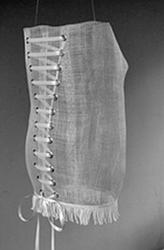
But the piece that took my breath away was a stand-alone corset refitted as a Torah cover in Nicholls’ Torat Imecha – The Maternal Torah Series. Nicholls brilliantly captures the symbolic tension between the Mishnaic saying, “Listen to the instructions of your father, but don’t forget the Torah of your mother” and the reSefer Torah Corset by Jacqueline Nichollsstricting relationship women traditionally have with the Torah.

The day Anna and I tumbled into the house as emotional refugees from the mall, we calmed down by listening to the instructions of the father of the house. Ken reminded us that our goal was one and the same: to have Anna feel happy in her new dress. The Torah of our mother included an addendum to the Ten Commandments: Honor Your Daughter and Son.

Ken’s intuition was right. Wearing new clothes is a mark of renewal and deserves a blessing – in this case the shehecheyanu to thank G-d for bringing one to a season of joy. For Anna and me, it’s also the season of shopping madness merged with the season of prom chicness.

After the conference, I went to Saks Fifth Avenue – the ultimate emporium of beauty and fashion. I had to run a gauntlet of women offering me free makeovers before I found the escalator to the fourth floor – the prom floor. All prom, all the time, and 20 percent off to boot. I took pictures of several dresses and e-mailed them to Anna. We narrowed down the choices to two lovely dresses. I’m happy to report that we have a winner, and that mother and daughter are doing very well.

Before leaving the fraught subject of fashion in the eye of mother and daughter, I want to note a couple of beautiful textual references that Jacqueline Nicholls wove into her presentation. According to the Zohar, the soul is a self-constructed garment. And in the traditional prayer lauding “a woman of valor,” a mother dressing her children is a form of protection.

Yes, I want to be that parent whose child’s security extends to feeling good in her clothing and, frankly, in her own skin. If that means going through racks of tulle and ruffles for the perfect dress, then feel free to call me over-protective.

The Toulouse Shootings: May Their Memories Be a Blessing by Judy Bolton-Fasman

Upon hearing bad news, it’s customary for Jews to say Baruch Dayan Emet — Blessed is the true judge. No questions asked. No motives suspected. This is God’s will.

The night before my father’s funeral I found a tattered prayer book in my old bedroom, a small square book with pastry thin pages that I had from my Yeshiva school days. The book was thick with line after line of tiny Hebrew letters. I practically choked on the chewy Aramaic. But this was the only way I knew how to prepare to be my father’s Kaddish.

I also knew that I would not find a single word about death in the Kaddish. But I was struck by the phrase that translated as “magnified and sanctified.” The words were connected to the act of enlarging God’s stature and acknowledging His holiness. The words of the Kaddish read like a stiff valentine to a lover who, in my resentful state of mind, did not deserve any adoration.

But sometimes there is nothing to do but to say the Kaddish. To accept God’s judgment. And yet to still be angry with Him. And so it is for the three children and their father, murdered in Toulouse because they were Jews. May their memories be a blessing. And may I be able to cope with being alternately grief-stricken and enraged over their deaths.


THE MOURNER’S KADDISH

Yitgadal viyitkadash sh’may raba, b’alma deevra chiruteh v’yamlich malchuteh b’chayechon uvyomechon, uv’chayey d’chol bait yisroel baagalo uvizman koreev, v’imur amen.

Y’hay sh’ may rabba m’vorach l’olam ulmay ulmaya.

Yitbarach v’yishtabach v’yitpoar vitromam viyitnasay, viyi’t hadar, v’yitaleh v’yatalal sh’may di’kudisha, breech hu, l’ayla min kol beerchata v’sheerata, toosh b’chata v’nechemata, d’ameeran, b’alma, vi’imru amen.

Yi’hay shl’omo rabba min sh’maya v’chaim alenu v’al kol yisrael, vi’imur amen.

Oseh shalom b’m’ramav, hu yaaseh shalom, alenu v’al kol yisrael, v’imru amen.


Magnified and sanctified be the glory of God

In the world created according to His will.


May his sovereignty soon be acknowledged,

During our lives and the life of all Israel.

Let us say: Amen.


May the glory of God be eternally praised,

Hallowed and extolled, lauded and exalted,

Honored and revered, adored and worshipped.


Beyond all songs and hymns of exaltation,

Beyond all praise which man can utter

Is the glory of the Holy One, praised is He.

Let us say: Amen.


Let there be abundant peace from heaven,

And life’s goodness for us and for all Israel.

Let us say: Amen.


He who ordains the order of the universe

Will bring peace to us and to all Israel.

Let us say: Amen.


Stories of Bat Mitzvah Around the World by Judy Bolton-Fasman

My Dear Sweet Daughter:

We’ve come a long way in making our place in the synagogue. When I was a little girl I once told my grandfather—my very old-fashioned Abuelo—that I wanted to be a rabbi. “That,” he said to me, “is very ugly.” He said the word in Spanish—fea.

I despaired. The bima, the Torah, even the dynamic fervent prayer—you know, the kind that comes with the feeling you have full access to God—would never be mine.

I was 11 then and having a bat mitzvah at 13 like you did was not an option for me. I would have to wait another thirty years to become a bat mitzvah. But in the intervening years between my childhood and my adult bat mitzvah, women made miraculous strides in Jewish life. For example, we don’t think twice about a woman being a rabbi. I remember the hoopla when the first women were ordained as rabbis in the Reform and Conservative movements. The first happened in 1970. The latter took place in 1985 when I coincidentally worked at the Jewish Theological Seminary. There was a lot of divisiveness over the decision to ordain Rabbi Amy Eilberg. It was still fea to a lot of people.

When Dad and I married six years later, we had our aufruf on the Shabbat before our wedding. An aufruf  is a simple, sweet ceremony where a couple blesses the Torah in anticipation of building a Jewish life together. But we almost cancelled our aufruf because I was not allowed to have an aliyah at Dad’s conservative temple. In 1991, women were still only allowed to bless the Torah there one Shabbat a month. You guessed it, our aufruf was not on the designated Shabbat. We had the aufruf and I said the Ashrei from the bima. It was a huge compromise, and I only did it because Dad was so upset and embarrassed by his temple’s sexism.

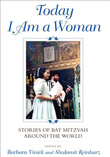
It turns out I’ve been under an illusion all these years. Jewish women have always been creative, committed and observant when it comes to taking their places as b’nai mitzvah. I’d like to share a new book with you that beautifully illustrates this point. Today I Am a Woman: Stories of Bat Mitzvah Around the World is a compilation edited by Barbara Vinick and Shulamit Reinharz and recently published by the Indiana University Press.

As Professor Reinharz, who heads the Hadassah-Brandeis Institute — a think tank devoted to Jewish women’s history as well as our future—notes in her introduction, “this book opens the door to many Jewish communities—large, medium, small and tiny—by focusing on one entry, the bat mitzvah story.”

The book is organized as its own idiosyncratic almanac—nine regions including Africa, Australia and the Caribbean—give entrée into Jewish communities you’d never guessed were large enough or even organized enough to initiate their daughters into Jewish womanhood. But you know all about Jews coming from far-flung places. How many times have you heard people say, “I didn’t know there were Jews in Cuba!”

Yes there are Jews in Cuba. And Jews in Nigeria too. I was taken with the story of the coming-of-age story for girls in the Igbo tribe. One of the elder statesmen of the group, a lawyer, suggests that the tribe claims Jewish origins. There are 40 million Igbos—the majority of them embracing their Jewish roots. But only a tiny fraction practice rabbinic Judaism.

Their transition to womanhood is called isi mgba. Girls are draped with beads pretty patterns are drawn on their bodies with a kind of white chalk. The girls then dance in groups to the marketplace where their mothers and grandmothers counsel them about the joys and responsibilities of Jewish womanhood. I love this pure version of the bat mitzvah. After all, we dressed up for your bat mitzvah and a friend did our makeup. Beautiful patterns, indeed.

Another thing that the book crystallized for me is how overtly some Jews connect the bat mitzvah with puberty. For example, the Bene Israel, Jews who have lived in India for over 2000 years, have a ceremony when girls begin to menstruate. One woman describes a ceremony in which dried fruits and nuts, including coconut, were wrapped in a handkerchief and placed on her lap. Coconut is plentiful on the coast of India and is a symbol of fertility.

So my dear daughter, name a country anywhere in the world where Jews live, and you’ll see that the bat mitzvah has always been an intrinsic part of Jewish womanhood. Make sure to pick up Today I Am A Woman. (It’s on the coffee table in the living room). You don’t need to read the book chronologically. In fact, it’s better if you flip through the various sections and read whatever catches your eye. It’s similar to spinning a globe and letting your finger randomly land on a country. You’ll glimpse at your sisters all over the world celebrating adulthood as women and Jews. And there’s nothing fea about that.

Shulamit Reinharz and Barbara Vinick will be discussing Today I am a Woman: Stories of Bat Mitzvah Around the World on Wednesday, March 14, 7pm at Brookline Booksmith.


We Are All Stars: Beren Academy and Jewish Pride by Judy Bolton-Fasman

The game was close. But the Robert M. Beren Academy Stars did us all proud Saturday night, even though the varsity basketball team lost the league championship, 46-42.

The fact that these boys from a Modern Orthodox Jewish day school in Houston actually played in the championships at all last weekend in Dallas was a human rights story crossed with a fairy tale.

The Beren Stars had been cultivating a championship team for the past four years. This year the players tore up the court and dribbled their way to the state championship tournament with their kippot firmly pinned to their heads.

Enter the Texas Association of Private and Parochial Schools (TAPPS), the governing body that oversees most private and parochial interscholastic sports in the state. Beren had made it to a game that was scheduled for last Friday evening – the victor of which was scheduled to play the following afternoon. The TAPPS Board had long ago decided that the only Sabbath to be celebrated in Texas was on Sunday: There would be no rescheduling Friday night games to Friday afternoon or Saturday afternoon games to Saturday night.

Beren Academy’s opponents were more than willing to accommodate the Beren team’s Shabbat. But TAPPS did not relent even when the mayor of Houston and a former coach for the Houston Rockets called upon the organization to review its decision. It wasn’t until TAPPS was forced to comply with a temporary restraining order that the association allowed the Beren Stars to reschedule. TAPPS’ tin-eared director, Edd Burleson, commented to the Houston Chronicle that “unlike many people, TAPPS does follow the law, and we will comply.” Many people? Which people? You people? My people?

And speaking of many people, where were the other schools in the league when Beren was initially disqualified from playing in the finals because its players observed the Jewish Shabbat? None of those teams stepped up and refused to play when it looked like Beren Academy would have to forfeit.

It’s easy for me to be outraged living here in Massachusetts, a place where a school like Maimonides doesn’t have to jump through hoops (yes, pun intended) to reschedule games that conflict with Shabbat. The school’s membership in the Massachusetts Interscholastic Athletic Association was never circumscribed as it was for Beren Academy, which was reportedly warned when it joined TAPPS that the league would not make exceptions for the Jewish Sabbath. Yet last year, the association accommodated a Seventh Day Adventist school that also observes the Sabbath from sundown on Friday to sunset on Saturday, enabling its soccer team to participate in the finals.

If it’s hard to be a Jewish school in TAPPS, it’s downright humiliating to be a Muslim one. According to The New York Times when Iman Academy SW, an Islamic school in Houston, requested membership in 2010, TAPPS sent an additional questionnaire that asked:

Historically, there is nothing in the Koran that fully embraces Christianity or Judaism in the way a Christian and/or a Jew understands his religion. Why, then, are you interested in joining an association whose basic beliefs your religion condemns?

It is our understanding that the Koran tells you not to mix with (and even eliminate) the infidels. Christians and Jews fall into that category. Why do you wish to join an organization whose membership is in disagreement with your religious beliefs?”

How does your school address certain Christian concepts (i.e. celebrating Christmas)?

Let me be very clear that this is not just demeaning to Muslims, but offensive to all people. As Rabbi Hillel said, “If I am only for myself, then what am I?”

After the Stars learned that the team had been given the all clear to play in Dallas, Beren Academy’s administration issued a press release thanking TAPPS for reversing its decision. The school’s statement was an example of grace and restraint. No hint of bitterness or pent-up hostility, so I’ll step in and do it for them.

Beren Academy shouldn’t have to thank TAPPS for anything. A judge – not the consciences of TAPPS’ administration or its board – forced the league to do the right thing.

And why is an association like TAPPS still playing by rules that not only smack of “separate but equal,” but also overtly discriminate against minorities in general? How many of TAPPS’ board members actually have read the Koran? Attended a synagogue service? Or let’s get more basic. How many of them truly understand that in the 21st century we live in a religiously diverse country?

Last Saturday night, the Beren Stars lost to the Abilene Christian Panthers by just two baskets. I watched the game on a live stream. With the exception of my own children’s sports teams, I’ve never wanted a team to win as much as I wanted the Stars to win. But when it was all over, Beren Academy achieved something even more lasting than a championship title. The school made me proud to be a Jew in a state and a country where I, more often than not, take my religious liberty for granted.

Bridging the Reality Gap: Stephen Wallace Empowers Parents by Judy Bolton-Fasman

When it comes to parenting books there is no bigger skeptic than I. Ironic, I know.

But I kept an open mind when I was asked to read and comment on “Reality Gap: Alcohol, Drugs and Sex – What Parents Don’t Know and Teens Aren’t Telling.” The author, Stephen Wallace, will be headlining a forum March 6 at Gann Academy in Waltham about keeping teenagers safe.

Never has a book’s subtitle been truer. Parents end up in that cavernous reality gap more than a few times during a child’s adolescence. But what I liked about Wallace’s book is that it’s one-stop shopping: He addresses a number of tough subjects in one succinct volume.

Wallace has impressive bona fides as a school psychologist and an adolescent counselor. He has put his experience to effective use as the chairman and CEO of SADD (Students Against Destructive Decisions). True to its roots as an organization originally founded to counter drunk driving, Wallace devotes a great deal of time and energy into plumbing the depths of the drinking epidemic among our teens.

But before he calls up statistics and programs, he establishes a hard truth. Most parents – I include myself as an occasional member of this group – tend to ignore information that runs counter to our positive perception of our children. This is called cognitive dissonance, and it’s a phrase that clangs around in my head. Am I really that unaware when it comes to my kids?

I no longer break into my children’s computers to look at their viewing histories. Yes, once upon a time I did that when they were in middle school to keep them safe. But my daughter and son are on the cusp of adulthood, and I’ve got to trust that Ken and I have done enough things right so that our children can make intelligent and moral decisions.

Role modeling for our kids is crucial. But as parents, we also need to be armed with information. Here are some basics that Wallace reports. Most of our kids’ risky behaviors fall into three broad categories: Avoiders, Experimenters and Repeaters.

Let’s use alcohol as an example to explain these descriptors. First, 80 percent of all high school students will have consumed alcohol by graduation. If you are the parent of a teenager, I’m willing to bet my mortgage that your teen has been to a party where there was drinking. My older teen has. As far as I know, she’s told me about most of the incidents. She’s certainly taken us up on our offer to pick her up with no questions asked when the presence of drinking has made her uncomfortable.

A kid who volunteers information and calls for a ride may be what Wallace describes as an avoider. Such teens have chosen to avoid alcohol for a number of reasons. Wallace cites religious beliefs as the prime motivator. But other kids are able to put the brakes on drinking long enough to think of the consequences. In theory, no one wants to throw away a thriving high school career for swigs of vodka and lemonade. That’s exactly the point: These kids have innately sound judgment.

But many avoiders can drift into the next category: experimenters. They’ll drink because their friends are drinking. They’ll drink because they’re curious about what it feels like to be buzzed.

If kids like that feeling, they may slide into the dangerous category of repeater. Note that most repeaters don’t drink just for the buzz. Drinking can be a form of self-medicating for anything from anxiety to low self-esteem.

I think drinking should be allowed in strict moderation at home during a holiday meal or a celebratory dinner. There’s no better way to demystify alcohol than to allow your child to have a glass under your supervision. Please, no e-mails about this; you know your child best, so this may not be the right choice for your family. But on Shabbat, Anna usually blesses the wine and then has a small glass with her meal. In doing so, I believe we’re teaching her restraint and limits. College is just around the corner for her, and drinking is a big part of college life that she’ll have to contend with.

I think our policy on alcohol falls in line with Wallace’s advice on transitioning a child into independence. Kids need limits throughout high school. Kids want limits so that they know how to create their own when parents aren’t there to supervise.

Wallace also addresses a situation that has tripped me up for a while. A lot of us were once experimenters and maybe even repeaters with alcohol or pot or sex. What you choose to share with your child is personal. But don’t feel that the adolescent decisions you made about sex and alcohol must influence your parenting. Our pasts shouldn’t necessarily influence our children’s futures.

As much as we’d like to be fair and open with our children, parenting is not always about parity. It’s about being wise and circumspect. And for Stephen Wallace, it’s about creating safety by establishing boundaries, regularly communicating and, as his book demonstrates, seeking out relevant knowledge.

Stephen Wallace will present his Parent Power program at Gann Academy in Waltham on Tuesday, March 6 at 7pm.