Some Lessons from Trayvon Martin’s Death: Donna Britt’s Memoir Brothers (& Me) by Judy Bolton-Fasman

Donna Britt - Roy Cox Photography

Donna Britt is an award-winning journalist still haunted by a chillingly nondescript headline from 1977: Gary Man Shot Dead by Police. The man – Britt’s older brother Darrell – was unarmed when he was shot and killed in racially torn Gary, Ind., by two white police officers who alleged that the young man, who had no history of mental, drug, or alcohol problems, launched an unprovoked attack with “a chain, a brick, a plastic baseball, and a three-foot length of pipe,’’ accusations that the family found unfathomable.

Darrell’s death, the centerpiece of Britt’s recently published memoir Brothers (& Me), eventually launched Britt on a personal path of self-examination: the only daughter in a middle-class black family with three self-absorbed brothers and a difficult father, early acceptance of her role as a self-sacrificing caregiver, and the place of race and sex in American life and in hers.

This morning on National Public Radio she spoke as the mother of three black sons. Her two older children joined her on the interview to reflect on the senseless death of Trayvon Martin the black unarmed teenager shot by a volunteer on neighborhood watch patrol in Florida.

Britt described “the talk” that black parents have with their sons and daughters.  The delicate timing of this “preparatory explanation and warning “ happens during the shift from childhood to teen years—when young black men are perceived as dangerous and threatening.” Her sons told anecdotes about their experiences as young black with authority. But what chilled me was when Britt talked about 16-year old son, a track star who essentially gambles with his life when he goes out running.

My son is on his school’s track team too. He’s a long-distance runner who will often run a stretch of the Boston Marathon Route. As mother of a white boy, I have the relative luxury of worrying about cars, dehydration, even strangers. But no one is every suspicious of my son because of who he is. “It’s hard not to be black,” said Justin Britt-Gibbons, Britt’s oldest son.

Britt was a graduate student in journalism at the University of Michigan when Darrell was killed in a predominantly white area near the family home. In the aftermath of Darrell’s death, Britt begins somehow to blame herself. In her book she writes, “Suddenly our growing apart, a process inevitable among even the closest siblings, was unforgivable. Darrell had stopped looking for me, too, but that hardly mattered. He was gone. And he’d left me with a question: How could I have stopped paying attention?’’

From that day on Britt paid scrupulous, aching attention to the men in her world. She became the mother of three sons – the middle one named for her dead brother. When she arrived at The Washington Post in the late 80s, she resurrected Darrell 12 years after his death in an extended essay that put “flesh on my ghost.’’ Steeped in memories of Darrell, she continued to think long and hard about the black man’s plight in American society: “As the sister, friend, daughter, and lover of brothers, I knew everything that deeply affects American men affects black men more harshly. Being human is wrenching for everyone. Yet the level of hostility and suspicion directed at black men is so palpable, their culturally inflicted wounds so raw, I understood how a decent brother might be drawn to anything that eased the pressure.’’

That piece, along with other writing assignments for the Post’s well-regarded features section, brought her to the attention of the paper’s top editors and led to an offer for one of journalism’s plum jobs as a columnist. I was a Baltimore to Washington DC commuter in the early 90s, and Britt’s personal, deep writing voice kept me company on those train rides. She wrote about balancing her family life with deadlines. She wrote about young black men like Trayvon Martin, like her sons. She was every woman while also uniquely herself.

This morning on National Public Radio, Donna Britt acknowledged that we’ve made some progress since that day in 1977 when her brother Darrell was randomly shot by police. But still, “racism is in the water and the air. Like sexism we absorb them. It takes time, love and forgiveness to make those shifts permanent.”

In Brothers (&Me) she presciently writes that love is “the glue that binds a soul’s warring selves, the meeting place at which our opposites melt into and become part of each other.’’ I’m sure that’s also part of Britt’s talk to her young black sons.

Just Love Them: Mayim Bialik and Attachment Parenting by Judy Bolton-Fasman

In all the years that I’ve been writing and thinking about kids and parenting, the best piece of advice I got was from my dear, late father in-law, Dennis. We had just brought Anna home from the hospital, and I was panicked. How in the world was I going to raise this tiny, vulnerable girl to womanhood? “Just love her,” Dennis said. “The rest will fall into place.”

Anna is almost a legal adult. Adam is not too far behind. For these past 18 years, I’ve just loved them.

Parents in various cultures bring up their children in distinctive ways. My Connecticut grandma and Cuban abuela had very different ideas about caring for an infant. Grandma thought that I shouldn’t be held too much and that I should “cry it out” until I fell asleep from exhaustion. Abuela wanted to hold me day and night, feed me on demand and let me nap in her arms. But for all the different ways we care for our children, many of us can relate to some of the values of “attachment parenting.”

Mayim Bialik, the actress and scientist, is a passionate advocate of attachment parenting in her new book, Beyond the Sling. You may remember Bialik from the movie “Beaches,” in which she played the Bette Middler character as a child. Bialik went on to star in her own television show, “Blossom,” in the ’90s and now appears in the sitcom, “The Big Bang Theory.”

Bialik – who studied Hebrew and Judaism and pursued a doctorate in neuroscience – cites eight basics for attachment parenting:

• Natural childbirth

• Exclusively feeding a baby breast milk

• Taking the time to formulate sensitive and thoughtful responses to your children

• Bonding through touch

• Co-sleeping

• Consistent parenting by a primary caregiver

• Gentle positive discipline, which means no corporal punishment

• Balancing your needs with those of your child

Bialik comes across as a supportive, informative friend, but that doesn’t dilute her fervency. For example, she’s an unequivocal proponent of natural childbirth. However, a drug-free delivery or a home birth is not an option for everyone. Sometimes there are complications like preeclampsia or gestational diabetes, both of which I had. My water also broke six weeks before Adam’s due date. Bialik considers extenuating circumstances, acknowledging that what worked for her and her family may not be safest or right for another family.

Much has been written about the salutary effects of breastfeeding for mother and child. Bialik anticipates the health and psychological challenges of nursing a baby. She acknowledges that there can be obstacles, but her message is to keep trying to do the best you can. I think she’s on target with that advice.

Sensitive and thoughtful responses to your children may seem obvious in parenting. Getting into that mindset connects with gentle and positive parenting. No hitting. No excuses. The one exception in my experience was the time a 2- year old Anna ran into the street, and I patted her bottom with some force. (I did not spank her). She was surprised, but not in any pain. What did hurt were her feelings. Afterward, she remembered not to approach the street without an adult.

But raise your hand if encouraging your children has sometimes crossed into pressuring them. I’ll raise two hands. And I’ll give you a textbook example of a mistake that I recently made. Adam came home last week with a nice report card. But I couldn’t leave well-enough alone. I suggested that maybe next term he could turn a couple of those B pluses into A’s. At first glance, it seems as if I took Adam’s hard work for granted. What I really did was to take my son for granted, and that was just plain wrong. Bonding through touch has always been a big issue for me. In my mind it links up to co-sleeping, which Ken wasn’t thrilled about when our children were babies. Our kids squirmed and kicked a lot. Nevertheless, I undid all of his scheduling and behavior modification around sleep when he was on business trips.

There are also controversial assertions in Beyond the Sling. For example, Bialik and her husband chose not to have their children vaccinated – a subject that has been addressed by others with much greater knowledge than I. She notes that her two young sons have never been on an antibiotic. Instead she pays careful attention to her sons’ body cues and manages their health accordingly. While her children’s well-being is a blessing, we all know that at times children need serious medical intervention. Bialik, the neuroscientist, points out that thousands of years of evolution have hardwired us to protect and raise our children. She emphasizes that a parent’s intuition is the first and best line of defense in childrearing. She also captures the bittersweet arc of a child gradually moving from dependence to independence.

Time with small children is fleeting. Just love them. That’s the charming, enduring subtext of Beyond the Sling.

Thank You, Gloria Steinem by Judy Bolton-Fasman


A while back, my son Adam and I struck a deal. He could stay up late for a Harry Potter flick if he watched a documentary with me called, Gloria in Her Words. The “Gloria” of the title was, of course, Gloria Steinem. Gloria Steinem is what Maya Angelou calls a “shero” of mine. She cleared the way for my mother to go to graduate school and open up her own checking account. She is the woman responsible for the fact that medical and law school classes are almost 50 percent women.

True, there can never exactly be another Gloria Steinem. She oversaw an unprecedented social revolution that transformed the world forever. But there doesn’t seem on obvious heir ready to take the mantle of feminist leadership from Steinem. Why is that? By my count we’re on the fourth wave of feminism.

Where is this generation’s Gloria Steinem?  Where is the one true, clear voice decrying the Ultrasound Bill? In 2012 seven states require a woman to undergo an ultrasound before terminating a pregnancy. And that bill was downgraded from a mandatory transvaginal ultrasound—a decidedly more painful and humiliating procedure. Where is the outrage over degrading a woman that has elected to have a legal medical procedure?

I’d like to tell you that discovering Steinem and understanding the origins of gender equality thrilled Adam. Alas, he passed most of the time playing with his Game Boy (note there is no Game Girl) until it was time to board the Hogwarts Express. But I take his disinterest as evidence of Gloria Steinem’s stunning success. Professional women, working women are the rule rather than the exception for him. He doesn’t think it’s unusual that his sister wants to become a doctor.

At one point in the documentary, Adam paused his game when archival footage of the suffrage movement caught his attention. He was shocked that women had not always been allowed to vote. His great-grandmother – who came to this country when she was barely 2 – was 30 years old when she legally cast her first vote.

Yes, we’ve come a long way, baby. When I was a child that meant that women finally had their own cigarette brand. By the time I was a teenager, we got our first national magazine. One of the documentary’s biggest hoots was to hear the male anchormen of my childhood predict the demise of Ms. Magazine and trip over the dated words: “women’s liberation.”

Ms. Magazine took off and in high schools and colleges more women were gradually added to the cannon in literature courses. Thank you, Gloria Steinem. But we’re not there yet. According to VIDA: Women in the Literary Arts, women have been notably absent on a number of literary prize shortlists this season. That might only seem reasonable to the novelist V.S. Naipaul, who thinks no woman is his literary equal. I dare him to say that in front of Toni Morrison.

When I was Adam’s age I was stumped by a riddle about a father and son who get into a car accident and need surgery. The surgeon on call takes one look at the boy and says, “I can’t operate on this child; he’s my son.”

“Why?” I asked Adam. “That’s easy,” Adam said. “The surgeon is the boy’s mother.”

Thank you, Gloria Steinem.


Longing for Home in the Middle East: Anthony Shadid’s House of Stone

My Dear Children:

I just read a memoir in which one of the many things I learned was that the Arabic word for house – bayt – is achingly close to the one in Hebrew – bayit. The book is called “House of Stone: A Memoir of Home, Family, and a Lost Middle East,” by Anthony Shadid.

Like me, Shadid grew up in two languages, with two translations of the world around us. He was a Lebanese American whose Arabic was as proficient as my Spanish. As it was for me with Spanish, the more time he spent immersed in Arabic – particularly in Lebanon – the more the words came back to him until he was practically fluent again.

Sadly, Mr. Shadid died last month covering the conflict in Syria for The New York Times. He succumbed to an asthma attack. He was only 43. Not only did he leave behind a body of sterling Pulitzer-prize-winning journalism, he also left his completed memoir of renovating his great-grandfather’s home in Marjayoun, a small town nestled in the hills of southern Lebanon. Renovate is not quite the right word for Shadid’s project. Renovate is what we did to our kitchen. But Shadid didn’t exactly rebuild the house, either. He writes that there was meaning and “an elegance of movement as the house hurtled towards its end and a new beginning.”

Anthony Shadid with his son in front of his great-grandfather's house in Lebanon

A house of stone is strong and proud. Its very material is “the yeast of the earth.” You can make the case that he restored the house to its original Levantine glory. But he did more than that: He wanted to live in this house as a way to reclaim his history while breathing new life into it.

The house had marble stairs buffed until they actually reflected the emotions of the occupants. Marble evokes elegance, antiquity, history. Did you know that your grandmother’s house in Cuba had marble stairs, too?

I remember her telling me how she scrubbed those floors until she saw her face mirrored back. Houses can be so intimate, so personal, so bound-up in identity.

When Shadid looked across the valley from his great-grandfather Isber Samara’s balcony, he crossed decades to make sense of the life that came before and after his sepia-photographed ancestor. Shadid was searching for those elusive sparks that illuminate both purpose and fate in short, intense bursts of insight.

Like your own ancestors from Greece and Turkey, the Ukraine and Poland, Isber had set his sights on America for his family. He sent his children, but never emigrated himself. Isber’s children settled in Texas and Oklahoma. The family worked together peddling, and then opened a dry goods store. Did you know that you had a great-great uncle who settled for a time in Galveston, Texas, running a small grocery store in the early 1900s?

Like Shadid, I have a love-hate relationship with the Diaspora, too. When your relatives have lived in four countries in just two generations, you begin to wonder if your family is “forever doomed to departures.” Where exactly is home anyway?

Shadid literally italicizes his family history. Paragraphs like that usually distract me. But trust me, these extended passages are well worth the time. Isber Samara lived and prospered in the Ottoman Empire, as did your great-grandfather’s family. My people, your people, lived in Ankara. They made their money in silver, and they educated their boys to become Torah scholars.

History was as continuous and borders were as seamless for my grandfather, Jacobo Alboukrek, as they were for Isber Samara. But the Ottoman Empire crumbled and crushed Jacobo’s family. Their Armenian friends and neighbors were disappearing. The Jews were afraid they were next. Some of them joined relatives already settled in Cuba. The rest of the family settled in Palestine.

Shadid longs for the open borders of the Ottoman Empire. Borders that enhanced the beauty and culture of Lebanon. He sees the memory come to life in the tiles that he picks for his home in Marjayoun. The tiles are called cementos, and Shadid goes to a store in Beirut to buy them from the Maalouf Trading Company. Doesn’t that sound like a name right out of Lawrence of Arabia?

Shadid takes time to describe both the artistry of these tiles and the history they awaken in him. For him, these decorative tiles in geometrics and floral, accented in purples and greens and yellows, remind him of “borders that were still for a time, crossable.”

For now, let’s leave politics alone. For the most part, Shadid does. “The Levant is no more,” he writes, “but I had been reminded – by the grace of the triple arches, the dignity and pride of the maalimeen [artisans who worked on the house], and … Isber’s sorrow and sacrifice – that behind the politics, there were prayers still being said with hope for what draws us together.”

Focus on that hope. Focus on the humanity that draws us together. Focus on the similarities between bayt and bayit. For in the end, they mean the same thing.

Love, Mom

Stories of Bat Mitzvah Around the World by Judy Bolton-Fasman

My Dear Sweet Daughter:

We’ve come a long way in making our place in the synagogue. When I was a little girl I once told my grandfather—my very old-fashioned Abuelo—that I wanted to be a rabbi. “That,” he said to me, “is very ugly.” He said the word in Spanish—fea.

I despaired. The bima, the Torah, even the dynamic fervent prayer—you know, the kind that comes with the feeling you have full access to God—would never be mine.

I was 11 then and having a bat mitzvah at 13 like you did was not an option for me. I would have to wait another thirty years to become a bat mitzvah. But in the intervening years between my childhood and my adult bat mitzvah, women made miraculous strides in Jewish life. For example, we don’t think twice about a woman being a rabbi. I remember the hoopla when the first women were ordained as rabbis in the Reform and Conservative movements. The first happened in 1970. The latter took place in 1985 when I coincidentally worked at the Jewish Theological Seminary. There was a lot of divisiveness over the decision to ordain Rabbi Amy Eilberg. It was still fea to a lot of people.

When Dad and I married six years later, we had our aufruf on the Shabbat before our wedding. An aufruf  is a simple, sweet ceremony where a couple blesses the Torah in anticipation of building a Jewish life together. But we almost cancelled our aufruf because I was not allowed to have an aliyah at Dad’s conservative temple. In 1991, women were still only allowed to bless the Torah there one Shabbat a month. You guessed it, our aufruf was not on the designated Shabbat. We had the aufruf and I said the Ashrei from the bima. It was a huge compromise, and I only did it because Dad was so upset and embarrassed by his temple’s sexism.

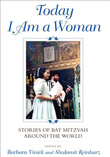
It turns out I’ve been under an illusion all these years. Jewish women have always been creative, committed and observant when it comes to taking their places as b’nai mitzvah. I’d like to share a new book with you that beautifully illustrates this point. Today I Am a Woman: Stories of Bat Mitzvah Around the World is a compilation edited by Barbara Vinick and Shulamit Reinharz and recently published by the Indiana University Press.

As Professor Reinharz, who heads the Hadassah-Brandeis Institute — a think tank devoted to Jewish women’s history as well as our future—notes in her introduction, “this book opens the door to many Jewish communities—large, medium, small and tiny—by focusing on one entry, the bat mitzvah story.”

The book is organized as its own idiosyncratic almanac—nine regions including Africa, Australia and the Caribbean—give entrée into Jewish communities you’d never guessed were large enough or even organized enough to initiate their daughters into Jewish womanhood. But you know all about Jews coming from far-flung places. How many times have you heard people say, “I didn’t know there were Jews in Cuba!”

Yes there are Jews in Cuba. And Jews in Nigeria too. I was taken with the story of the coming-of-age story for girls in the Igbo tribe. One of the elder statesmen of the group, a lawyer, suggests that the tribe claims Jewish origins. There are 40 million Igbos—the majority of them embracing their Jewish roots. But only a tiny fraction practice rabbinic Judaism.

Their transition to womanhood is called isi mgba. Girls are draped with beads pretty patterns are drawn on their bodies with a kind of white chalk. The girls then dance in groups to the marketplace where their mothers and grandmothers counsel them about the joys and responsibilities of Jewish womanhood. I love this pure version of the bat mitzvah. After all, we dressed up for your bat mitzvah and a friend did our makeup. Beautiful patterns, indeed.

Another thing that the book crystallized for me is how overtly some Jews connect the bat mitzvah with puberty. For example, the Bene Israel, Jews who have lived in India for over 2000 years, have a ceremony when girls begin to menstruate. One woman describes a ceremony in which dried fruits and nuts, including coconut, were wrapped in a handkerchief and placed on her lap. Coconut is plentiful on the coast of India and is a symbol of fertility.

So my dear daughter, name a country anywhere in the world where Jews live, and you’ll see that the bat mitzvah has always been an intrinsic part of Jewish womanhood. Make sure to pick up Today I Am A Woman. (It’s on the coffee table in the living room). You don’t need to read the book chronologically. In fact, it’s better if you flip through the various sections and read whatever catches your eye. It’s similar to spinning a globe and letting your finger randomly land on a country. You’ll glimpse at your sisters all over the world celebrating adulthood as women and Jews. And there’s nothing fea about that.

Shulamit Reinharz and Barbara Vinick will be discussing Today I am a Woman: Stories of Bat Mitzvah Around the World on Wednesday, March 14, 7pm at Brookline Booksmith.


We Are All Stars: Beren Academy and Jewish Pride by Judy Bolton-Fasman

The game was close. But the Robert M. Beren Academy Stars did us all proud Saturday night, even though the varsity basketball team lost the league championship, 46-42.

The fact that these boys from a Modern Orthodox Jewish day school in Houston actually played in the championships at all last weekend in Dallas was a human rights story crossed with a fairy tale.

The Beren Stars had been cultivating a championship team for the past four years. This year the players tore up the court and dribbled their way to the state championship tournament with their kippot firmly pinned to their heads.

Enter the Texas Association of Private and Parochial Schools (TAPPS), the governing body that oversees most private and parochial interscholastic sports in the state. Beren had made it to a game that was scheduled for last Friday evening – the victor of which was scheduled to play the following afternoon. The TAPPS Board had long ago decided that the only Sabbath to be celebrated in Texas was on Sunday: There would be no rescheduling Friday night games to Friday afternoon or Saturday afternoon games to Saturday night.

Beren Academy’s opponents were more than willing to accommodate the Beren team’s Shabbat. But TAPPS did not relent even when the mayor of Houston and a former coach for the Houston Rockets called upon the organization to review its decision. It wasn’t until TAPPS was forced to comply with a temporary restraining order that the association allowed the Beren Stars to reschedule. TAPPS’ tin-eared director, Edd Burleson, commented to the Houston Chronicle that “unlike many people, TAPPS does follow the law, and we will comply.” Many people? Which people? You people? My people?

And speaking of many people, where were the other schools in the league when Beren was initially disqualified from playing in the finals because its players observed the Jewish Shabbat? None of those teams stepped up and refused to play when it looked like Beren Academy would have to forfeit.

It’s easy for me to be outraged living here in Massachusetts, a place where a school like Maimonides doesn’t have to jump through hoops (yes, pun intended) to reschedule games that conflict with Shabbat. The school’s membership in the Massachusetts Interscholastic Athletic Association was never circumscribed as it was for Beren Academy, which was reportedly warned when it joined TAPPS that the league would not make exceptions for the Jewish Sabbath. Yet last year, the association accommodated a Seventh Day Adventist school that also observes the Sabbath from sundown on Friday to sunset on Saturday, enabling its soccer team to participate in the finals.

If it’s hard to be a Jewish school in TAPPS, it’s downright humiliating to be a Muslim one. According to The New York Times when Iman Academy SW, an Islamic school in Houston, requested membership in 2010, TAPPS sent an additional questionnaire that asked:

Historically, there is nothing in the Koran that fully embraces Christianity or Judaism in the way a Christian and/or a Jew understands his religion. Why, then, are you interested in joining an association whose basic beliefs your religion condemns?

It is our understanding that the Koran tells you not to mix with (and even eliminate) the infidels. Christians and Jews fall into that category. Why do you wish to join an organization whose membership is in disagreement with your religious beliefs?”

How does your school address certain Christian concepts (i.e. celebrating Christmas)?

Let me be very clear that this is not just demeaning to Muslims, but offensive to all people. As Rabbi Hillel said, “If I am only for myself, then what am I?”

After the Stars learned that the team had been given the all clear to play in Dallas, Beren Academy’s administration issued a press release thanking TAPPS for reversing its decision. The school’s statement was an example of grace and restraint. No hint of bitterness or pent-up hostility, so I’ll step in and do it for them.

Beren Academy shouldn’t have to thank TAPPS for anything. A judge – not the consciences of TAPPS’ administration or its board – forced the league to do the right thing.

And why is an association like TAPPS still playing by rules that not only smack of “separate but equal,” but also overtly discriminate against minorities in general? How many of TAPPS’ board members actually have read the Koran? Attended a synagogue service? Or let’s get more basic. How many of them truly understand that in the 21st century we live in a religiously diverse country?

Last Saturday night, the Beren Stars lost to the Abilene Christian Panthers by just two baskets. I watched the game on a live stream. With the exception of my own children’s sports teams, I’ve never wanted a team to win as much as I wanted the Stars to win. But when it was all over, Beren Academy achieved something even more lasting than a championship title. The school made me proud to be a Jew in a state and a country where I, more often than not, take my religious liberty for granted.

Bridging the Reality Gap: Stephen Wallace Empowers Parents by Judy Bolton-Fasman

When it comes to parenting books there is no bigger skeptic than I. Ironic, I know.

But I kept an open mind when I was asked to read and comment on “Reality Gap: Alcohol, Drugs and Sex – What Parents Don’t Know and Teens Aren’t Telling.” The author, Stephen Wallace, will be headlining a forum March 6 at Gann Academy in Waltham about keeping teenagers safe.

Never has a book’s subtitle been truer. Parents end up in that cavernous reality gap more than a few times during a child’s adolescence. But what I liked about Wallace’s book is that it’s one-stop shopping: He addresses a number of tough subjects in one succinct volume.

Wallace has impressive bona fides as a school psychologist and an adolescent counselor. He has put his experience to effective use as the chairman and CEO of SADD (Students Against Destructive Decisions). True to its roots as an organization originally founded to counter drunk driving, Wallace devotes a great deal of time and energy into plumbing the depths of the drinking epidemic among our teens.

But before he calls up statistics and programs, he establishes a hard truth. Most parents – I include myself as an occasional member of this group – tend to ignore information that runs counter to our positive perception of our children. This is called cognitive dissonance, and it’s a phrase that clangs around in my head. Am I really that unaware when it comes to my kids?

I no longer break into my children’s computers to look at their viewing histories. Yes, once upon a time I did that when they were in middle school to keep them safe. But my daughter and son are on the cusp of adulthood, and I’ve got to trust that Ken and I have done enough things right so that our children can make intelligent and moral decisions.

Role modeling for our kids is crucial. But as parents, we also need to be armed with information. Here are some basics that Wallace reports. Most of our kids’ risky behaviors fall into three broad categories: Avoiders, Experimenters and Repeaters.

Let’s use alcohol as an example to explain these descriptors. First, 80 percent of all high school students will have consumed alcohol by graduation. If you are the parent of a teenager, I’m willing to bet my mortgage that your teen has been to a party where there was drinking. My older teen has. As far as I know, she’s told me about most of the incidents. She’s certainly taken us up on our offer to pick her up with no questions asked when the presence of drinking has made her uncomfortable.

A kid who volunteers information and calls for a ride may be what Wallace describes as an avoider. Such teens have chosen to avoid alcohol for a number of reasons. Wallace cites religious beliefs as the prime motivator. But other kids are able to put the brakes on drinking long enough to think of the consequences. In theory, no one wants to throw away a thriving high school career for swigs of vodka and lemonade. That’s exactly the point: These kids have innately sound judgment.

But many avoiders can drift into the next category: experimenters. They’ll drink because their friends are drinking. They’ll drink because they’re curious about what it feels like to be buzzed.

If kids like that feeling, they may slide into the dangerous category of repeater. Note that most repeaters don’t drink just for the buzz. Drinking can be a form of self-medicating for anything from anxiety to low self-esteem.

I think drinking should be allowed in strict moderation at home during a holiday meal or a celebratory dinner. There’s no better way to demystify alcohol than to allow your child to have a glass under your supervision. Please, no e-mails about this; you know your child best, so this may not be the right choice for your family. But on Shabbat, Anna usually blesses the wine and then has a small glass with her meal. In doing so, I believe we’re teaching her restraint and limits. College is just around the corner for her, and drinking is a big part of college life that she’ll have to contend with.

I think our policy on alcohol falls in line with Wallace’s advice on transitioning a child into independence. Kids need limits throughout high school. Kids want limits so that they know how to create their own when parents aren’t there to supervise.

Wallace also addresses a situation that has tripped me up for a while. A lot of us were once experimenters and maybe even repeaters with alcohol or pot or sex. What you choose to share with your child is personal. But don’t feel that the adolescent decisions you made about sex and alcohol must influence your parenting. Our pasts shouldn’t necessarily influence our children’s futures.

As much as we’d like to be fair and open with our children, parenting is not always about parity. It’s about being wise and circumspect. And for Stephen Wallace, it’s about creating safety by establishing boundaries, regularly communicating and, as his book demonstrates, seeking out relevant knowledge.

Stephen Wallace will present his Parent Power program at Gann Academy in Waltham on Tuesday, March 6 at 7pm.

Beren Academy Boys’ Basketball Team Forfeits Game for Shabbat by Judy Bolton-Fasman

I get the feeling that the Board members of the Texas Association of Private and Parochial Schools—TAPPS—don’t meet a lot of people who are different then they are. Apparently, it’s impossible for those folks to understand that not everyone celebrates the Sabbath on a Sunday. Enter the Robert M. Beren Academy Boys’ Varsity Basketball—known as the Stars—to shake up the TAPPS Board’s world.

Perhaps it’s the first time that anyone at TAPPS has seen that serious athletes can also be observant Jews. Beren’s players tear up a court with their yamulkas pinned firmly in place. And for the first time in its 42-year history, this Modern Orthodox day school in Houston has made it to the play-offs in their division. Imagine the boys’ excitement when they realized they would be going to the semifinals in Dallas this weekend. Imagine their disappointment when they realized that their playoff game in Dallas was scheduled for 9PM on March 2, Friday night—erev Shabbat. Imagine their heartbreak when their appeal to TAPPS to move the game start time to earlier in the afternoon was unilaterally denied.

Yes, unilaterally denied. TAPPS acted alone when its Board decided to sideline Beren Academy. According to Beren Academy’s head of school, Rabbi Harry Sinoff, the heads of school of the opposing teams had no objection to accommodating the Stars. In fact, just the week before, Beren moved their quarterfinals game against a local Catholic high school to 2pm on a Friday afternoon. Our Lady of the Hills Catholic High School had no trouble understanding that playing basketball on Shabbat is not an option for the Beren Academy boys.

If there was ever a perfect case for the Anti-Defamation League to broker, this was it. The director of ADL’s Southwest’s regional office in Houston wrote a letter to Edd Burleson, TAPPS’ director, which read in part:

Many of the private and parochial schools that are TAPPS members are faith-based institutions where religion is their guiding principal. As such, it is incumbent upon TAPPS to ensure that its members do not have to choose between observing their religious holy days and competing in championship activities. By asking a member school to participate on their Sabbath day, TAPPS will send the message to the Beren Academy team and all other teams whose faith prohibits Sabbath activities, that their religious principles are not valued and that they are not equal members of the TAPPS family.

But the hard truth is that at best TAPPS is sending mixed signals about religious observance and sportsmanship. In 2010, the Association accommodated the Arlington Burton Adventist Academy whose students also observe the Sabbath from Friday sundown to Saturday sunset. The Seventh Day Adventist school had reached the soccer finals in its division and, with TAPPS’ approval, secured a location to play its soccer game after the Sabbath.

When I spoke to Burleson on the phone he said that the logistics for the Seventh Day Adventists’ participation in the soccer finals was simpler, involving only four schools. Logistics? This isn’t a military operation—it’s a high school basketball game. Burleson explained that, “In that case the one school that observed the Sabbath and their opponents were adamant that all of the qualifying teams play.” Okay, so where is Our Lady of the Hills this week? The Stars team has been forced to forfeit Friday night’s upcoming game and the Catholic high school will be taking Beren’s place.

Burleson went on to qualify the Arlington Burton decision. “The [TAPPS] Board made an exception when it allowed [Arlington Burton] to play. Afterwards the Board felt that they had made a mistake and they do not want to make the same mistake again.” Of course they don’t. Who wants to repeat an act of grace and empathy more than once?

This is not the first time that Sabbath observance has been an issue for a Jewish day school. In my backyard, the Modern Orthodox Maimonides School in Brookline faced a similar conflict in 2009 when the school’s mock trial club had reached the national championships in Atlanta. The competition’s organizers initially refused to change the Saturday date, but the school enlisted the help of the Justice Department and two days before the competition, the mock trial organization allowed Maimonides to schedule its appearance on Thursday.

“I’ve been bombarded with hate mail over this issue,” Burleson said. He sounded a bit incredulous. While it’s not right that Burleson has been the target of some folks’ frustration and venom over the incident, it’s not surprising that intolerance and ignorance lead to unpleasant things like hate mail.

Rabbi Sinoff wisely put the TAPPS fiasco in perspective. “Even though the start times for this weekend’s tournament in Dallas haven’t been changed, we’ll still celebrate Shabbat like we always have.”

Amen and Shabbat Shalom.

The Other Wes Moore: One Name Two Fates by Judy Bolton-Fasman


Lately, I’ve been thinking a lot about Wes Moore’s memoir, The Other Wes Moore: One Name, Two Fates. If Moore’s memoir had not actually happened, it would be a neat parable of two radically different lives that originated at the same starting point.

But this is not a There but for the Grace of God Go I story. Moore’s story may appear to be the very embodiment of the symbiotic relationship between fate and choice. But really this is a story about locating and then tapping into free will to beat the odds.

Here’s the book’s stark premise: Around the time that the author Wes Moore became Johns Hopkins University’s first Rhodes Scholar in 13 years and the university’s first-ever African-American Rhodes scholar, another Wes Moore—a contemporary—was wanted for the murder of a police officer in an armed robbery for which he would eventually go to jail for life. That was 2000.

“One of us is free and has experienced things that he never even knew to dream about as a kid,” the author Wes Moore writes in his memoir. “The other will spend every day until his death behind bars. … The chilling truth is that his story could have been mine. The tragedy is that my story could have been his.”

The two men grew up in the same tough West Baltimore neighborhood, but irony does not hang over this book like a dark cloud. Wes Moore, the author, went to Oxford, was a decorated war hero who served in Afghanistan and was a White House Fellow. And yes, the other Wes Moore is serving a life sentence without parole and became a grandfather at the age of 33. Two paths began at the same point, but diverged. The road taken, the road not taken—each of them men spent time on both roads.

The Wes Moores converge on the same destination. Through prison visits and letters, the two Moores bared their souls to one another and laid out their lives side by side. Poverty was both the level playing field and the catalyst that propelled these two men in opposite directions. Both of them grew up without their fathers—author Wes’ father died when he was four, prisoner Wes never met his father. Both were grief stricken. But one mourns the death of a loving father, while the other seethes over his absent one.

The author’s mother was a teacher who kept careful track of her son’s growing apathy toward school and attraction to life on the streets. She moved her family to the Bronx when Wes was a young teenager to be near loving grandparents at the ready to help Wes and his sisters. Wes won a scholarship to Riverdale Country Day School, but he couldn’t connect to his rich white classmates. He missed school and failed most of his classes.

The Rhodes Scholar Wes Moore had a mother who never gave up on him. She bought her son Mitch Albom’s book about a Michigan basketball team, and his spark for reading caught on fire. She scraped together tuition money to send him to a military school in Pennsylvania where he thrived and became one of the youngest officers in the history of the school. The other Wes Moore’s mother did her best to protect Wes from the streets. She did that and more while trying to make rent and put food on the table. It’s heartbreaking that when someone bothered to teach the other Wes Moore to read, he soared up to college level.

There were other aching near misses in the other Wes Moore’s life. His mother enrolled at Johns Hopkins in the early 80s, determined to get an education that would have propelled her into the middle class. Government cuts abruptly ended her college career. Wes himself went through a year-long Job Corps program, earning high scores on his GED and training as a carpenter. But there was no job to be had afterwards, and the money to be made on the streets was too tempting.

You may be thinking “The Other Wes Moore” sounds like a fascinating story—an important call to arms to reform society—even offering a comprehensive appendix of resources at the end of the book to help at-risk youth. You may also wonder if these men’s stories have resonance for a reader beyond the book.

I lived in Baltimore for five years during the 90s. My husband worked at Johns Hopkins Medical School in rough, jagged West Baltimore. When I drove through those streets, I was always overwhelmed by the stories I didn’t know. And I’d think about one of my favorite quotes from Rabbi Hillel of the Talmud: If I am not for myself, who will be for me? If I am not for others, what am I? And if not now, when?


Le Bébé et le Gun-Toting Père: Pamela Druckerman Meet Tommy Jordan by Judy Bolton-Fasman

It seems the French do so many things better than Americans. The cooking is superior. Chicken nuggets? Non! The women are skinnier even though they eat their weight in cheese annually. And now we find out that the French are more successful parents. At least according to Pamela Druckerman, an American journalist who lives in Paris with her husband and three children. She details her anecdotal findings in her new book, “Bringing up Bébé: One American Mother Discovers the Wisdom of French Parenting.”

The book is a breezy cross between parenting manual and personal memoir. The takeaway is that French parents don’t sweat the small stuff and their kids are better adjusted for it. For example, I was impressed that French babies “do their nights” far earlier than their American counterparts, sleeping through the night on average at six weeks old. I guess French babies don’t get “le colic.”

French parents’ success continues by cultivating patience in their children. From the beginning, French children are taught to tolerate frustration whether it be discovering ways to amuse themselves or waiting until a parent finishes a phone call. The French are also visibly less child-centric. Play kitchens and matchbox cars don’t take over a living room in Paris. At least not the ones Druckerman has seen.

About halfway through Druckerman’s book, it suddenly hit me that she should meet Tommy Jordan. He’s the guy who tried to teach his very American teenager a lesson by shooting up her laptop. Furthermore, he videotaped his serious lapse in judgment for the world to see. It wasn’t so much the shooting that scared me (although that was very disconcerting), but it was Jordan’s eerie calmness on camera – a saccharine-like calm studded with emotional landmines that could go off at any moment.

The catalyst for this brouhaha was daughter Hannah’s rude Facebook post in which she bitterly complained about her chore-laden life. Laced with adjectives unfit to print here, Hannah was sick of cleaning up after her siblings and making coffee for her parents. As she points out, her family has a cleaning lady and her name is Maria, not Hannah.

Jordan was also miffed that the day before he read Hannah’s post he had put time and money into fixing his daughter’s laptop, for which she didn’t offer a single word of appreciation. The man clearly was pushed to the brink. What else could he do, but shoot his kid’s laptop at point blank range nine times? I don’t know what 18 million-plus viewers felt when they watched the gratuitous shoot up on YouTube, but I couldn’t shake the feeling that I was witnessing a crime.

If my daughter had written a churlish screed like Hannah’s, I’d be pretty angry, too. By the way, someone should tell Hannah that emptying the dishwasher and making the bed does not qualify as indentured servitude. But here’s where Pamela Druckerman could be useful to Tommy Jordan. First, it’s helpful that they have some cultural commonalities. I don’t think his cigarette smoking would put her off. Everyone smokes in Europe. (I can generalize too, Ms. Druckerman.) And they both like hats. Druckerman appeared on the Today show wearing a beret to emphasize the oh-so-Frenchness of her book. As for Jordan, he sports a ten-gallon hat.

My guess is that mistakes were made with Hannah from the beginning. She probably didn’t do her nights until she was at least 1 – embarrassingly late for a French child not to be sleeping through the night. She was probably never told to be sage. (In French, the word sage rhymes with Taj). Druckerman explains that when French parents urge their children to be sage, they are telling them much more than just to be good. They are exhorting their children to use their discreet judgment and to be in control of their emotions. For example, if Jordan had told his daughter to be sage early and often, she might not have impulsively posted that letter on Facebook.

As for Hannah’s appalling language, the French have solved that problem, too. Preschoolers have their own swear words. That’s right, there’s a lightly scatological phrase particular to kids that allows them to use naughty language in a controlled (there’s that word again) and, albeit, civilized way. I’m sure Jordan would not have minded Hannah’s foul language nearly as much if she were using parent-sanctioned epithets. Hannah’s overall rudeness might have been considerably less offensive if she were taught at a very early age to look an adult in the eye and politely greet them. “Hello” and “goodbye” in France get top billing with “please” and “thank you.” (I’m with the French on that one). Yes Hannah, that means that Maria the cleaning lady must be properly greeted and seen off.

As I think about it, maybe Druckerman should first use French parenting techniques on Tommy Jordan. After all, he acted like the more petulant child.