Being Both: Susan Katz Miller’s Interfaith Journey by Judy Bolton-Fasman

It has been more than a decade since my children entered Jewish day school. Our choice was the Solomon Schechter Day School of Greater Boston and I don’t regret a minute of their education there. But in the beginning Ken and I paused over the fine print of the application that asked us to confirm that our children had a Jewish mother or were converted in a mikveh—a ritual bath. A part of us felt that any child with a Jewish parent—mother or father—who sought out a Jewish education should have one. But we are also temple-going Conservative Jews who support matrilineal descent. It was a conundrum—one that after all these years I haven’t fully worked out.

I’ve had this discussion many times with my good friend Susan Katz Miller. Sue grew up Jewish with a Jewish father and an Episcopalian mother. The Jewish community frequently misunderstood her patrilineality and often made her feel like an outsider. Although she had a bat mitzvah and attended Hebrew school, she steered clear of a Hillel in college that made her feel unwelcomed. She married her Episcopalian husband in an out-of-the box interfaith ceremony that was almost unheard of twenty-five years ago.

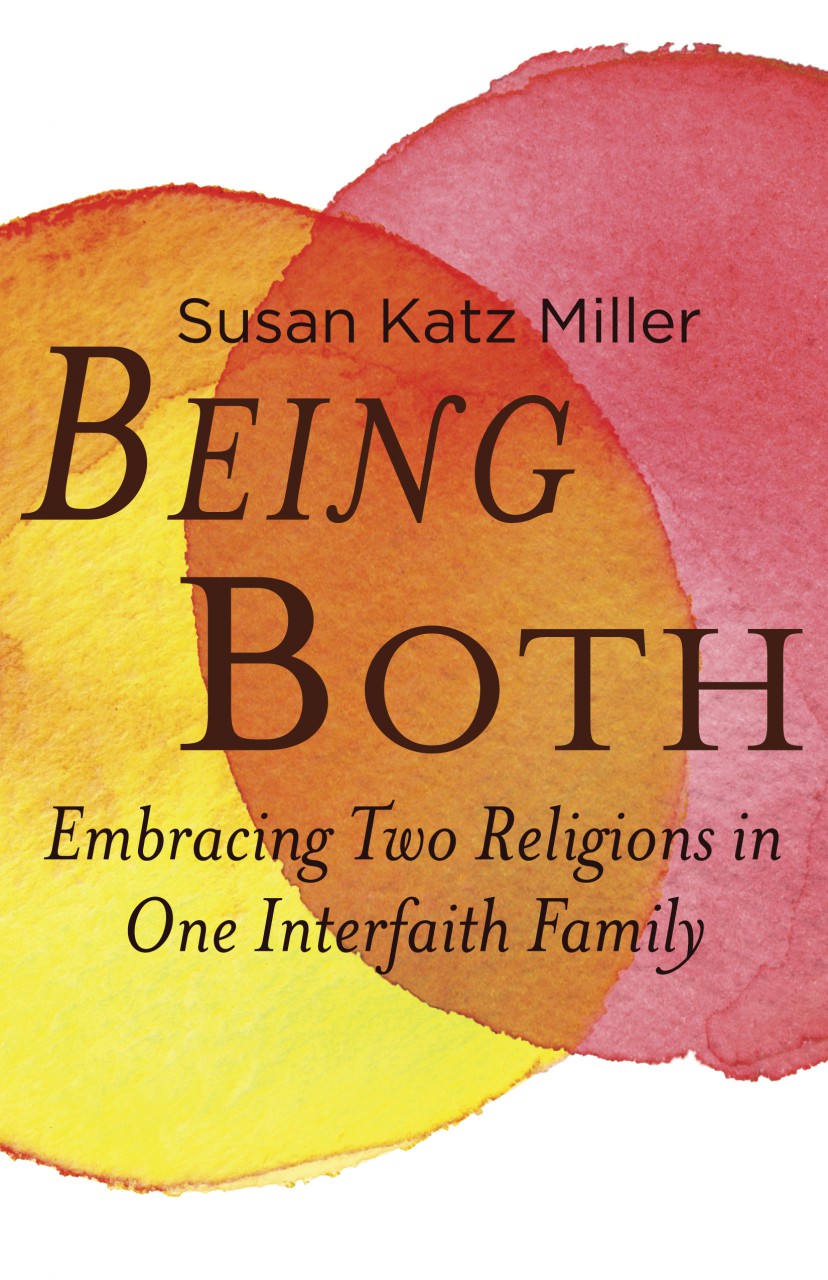
In her new book, Being Both: Embracing Two Religions in One Interfaith Family, Sue chronicles her experiences as a Jewish interfaith child as well as the bold move to bring up her children with both Jewish and Christian traditions. She and her husband are part of an interfaith community called the Interfaith Families Project of Greater Washington. Sister organizations exist in New York, Chicago and Los Angeles. Through IFFP, Sue and her husband have sent their children to Sunday School and celebrated Jewish and Christian holidays with their interfaith community.
1202_being-both


Over the last decade, I’ve watched Sue grow in her commitment to Judaism in ways that I did not always fully appreciate. And in the end what Sue and her family are doing may not be so bad for the Jews. After all, her children are religiously knowledgeable citizens of the world. Their Jewishness flows from just one Jewish grandparent, yet Judaism gets equal time at the Katz Miller household. As Sue writes in the introduction to her book:


“Some of us are audacious enough to believe that raising children with both religions is actually good for the Jews (and good for the Christians or any other faith or denomination represented in marriage. The children in these pages have grown up to be Christians who are uncommonly knowledgeable about and comfortable with Jews, or Jews who are adept at working with and understanding Christians. Or they continue to claim both religions and serve as bridges between the two. I see all these possible outcomes as positive.”


I do too until my bias for rearing children in one religion comes into play. Like me, Sue and her community are invested in Judaism’s survival. She writes that, “Interfaith families who choose both [religions] for their children do feel concern for the survival of Judaism in the world. But many of us also feel that we are ‘making a Jewish choice’ by giving our children access to both cultures, rather than choosing nothing, choosing only Christianity, or choosing a third religion.” But for me it’s not only about demographics; it’s about raising literate Jews committed to Judaism alone. I see that commitment as the ultimate survival tactic.


As much support as there is for Jewish continuity at IFFP, there is also the Jesus factor to consider when it comes to embracing Judaism and Christianity. As a Jew who went to a Catholic high school, I’ve thought a lot about the role of Jesus in Jewish history and his place in my Jewish pantheon. Sue unambiguously declares that she sees Jesus as a teacher, not as a personal savior. She describes herself as “a Jew who celebrates interfaithness.” She also reports that her children’s formal religious curriculum presents Jesus as a Jew who lived 2000 years ago. The class explores Jewish history until the birth of Jesus. Jesus’ teachings are examined in a Jewish context and also presented as a critique of the Judaism of his time.


But it’s a sixth grade interfaith education syllabus in Chicago that forthrightly asks the question that is on my mind:


“How can we teach this material and not sound like the evangelical group Jews for Jesus? We answer these questions with a very Jewish approach focused on the importance of learning history, a foundation of any good Jewish education. As many of our sister and brother Catholics have discovered, understanding the Jewishness of Jesus is key to a much deeper understanding of his wisdom and ministry—an understanding that we have experienced through out marriages with Jewish partners.”


I appreciate the sensitivity to Judaism in Sue’s interfaith world. I’d go as far as to argue that she has a very Jewish approach to interfaith education and celebrations. Am I comfortable with everything she’s doing? Not always. It’s similar to the discomfort I felt when I read the fine print all those years ago on Schechter’s school application. But embracing two religions pushes my boundaries even further. And yet, I love that Sue’s kids claim their Judaism, patrilineal or otherwise. And I love that my friend has written an important, thought-provoking book for Jews and Christians, and interfaith families.




Sorting Through the Parent Backpack by Judy Bolton-Fasman

When Anna was 11 years old, she asked if I would read “ The Adventures of Huckleberry Finn” to her. Not one to want to miss out, Adam asked if he could also listen to the story.

I was hesitant to read the book to my young children. How would I explain its apparent racism? Were they too young to understand the difference between cultural norms and malicious prejudice? Had I worked out the context in which “Huckleberry Finn” existed in my own heart and mind?

I plunged ahead and read the book to my children. As a result, we had deep conversations about the language of racism. We concluded that words hurt as much as punches. It turns out that “Huckleberry Finn” is on Adam’s English syllabus this year. I feel good that I prepared him for the tough issues the book brings to the foreground.

I told that story recently to ML Nichols, author of the very helpful book “ The Parent Backpack for Kindergarten through Grade 5: How to Support Your Child’s Education, End Homework Meltdowns, and Build Parent-Teacher Connections.” In addition to having that important conversation about difficult subjects, she confirmed what I have intuited all these years: that “reading with your kids even for 15 minutes a day makes a profound difference in a child’s education. Teachers know which families are reading to their children. And if your kids will let you, read to them through middle school.”

parentbackpack
Middle school? Isn’t that the time when kids are first testing out their independence? Nichols noted that in between those attempts at separation from parents, some middle schoolers secretly like to be read to: “ They won’t tell their friends but from a very young age, kids like the bonding, the rhythm the expression in your voice. All that makes reading a pleasurable experience. Reading with your kids is also a great way to help them build vocabulary.”

According to Nichols, the best way to support a child’s education is to model read for that child. “Reading is a pillar of the elementary school years,” she noted. “If a child doesn’t develop those core reading skills, he or she can struggle through the rest of school.” Nichols asserts that the best way to inspire a child to read is to model it for children: “ Whether you’re reading a book, a newspaper or a tablet – let your kids see you reading.”

Nichols’ wisdom on all things connected to elementary school education is hard-won. The idea for her book came about 12 years ago when her oldest child, now a senior in high school, was entering kindergarten. She looked around for a book that might guide her through her children’s early school years and came up empty. It was also a time when she had stopped working outside the home and got a bird’s-eye view of the elementary school classroom by volunteering.

“I learned a lot as a parent volunteer in schools and on district committees,” she noted. “But it wasn’t until I helped a parent write an email to a teacher that a light bulb went off for me that I could put everything I’d learned in a guide for parents on the elementary school years.”

To that end, Nichols emphasizes that establishing a good relationship with a child’s teacher is another cornerstone of his education. “I see our children’s elementary journey like a winding river,” she said. “ We’re on one side of the bank and on the other side is the teacher with whom we’re partners. Each of us does our part.” Nichols makes her metaphor concrete with basic suggestions: “Do your part,” she asserts. “Make sure your child has had breakfast and gets to school on time. Teachers notice those things. Don’t be the parent who gets in permission slips late. I’m also hearing of more and more teachers getting notes from parents that a child couldn’t do the homework because of a dance recital or lacrosse practice. Such conflicting expectations confuse kids in elementary school because they want to please both their parents and their teachers.”

I’ve always had ambivalent feelings about homework, which is ironic given how much of it my own children have done over the years. Nichols does not debate the value of homework for young children. Instead, she offers helpful suggestions for painlessly getting it done. Like everything suggested in the book, the key is organization and consistency. Establish a time and a place to do homework with your child. According to Nichols, “ That place should be a happy one. Make it a fun destination with colorful pencils, cool puzzles or creative glue sticks. Our role as parents is to coach and guide, not to do or correct homework, which provides valuable feedback for a teacher.”

Adam is a junior in high school. I’m grateful that I no longer supervise his homework, but I miss reading to him and his sister. Although Nichols focuses on younger children in her book, I can still write a thank-you note to his longtime academic advisor for helping my boy to self-advocate and step out of his comfort zone.

“Teachers,” says Nichols, “appreciate a genuine expression of thanks from parents or students more than anything.”

Reciting Kaddish, As a Daughter by Judy Bolton-Fasman

The night before my father’s funeral, I found a tattered prayer book from my Yeshiva days. It was small and square, the kind of prayer book I’ve seen women praying with at the kotel. Its filo-thin pages suggested a false modesty that diminishes a woman’s place in the Jewish world. That siddur was also thick with line after line of tiny Hebrew letters. I lay down on my bed and read through the Kaddish prayer for my father, something that was unheard of for a woman to do 50 years ago.

Saying the Kaddish for a loved one used to be an all boys club. No son, no Kaddish — unless you paid a man (yes, there is still such a thing) to recite the Kaddish for the 11 months a child mourns a parent. Recently, there was a case of gender segregation and Kaddish discrimination at an ultra-Orthodox cemetery in Israel. A woman named Rosie Davidian was denied the right to eulogize her father at his funeral. Ms. Davidian took her case to the Knesset to campaign for women to grieve as they see fit. An invitation quickly followed, asking her to read her father’s eulogy on a popular radio show where millions heard her words.

My father was buried on the eve of Rosh Hashanah and I had the honor of eulogizing him. The next day I was part of the overflow crowd — the common folk who didn’t pay for the pricier sanctuary tickets across the hall. One of the rabbis met my eye from the bima. She nodded in sympathy as I said the Kaddish in front of 800 people, so nakedly, so publicly for the first time.

Since leaving Jewish day school, I had wandered through the various branches of Judaism and settled on practicing Conservative Judaism. At the time of my father’s death, I decided to attend a daily Conservative minyan for 30 days to say the Kaddish for him. It was almost Thanksgiving when I realized I had gone long past my original self-imposed deadline. As I wrote in my journal:

I’m both surprised and fulfilled that the daily recitation of the Kaddish has become part of my days. In remembering my father every day, I have an ongoing dialogue with him. I have space and time to contemplate my life as a mother and a wife and a daughter.

My year of Kaddish so deeply impressed me that, ever since, I’m always on the lookout for father-daughter Kaddish stories. While researching my memoir I came upon a story that took place in 17th century Amsterdam. A man with one daughter and no sons planned ahead for his Kaddish. Before he died, he arranged for a minyan to study at his house every day for 11 months. At the conclusion of studying Torah it is customary to say a version of the Kaddish, which allowed his daughter to recite the Kaddish in an adjacent room as the male students responded “amen” to her prayer.

Despite patriarchal obstacles, the Kaddish has always belonged to women. Henrietta Szold, the daughter of a rabbi and founder of Hadassah, was the oldest child in a family of eight daughters and no sons. She declined a male friend’s offer to say the Kaddish in her place when Szold’s mother died in 1916. Szold wrote in a letter that year:

The Kaddish means to me that the survivor publicly manifests his wish and intention to assume the relation to the Jewish community that his parents had, and that the chain of tradition remains unbroken from generation to generation. You can do that for the generation of your family. I must do that for the generations of my family.

During the year after my father died, I visited Rome on vacation. It was there among the city’s more than 900 churches, I went searching for a synagogue. I was determined not to skip a day of saying the Kaddish. I went to Rome’s Great Synagogue where armed policemen surrounded the courtyard. A private security guard asked my husband, not me, what business he had there. I told the young guard, who was wearing a kippah, that I needed to say the Kaddish for my father. “Americana,” he sighed.

Inside, the daily minyan was formal — like walking into a sepia photograph — with the cantor and rabbi wearing traditional robes and hats. My husband and I had to sit separately. A divider, improvised with a row of tall potted plants as stiff as the policemen outside, walled off the women. The women talked throughout the service until I rose to say the Kaddish.

The woman next to me said, “Ladies don’t have to.”

I told her that I wanted to say the Kaddish. Although the cantor blasted through the prayer, I managed to keep up and the women said “amen” to my Kaddish.

Who will tell the women in Rome who magnified and sanctified my Kaddish that their amens were not only irrelevant, but that they could be illegal in a cemetery in Israel? And how dare anyone tell Jewish women in the name of God not to eulogize their dead or say the Mourner’s Kaddish.

This piece originally appeared in the Sisterhood Blog of the Forward as well as the paper’s print edition.

The Joy of Cooking with ChopChop by Judy Bolton-Fasman

I don’t cook very well. My family is bored with my rotating repertoire of chicken, turkey meatballs, and pasta with kosher turkey sausage.

I did have a creative period where I made chicken fajitas and a pretty decent meatloaf. But those didn’t last long. My excuse is that I’m always short on time, but the truth is that cooking intimidates me. I’m from the Birds Eye generation where convenience trumped fresh food and cooking itself.

I’ve been waiting a long time for a food writer such as Sally Sampson. Sampson is the founder and publisher of a nonprofit organization that publishes a delightful magazine for children called Chop- Chop: The Fun Cooking Magazine for Families. Sampson not only finds the fun aspects of cooking; she demystifies it and elevates simple cooking to its own art form.

Sampson is no stranger to creating recipes. With 22 cookbooks under her belt, she decided the time was right to combine her expertise with her burgeoning interest in health care and preventing obesity in children. In a recent interview at ChopChop’s offices in Watertown, Sampson noted that ChopChop Magazine and her new cookbook “ChopChop: The Kids’ Guide to Cooking Real Food With Your Family” allows her “to address obesity by having doctors prescribe cooking at well-child visits. And I’m using my skills [as a food writer and healthy-eating advocate] in the magazine recipes and the new cookbook.”


ChopChop Magazine, a quarterly publication, is distributed in 10,000 pediatricians’ offices in all 50 states. The magazine is endorsed by the American Academy of Pediatrics, which reviews every issue. Since its launch in 2010, ChopChop boasts a circulation of 500,000 with 20 percent of the issues printed in Spanish. The magazine is funded primarily through sponsors such as the New Balance Foundation, and Children’s Hospitals in Boston, Cleveland and Philadelphia. ChopChop recently garnered the equivalent of an Oscar in the food world when it was named “Publication of the Year” by the James Beard Foundation.

ChopChop

Sally Sampson’s new cookbook is an extension of her nonprofit’s popular magazine.
No doubt ChopChop’s appealing design and clear language, along with bright colors and gorgeous food photography, were factors in wining the prestigious Beard Foundation award. But there is something more at stake here. It’s the recipes themselves that are innovative. Although the magazine and new cookbook are aimed at children ages 5 to 12, the recipes are surprisingly sophisticated without being complicated.

“I think of kids as inexperienced cooks,” said Sampson. “We cover the basics in our recipes, such as what kind of kitchen utensils they’ll need and whether or not making a recipe requires adult supervision. There are not too many steps in these recipes and not too many ingredients. And I don’t cook anything that goes into two pans.”

Sampson divides her recipes into three categories: the basics; the fancy version of the basics, in which kids can bump up a recipe with spices or herbs; and the expert level, which requires things such as kneading dough or using a blender. Adults need to be on hand to help with most recipes, which makes the ChopChop way of preparing food an intergenerational experience. Bear in mind there are no peanut butter and jelly sandwiches here. To prove how easy yet still elegant food preparation can be, Sampson taught me to make a basic vinaigrette dressing with olive oil, vinegar and mustard. I drizzled it onto a simple spinach salad that I tossed with almonds and raspberries. After my family got over their initial surprise, they were impressed. Preparation time was less than 10 minutes. We haven’t had store-bought salad dressing since then.

“Eating well is cooking well,” noted Sampson. “If you can’t cook, then you don’t have a really clean diet. [ChopChop’s] No. 1 criterion is that it tastes good. We don’t want to demonize sugar and fat, but reduce them while being flavorful. We’re competing with fast food and takeout, which is causing an uptick in the obesity rates.”

Sampson’s solution to the dinner dilemma is straightforward too. She said the key lies in “a well-stocked pantry. Beans, pasta, rice and any other staples you can think of. Have olive oil on hand and a couple of vinegars, spices, onions, garlic, carrots, lemons and lime. Tofu is also good to have in the house. If you eat meat, have chicken breasts in the freezer. You can make an amazing salad with basic ingredients.”

As for me, I recently spiced up my pasta dishes by making Sampson’s “World’s Quickest Tomato Sauce.” Foregoing store-bought sauce, I also dispensed with sugar and, in some cases, fillers and preservatives.

As Sampson noted, “Cooking can seem out of reach for some people. We want to focus on the joy of cooking for kids and adults alike.” She’s helped me to do just that.

A New Year’s Resolution at the Wall by Judy Bolton-Fasman

Hallel Abramowitz-Silverman has a fervent wish—to see her younger sister Ashira celebrate her bat mitzvah at the Wailing Wall—the kotel. At just eighteen years-old, Hallel is one of the very public faces of Women of the Wall (WoW). For nearly a quarter of a century, the group has been advocating for women to pray as they see fit at the Wall—whether it be wearing tallitot—prayer shawls—or tefillin, or both. The founder of the group, Anat Hoffman, has consistently said that WoW’s goal is not to desegregate the Wall, but to make it a venue for all Jews.

Hallel Abramowitz-Silverman

Hallel Abramowitz-Silverman

In the coming new year Hallel, who lives in Jerusalem, has her work cut out for her. The Israeli government has approved a plan set forth by cabinet secretary Avichai Mendelblit that effectively exiles women to pray “according to their custom” only in the Robinson’s Arch area, a small 400 square-meter space near the southern end of the Wall. Israel’s leading daily newspaper, Haaretz, reports that the proposal departs from Natan Sharansky’s plan to set aside an egalitarian space at the Wall. It also snubs a court ruling, which effectively allows women to read Torah and wear tallitot and tefillin at the Wall

In the interest of full disclosure, I have loved Hallel since the moment I met her. Two years-old at the time, she was an adorable, mischievous tot with outsized glasses that matched her outsized personality. As passionate as I am about the issues attached to WoW, I am equally fascinated by how a young adult grows up to become an outspoken activist. I recently sat down with Hallel while she was visiting Newton. Upon her return to Jerusalem she will serve two years in the Israeli army. College is on the horizon as are opportunities she’ll seek out to help people in Africa.

As Hallel explains, “I’m from an activist family.” She and her family moved to Israel in 2006 from Newton where Hallel had attended the Jewish Community Day School. The family first settled on Kibbutz Ketura in the Arava desert and then moved to Jerusalem three years later where Hallel just completed high school. Her interest in WoW was piqued.


When I heard that women were not allowed to pray their own way at Judaism’s holiest site, I decided to go and pray with WoW. That was in Adar—last March just before Purim. I fully understood what was happening to Jewish women at the Wall when I saw the violence and the cruelty fellow Jews did to one another. All of this was happening in a Jewish country because Jewish women wanted to wear a tallit.


 Hallel has clear role models for her activism. Her father Yosef Abramowitz is an advocate for global solar power through his company Energiya Global. Abramowitz’s own fight for social justice goes back to his days at Boston University when he urged the administration to divest its investments in companies doing business in South Africa. He was also a student leader in the Soviet Jewry movement in the early ‘80s. Hallel’s mother is Rabbi Susan Silverman, who is an international advocate for adoption and has written a memoir about the spirituality of adoption. Rabbi Silverman is one of the faces of WoW, and she and Hallel were among the ten women arrested at the Wall for refusing to take off their tallitot.


The women were eventually released and Hallel got to work on brokering a solution for all women who worship at the Wall. “I knew I couldn’t see my nine year-old sister get spat on again. Nor could I allow another friend to get hit with a rock.” She took her fight to the Israeli Parliament and to the press. She wrote an open letter to Natan Sharansky, a former Soviet refusenik and a member of Israel’s cabinet, who was appointed by the prime minister to find a way for peaceful prayer at the Wall. “I am a stakeholder in your decision,” Hallel wrote to Sharansky. “In other words, I am a Jew. A Jew who prays with other women at the Kotel.”

Among Hallel’s solutions was to establish a tri-chitzah. Derived from the word mechitza or divider, Hallel suggested that,


It only seems fair to divide the Wall into three equal sections; men, mixed and women. And since there is no Jewish ritual for which men get arrested then clearly equality mandates that there should be no Jewish ritual that should land any woman in prison.

Although women have been granted the right to wear tallitot at the Wall, the future for a pluralistic Judaism there is dubious in light of the Mendelblit plan. Yet Hallel is optimistic. “We are a colorful circle among a sea of monochromatic black and white,” Hallel notes. “After the first month it was legal to wear our tallitot, two [ultra-Orthodox] seminary girls came up to me and said we really appreciate what you are doing. If I had a doubt in my mind, it was squashed. I need to keep fighting for these girls.”


Should I Stay or Should I Go? by Judy Bolton-Fasman

My husband and I are folding clothes on a Sunday night. Bless him for helping me tackle the mountain of wrinkled shirts and pants. Not to mention that we were running out of underwear. And bless him for not blaming me for letting the laundry get so out of control; I blame myself enough for the two of us. It’s all bound up in my underlying confusion with regard to work and child rearing.

What prompted me to think about whether I’m actually in or out of the workforce is a recent cover story in the New York Times Magazine by Judith Warner on women who opted out of working outside the home in the late 1990s and early 2000s. Mostly these women—and it’s a very select group—left lucrative jobs to stay home and raise children.

opt in


Reevaluating their decision almost two decades out, these women have decided to go back to work. For some, it was figuring out what to do with too much time on their hands now that their children were older. For others, it was the only option after divorce or other economic difficulties. For example, one woman’s husband had been a higher earner who was adversely affected by the 2008 recession. In any case, Warner asserts that, “the culture of motherhood, post-recession, had altered considerably too. The women of the opt-out revolution left the work force at a time when the prevailing ideas about motherhood idealized full-time round-the-clock, child-centered devotion.”

I mention that the group Warner’s research is based on is select because, for the most part, these women are well off and well educated. The majority of them are white and live in affluent neighborhoods. Her article doesn’t touch on women for whom staying at home was an economic sacrifice—women whose net pay would appreciably shrink when childcare became a line item in the budget. As far as I could tell the women in Warner’s article did not significantly alter their lifestyle when they initially left the workforce. But they had measured their worth by their paychecks and ten or fifteen years out, they were unable to assess that worth without a dollar sign in front of it.

I suspect that my situation is more typical of the women who opted out of the formal workforce. I can pinpoint the exact moment I knew that I would stay home with my kids while they were babies. My first-born was a couple of months old and we had had a difficult, colicky night. I was up every couple of hours with her. After her five A.M. feeding I brought her into bed and we fell asleep until nine in the morning. That’s when I knew that I didn’t have the fortitude or the organizational skills to balance a job outside the home with new motherhood. I’m in awe of women who have done both. I know it’s not easy. I know it’s not magic.

But I also knew I wasn’t a 24/7 type of mother. I wanted to write. And so I began to freelance with an eye toward going back to work when my children were in school all day. When they were, I went back part-time as an Internet magazine editor until I was laid off. That was ten years ago. At the time, my husband and I decided that it didn’t make economic sense for me to pursue full-time employment. He was able to support us and our version of luxury was having me at the ready for our children.

I became a full-time writer seven years ago. My income is not that significant. But working from home or the library, I’m always around even if mountains of unfolded laundry surround me. I’m working on a book that may or may not get published, but my husband understands that I’m driven to do it if only for the accomplishment of telling my family story.

Which brings me to the crux of the problem with women who opt in or out. The husbands portrayed in Warner’s article sounded unreasonably difficult. One woman complained that as her kids grew older, her husband’s role as the wage earner and hers as the de-facto housekeeper became problematic. Warner quotes her as asserting that, “I had the sense of being in an unequal marriage. I think he preferred the house to be ‘kept’ in a different kind of way than I was prepared to do it. If I had any angst about being an overeducated stay-at-home mom, it was not about raising kids, but it was about sweeping.”

Raising children is an art, a soul-giving endeavor. Housework is drudgery. These high-flying husbands didn’t appreciate that cleaning was their responsibility too and if they didn’t like it they should hire a house cleaner.

The advice I would give my daughter is not whether or not she should opt-out and then back in when she has children.  It’s to marry a partner who will fold clothes with her while watching reruns on a Sunday night with nary a complaint.


The Calendar Year by Judy Bolton-Fasman

I’ve just bought a new calendar that spans from August to August. August is my Rosh Hashana—the head of a new year that holds milestones and obligations. But before I stash my 2012-2013 calendar in the recycling bin, I want to trace the arc of my ordinary extraordinary life over the past year.

calendar

Amidst the panoply of doctors’ appointments and deadlines there is one entry last August that stands out for me—the day we brought Anna to college for her freshman year. I noted it on August 17. Just a quick note to remind me (as if I could forget) that we’d be headed up and out of town. No details of how tightly the car was packed, how my freshman-to-be was so nervous she barely said anything during the six hour ride. There is no mention that on the return trip home, I cried for hours, Ken drove in a funk and Adam was too stunned to talk.

Then in September the world jolts back to life from the summer and there are dates with friends, book readings and more work deadlines. Sandwiched in between spurts of activity is a weekend trip put of town. Other than that brief mention, there is nothing about Anna’s homesickness and our family’s adjustment to Anna away at college. The high holidays are penciled in, but there is no way to infer that Anna would be at school for the holidays—her first time away from us on Rosh Hashana.

Last Rosh Hashana also marked the first time we allowed Adam to go to school albeit for only the second day. That decision was a momentous one for Ken and me. Neither of us had ever attended school on the high holidays under our parents’ roofs. Adam’s well-reasoned request begged the question of whether we had done the right thing to send him to a preparatory school where he bears the workload much like Atlas holds up the world.

October and November blur together except for one bright spot where we go back to college again for an official parents’ weekend. In less than two months our girl has carved out a lovely niche for herself in a big university. She gives us a lengthy tour of the campus and we walk through her busy schedule. Ken and I breathe a sigh of relief. She loves school. She has wonderful friends.

In December we learn to live with Anna all over again. It’s been over four months since she left for school. She has her own way of doing things and we have ours. Life is a series of adjustments and malleable curfews. Adam leapfrogs over the December dilemma in school—Hanukkah blending into Christmas—and all is well in preparation for the New Year. But I have a note in my calendar—Newtown, December 14. Small children gunned down in their classrooms. What my calendar doesn’t reflect is that I’ve carried images of these children in my heart alongside memories of my own children at that age.

By the middle of January Anna is ready to go back to school and we are more than happy to support her return. The past month has been cold and dark and very, very busy. Anna’s high school friends have been ringing the doorbell late in the evening and their powwows go on and on into the night. My girl regularly sleeps until eleven in the morning. And Adam complains about returning back to school from his relatively short vacation.

In my calendar the death of a young family friend will disrupt February forever. In March there is another school vacation for Anna. More late night powwows in our den until Anna finally leaves for school the day before Passover. My Gregorian calendar records an early Passover and my heart is slightly cracked when Anna decides she can’t miss a day of school and stay on for the Seders. Her reasons for finding a Seder at school are sound and sensible. My mind tiptoes around the question that if she were closer geographically, would we have had her for the first night at least.

In May Anna comes home and there is a flurry of activity, which somehow doesn’t include her replacing her expired learner’s permit. The calendar records her appointments and duties to which I must drive her. I secretly love this busyness. I’m a juggler by nature and parenthood has always been the perfect venue for me. By June we have our summer schedule in place. Adam masters the T and my girl finds a dependable ride to work.  The calendar goes quiet for weeks until Anna’s July birthday.

I’ve already filled in the new calendar a bit. Appointments, deadlines and social engagements—yet I very much live the solitary life of a writer. We’re up to year two of college for Anna and that ever-busy junior year of high school for Adam. As I flip through the still blank months, I’m reminded that I am no longer that younger self who can squander time. And no matter how much time fate has in store for me it will never be enough.

A Letter to My Future Child-in-Law by Judy Bolton-Fasman

Dear Future Child-in-Law:

I’ve been dreaming about you for a long time. I’ve already conjured you with a heady mix of my imagination, my heart and my soul where you are the perfect mate for my child. A romantic like me might say you complete my child, but the truth is my daughter and son were whole and perfect from the day they were born.

I’ll admit that I’m a little jealous of you. You will know my child like no other person in the world. And you will take my place as the primary person in her life. It’s hard to cede that top spot to you even if it is right and natural. But if all goes well I won’t be giving my child away so much as gaining another child. Let’s face it: initially you and I are solely bound to each other through my daughter or son. I pray that I will be gracious and wise enough to welcome you into my life as if you were my own.

It has always amazed me that two people can come together and make a family from love and optimism and grit. No matter how much you think you and your beloved have in common, you are two distinct and different people. It’s the ensuing friction and magnetism that makes marriage so challenging and compelling.

Before I go on, I need to make it perfectly clear that if you ever hurt my child, you will have to answer to me. I don’t care how old he is. As long as there is blood coursing through my veins and breath powering my lungs, I will be fiercely protective of my child. I know this sounds like bravado. It’s not. I recognize that I will sometimes disagree with you as well as witness you and my child having a row or two. I won’t step in; it’s not my place. But if I ever see you truly hurting my kid physically or emotionally, nothing will stop me from coming to her aid.


 Traditional Jewish Bride & Groom


I also need to tell you that I hope you are Jewish. I will respect my child’s decision to marry anyone that he loves. I won’t stand in the way if you are not a Jew. However, if I’m completely honest with myself, I have to admit that if you are not Jewish a part of me will be disappointed. Judaism’s values and the paths it forges for us in the world have shaped our lives for the better. I hope Judaism will do that for you too and that you will bring up my grandchildren as Jews. This is not to say that I won’t grow to love you as much as I would my child’s Jewish partner. Notice that I used the word “grow” to describe our relationship. Any in-law relationship has to put down roots.

Let me also make it perfectly clear that being Jewish won’t instantly endear me to you. More than anything, there are practical considerations for choosing a Jewish partner. In my mind, Jews share a unique vocabulary and set of feelings with one another. I love the fact that I can go to any synagogue in the world and follow the service in Hebrew. To me, that’s a grand metaphor that speaks volumes about marrying a fellow Jew. Marriage is hard enough without adding a different religion to the mix. I also have to confess to you that I spent a lot of blood, sweat and tears to give my children a Jewish education. Both of them went to day school. I can’t say that either of my teenage children is traditionally religious. But their hearts and souls are Jewish. This is not an empirical point. I’m just a mother who knows her children. And I’m a wiser adult who once thought that marrying a Jewish partner was secondary to love. I suppose that in some cases it is. All I’m saying is that marrying a Jew will more likely give me Jewish grandchildren.

I can see where you might misinterpret my desire for a Jewish child-in-law as bigoted. I promise you that it’s not. My wish for Jewish grandchildren is as much demographic as it is spiritual. We Jews are a vocal yet tiny minority in this world. We can’t afford to lose whatever little ground we cover. Having said that, I’ve told my children early and often that I love them unconditionally. Unconditional love, though, does not necessarily equate with happiness. It simply means that I’m committed to my children for life and, by association, to you as well.

When each of my children became a bat and bar mitzvah, the rabbi’s charge included a blessing that Ken and I have the joy of escorting our children to the huppah—the marriage canopy. I look forward to that day. And I look forward to meeting you, new child of mine.

With Love,

Judy


The Next Phase by Judy Bolton-Fasman

The young woman sitting across from me at the dinner table talked enthusiastically about her research at the MIT Media Lab. She was involved in designing prosthetics that would enable a person to climb a mountain or run a marathon. She was also graduating the next day from MIT and on her way to a masters program clear across the country to study mechanical engineering. Only 14 percent of engineers in this country are women and my niece is one of them.

My nephew graduated the day after his sister and is off to college to pursue his dream as a video game designer. At the other end of the table, Anna is telling my sister-in-law about her internship shadowing a cardiologist. She’s been scrubbing in to observe procedures like putting in pacemakers and defibrillators. “And you don’t feel like fainting when you see all that blood?” I ask in disbelief. Adam is excited to start a research internship in a lab studying stem cells.

These kids alternately awe me and make me weepy. When did they become young adults with interests and expertise so far from my own area of knowledge? When did I stop becoming my children’s primary confidante? Their first line of defense? I don’t write to their teachers anymore about this or that or send notes that they have to sit out recess because of a cold. They advocate for themselves. I watch Anna explain to a server about her severe dairy allergy. I used to do that stuff.

AnnaAdam

My role as a mother is undergoing a radical realignment and I’m not ready. I’ve known that my kids would only belong to me for a finite period of time. They’d grow and want to stumble into the greater world on their own. What young adult wouldn’t? I did.

So it was with great reluctance and more than a bit of trepidation that I let my children take the train down to Manhattan to stay with their respective friends for the weekend. I know there are kids younger than they are that literally travel the world by themselves. I also know that my kids are more than capable of taking trains and catching subways on their own. They’ve spent extended time away from home at camp and on school trips abroad. But this was a new adventure for them, navigating New York City on their own. Adam told me not to worry—in New York you’re never lost for long. You just count. I wasn’t concerned that he’d get lost, I was hyper about him looking like he was lost.

There are books written about parents like me. The classic on the subject of the overprotective parent is by Lenore Skenazy. She wrote a book called Free-Range Kids: Giving Our Children the Freedom We Had Without Going Nuts With Worry. After her book came out a few years ago, she was on the Today Show with her then nine year-old son whom she allowed to navigate the New York City subway system without a cell phone. It was jaw dropping for me. I thought about Skenazy when I interrogated my almost sixteen year-old about his pending maiden voyage on the Times Square shuttle. He shrugged me off and said he took the T in Boston. And then I remembered he’s the kid who debates at school and speaks Spanish fluently. My niece the engineer backpacked through Europe after her senior year in high school. At her college graduation dinner she told us a story about dusting off her French to ask a hotel concierge where she could do laundry. And my computer science nephew will likely be acquiring skills to control a drone someday.

It’s thrilling to watch this generation put down a stake in their future. But does that future include me as a mother? Friends with grandchildren assure me that there’s a Round Two in the mothering game and it’s even sweeter the second time around. One friend went so far as to tell me that if she had known how wonderful grandchildren were she would have skipped having children and gone straight into grandparenting.

I have no doubt that my niece, my nephew and my own children will have a great impact on the world. Like any experienced chess player, I can see the endgame already. And my part is to let go and wave goodbye after each milestone. The other day I was helping Adam through some disappointing news. I sat on the edge of his bed and he said that he felt like a five year-old. I told him that sometimes we need to feel like a little kid to be nurtured.

For the moment, though, I’m going to pretend that the only changes I have to cope with in the near future are to wave goodbye at the train station and cheer on my niece and nephew for receiving their diplomas.