*Dreaming in Cuban by Judy Bolton-Fasman

Dear Mamá:

You came to the United States in 1958, a year before the revolution. Havana is an aerosoled city—Viva la Revolucion 54 is spray painted everywhere. It’s been fifty-four years since Castro came down from the Sierra Maestra Mountains and triumphantly marched into Havana on New Year’s Day. You once waved the Cuban flag for him. He was going to change Cuba for the better. Maybe he did for some people. But in the end your family fled along with 90% of the country’s middle class. You like to say that your mother packed a small bag and closed the door on forty years of her life at Calle Merced 20.

Calle Merced #20

Calle Merced #20

Calle Merced was a storied address in my childhood. It was Never Never Land, the place of your eternal youth. When I finally saw it a few weeks ago, the heavy wooden door you described was still there and I recognized the balcony from pictures you had shown me. You lived in Old Havana. But that too was consigned to fantasy. There were no marble steps that a maid had shined in your apartment. You lived simply on one floor, with a courtyard between the dining room and kitchen. Sometimes your mother brought home a live chicken and called the shochet – the kosher butcher – to slaughter it for the Sabbath meal. I imagine he did it right there in that open area between cooking and eating.

When I think of what is now our Havana, I envision the laundry on the balconies hanging like team pennants. But we are no longer divided into them and us. The people of Cuba hope and dream and cry with you for your country. How often did I hear you say in one long sigh – Hay Cuba como to estrano. I didn’t realize how much I missed Cuba too until I went there.

I saw the synagogue where you grew up. Women in the balcony, men gathered around a raised bima. I also went to the Patronato where you dreamed of being married before Castro took over the country. Your schoolmate Adela Dworin stayed in Cuba. She said that to be a revolutionary before the age of 40 is about passion. After 40 it seems like a foolhardy decision. Adela’s parents, who emigrated from Russia in the 1920s, stayed in Cuba because she was committed to the new socialism and they couldn’t bear another exile. Adela remembers you. Your old classmate is now the head of Cuba’s Jewish Community, much honored by Hadassah and others for her work with the country’s 1500 Jews.

There were only 11,000 Jews when you lived in Cuba, but you were a thriving community. Enough of you were committed to Judaism to fill five Ashkenazi and Sephardic synagogues. You had Hanukkah parties and Purim balls. That’s still happening, but the community is mostly growing through conversion and the number of functioning synagogues has dwindled to two. There’s an old joke that in the days when the revolution was in full bloom, a Cuban minyan consisted of nine people and a Torah.

A rabbi from Chile comes to Havana every six weeks to minister to the community. If someone is connected to a Jew, usually through marriage, they are encouraged to convert. This past Christmas over 70 people went into the warm ocean and immersed. When they came out they were Jews. There are over 140 children enrolled in the Albert Einstein Hebrew School. Some of those teachers are Jews by choice.

Havana is more beautiful than I had imagined. It’s in gorgeous ruins—an aging beauty queen who hasn’t lost her looks amid the rubble of benign neglect and abject poverty. The place is translucent with pastel colors and light. The outside of your house is a pretty light green. Green is your favorite color — the color of your eyes.

But the people are hungry. Rations are strict. The black market is darker than the Buena Noche, the Christmas Eve sky. People trade all kinds of things for an extra pound of meat or a cup of cooking oil.  Something as simple as a pair of jeans or sneakers that a relative in the States has brought gives a loved one a leg up in the barter system.

You should see the scene at the airport in Miami. Daily charters to Cuba all leave from the same place at Miami International and the check-in is transformed into a veritable marketplace. Cuban ex-pats going back for a visit have emptied Costco or Target or Best Buy, buying televisions, microwaves, bicycles, and air conditioners for their loved ones in Cuba. I saw my fair share of fishing reels too. That old chestnut of teaching a man to fish so he eats for life went through my mind like ticker tape.

God Bless America for all of her materialism and convenience.

“God Bless America,” that’s what my cab driver said in his fractured English as he drove me to the University of Havana. Aside from Calle Merced 20, that was the other place you wanted me to see. How you wish you could have studied at Alma Mater. Maybe you did or maybe you didn’t walk up its famous staircase.  You believed that you did, and that’s all that matters.

My cabbie leaned in close at a light and told me that from one Cuban to another, he was aburrido de esta vida. He prayed that his 30 year-old Russian Lada taxi would start each morning and that he’d catch enough fares to put food on the table for his kids. We both know that aburrido means so much more than just boredom. It’s a kind of lassitude mixed with the same Cuban melancholia I heard when you said how much you missed Cuba.

The driver had a mother-in-law in New Jersey who sent him money every once in a while. It helped more than I could imagine, he said. When I went to pay him he asked me if I had any medicine — aspirin, antacid, anything—that I could spare. He’d take it in lieu of a gratuity. I gave him a half-full bottle of Advil and a 30 percent tip. I had already donated all of the medicine I brought down to the pharmacy run by the Jewish community. The doctor who runs the operation has the same last name as your mother. “We’re all related,” she said jauntily.

Earlier in the day I had passed a state-run pharmacy where a woman beckoned me to come inside. I had an antibiotic prescription with me that I wasn’t going to use. Yes, she would take that, thank you, and did I also have pens to spare? I gave her what I had. She was about your age. Maybe you passed her on the street once upon a time.

“Tell your government we want to be friends again,” she said. “Tell your President Obama, embargo no.”

Aren’t you aburrida of the embargo too, Mamá?

Love,

Judy

*A version of this essay is forthcoming in the Jerusalem Report



On a Journey to Safety by Judy Bolton-Fasman

I’ve been missing my girl a lot. More to the point, I’ve been missing the 11 year-old she was seven years ago. So I decided to do a bit of time-traveling last week and hang out with Girl Scout Troop 73037 based at the Ward Elementary School in Newton. My friend Joanne’s daughter is in the troop and Joanne sensed that as the days got shorter I needed some girl energy the way some people need sunshine. She invited me on one of the troop’s field trips; it involved food so I was keen to go.

The girls and their indomitable troop leader Karine are on a mission to observe how things work. One way they do that is to peek behind the scenes at various businesses. I accompanied the girls to Jonathan’s Bar & Grill in Newton, and was so in awe of the complicated choreography of getting a meal to a table, I didn’t check my cellphone once.

I had a new appreciation for the salad and seared ahi tuna that I ordered that afternoon. I think the girls looked at their food differently too. But what I was most taken with was the way these girls were literally on the verge of young adulthood. I could see the changes coming. In not so many years they would be entangled in crushes, maybe first love. They’d be grappling even more deeply with body image and sexual identity. As young women of the 21st century there would be times they would be at risk and other times they would feel empowered.

An hour after I left those sweet Girl Scouts I sat in Elizabeth Schön Vainer’s office at Jewish Family & Children’s Services. Schön Vainer is the director of the agency’s To Safety Program and it’s well worth reprinting Journey’s poignant mission statement.

Journey to Safety’s mission is to prevent domestic abuse in the Jewish community, while helping those who have been abused find a way to safety, regardless of their background or beliefs. We offer culturally competent, religiously sensitive services to survivors of domestic abuse, with specialized services for the Jewish and Russian-speaking communities. Information, support, referrals, and other resources are available for all domestic abuse survivors, including teens, seniors, people with disabilities, and members of the LGBT community. 

journey_to_safety_2

I met Schön Vainer a couple of years ago when I was invited to learn more about the work of Journey to Safety. One of the distinct memories I have of that meeting was the eclectic group of women who came together. We were social workers, attorneys, nonprofit executives or just concerned women. Some of us were survivors of domestic abuse. The meeting happened in the wake of a tragedy—a relationship between two Wayland teens that had ended in murder. The young woman’s boyfriend had harassed her for months both physically and emotionally. And one night, after they had broken up, he stabbed her to death. Post- break up, particularly for teens, is a proven time of great risk for dating/domestic violence victims. The abuser wants ultimate control by keeping them in the relationship. Sadly, this young woman agreed to meet with her abusive ex-boyfriend in a remote place

That story exemplifies one of the critical reasons that Journey to Safety has recently piloted a peer-led program called TeenSafe. The program bears out research showing that over 80% of teens would sooner tell a peer than an adult about an abusive situation. That statistic has spurred Schön Vainer and her team to recruit a girls leadership group that has been trained to help other teens see their way out of dangerous, controlling or violent relationships.

Training teenagers to identify the inner workings of a healthy relationship is a natural outgrowth of Journey to Safety’s mandate. But the work to educate and prevent domestic violence begins even earlier. Journey to Safety has begun reaching out to girls and boys in middle school through a specialized curriculum. Schön Vainer explains that

For young teenagers we introduce the concept of relationships. What are they? What are the expectations in a relationship? We help them tease apart what makes them feel comfortable and uncomfortable in a relationship. The discussion inevitably leads to talk about establishing boundaries.

The curriculum is also unique for the way it brings together Jewish values and pop culture. A Katy Perry song in which the singer finds the strength to leave an abusive situation is offered alongside two powerful texts that frame a context for looking at relationships:

In the image of God, God created them; male and female [God] created them.

Whoever destroys soul, it is considered as if he or she destroyed an entire world. And whoever saves a life, it is considered as if she or he saved an entire world.

“Abuse,” adds Schön Vainer, “is also about taking someone’s choices away. With younger teens that’s a nuanced conversation.” As she said this, I scribbled in my notebook that I hoped and prayed that the Girl Scouts of Troop 73037 and their peers would know when and how to save a life. And that they would always have choices and delight in those choices the same way they did on an early winter afternoon at Jonathan’s Bar & Grill.

After Newtown: Talking to Our Children by Judy Bolton-Fasman

I’ve passed the sign for Newtown, Connecticut hundreds of times. Just sixty miles northeast of New York City, Newtown is one letter away from my hometown of Newton. That near coincidence always made me smile. And now I cry because it is just one letter away from Newton. That’s how close this tragedy has been for all of us.

The Columbine murders were incomprehensible. And so were the murders at Virginia Tech and in a movie theatre in Aurora, Colorado. But Newtown was on a different scale of horror. A young man in black fatigues and armed to the teeth walked into Sandy Hook Elementary School and slaughtered an entire first grade class.

When did mass murder become the norm in this country?

We shake our heads and try to bring the victims closer to our hearts by piecing together their life stories, staring at their snapshots in the paper. Maybe we’ve stood together in synagogue and said the Kaddish for these fallen sisters and brothers. But it’s no longer good enough to memorialize their deaths. We have to acknowledge the overarching issue of gun control, and we can begin to do that by understanding gun control as a parenting issue.

Taking up gun control within the purview of parenting also connects us to the emotional and mental health of our young people. Maybe it starts with addressing bullying. Yes, we’ve made great strides in making students and parents aware of the deadly consequences of bullying—the suicides, the homicidal rages. I can’t help but think that we haven’t done enough. We’ve tried to legislate against bullying, but a lot of people still shrug it off as human nature or a natural part of childhood.

There has also been a lot written about helicopter parents—parents who constantly monitor their children’s social lives, their grades or their extracurricular activities. We’ve all been there and done that to some degree. Our focus gets blurred. If we step off the high-achiever’s treadmill for a moment, we may realize that our kids really need a good, old-fashioned, swim-in-a-lake camp instead of eight weeks of intensive math in the summer. Down time is highly underrated.

In the wake of the shootings in Newtown, a visibly shaken President Obama fought back tears and declared that Americans were “broken-hearted.” He said that the country must “come together and take meaningful action.” Yet his press secretary put off the subject of gun control that same day at a press conference. All I could think of was the famous quote from Rabbi Hillel who sagely noted, “if not now, when?”

In the meantime, we have to somehow reassure our children that they are safe. After the Virginia Tech shootings in 2007, the Child Study Center at New York University provided some good advice for parents and teachers. First and foremost open up the lines of communication. Don’t hesitate to talk about what happened in Newtown. If a child is able to read, chances are that he or she has also heard about the shootings. Between social media and television, it’s almost impossible to shield a child from the news.

Give a child context and perspective. This happened in one community, and although gun violence is out there, the chances are minimal that it will happen in her school too. Continue to reassure the child that he is safe and that you are doing everything you can to keep him safe. Make home a calm oasis. Of all the studies and advice that I read, NYU’s literature was unique in suggesting that parents encourage their children to look towards the future. Stick to goals and continue to make plans.

And there was almost unanimous agreement in all of the trauma literature that I saw to encourage children to give back. The American Academy of Pediatrics suggested that families find ways to help people. Make sympathy cards for the kids of Sandy Hook Elementary School. Find a child-centered charity and make a contribution. I liked a friend’s suggestion to call local restaurants in Newtown, give a credit card number, and donate a meal.

The Academy also suggested opening up a conversation by asking children how much they know about what happened in Newtown. Clarify a child’s question before answering. Is the child curious about issues surrounding the event such as how people obtain guns? Or is there something deeper, more personal going on like, “could this happen to me or someone I love?”

s-NEWTOWN-SCHOOL-SHOOTING-large

Conversations can be more nuanced with older kids. My teenagers have heard me call out falsehoods put out by the gun lobby like “guns don’t kill people, people kill people” or “more people are protected by guns than killed by them.” If that’s getting too political just look at the devastating image of the children walking single file out of the Sandy Hook Elementary School—eyes closed, hands on the shoulders of the child in front of them.

I’ll end with part of a prayer written by Rachel Barenblat, a rabbi and poet who writes a thoughtful blog called The Velveteen Rabbi.

Soothe the children who witnessed

things no child should see,

the teachers who tried to protect them

but couldn’t, the parents

who are torn apart with grief

who will never kiss their beloveds again.

Help, Thanks, Wow. And Amen by Judy Bolton-Fasman

Help, thanks, wow. Those are the touchstones of prayer identified by the writer Anne Lamott. Lamott is a person of faith, a Christian who has something to say to everyone. The word “inclusive” comes to mind when I think about Lamott. She’s a church-going equal opportunity ecumenist, which is why I took so much away from her new book simply called Help, Thanks, Wow: The Three Essential Prayers.

Helpthankswow

I can guess why Lamott set up three central points to rein in the overwhelming notion of prayer. She’s given her broad readership a user-friendly guide to the sacred trinity of Christianity. But she’s also given me, as a Jew, a way to think about Judaism’s formal schedule of worship. I read Help, Thanks, Wow within the framework of shacharit, mincha and ma’ariv—the set prayers for morning, noon and night that complement spontaneous prayer for reaching out to G-d.

Help-Shacharit.-Morning—Lamott describes calling out for G-d’s help as, “[t]he first great prayer.” To my mind this plea feels like a morning prayer. It’s so primal to shout, to ask, to whisper for G-d’s help.

Help me G-d. The days are so long when you are with young children. Ken travelled constantly when the kids were toddlers. Nothing struck fear in my heart quite as deeply as when I knew he would be away over a weekend. Weekdays we had a routine. Pre-school, scheduled naps, dinner at 5:30 and a couple of hours later a bath-induced sleepiness that gave way to bedtime. On the weekend time flowed like molten lava. Routines went out the window. And to top it off, I was outnumbered two to one. Twelve hours a day of non-stop hard labor.

And then my babies grew older and it got even more difficult. Help me G-d from pretzelitizing my children. “Pretzelitizing” is Anne Lamott’s word, a great word that says so much. Here’s a context for it: Help us G-d to witness the transformation of our children into the people they were meant to be before we pretzelitized them into high achievers, anxious, stressed-out automatons or “charming wired robots.”

Thanks-Mincha-Afternoon—Lamott describes the prayer of thanks as a chance for grace. And grace for her “can be the experience of a second wind, when even though what you want is clarity and resolution, what you get is stamina and poignancy and strength to hang on.” Thank you God.

I’m a morning person by necessity. Given my druthers, I’d stay up late and sleep late. With the morning obligations behind me, I welcome the afternoon. A second wind. When the kids were little, they sort of reliably napped in the afternoon when I could read or just think. Then they graduated to grammar school and my afternoon pick up made me realize how much I’d missed them during the day. Thank you, G-d for trusting me with these lovely children.

I also associate the teen years with the mincha part of my parenthood. It’s still broad daylight in terms of parenting, but there’s the heat of noon, the glare of the deep afternoon sun with which to contend. You can’t look directly at the sun in the afternoon and you can’t look straight on at your occasionally frustrating, obnoxious, glorious, I-really-wouldn’t-trade-this-kid-in teenager. Hormones, driver’s licenses, puppy love, first real love. Thankfully the teen years are a relatively short stretch of time and mincha is the shortest of the three services.

Wow-Ma’ariv-Evening—For better or for worse, another day in Kid Land signed, sealed and delivered to the annals of memory. Wow. Baby took a few steps into toddlerhood. Toddler grabbed words from here, there and everywhere and formed sentences. My boy wrote a fantastic short story with an imagination still pure and free of self-consciousness. My daughter has a fierce kick that gives her a leg up in a soccer game. Wow.

Some etymologists speculate that the word “wow” was once a blurry contraction of the words “I vow.” Here’s another lovely observation from Lamott: “The words ‘wow’ and ‘awe’ are the same height and width, all w’s and short vowels. They could dance together.” Indeed they could. Wow.

The rabbi pronouncing Ken and me husband and wife for the first time. Wow.  The look on Ken’s face as each of our children was born. Wow. Anna going off to her senior prom in a dress and hairdo to die for. Wow.  Adam writing my mother a lengthy note in her native Spanish wishing her a speedy recovery from surgery. Wow.

Wowwowwowwowwow. Strung together, the word is rhythmic, pulsating. Like a miracle it might respond to, wow has its own reverberation.

A Midnight Utterance-Amen. Amen the final word. It’s also from the Hebrew word emunah—faith.  Amen is a concise proclamation of faith in what has been expressed.  Amen completes us. Amen is certainty.

Amen is a response to this lovely, messy life that yields moment after moment of wows—moments that Abraham Joshua Heschel described as “radical amazement.”

Goodbye 1735 Asylum Avenue

If you have travelled the stretch of Interstate 84 through Hartford, Connecticut, you might have done a double take when you saw an exit for Asylum Street. I grew up about three miles up the road from that exit where the street unfurls into a suburban avenue.

My ancestral address, 1735 Asylum Avenue, is rich with symbolism and irony. But there is something subtler at work here—something beyond connotations of political or insane asylums. A quirky address like 1735 Asylum befit a kid like me—preternaturally grown-up at six—who emerged out of the rubble created by the collision between my father’s mid-twentieth century American patriotism and the fire-breathing communists in Cuba from which my mother fled.

We settled at 1735 Asylum Avenue in 1963—on my third birthday—into a house whose chief merit was that it sat on a main bus line for my mother—a life-long non-driver. If we couldn’t get from here to there via the Asylum Avenue bus, we didn’t go. More than mastering the transit system, my mother charmed the bus drivers; we always had door-to-door service at 1735.

I know that this former address of mine sounds like a cross between the historical and the unbalanced. But Hartfordites understand that the address was neither—this street was the original location of the American Asylum for the Deaf and Dumb, built in 1817, a precursor to the American School for the Deaf in West Hartford.

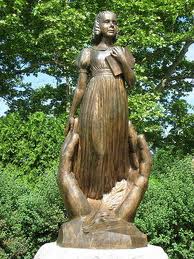
The original asylum was a gift of love and devotion from Mason Fitch Cogswell to his brilliant deaf and mute daughter Alice. Take Exit 48 of Asylum Street notoriety and you will almost immediately see a bronze statue of Alice Cogswell that sits at a fork in the road in which Asylum Avenue is to the right and Farmington Avenue is to the left.

Alice looks to be about eight years-old when her likeness was cast in bronze, the same age I was when I began to notice her. Two enormous cupped hands tenderly hold Alice, and she clutches a book to show everyone that dumb means mute, not stupid. As an adult I learned that the hands in which she stands—perfectly manicured hands that resembled my father’s—form the word “light” in sign language.

In many ways, now that I know this detail about those giant hands it make sense that Alice was such an illuminating landmark for me. She not only marked my comings and goings on the Asylum Avenue bus with my mother to and from Downtown Hartford, she marked the beginning and end of Sunday drives to my Bolton grandparents in New Haven. The forty mile trek felt interminable to me. But Alice was a touchstone. She limned crucial beginnings and endings in my childhood.

alicecogswell

Alice’s statue also stood near the stretch of Asylum Avenue where the houses were monied and pretty. On the bus ride west to 1735 Asylum, the Queen Anne homes closest to Alice gave way to larger brick homes that ended at Steele Road, the dividing line of wealth. West of Steele Road were boxy colonials and heavily mortgaged roofs; 1735 Asylum—a three bedroom colonial—among them. The house would be the only property my parents would ever own.

1735Asylum,JPG

When my parents and I moved into 1735, I was still an only child. Beige was everywhere you looked, except for the yellow straw wallpaper in the dining room and the deep lipstick-red shellac inside the kitchen cabinets. The previous owner’s neutrality was at odds with the passion and emotion that now rattled the house. My mother eventually redecorated the hallways, and the dining and living rooms in shades of green—the color of her pretty, translucent eyes.

Last week my sister, brother and I said goodbye to 1735 Asylum Avenue. The house was sold to a contractor who will take it down to its studs and rebuild it into something unrecognizable to us. But the truth of the matter is that these past couple of decades, 1735 Asylum was not the house in which we grew up. Like its proud matriarch, it had declined. Not beyond recognition, but to something else—a memory tinged by inevitable age and benign neglect.

When we were done cleaning out 1735, my sister Carol and I took pictures in front of the house, smiling the smiles of the brave, the weary and the sad. We walked through the rooms slowly, mournfully, as if following some sort of casket. “Do you mind if I say a Kaddish for the house,” I asked Carol.

She told me to say goodbye in my own way and in my own time. The Kaddish is a prayer of mourning that does not say a word about death. It’s all about praising God when one feels least inclined to do so. But there was a lot to thank God for even as we emptied our childhood home. On the way out of town I drove the Asylum Avenue bus route so I could say goodbye to my old friend Alice, still stalwart and serene in the hands of God.


A Deep Longing: An Interview with Michael Lowenthal, author of The Paternity Test

Michael Lowenthal’s fourth novel, [“The Paternity Test,”](http://lowenthal.etherweave.com/) is a beautifully told story that brings myriad social issues to the forefront, and also manages to be a literary page-turner.

Lowenthal’s work is hard to categorize. His first book, [“The Same Embrace,”](http://lowenthal.etherweave.com/the-same-embrace.html told the story of identical twins, one of whom became gay while the other became an Orthodox Jew. [“Avoidance”](http://lowenthal.etherweave.com/avoidance.html) explored the cloistered worlds of the Amish and the protagonist’s long-ago summer boys’ camp. [“Charity Girl”](http://lowenthal.etherweave.com/charity-girl.html) took up a little-known chapter of American history when women were incarcerated during the First World War in a government effort to contain venereal disease.

Versatility is a hallmark of Lowenthal’s work, as is the 43-year-old writer’s gift for language and depth of character. “The Paternity Test” gracefully merges gay marriage, Jewish identity, sexuality, the Holocaust, Jewish continuity and sexual fidelity in one story.

Pat Faunce and Stu Nadler have been together for a decade. Pat is a blue blood  (there’s a small street named after his family near Plymouth Rock) and a failed poet who earns his living by writing textbooks. Stu, a dashing airline pilot, is the son of a Holocaust survivor who, as Lowenthal recently described him in a conversation over coffee, “has a boy in every port. But their ‘no rules relationship’ is starting to wear on them. So in a 21st century twist on saving their ‘marriage,’ they decide to have a baby.”

The issue of Jewish continuity following the Holocaust further complicates the story. Stu’s sister, Rina, recently married Richard, a nice Jewish boy, but she cannot conceive. Meanwhile, Stu also feels the pressure of passing on the Nadler genes.

Lowenthal’s grandparents escaped the Holocaust just before deportations began in Germany. The grandson of a rabbi, has a multi-pronged answer when asked if he considers himself a Jewish writer. He said:

I was raised in a [Conservative] Jewish household, and three of my four novels prominently feature Jewish characters and Judaism-related plot elements, so yes, obviously, I’m a Jewish writer. I’m reminded of a remark by a gay writer when he was asked if there is such a thing as a gay sensibility, and, if so, what effect it has on the arts. He said, ‘No, there is no such thing as a gay sensibility, and yes, it has an immense impact on the arts.’ Maybe the same thing could be said of Jewish sensibility?

Stu and Pat’s search for a surrogate begins, as does an intense exploration of Jewish identity. After visiting various agencies and trolling surrogate sites on the Internet, they settle on Debora Cardozo Neuman. In Stu Nadler’s surprisingly traditional mindset, Jewish babies must be born to Jewish mothers and Debora fits the bill, albeit in an unusual way. A native of Brazil, she comes from a *converso*background — generations before her, Jews practiced Catholicism outwardly yet clung to their Judaism. Now Deborah follows a set of quirky habits and mysterious dietary restrictions until the community uncovers its Jewish roots.

While Stu is taken with Debora’s story, Lowenthal raises the stakes: Rina and Richard adopt, which causes Richard to lose himself in the “minutiae of Judaism. Richard pays attention to legalistic questions that shouldn’t trump choosing to raise a child in a Jewish home. For him it’s not enough. It’s better if the child is converted shortly after birth to avoid the possibility of having a *mamzer*.”

A *mamzer* is a child considered to be illegitimate if born to a woman who has conceived a child outside of her marriage. Like the plight of the *aguna* — a woman who is legally stranded in a marriage because a husband refuses to grant her a Jewish divorce or a *get* — *mamzerim* have no control over their fate or their standing in the community. While liberal branches of Judaism have done away with the *mamzer*status, Richard adheres to ultra-Orthodox tradition and in the process destroys his marriage.

“The book,” says Lowenthal, “is so much about looking from the outside with regard to parenthood, family, sexuality and Judaism. Sexuality is also very fluid in the book, which takes on an intimate situation. But intimacy is so much more important than gender and sexuality.”

Place is also important to Lowenthal. Pat and Stu relocate to a house on Cape Cod very similar to the one in which Lowenthal spent his summers. His Portuguese sounds flawless to this Spanish speaker’s ear as I ask him about the word *saudade* — a word that Debora uses when describing Pat and Stu’s need for a child.

“*Saudade* describes a deep longing for something that can never be recaptured,” he explained. “It’s about the immigrant who can’t return to his homeland because so much has changed. It’s the fantasy of family — the mythical idea of who they are.”

There’s no question that a feeling of *saudade* permeates “The Paternity Test.”Each character has his or her own *saudade* in longing for a baby. And their complex desires irrevocably change life for Stu, Pat and Debora in ways they could never imagine.

When Bad Things Happen to Good Kids

A day on which a life changes forever always begins as ordinary – so ordinary that thereafter, daily life is a deliberate celebration.

Carolyn Roy-Bornstein writes about an ordinary day gone awry in her new memoir “Crash: A Mother, a Son, and the Journey from Grief to Gratitude.” In her engrossing narrative, Bornstein divides her life “into two unequal parts. A line, like a crack in the glass, which carves time and events into two: those that occurred before the crash and those that tumble and falter in its wake. There is the one moment after which nothing is the same. It occurs in a heartbeat.”


And so begins Roy-Bornstein’s extraordinary account of the minutes, hours and days following her son Neil’s accident with a teenage drunken driver. On the night of Jan. 7, 2003, 17-year-old Neil and his girlfriend, Trista, set off on foot for the short walk between his house and Trista’s. The driver who ran down the two of them sped away from the scene. Neil survived the accident. Trista did not. Nine years later Roy- Bornstein garnered enough perspective to tell the story of the accident that changed her family’s life with humanity and love.

Roy-Bornstein, a pediatrician practicing on Boston’s North Shore, demonstrates her gifts as a writer as she unfurls one of the illuminating quotes that introduce the book: “We must embrace pain and burn it for fuel for our journey.” In a recent interview with the Jewish Advocate, Roy-Bernstein pointed out that she and her family burned gallons of emotional fuel, particularly during the immediate aftermath when “[t]here was something called temporal lobe agitation,” said Roy-Bornstein, “which occurs in many brain-injured patients where they can become very disinhibited, very irritable and act in ways that are totally not like them.”

Neil, a shy and contemplative young man, uncharacteristically lashes out at his mother as both his parent and a doctor. This brings the reader to a poignant quote that gets to the heart of Roy-Bornstein’s story: “No amount of doctoring can prepare you for being a patient.”

She elaborates that “even though I knew it was [Neil’s] injury talking, that was very painful to go through. Months later I found him reading my diary at the dining room table. Before I could decide whether to ask him to stop or let him continue, he looked up at me and said, ‘I’m sorry I yelled at you in the hospital, Mom.’”

Roy-Bornstein’s memoir makes it very clear that first and foremost, she is a mother to Neil and her older son, Dan. And she tilts at windmills during her encounters with the healthcare system. Her frustrations are memorably dramatized in a chapter titled “He’s Gonna Be Just Fine.” Roy-Bornstein recalls, “When we were in the ER at the Brigham and Women’s Hospital, we were told by the emergency room physician that Neil was ‘gonna be just fine.’ But that has not been our experience. Almost 10 years later he still sees a therapist, suffers from anxiety and has petitioned the disabilities office at his graduate school program for a distraction free environment for test taking.”

Roy-Bornstein notes that even as a physician she was unaware of the subtle long-term effects of traumatic brain injury (TBI). After Neil’s accident, she educated herself about TBI and over the years has become a de facto ambassador for the Traumatic Brain Injury Association of Massachusetts. Her role includes educating other health care professionals as well as the general public about TBI. Roy-Bornstein’s advocacy on behalf of TBI patients and their families also extends to education about concussions: “I’m trying to get the word out about concussion and its long-term effects on kids. In July of 2010, Massachusetts instituted new guidelines for public, middle and high school students that require coaches who suspect a concussion in their student-athlete to sit them out for the rest of the game or practice. We’re trying to change the culture in youth sports and the old mantra of ‘If you can walk, you can play’ to ‘When in doubt, sit them out.’” Roy-Bornstein has shared her expertise on the subject on WBUR’s “Radio Boston” and on the lecture circuit where she educates healthcare professionals and social workers about concussion and traumatic brain injury. “It’s become my passion,” she says.

Roy-Bornstein’s passions also include advocating for victim’s rights and health issues related to teens and drinking.

“When the accident occurred there was a lot of chatter in the media about under-aged drinking and drunk[en] driving,” she notes. “A vocal minority of parents stuck by their practice of letting their teens and their friends drink in their home, believing that they were keeping them safe by taking away their keys. But even if kids aren’t drunk[en] driving they’re still drunk.”

And as Roy-Bernstein knows all too well, “Bad things happen to good kids and drunk[en] kids.”

My Grandmother’ Tallit

It’s been five years since my daughter Anna had her bat mitzvah. In her bat mitzvah state of mind she had read trope cues as easily as ABC’s. She teased out meaning from her Torah portion, which recorded the life and death of Sarah. And she wore a tallit or a prayer shawl she picked out in Jerusalem. I’ve never felt any of the rituals my husband and I gifted her were truly mine, but my daughter didn’t think twice about accepting them. Her Bat Mitzvah was as much about her rights as a Jewish woman as it was her rite of passage.

When I look at Anna’s tallit—pink and silk and uniquely hers—I think of my grandmother whom I called Abuela. Abuela was born in Greece at the dawn of the 20th century and went to a school there funded by the Rothschilds. She learned the minimum Hebrew to recite the blessings over the Sabbath candles and did needlepoint to fill in the rest of her life. Family lore claims that she and her siblings made their way to Cuba after Greek soldiers kidnapped her sister and held her for ransom. Her father and brothers delivered the ransom on horseback and when the exchange was complete, there was just enough money left for passage to Havana. Abuela was a young teenager when she arrived in Havana.

Even in Cuba, nobody wielded a needle and thread like my Abuela. With deft rhythm and mesmerizing patterns, she conveyed a life story of painstaking work and imposed silence. Abuela sewed late into the night to make ends meet. She made my mother and my aunt frilly dresses between the sewing jobs she took in from neighbors. Abuela also crocheted her husband and her son’s tallitot—prayer shawls—for which she carefully tied the ritual fringes with sore fingers.

In America Abuela fashioned a kind of tallit for herself when she pulled the wool shawl she wore year round closer to her chest. In her small apartment she sat in a chair with stuffing peeking out of its arm that she was too tired to mend. The few times a year that she ventured to a synagogue, she stood when the ark was opened and blew kisses toward the bimah or altar as if greeting a lover. In a hoarse voice she muttered the Kaddish or the Mourner’s Prayer with her hand firmly on my shoulder so that I could not stand up and tempt fate.

When I was twelve my mother lugged a reel-to-reel tape recorder home, which she borrowed from the high school where she taught Spanish. She had planned to record Spanish lessons for the kids that she tutored on the side. But I quickly seized the recorder. The microphone that came with the machine transformed me into a roving reporter. I walked around the house inventing news about my mundane summer days.

Abuela spent most of that summer sitting on our porch, staring through the slats of the new jalousie windows. I felt that I was doing something important when Abuela intently watched me playing with the reel-to-reel. And then one day I got the idea to interview her. “Talk about anything,” I told her. Recipes, sewing, childhood stories. But mostly I wanted her to sing again. When she was a young girl she played the lute and sang Ladino songs in a lilting soprano. Her father forbade her to sing when she turned twelve.

My grandfather, Abuelo, was more than willing to take Abuela’s turn at the tape recorder. He held the microphone like a preacher and told me a story from when he was a boy in Turkey. On his way to school he witnessed a Turko soldier stab an Armenian man to death. His family left for Cuba a week later. “Why Cuba?” I asked him. Spanish was easier to learn than English for a Ladino speaker.

The next day Abuelo came back for another recording session dressed for prayer. He wound the straps of his tefillin around his left arm and placed the leather boxes on his forehead in the crook of his left arm. At twelve, I was approaching bat mitzvah age yet had no hope of winding leather straps of my own tefillin around my arm. Abuelo wore a tallit that he snagged from a local synagogue—he had to leave the one that Abuela made him with the rest of his possessions in Cuba. He sang the shacharit—as if offering that morning liturgy as his personal history. His voice started off as wobbly as the plastic reels spooling the shiny brown ribbon of tape.

His voice was stronger after he gathered the tzitzit or fringes of his tallit to recite the Sh’ma—Judaism’s central prayer. Eyes closed. Voice pleading. I joined him at the microphone. It was thrilling to sing about listening for and loving God with all of my heart and my soul and my strength. In that moment I blurted out that I wanted to be a rabbi.

Abuelo stopped singing and the only thing audible was the squeaking of the reel-to-reel tape recorder, making me cringe as if I heard nails scratching a blackboard. He dropped his tzitzit and said, “Eso es muy feo”—that is so ugly. Abuela looked up.

Turko,” she screamed at Abuelo as if he had stabbed me. Finding her voice, she said to me, “You can be anything you want.”

A few years ago Anna had a towel draped around her shoulders. She had been drying her hair. “Look Mom, my tallit,” she joked. I wished I had recorded the moment in memory of my Abuela, in honor of the future. But more importantly, I wished that Abuela could have seen her great-granddaughter happily wearing her tallit and celebrating her coming-of-age by reading from the Torah about every woman’s life.

You Are Not a Test Score: Some Advice for the College Applicant

With much anticipation and a shot of dread, it’s time for some families of high school juniors and seniors to enter the college sweepstakes. Once a kid is knee-deep into her junior year of high school, the mostly self-imposed requirements to apply to colleges come fast and furious: SATs, SAT tutoring, subject test tutoring. AP classes, exams – midterms and finals. Everything is magnified in search of the Holy Grail at the end of sending out college applications—acceptance to a school you actually want to attend or bragging rights to the kinds of schools that accepted you.

Applying to college in rarefied circles—solid to upper middle class—is a virtual blood sport. The grueling psychological competition is explicitly and humorously laid out in a book I really liked called Crazy U: One Dad’s Crash Course in Getting His Kid into College. The author, Andrew Ferguson, is a self-deprecating realist who manages to poke fun at, as well as take seriously, the business of shepherding your child to the threshold of his college dorm.

The fact is that 70% of high school seniors in the United States will go to college. Most of those seniors will not have cured cancer, written an opera or started a Fortune 500 business by the time they apply. They’ll be just like the zillion other candidates they’re up against at Fancy U. But bear in mind that 80% of college kids will happily matriculate at non-selective colleges—schools that offer automatic acceptance if you meet the minimum requirements. As my father used to say, “You can get a great education anywhere.”

The rest of us well-meaning parents will shell out thousands of dollars for at least one of the following: SAT tutoring, regular subject tutoring, college coaching and application preparation. Here’s how it works at one extreme: An application boot camp can cost $14,000 for four days of marathon essay writing and interviewing strategies. If you’re willing to empty out your 401K you can hire a private counseling service. The Cadillac of private college coaching can run up to $40,000.

SAT tutors in the Boston area can charge up to $200.00 an hour to prep a kid for “the test.” I’m glad I don’t live in the New York metropolitan area. SAT tutors in the Big Apple charge up to $425.00 an hour. In a New York Times article reporting on the fierce competition for perfect grades in high school, an anonymous parent at a tony private school in New York admitted to paying up to six figures in a given year for extra help in regular school subjects. That doesn’t count the steep tuition she already pays. I think my husband may be sitting on a pot of gold. Over the years he has saved us a bundle by tutoring our children in everything from calculus to biology.

Ferguson is at his wryest when he talks about the kitchen people—the folks who gather in the kitchen at a party to share war stories about their kids applying to college. In these clandestine conversations a parent would rather reveal the annual family income than her child’s SAT scores or GPA. Speaking of SATs—this is a test originally administered after the First World War to veterans with college aspirations. Somewhere along the line the SATs garnered the power to make or break a college career.

I could go on about the U.S. News and World Report college rankings. This is the list that admissions offices love to vilify yet secretly pray for a top 20 spot. There’s the college essay, which demands an epiphany so wise, so rare, that most 17-year olds simply don’t have the emotional maturity to have earned it.

Overwhelmed yet?

In the spring of junior year, usually with a guidance counselor and with grudging parental input, a student creates “the list” of schools to which she might apply. The list is usually a mix of colleges for which a kid is a leading candidate and schools that are designated as “a stretch.” As a parent you may look at up the admission statistics for your alma mater and shake your head in wonder at how you ever got into college.

At the core of every college application, job interview or personal relationship is the fear of vulnerability. Yet it’s vulnerability that gives us courage and compassion. Vulnerability begets connection; it keeps us honest. Vulnerability is important to show whether it be in the college essay or the alumni interview. Be human. You are multi-dimensional. And yes, you are not a test score.

I can remember Anna telling me that she didn’t need a campus full of valedictorians to feel academically fulfilled. During the process she was also also wise enough to demonstrate to her mother that lists, whether it the US News & World Report or the college lists she generated–should be used sparingly and mostly for things like groceries.


My Nest

Here’s a joke that I recently heard. An optimist sees the glass half-full. A pessimist sees the glass half-empty. An opportunist drinks the water. Not all that coincidentally, these describe the various emotional states of my half-occupied nest. Sometimes it’s half-full; sometimes it’s half-empty. Although there is more time and space in my house since Anna left for college, I’m still shocked that she packed up and moved away a five hour drive from me. Bearing in mind that our daughter wakes up every day almost 300 miles away, here’s a very short list of what’s changed at my house.

The bedroom. Be careful what you wish for because it may come true. Before she left for school, we blasted Anna’s room, clearing over eight years of detritus. We were sorting stuff that dated all the way back to 4th grade. There was that book project Anna couldn’t part with or that oh so pretty party dress that she wore on the bar mitzvah circuit six years ago! Six years ago?! Mind-boggling. In fact, Parents’ Weekend at Anna’s school falls on the fifth anniversary of her Bat Mitzvah. The quiet, clean bedroom matches the quiet, sort of clean house. I don’t mean to say that Anna is loud. But there is a liveliness, a spirit of wonder and a megawatt smile that she brings into a room. And with her departure for college, I’m now the only girl in the house. Even the dog is a boy and like the men in this house he could care less about the fabulous sweaters and pocketbooks that I find on sale.

The car. Anna never made the deadline we gave her for getting her driver’s license. Even her learner’s permit has expired. This means that Anna needed rides early and often. The longest ride we had together was between her school and Adam’s. I’ll admit I was almost always grumpy about the prospect of driving 15 miles in traffic between schools. But my annoyance evaporated when Anna got in the car and we had a half-hour to ourselves. We put the time to good use. We’d talk about the books she was reading, the people she was hanging out with, the latest doings at Student Council. The car ride was the teenage equivalent of lying down with her before she fell asleep. When she was a little girl that was the time that I learned what was near and dear to her heart, or conversely, what broke her heart.

Mealtime. Anna’s acute dairy allergy shaped who she was and, consequently, who we became as a family. Over the years Ken and I worked to help her advocate for herself at a birthday party or a restaurant. It turns out that Anna’s allergy also informed our Judaism. Since we had such little dairy in our house and we had made the commitment to send our kids to Jewish day school, it was not such a big leap for us to start keeping kosher. At first, we practiced keeping kosher using our non-kosher dishes. That is to say, we didn’t buy new plates or get a second set of plates to separate meat from dairy more fully. The fully stocked kosher kitchen was a natural outcome of our kitchen remodel. Everything was new including a dishwasher with two drawers—one for meat and one for milk. Nevertheless, we mainly lived a meat and pareve existence. When Anna left for college, I was sure that we would have a dairy fest every night in the house. I’ll admit that for the first couple of weeks we went wild and crazy with cheese tortellini and traded some of our Mother’s pareve margarine for a tub of butter. But it wasn’t as fun as we thought it would be. There was something disloyal about indulging in all that dairy and so barely realizing it we went back to our pareve life.

The brother. In many ways, Anna’s departure has been hardest on Adam. When it became clear that Anna was indeed going to college he got downright depressed at the thought of being the only child at home. He’d mumble under his breath, “I can’t believe I’m going to be stuck with those two. “ Those two, in case you haven’t figured it out, are Ken and me. I tried not to be insulted and chalked up his rudeness to anticipatory anxiety. It’s been six weeks since Anna settled into a dorm room with posters of Coldplay and the Beatles, and Adam still can’t believe he’s stuck with the two of us. I thought he’d be thrilled to be picked up on time and have unfettered access to parmesan cheese. It turns out he was just making noise about those things. He’d rather have Anna home.

When it’s all said and done, this half-empty nest, or depending on a given day, half- full nest, is ultimately emotional limbo. I’m not exactly pushing Adam out the door, but I’m kind of curious about what being an opportunist feels like.