Recognizing Signs of Abusive Dating Among Teenagers by Judy Bolton-Fasman

I wish February had been Teen Dating Violence Awareness Month when I was growing up. I might have realized that in the era before e-mails or cellphones, my boyfriend’s demand that we speak on the telephone every night was unreasonable. I was in college and my life revolved around those phone calls.

At 18, I thought his behavior demonstrated intense love for me. Young and inexperienced, it never occurred to me that he wanted to control me. In my mind, this was love and love always hurts, doesn’t it? All I had to do was listen to a pop song or watch a soap opera to see that a love worth having was often portrayed as painful, or at the very least, something mostly difficult to endure.

To read the rest of this post please click on : http://parenting.blogs.nytimes.com/2013/02/15/recognizing-signs-of-abusive-dating-among-teenagers/#more-43701

Parenting the Ritalin Generation: An Interview with Bronwen Hruska by Judy Bolton-Fasman

Bronwen Hruska gained national prominence last August as a mother and activist when she published an opinion piece in The New York Times called “Raising the Ritalin Generation.”

BronwenHruska
The piece was a clarion call to parents to closely assess the accuracy of a child’s Attention Deficit Disorder (ADD) or Attention Deficit Hyperactivity Disorder (ADHD) diagnosis. Hruska outlined her own son’s tumultuous journey when he was misdiagnosed with ADD at the age of 8. Two years later, Hruska and her son decided that the treatment was not only unnecessary, but had also been unwarranted. Hruska, the publisher of SoHo Press, recently published her first novel, “Accelerated,” through Pegasus Publishers. Part thriller and part social commentary, “Accelerated” is a brilliant, complex story about the consequences of over-diagnosing children with ADD and ADHD.
Q: There have been a number of articles, including your own, written about ADD and ADHD. Why do you think there’s an increase in interest?

A: With diagnoses of ADHD increasing 5.5 percent every year in this country, I believe we’re finally at a tipping point. As of 2010, 5.2 million children had been diagnosed with the neurological disorder. If that’s not an epidemic, I’m not sure what is. And I don’t believe that the increase in diagnoses has anything to do with a decreased attentiveness of children overall. There was an article in The Atlantic earlier this year that cited a study by a team of Penn State psychologists in The Journal of Attention Disorders that stated, “Children are no more or less inattentive and impulsive today than in 1983.” But schools and doctors routinely recommend medication for “Inattentive-type ADHD,” which means simply that in distracting situations, such as school, these children find it more difficult to focus. And with more and more children being medicated to help them succeed academically (as opposed to help manage the symptoms of the disorder), more children are at risk of suffering from the real and often scary side effects of the psychotropic medication that has been downplayed by the medical community as “safe.”

“Accelerated” examines the consequences of over-diagnosing children with ADD and ADHD. As medicating kids becomes more and more common, so does the general sentiment that if your child isn’t on medication, he or she is at a disadvantage. It’s the same mentality that created the phenomenon of “juicing” in athletics. We’re ratcheting up the level of competition in school with performanceenhancing drugs.

Accelerated

Q: “Accelerated” is told from a dad’s point of view. Would it have been a different book if the protagonist had been a single mother?

A: I wanted Sean Benning to feel very outside of the Manhattan private school community where his son Toby goes to school. Not only did Sean grow up in Troy, N.Y., but he’s also one of the only fathers in the estrogen-heavy circle of mothers that make up the vast majority of parents responsible for drop-off and pickup at The Bradley School. Without a community of parents to share information with, Sean feels even more at sea when the school strongly suggests that “a little bit of medication could turn everything around for Toby.”

Q: Third grade seems to be the time kids (especially boys like fictional Toby and your own son) are diagnosed with ADD. Why the zealousness? Is it warranted?

A: Schools tend to crank up the scrutiny in 3rd grade. As a parent, I was grateful that teachers were paying attention, making sure nothing fell through the cracks. But in their zealousness I worry that teachers are so determined to find something, anything, that they often err on the side of overkill. Don’t forget, 3rd grade is also the time when children are expected to sit still for longer periods of time, transition quietly between classes and cut the silliness. And the truth of the matter is that some children (especially boys) at 8, 9 and 10, who are perfectly within the developmental norm, still find this challenging.

It’s important to understand that Attention Deficit has become the go-to diagnosis. Sanford Newmark wrote in The Wall Street Journal this fall that many doctors making the diagnoses aren’t distinguishing between normal developmental immaturity and ADHD. These misdiagnoses could account for as many as 20 percent of the current ADHD diagnoses in the U.S., or about 900,000 children.

That said, for kids who do suffer from Attention Deficit, medication could truly turn things around for them. One adult, who was diagnosed late in life, told me that as soon as he took that first pill, the white noise in his head (a noise he’d never even noticed) turned off and he was finally able to complete projects he started, including reading books. It changed his whole life, and he wished he’d been diagnosed as a child. My worry is that kids who are simply not ready for the expectations of accelerated curricula are being diagnosed with a disorder. The flipside, of course, is that in poorly funded regions, children are being medicated so they can succeed within a broken school system with too few teachers.

Q: I read that boys are being treated like “defective girls” with regard to diagnosing ADD and ADHD. Do you think this has some validity or is it just an inflammatory statement?

A: Just look at the statistics. Boys are 2.8 times more likely to be diagnosed with ADHD than girls. If 13.2 percent of all boys have been diagnosed with the disorder (as opposed to 5.6 percent of girls), I’d say that we need to determine what the barometer for “normal” is. In “The War Against Boys,” Christina Hoff Sommers looks at how the education system was overhauled in the wake of Carol Gilligan to accommodate the specific learning styles of girls and as a result has left boys in the dirt. I think that schools now do value traits that are more traditionally female, and leave little room for the very normal (and different) developmental style of boys.

Q: Medication doesn’t carry as much of a stigma as it used to. Are we changing the way children develop with so many ADD and ADHD diagnoses?

A: I want to be careful because, again, I believe that for kids who do suffer from ADD and ADHD, medication can actually help them to develop on a level playing field with kids who don’t suffer from it. But when so many kids are taking medication to enhance their academic performance, it really does send a powerful message to an entire generation. We’re teaching our kids that challenges should be met and problems solved by swallowing a pill.

Too often, due to extreme pressure from an accelerated society that demands everything be better, faster and more impressive, kids aren’t being allowed to do the hard work of growing up, getting organized and learning what’s expected of them. Also, if a young child is put on medication and it’s deemed to be “working,” parents are loathe to take them off of it, and as a result will never know whether their child has “outgrown” the attention issues. Instead, dosages continue to be raised as the child grows, and soon kids are selling their prescription medication as study drugs in college where Ritalin and Adderall and other focus drugs are as commonly used the way No Doze was used when I was in college.

Q: How does your novel help parents grappling with the decision to give their kids Ritalin or even to seek out help?

A: The reason I started the novel was to explore the impossible position in which so many parents find themselves – deciding whether or not to medicate. When my son’s 3rd-grade teacher suggested we get him evaluated, it was a no-brainer. Of course, I wanted to catch anything that might be an issue. Of course, I’d trust the school if they thought there was a problem, and I’d trust the doctor who did the evaluation. But there’s a moment when, as a parent, you’re torn between your gut and the experts. There is both too little information out there and too much (if you’re looking on the Internet). You don’t know who or what to trust, and parents aren’t talking about it. There’s this feeling of being alone at sea – you feel like your child is the only one going through this.

As I started researching the topic for my novel, I realized that there were approximately 10.5 million parents having to make this very same decision. I thought it was crazy that no one was talking about it, sharing information, anecdotes, research. Simply knowing how many kids were getting this diagnosis made me think about my son’s diagnoses differently.

I’m hoping that parents read “Accelerated” and continue the dialogue. Whether they like what it has to say or hate it, I want people to tell each other their stories. Just talk. It’s a powerful thing.

A Letter to Anna: Balancing Work & Life by Judy Bolton-Fasman

Dear Anna,

I watch you carry on with your dream of going to medical school and I’m already worried about the work-life balance issues you will inevitably face. Having a profession will present you with a unique set of challenges that men don’t encounter. We are socialized to be the family’s primary caregiver; men are ingrained to be the breadwinner. It’s changing, but it’s changing too slowly.

stethescope

Maybe I’ve come late to the party, but a book by local author Michelle Cove and an article by law professor Anne-Marie Slaughter have me reaching deeply into my own life. Let me start by saying that I want more for you. It’s not that I don’t have enough or I haven’t made a successful go of my writing career. But my earnings don’t reflect the hours and the keen effort that I put into my work. While that’s been a source of frustration for me, on the flipside I have control over my schedule. I can run an errand or stay home with a sick kid. But if I do that, you can be sure that I’m working after dinner to make up the time.

Slaughter was a high government official in the Obama administration who decided to return to her teaching position at Princeton after two years. Her son was in the midst of a rocky adolescence and Slaughter went home to spend more time with her family. She published an article last July in The Atlantic called Why Women Still Can’t Have It All. At first glance that title is very provocative. But that’s not why I resisted giving the article a close read. I was scared to hold myself up to this super woman who worked closely with Hillary Clinton and then returned to a tenured position at Princeton University. Until she went to Washington she was Dean of the Woodrow Wilson School at Princeton. Slaughter and I are not in the same league. But I read on and I found some comfort. “There are genuine super women,” Slaughter writes. “These women cannot possibly be the standard against which even very talented professional women should measure themselves. Such a standard sets up most women for a sense of failure.”

Let me back up and mention that I read Slaughter’s article after I read Cove’s book, “I Love Mondays.” It’s a unique book for the way it crosses genres as both a handy reference guide and a practical self-help book for working mothers. Subjects range from how a mom should minimize her guilt if she misses a soccer game to moms, like me, who have home offices and must establish strict boundaries. In a recent interview, Cove agrees with Slaughter that having it all is “completely unachievable. It’s not a sustainable state. Power constantly shifts and we need to be much gentler on ourselves.”

Anna, I think the generation between us is dealing more realistically with the work-life balance than my peers or I have. Slaughter quotes a pair of 30 year-old women who realize the importance of linking together every aspect of their lives. I quote them through Slaughter because I want you to hear their bluntness.

If we didn’t start to learn how to integrate our personal, social, and professional lives, we were about five years away from morphing into the angry woman on the other side of the mahogany desk who questions her staff’s work ethic after standard 12-hour workdays, before heading home to eat moo shoo pork in her lonely apartment.

This scenario begs a question you’ll have to grapple with someday—“finding the right sequence of family and career.” When do you marry? When do you have a baby? Slaughter and Cove agree that there is no definitive answer.

Cove has been thinking about these issues for a long time and her book was a natural successor to her documentary “Seeking Happily Ever After.” The film was a retort to media representations of 30-something women who were either career obsessed or so desperate to get married that they were driving men away. Cove notes, “As a journalist and a writer I was interested in why the headlines were proclaiming there were more single 30-something women than ever. I picked up a video camera and did street interviews.” The big take away for you, my dear Anna, is to know that women can define their own “happily ever afters.”

I have faith that your generation will finally tease apart the false morality and promises of “family values.” That by speaking up about implementing family-friendly policies in this country and acknowledging the importance of work-life balance, you and other women will close in on the “leadership gap” in the White House, the corridors of multinationals and yes, even the home.

As for me, I’m starting to understand my choices as part of “the new gender gap”—that is, measuring my success by my wellbeing rather than a paycheck. Maybe I’m not too late to take advice myself. In fact, I think I read Anne-Marie Slaughter’s article and Michelle Cove’s new book just in the nick of time.

Love,

Mama


*Dreaming in Cuban by Judy Bolton-Fasman

Dear Mamá:

You came to the United States in 1958, a year before the revolution. Havana is an aerosoled city—Viva la Revolucion 54 is spray painted everywhere. It’s been fifty-four years since Castro came down from the Sierra Maestra Mountains and triumphantly marched into Havana on New Year’s Day. You once waved the Cuban flag for him. He was going to change Cuba for the better. Maybe he did for some people. But in the end your family fled along with 90% of the country’s middle class. You like to say that your mother packed a small bag and closed the door on forty years of her life at Calle Merced 20.

Calle Merced #20

Calle Merced #20

Calle Merced was a storied address in my childhood. It was Never Never Land, the place of your eternal youth. When I finally saw it a few weeks ago, the heavy wooden door you described was still there and I recognized the balcony from pictures you had shown me. You lived in Old Havana. But that too was consigned to fantasy. There were no marble steps that a maid had shined in your apartment. You lived simply on one floor, with a courtyard between the dining room and kitchen. Sometimes your mother brought home a live chicken and called the shochet – the kosher butcher – to slaughter it for the Sabbath meal. I imagine he did it right there in that open area between cooking and eating.

When I think of what is now our Havana, I envision the laundry on the balconies hanging like team pennants. But we are no longer divided into them and us. The people of Cuba hope and dream and cry with you for your country. How often did I hear you say in one long sigh – Hay Cuba como to estrano. I didn’t realize how much I missed Cuba too until I went there.

I saw the synagogue where you grew up. Women in the balcony, men gathered around a raised bima. I also went to the Patronato where you dreamed of being married before Castro took over the country. Your schoolmate Adela Dworin stayed in Cuba. She said that to be a revolutionary before the age of 40 is about passion. After 40 it seems like a foolhardy decision. Adela’s parents, who emigrated from Russia in the 1920s, stayed in Cuba because she was committed to the new socialism and they couldn’t bear another exile. Adela remembers you. Your old classmate is now the head of Cuba’s Jewish Community, much honored by Hadassah and others for her work with the country’s 1500 Jews.

There were only 11,000 Jews when you lived in Cuba, but you were a thriving community. Enough of you were committed to Judaism to fill five Ashkenazi and Sephardic synagogues. You had Hanukkah parties and Purim balls. That’s still happening, but the community is mostly growing through conversion and the number of functioning synagogues has dwindled to two. There’s an old joke that in the days when the revolution was in full bloom, a Cuban minyan consisted of nine people and a Torah.

A rabbi from Chile comes to Havana every six weeks to minister to the community. If someone is connected to a Jew, usually through marriage, they are encouraged to convert. This past Christmas over 70 people went into the warm ocean and immersed. When they came out they were Jews. There are over 140 children enrolled in the Albert Einstein Hebrew School. Some of those teachers are Jews by choice.

Havana is more beautiful than I had imagined. It’s in gorgeous ruins—an aging beauty queen who hasn’t lost her looks amid the rubble of benign neglect and abject poverty. The place is translucent with pastel colors and light. The outside of your house is a pretty light green. Green is your favorite color — the color of your eyes.

But the people are hungry. Rations are strict. The black market is darker than the Buena Noche, the Christmas Eve sky. People trade all kinds of things for an extra pound of meat or a cup of cooking oil.  Something as simple as a pair of jeans or sneakers that a relative in the States has brought gives a loved one a leg up in the barter system.

You should see the scene at the airport in Miami. Daily charters to Cuba all leave from the same place at Miami International and the check-in is transformed into a veritable marketplace. Cuban ex-pats going back for a visit have emptied Costco or Target or Best Buy, buying televisions, microwaves, bicycles, and air conditioners for their loved ones in Cuba. I saw my fair share of fishing reels too. That old chestnut of teaching a man to fish so he eats for life went through my mind like ticker tape.

God Bless America for all of her materialism and convenience.

“God Bless America,” that’s what my cab driver said in his fractured English as he drove me to the University of Havana. Aside from Calle Merced 20, that was the other place you wanted me to see. How you wish you could have studied at Alma Mater. Maybe you did or maybe you didn’t walk up its famous staircase.  You believed that you did, and that’s all that matters.

My cabbie leaned in close at a light and told me that from one Cuban to another, he was aburrido de esta vida. He prayed that his 30 year-old Russian Lada taxi would start each morning and that he’d catch enough fares to put food on the table for his kids. We both know that aburrido means so much more than just boredom. It’s a kind of lassitude mixed with the same Cuban melancholia I heard when you said how much you missed Cuba.

The driver had a mother-in-law in New Jersey who sent him money every once in a while. It helped more than I could imagine, he said. When I went to pay him he asked me if I had any medicine — aspirin, antacid, anything—that I could spare. He’d take it in lieu of a gratuity. I gave him a half-full bottle of Advil and a 30 percent tip. I had already donated all of the medicine I brought down to the pharmacy run by the Jewish community. The doctor who runs the operation has the same last name as your mother. “We’re all related,” she said jauntily.

Earlier in the day I had passed a state-run pharmacy where a woman beckoned me to come inside. I had an antibiotic prescription with me that I wasn’t going to use. Yes, she would take that, thank you, and did I also have pens to spare? I gave her what I had. She was about your age. Maybe you passed her on the street once upon a time.

“Tell your government we want to be friends again,” she said. “Tell your President Obama, embargo no.”

Aren’t you aburrida of the embargo too, Mamá?

Love,

Judy

*A version of this essay is forthcoming in the Jerusalem Report


After Newtown: Talking to Our Children by Judy Bolton-Fasman

I’ve passed the sign for Newtown, Connecticut hundreds of times. Just sixty miles northeast of New York City, Newtown is one letter away from my hometown of Newton. That near coincidence always made me smile. And now I cry because it is just one letter away from Newton. That’s how close this tragedy has been for all of us.

The Columbine murders were incomprehensible. And so were the murders at Virginia Tech and in a movie theatre in Aurora, Colorado. But Newtown was on a different scale of horror. A young man in black fatigues and armed to the teeth walked into Sandy Hook Elementary School and slaughtered an entire first grade class.

When did mass murder become the norm in this country?

We shake our heads and try to bring the victims closer to our hearts by piecing together their life stories, staring at their snapshots in the paper. Maybe we’ve stood together in synagogue and said the Kaddish for these fallen sisters and brothers. But it’s no longer good enough to memorialize their deaths. We have to acknowledge the overarching issue of gun control, and we can begin to do that by understanding gun control as a parenting issue.

Taking up gun control within the purview of parenting also connects us to the emotional and mental health of our young people. Maybe it starts with addressing bullying. Yes, we’ve made great strides in making students and parents aware of the deadly consequences of bullying—the suicides, the homicidal rages. I can’t help but think that we haven’t done enough. We’ve tried to legislate against bullying, but a lot of people still shrug it off as human nature or a natural part of childhood.

There has also been a lot written about helicopter parents—parents who constantly monitor their children’s social lives, their grades or their extracurricular activities. We’ve all been there and done that to some degree. Our focus gets blurred. If we step off the high-achiever’s treadmill for a moment, we may realize that our kids really need a good, old-fashioned, swim-in-a-lake camp instead of eight weeks of intensive math in the summer. Down time is highly underrated.

In the wake of the shootings in Newtown, a visibly shaken President Obama fought back tears and declared that Americans were “broken-hearted.” He said that the country must “come together and take meaningful action.” Yet his press secretary put off the subject of gun control that same day at a press conference. All I could think of was the famous quote from Rabbi Hillel who sagely noted, “if not now, when?”

In the meantime, we have to somehow reassure our children that they are safe. After the Virginia Tech shootings in 2007, the Child Study Center at New York University provided some good advice for parents and teachers. First and foremost open up the lines of communication. Don’t hesitate to talk about what happened in Newtown. If a child is able to read, chances are that he or she has also heard about the shootings. Between social media and television, it’s almost impossible to shield a child from the news.

Give a child context and perspective. This happened in one community, and although gun violence is out there, the chances are minimal that it will happen in her school too. Continue to reassure the child that he is safe and that you are doing everything you can to keep him safe. Make home a calm oasis. Of all the studies and advice that I read, NYU’s literature was unique in suggesting that parents encourage their children to look towards the future. Stick to goals and continue to make plans.

And there was almost unanimous agreement in all of the trauma literature that I saw to encourage children to give back. The American Academy of Pediatrics suggested that families find ways to help people. Make sympathy cards for the kids of Sandy Hook Elementary School. Find a child-centered charity and make a contribution. I liked a friend’s suggestion to call local restaurants in Newtown, give a credit card number, and donate a meal.

The Academy also suggested opening up a conversation by asking children how much they know about what happened in Newtown. Clarify a child’s question before answering. Is the child curious about issues surrounding the event such as how people obtain guns? Or is there something deeper, more personal going on like, “could this happen to me or someone I love?”

s-NEWTOWN-SCHOOL-SHOOTING-large

Conversations can be more nuanced with older kids. My teenagers have heard me call out falsehoods put out by the gun lobby like “guns don’t kill people, people kill people” or “more people are protected by guns than killed by them.” If that’s getting too political just look at the devastating image of the children walking single file out of the Sandy Hook Elementary School—eyes closed, hands on the shoulders of the child in front of them.

I’ll end with part of a prayer written by Rachel Barenblat, a rabbi and poet who writes a thoughtful blog called The Velveteen Rabbi.

Soothe the children who witnessed

things no child should see,

the teachers who tried to protect them

but couldn’t, the parents

who are torn apart with grief

who will never kiss their beloveds again.

A Deep Longing: An Interview with Michael Lowenthal, author of The Paternity Test

Michael Lowenthal’s fourth novel, [“The Paternity Test,”](http://lowenthal.etherweave.com/) is a beautifully told story that brings myriad social issues to the forefront, and also manages to be a literary page-turner.

Lowenthal’s work is hard to categorize. His first book, [“The Same Embrace,”](http://lowenthal.etherweave.com/the-same-embrace.html told the story of identical twins, one of whom became gay while the other became an Orthodox Jew. [“Avoidance”](http://lowenthal.etherweave.com/avoidance.html) explored the cloistered worlds of the Amish and the protagonist’s long-ago summer boys’ camp. [“Charity Girl”](http://lowenthal.etherweave.com/charity-girl.html) took up a little-known chapter of American history when women were incarcerated during the First World War in a government effort to contain venereal disease.

Versatility is a hallmark of Lowenthal’s work, as is the 43-year-old writer’s gift for language and depth of character. “The Paternity Test” gracefully merges gay marriage, Jewish identity, sexuality, the Holocaust, Jewish continuity and sexual fidelity in one story.

Pat Faunce and Stu Nadler have been together for a decade. Pat is a blue blood  (there’s a small street named after his family near Plymouth Rock) and a failed poet who earns his living by writing textbooks. Stu, a dashing airline pilot, is the son of a Holocaust survivor who, as Lowenthal recently described him in a conversation over coffee, “has a boy in every port. But their ‘no rules relationship’ is starting to wear on them. So in a 21st century twist on saving their ‘marriage,’ they decide to have a baby.”

The issue of Jewish continuity following the Holocaust further complicates the story. Stu’s sister, Rina, recently married Richard, a nice Jewish boy, but she cannot conceive. Meanwhile, Stu also feels the pressure of passing on the Nadler genes.

Lowenthal’s grandparents escaped the Holocaust just before deportations began in Germany. The grandson of a rabbi, has a multi-pronged answer when asked if he considers himself a Jewish writer. He said:

I was raised in a [Conservative] Jewish household, and three of my four novels prominently feature Jewish characters and Judaism-related plot elements, so yes, obviously, I’m a Jewish writer. I’m reminded of a remark by a gay writer when he was asked if there is such a thing as a gay sensibility, and, if so, what effect it has on the arts. He said, ‘No, there is no such thing as a gay sensibility, and yes, it has an immense impact on the arts.’ Maybe the same thing could be said of Jewish sensibility?

Stu and Pat’s search for a surrogate begins, as does an intense exploration of Jewish identity. After visiting various agencies and trolling surrogate sites on the Internet, they settle on Debora Cardozo Neuman. In Stu Nadler’s surprisingly traditional mindset, Jewish babies must be born to Jewish mothers and Debora fits the bill, albeit in an unusual way. A native of Brazil, she comes from a *converso*background — generations before her, Jews practiced Catholicism outwardly yet clung to their Judaism. Now Deborah follows a set of quirky habits and mysterious dietary restrictions until the community uncovers its Jewish roots.

While Stu is taken with Debora’s story, Lowenthal raises the stakes: Rina and Richard adopt, which causes Richard to lose himself in the “minutiae of Judaism. Richard pays attention to legalistic questions that shouldn’t trump choosing to raise a child in a Jewish home. For him it’s not enough. It’s better if the child is converted shortly after birth to avoid the possibility of having a *mamzer*.”

A *mamzer* is a child considered to be illegitimate if born to a woman who has conceived a child outside of her marriage. Like the plight of the *aguna* — a woman who is legally stranded in a marriage because a husband refuses to grant her a Jewish divorce or a *get* — *mamzerim* have no control over their fate or their standing in the community. While liberal branches of Judaism have done away with the *mamzer*status, Richard adheres to ultra-Orthodox tradition and in the process destroys his marriage.

“The book,” says Lowenthal, “is so much about looking from the outside with regard to parenthood, family, sexuality and Judaism. Sexuality is also very fluid in the book, which takes on an intimate situation. But intimacy is so much more important than gender and sexuality.”

Place is also important to Lowenthal. Pat and Stu relocate to a house on Cape Cod very similar to the one in which Lowenthal spent his summers. His Portuguese sounds flawless to this Spanish speaker’s ear as I ask him about the word *saudade* — a word that Debora uses when describing Pat and Stu’s need for a child.

“*Saudade* describes a deep longing for something that can never be recaptured,” he explained. “It’s about the immigrant who can’t return to his homeland because so much has changed. It’s the fantasy of family — the mythical idea of who they are.”

There’s no question that a feeling of *saudade* permeates “The Paternity Test.”Each character has his or her own *saudade* in longing for a baby. And their complex desires irrevocably change life for Stu, Pat and Debora in ways they could never imagine.

*My Grandmother’s Tallit – A Letter to Anna

Dear Anna:

It’s been five years since your bat mitzvah. In your bat mitzvah state of mind you read trope cues as easily as ABC’s. You teased out meaning from your Torah portion, which recorded the life and death of Sarah. And your wore a tallit or a prayer shawl you picked out in Jerusalem. If you had done any of these things at the Western Wall in Jerusalem the Israeli police might have arrested you and me, the mother who allowed you to commit such a crime.

I must confess to you my dear daughter that I’ve never felt that any of the rituals your Dad and I gifted you with were truly mine. But in light of Anat Hoffman’s recent arrest last week for wearing her tallit at the Wall, your Bat Mitzvah was as much a political statement as it was a rite of passage.

When I look at your tallit—pink and silk and uniquely yours—I think of my grandmother whom I called Abuela. Abuela was born in Greece at the dawn of the 20th century and went to a school there funded by the Rothschilds. She learned the minimum Hebrew to recite the blessings over the Sabbath candles and did needlepoint to fill in the rest of her life.

Nobody wielded a needle and thread like my Abuela. With deft rhythm and mesmerizing patterns, she conveyed a life story of painstaking work and imposed silence. After she arrived in Cuba, Abuela sewed late into the night to make ends meet. She made my mother and my aunt frilly dresses between the sewing jobs she took in from neighbors. Abuela also crocheted her husband and her son’s tallitot—prayer shawls—for which she carefully tied the ritual fringes with sore fingers.

In America Abuela fashioned a kind of tallit for herself when she pulled the wool shawl she wore year round closer to her chest. In her small apartment she sat in a chair with stuffing peeking out of its arm that she was too tired to mend. The few times a year that she ventured to a synagogue, she stood when the ark was opened and blew kisses toward the bimah or altar as if greeting a lover. In a hoarse voice she muttered the Kaddish or the Mourner’s Prayer with her hand firmly on my shoulder so that I could not stand up and tempt fate.

When I was twelve my mother lugged a reel-to-reel tape recorder home, which she borrowed from the high school where she taught Spanish. She had planned to record Spanish lessons for the kids that she tutored on the side. But I quickly seized the recorder. The microphone that came with the machine transformed me into a roving reporter. I walked around the house inventing news about my mundane summer days.

Abuela spent most of that summer sitting on our porch, staring through the slats of the new jalousie windows. I felt that I was doing something important in the way that she intently watched me playing with the reel-to-reel. And then one day I got the idea to interview her. “Talk about anything,” I told her. Recipes, sewing, childhood stories. But mostly I wanted her to sing again. When she was a young girl she played the lute and sang Ladino songs in a lilting soprano. Her father forbade her to sing when she turned twelve.


My grandfather, Abuelo, was more than willing to take Abuela’s turn at the tape recorder. He dressed for prayer, winding the straps of his tefillin around his left arm and placing the leather boxes on his forehead and in the crook of his left arm. Abuelo wore a tallit that he snagged from a local synagogue—he had to leave the one that Abuela made him with the rest of his possessions in Cuba. He sang the shacharit—as if offering that morning liturgy as his personal history. His voice started off as wobbly as the plastic reels spooling the shiny brown ribbon of tape.

His voice was stronger after he gathered the tzitzit or fringes of his tallit to recite the Sh’ma—Judaism’s central prayer. Eyes closed. Voice pleading. I joined him at the microphone. It was thrilling to sing about listening for and loving God with all of my heart and my soul and my strength. In that moment I blurted out that I wanted to be a rabbi.

Abuelo stopped singing and the only thing audible was the squeaking of the reel-to-reel tape recorder, making me cringe as if I heard nails scratching a blackboard. He dropped his tzitzit and said, “Eso es muy feo”—that is so ugly. Abuela looked up.

Suddenly, finding her voice, Abuela said to me, “You can be anything you want.” Abuela could have been anything she wanted too, only she wasn’t allowed to think that way. If she were born in a different time, she might have used her voice to defend Anat Hoffman.

I’m sure she would have been inspired by you as you happily wore your tallit and celebrated your coming-of-age by reading from the Torah about every woman’s life.

Love,

Mamma

*This piece was reconfigured as a letter to my daughter and published in the Jewish Advocate


How Children Succeed: An Interview with Paul Tough

Parenting books – love ’em or leave ’em. Most times, I leave them after perusing the table of contents. I don’t like the one-size-fits-all approach that so many of them take. But Paul Tough’s excellent new book, “How Children Succeed: Grit, Curiosity and the Hidden Power of Character,” rises to the top of the parenting book pile for its deep exploration of failure and the ways in which it builds character in our kids.

First a word about character. It’s as unique to each person as her DNA. Tough offers the revolutionary concept that character, unlike DNA, is not fixed or completely innate in a person. It is, in a word that recurs throughout “How Children Succeed,” malleable. I confess that I was initially very uncomfortable with the word malleable for its implication of weakness and undue influence. But read Tough’s book and you quickly learn that malleable is an asset.

Tough talked about character in a recent interview with [start ital.]The Advocate[end ital.], citing a chain of charter schools called KIPP and its dedicated founder David Levin. KIPP schools dole out report cards for academic performance and character assessment. “Dave is doing new and important work,” Tough said, adding:

“He has a new vision for character and it’s quite scientific in that he’s trying to figure out which character strengths make a difference in a kid’s success. And at the root of his research and thinking is the assertion that character is … a set of qualities that [enables] kids to change themselves and qualities that parents and teachers can instill.”

Tough presents living examples of low-income kids who have had the opportunity through mentoring programs, family members or discerning teachers to pause and look inward to shape and reshape their character. Kewauna Lerma was such a student. On the fast track to derailing her life, Kewauna did an about-face during her junior year of high school. She still lived at the poverty level on the South Side of Chicago, picking fights at school and struggling academically. But a spark was lighted inside of Kewauna through a mentoring program and encouragement from her mother and great-grandmother.

“Kewauna,” explained Tough, “became motivated to be a different person. It was very telling that she changed in that it came from her clear vision that she had of herself. That vision was further clarified in the program she was in as well as by her family.”

There is no question that kids mired in poverty have it tougher than children of affluence. But Tough admirably teases apart the hazards of having it too good without falling into the “poor little rich kid” syndrome.

For wisdom on the challenges faced by kids who seemingly have it all he turned to Dominic Randolph, headmaster of the tony Riverdale School in Riverdale, N.Y. – a well-off section of the Bronx. Randolph was initially the subject of a [start ital.]New York Times Magazine[end ital.]article that Tough wrote last fall. In that article, Tough explored Randolph’s claim that failure and character lead to academic success.

Advocating for failure is a radical step for a head of school where the majority of the class goes on to Ivy League and other highly competitive colleges. But that’s exactly what Randolph did when he came to Riverdale in 2009. Tough noted:

“[T]here is this way that certain high-pressure academic environments can stress kids out. They are on this treadmill versus climbing a mountain. At KIPP kids are climbing a mountain and it’s a bigger challenge than staying on that familiar treadmill. I think that’s why KIPP kids get out of college with more success and character. It’s the way you get on a life path, not the actual life path you end up on, and that makes all the difference.”

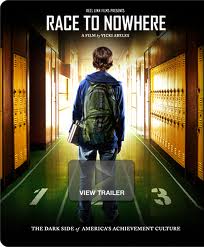
Tough points to the documentary “The Race to Nowhere” as a prime of example of affluence undoing kids. Vicky Abeles, the mother of three kids who were scorched by the heat of extreme academic competition, framed her film as a cautionary tale. I’m not a fan of the film because I think it’s slanted toward sensationalism. Tough thinks it’s a helpful example of the importance of establishing a good relationship with failure. “Affluent kids,” he said, “are in suspended animation throughout college without every hitting road bumps. Then they hit an obstacle in their 20s and they don’t have resources to deal with it.”

I think that Tough is on to something big here. We talked about post-college choices that kids who have graduated competitive colleges have made. He asserts that ironically their fear of failure steers them toward investment banking and management consulting jobs.

I wonder if our adult kids’ pervasive fear of failure hasn’t returned them to their childhood bedrooms, dissatisfied and unemployed. Yes, it’s a tough economy out there, but have we made them afraid to take chances, to bypass meaningful engagement and social justice opportunities?

Which brings me back to where I started. Perhaps character is not destiny, that it’s malleable enough to forge the kind of future that can fulfill our kids.

The Race to Nowhere

Vicki Abeles means well. She is a mother who wanted to give her three children all the advantages she never had as a child. As a result, she and her children weathered long school days followed by a daily onslaught of extracurricular activities. Sound familiar? But somewhere along the way her best intentions went awry and she realized that she and her children were running in, what she descriptively calls a “race to nowhere.”

Out of frustration, Abeles picked up a camera and made a movie, her first, about the never-ending marathon in which we have inadvertently sponsored our children. The resulting film, The Race to Nowhere, alternates between a cautionary tale and an overreaction to what happens when kids and parents are trapped by their own ambitions.

When it came out two years ago, Abeles’ film was screened in various upscale locations followed by question and answer periods. The high-achieving Boston suburbs where I live are the perfect laboratories to test Abeles’ theories. In the question and answer period I attended, a group of educators in the audience said how unfair it was to adjust their lesson plans simply for the sake of delivering high MCAS scores. “It is,” said one of the women, “like putting the cart before the horse.”

There are no surprises in Abeles’ film. Dedicated teachers are thwarted by school boards. One exemplary English teacher felt so beleaguered by the Oakland, California school system that she left teaching altogether. The woman openly wept on camera about leaving her students to fend for themselves in a mediocre school system.

The camera pans to a Stanford University freshman confessing that he regurgitated information for tests in high school only to be woefully unprepared for his freshman year of college. Then there are the befuddled parents and students who have no idea how to get off this exhausting treadmill. Fewer activities, an adjusted academic schedule? If only it were that easy.

In the middle of all this angst is a heart-breaking interview with a mother whose 13 year-old daughter Devon committed suicide after getting a bad grade on a math test. I think back to a column I wrote about Amy Chua, the original tiger mom, wouldn’t accept anything less than an A from her daughters. The Tiger Mother roars and her cubs fall into line. And yet I have to believe that it was more than poor test results that tragically sent Devon over the edge.

I worry about my children and the academic loads they carry. Anna was a three-season athlete in high school and often didn’t get to her homework until after dinner. Nothing annoyed her more than when I ask her how the homework situation is. She’d tell me the work is there and she would get through it no matter how long it took. Most nights I didn’t think she had an unreasonable amount of homework for a student as committed as she was. Yet I still fret about sleep-deprivation and the onslaught of emotional challenges she’s beginning to face as a college studentl.

Adam is no stranger to buckets of homework. His school prides itself on creating young men of character and discipline. Part of cultivating that persona is a full curriculum. For example, most nights he’ll be assigned up to 25 math problems. Although I hate homework as much as the next parent, I don’t think his assignments are busy work or aimed at “survival of the fittest.”

Sara Bennett is among those advocating education reform in Abeles’ film. She co-wrote a treatise with the self-explanatory title: The Case Against Homework. Like Abeles, she was a concerned parent who saw her children struggling against the overwhelming tide of worksheets and reading assignments in middle school.

According to Bennett’s research, a child needs to do only 5 math problems to catch on to a concept. Tell that to Amy Chua whose older daughter was once bested in a math competition. Chua’s solution was to have her daughter complete 200 (no there is not an extra zero) math problems a night for 10 days. That’s 2000 problems. That’s a lot of math. That’s a long race.

I wasn’t surprised to see Wendy Mogel make a cameo appearance to warn about the myriad ways our kids are stressed out. For Abeles and company, Mogel’s latest parenting book, The Blessings of a B-, is an island of calm in the madness of running after perfect SAT scores and padding resumes to resemble the CV of a Nobel prize-winner.

As parents we all too often walk that tenuous line between encouraging our children to be their best and demanding perfection from them. What goes loudly unsaid throughout the film is that entrants in the “race to nowhere” are more often than not socioeconomically privileged. All I can say in the face of these tense times is to hug your kids often. Set a realistic course that takes them towards a fulfilling, healthy future because the alternatives are too upsetting to contemplate.

The God of Our Foremothers–Why I am a Feminist Jew

I am a feminist Jew because I am the mother of a daughter and a son.

I am a feminist Jew because the God of my foremothers doesn’t recognize a caste system. When my G0d blessed Jacob’s children, he also blessed Jacob’s concubines, Bilhah and Zilpah. Yet it astounds that mentioning the God of my foremothers – the imahot – is still optional in the Conservative Jewish liturgy. To my mind, this sends a message that the imahot can be optional in the hearts and souls of our children.

I am a feminist Jew because I’m angry over the injustices too frequently lorded over Jewish women.

A few years ago, my children’s day school finally included the imahot in every prayer service. But it came after a struggle. The message that landed in my mailbox announced that in consultation with local Conservative rabbis, the school decided to include the imahot in the Amidah as standard practice. Amen. And yet the message felt perfunctory to me, as if our foremothers were shadowy figures. Had Abraham, Isaac and Jacob finally decided to share their God?

Perhaps lost in redaction, our foremothers are not mentioned as a group in the Bible, but thank goodness they star in many ancient and modern midrashim as role models and prophets.


I am a feminist Jew because Sarah was said to be a greater prophet than Abraham. She understood that God didn’t demand the sacrifice of her first-born son. During her pregnancy, Rebekah knew that she had two great nations inside of her, but that the fate of the Jewish people rested with her younger son. These women triumphed over infertility and infidelity (even when they sanctioned it). I am a feminist Jew because the imahot are summoned to help the Jewish people in times of distress. Rachel was buried at a strategic place on the road where she can hear the cries of her people in captivity. Her prayers uniquely move God on their behalf.

I am a feminist Jew because prayer is instinctively beautiful for Jewish women.

Prior to the modern debate over whether to include the imahot in the liturgy, women had the wisdom and clarity to call upon them in their own prayers throughout the centuries. The imahot are front and center in the techinot, prayers of Jewish women from medieval times through the 19th century.

I am a feminist Jew because our foremothers were called upon to help Jewish women express their deepest desires and most fervent hopes in both set and spontaneous prayer.

I am a feminist Jew because I can frequently call upon the God of my foremothers. God of Sarah, hear my prayers to keep my children safe in planes, trains, automobiles and all manner of place and time. God of Rebekah, help me to recognize perilous situations. God of Rachel, help me guide my children through disappointment and desperation. God of Leah, comfort me when someone doesn’t love my children the way they deserve to be cherished.

I am a feminist Jew because the G0d of Bilhah and Zilpah brings women to the foreground where they belong.

Some sources – the sources that shaped my vision as a feminist Jew – acknowledge Jacob’s concubines, Bilhah and Zilpah – the mothers of four of Israel’s 12 tribes – as matriarchs, bringing the number of imahot to six. In terms of Jewish symbolism, six corresponds to the six days of creation. Who on earth has been more responsible for the creation of the Jewish people than Sarah, Rebekah, Rachel, Leah, Bilhah and Zilpah?

I’ve read about the brouhaha of nursing a child in a public space. I am a feminist Jew because I know that Sarah, a mother who weaned her own child when he was 3 years old, would have defended these women asserting their right to be mothers. Rachel would have heard the cries of those hungry babies and interceded so that their mothers could do the most natural and loving thing in the world for their children – nourish them.

Leah continues to hear the prayers of all mothers who send their children to serve their countries in dangerous places. Rebekah hovers near mothers who must make tough choices for their children. Bilhah and Zilpah understand women who feel marginalized.

I am a feminist Jew because women recovered Leah’s story to teach my children and their children that the woman thought to be plain with weak eyes, was as strong and holy as her husband.

One of my favorite midrashim on the imahot addresses the order in which the matriarchs appear in the liturgy – God of Sarah, Rebecca, Rachel and Leah. After the name Leah appears in the text, the next word is Ha-el – The God. Ha-el is Leah spelled backwards. This wordplay elevates Leah from second class wife to matriarch. Hers is the last name to linger after the initial blessing. Hers is the name that inverts the name of God.